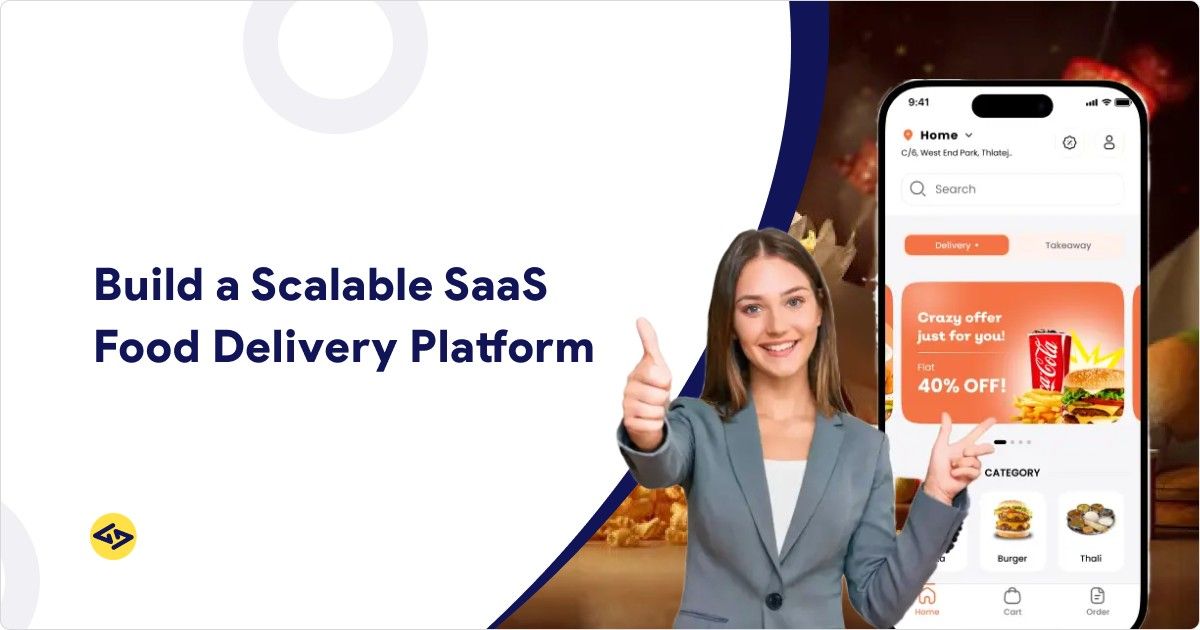
What Is SaaS Food Delivery Platform Development?
SaaS food delivery platform development is the process of building (or customizing) a cloud-hosted, multi-tenant software platform that lets many restaurants, cloud kitchens, or brands run online ordering, dispatch, payments, and delivery tracking from one shared system, usually sold by subscription.
In practice, businesses approach it in one of three ways:
- Subscribe to an existing SaaS and configure it (fastest, least control).
- Customize a white-label platform and launch under your own brand (balanced).
- Build your own multi-tenant SaaS product and sell it to restaurants (most control, highest investment).
This guide covers all three, with a focus on what you need to know if you are building or commissioning a platform in 2026.
Key Takeaways
- A SaaS food delivery platform serves multiple restaurants from one cloud system, with each tenant’s data kept isolated.
- Subscription and white-label routes can launch in days to weeks. Building your own SaaS product usually takes 4 to 9 months for an MVP.
- Realistic 2026 budgets range from roughly $5,000 for a basic white-label setup to $250,000+ for an enterprise-grade multi-tenant product.
- The core stack is four apps: customer app, restaurant panel, driver app, and admin dashboard.
- AI (recommendations, ETA prediction, dispatch optimization, demand forecasting) is now a competitive feature, not a novelty.
- The biggest risks are weak multi-tenant design, unreliable dispatch, and poor restaurant onboarding.
Why Demand Is Growing
Market research firms size the online food delivery market very differently depending on scope. Mordor Intelligence, for example, projects it will rise from about USD 284.7 billion in 2026 to about USD 468.5 billion by 2031. Whichever estimate you use, the direction is the same: steady growth, rising customer expectations, and restaurants looking for ways to reduce dependence on third-party marketplaces and their commissions.
That shift is exactly why food delivery app development has moved toward SaaS and white-label models: they let operators own the customer relationship without carrying the full cost of a custom build.
How Does a SaaS Food Delivery Platform Work?
A SaaS food delivery platform connects four user groups (customers, restaurants, delivery partners, and platform admins) through one synchronized, cloud-hosted system. Here is the order lifecycle:
- Customer orders. The customer browses menus, builds a cart, pays, and places the order.
- Restaurant accepts. The restaurant panel receives the order, confirms it, and sets a preparation time.
- Dispatch. The platform assigns the nearest available driver (or a third-party fleet) based on distance, load, and ETA.
- Live tracking. Customer, restaurant, and admin see GPS location and status updates.
- Delivery and payment settlement. The order is completed, and the platform splits payment between restaurant, driver, and platform commission.
- Feedback and analytics. Ratings, reviews, and performance data feed back into the system.
Multi-Tenant Architecture Explained
“Multi-tenant” means one codebase and infrastructure serves many restaurants or brands (tenants), each with isolated data, branding, and settings. There are three common patterns:
| Pattern | How it works | Best for | Trade-off |
|---|---|---|---|
| Shared database, tenant ID | All tenants share tables, separated by a tenant ID column | Early-stage and SMB-focused SaaS | Lowest cost; needs strict access controls |
| Schema per tenant | Each tenant gets its own schema in one database | Mid-size platforms needing cleaner separation | Higher operational overhead |
| Database per tenant | Each tenant has a separate database | Enterprise or compliance-heavy clients | Highest isolation and cost |
Choosing the wrong pattern early is one of the costliest mistakes in SaaS builds, because migrating tenant data later is slow and risky.
Why Businesses Choose SaaS Food Delivery Platforms
Restaurants and startups choose SaaS because it removes the cost and complexity of running software in-house.
- Lower upfront investment compared to building from scratch
- Faster launch, often in weeks instead of months
- Automatic updates and security patches
- Managed cloud hosting and backups
- Elastic scalability as order volume grows
- Predictable subscription pricing
- Easy integrations with payments, maps, POS, and CRM
- Direct customer ownership, reducing dependence on aggregator commissions and their fees
How Platform Owners Make Money
If you are building a SaaS platform to sell, your revenue model matters as much as your features. The most common models are:
- Commission per order (a percentage of order value)
- Monthly or annual subscription tiers per restaurant
- Delivery and service fees charged to customers
- Featured listings and in-app advertising
- Setup or onboarding fees
- Hybrid models combining a low subscription with a smaller commission
Design your admin dashboard to support several of these from day one, because pricing experiments are inevitable.
SaaS vs White-Label vs Custom Food Delivery Platform: Which Should You Choose?
| Factor | Subscription SaaS | White-Label Platform | Custom-Built Platform |
|---|---|---|---|
| Time to launch | Days to weeks | 2 to 8 weeks | 4 to 9+ months |
| Upfront cost | Low | Low to moderate | High |
| Ongoing cost | Monthly fee (often plus commission) | License plus hosting | Hosting plus maintenance team |
| Branding control | Limited | High | Full |
| Customization | Limited to settings | Moderate to high | Unlimited |
| Source code ownership | No | Sometimes (varies by contract) | Yes |
| Data ownership | Per vendor terms | Usually yours | Fully yours |
| Vendor lock-in risk | Higher | Medium | None |
| Best for | Single restaurants testing online ordering | Startups and multi-restaurant marketplaces | Enterprises and funded startups with unique workflows |
Quick decision guide:
- Choose subscription SaaS if you want to test demand with minimal spend.
- Choose white-label if you want your own brand, your own apps, and a fast launch.
- Choose custom if dispatch logic, pricing, or integrations are your competitive advantage.
Still comparing paths? See our guide on how to build a food delivery app for real-world scenarios.
Must-Have Features of a SaaS Food Delivery Platform
A complete platform includes four connected apps.
Customer App Features
- Registration and login (email, phone OTP, social)
- Search, filters, and cuisine browsing
- Menu with images, modifiers, and dietary tags
- Cart, checkout, and multiple payment methods
- Scheduled and group orders
- Live order tracking with accurate ETAs
- Ratings, reviews, and one-tap reorder
- Loyalty points, coupons, and referral rewards
- Push, SMS, and email notifications
Restaurant Panel Features
Good restaurant ordering software gives owners control over daily operations:
- Menu, pricing, and availability management
- Real-time order inbox with accept/reject and prep-time controls
- Inventory tracking and low-stock alerts
- Promotions and discount tools
- Sales reports, payout history, and customer insights
- POS integration and printer support
Delivery Driver App Features
- Order assignment with accept/decline
- Turn-by-turn navigation and route optimization
- Proof of delivery (photo, OTP)
- Earnings dashboard and payout tracking
- Shift and availability management
Admin Dashboard Features
- Restaurant approval and onboarding workflow
- Tenant management, branding, and subscription plans
- Commission, fee, and tax configuration
- Dispatch rules and fleet management
- Analytics, reporting, and fraud monitoring
- Coupon, CMS, and customer support tools
- Role-based access control
For a full module-level breakdown, read our guide to food delivery app features.
Step-by-Step SaaS Food Delivery Platform Development Process
A typical build follows ten stages. Timelines below assume a custom multi-tenant MVP.
| Stage | What happens | Typical duration |
|---|---|---|
| 1. Discovery and market research | Define niche, competitors, users, and business model | 1 to 2 weeks |
| 2. Business model and scope | Single-restaurant, marketplace, or cloud kitchen; MVP feature list | 1 week |
| 3. UI/UX design | Wireframes and prototypes for all four apps | 3 to 5 weeks |
| 4. Architecture and tech stack | Multi-tenancy pattern, cloud setup, API design | 1 to 2 weeks |
| 5. Backend development | Core logic, tenant management, order engine, payments | 6 to 10 weeks |
| 6. App and panel development | Customer, restaurant, driver apps, and admin dashboard | 8 to 12 weeks (parallel) |
| 7. Integrations | Payments, maps, SMS, push, POS | 2 to 4 weeks |
| 8. Testing and QA | Functional, load, security, and device testing | 3 to 4 weeks |
| 9. Deployment | Cloud launch and app store submission | 1 to 2 weeks |
| 10. Maintenance and growth | Monitoring, updates, and feature releases | Ongoing |
Building an MVP first is the single best way to control cost and learn from real users. For a deeper walkthrough, see our guide to online food delivery software development.
Technology Stack for SaaS Food Delivery Platform Development
A reliable food delivery SaaS architecture relies on proven, scalable technologies.
| Layer | Common technologies | Purpose |
|---|---|---|
| Frontend (web) | React.js, Next.js, Angular, Vue.js | Responsive customer and admin interfaces |
| Backend | Node.js, Python (Django/FastAPI), Laravel, Java Spring | APIs and business logic |
| Mobile | Flutter, React Native, Swift, Kotlin | Customer, restaurant, and driver apps |
| Database | PostgreSQL, MySQL, MongoDB | Transactional and flexible data storage |
| Caching and queues | Redis, RabbitMQ, Kafka | Speed, real-time events, order queues |
| Real-time | WebSockets, Firebase | Live order and driver location updates |
| Cloud | AWS, Google Cloud, Microsoft Azure | Scalable, on-demand hosting |
| Payments | Stripe, Razorpay, PayPal, Adyen | Secure payments, splits, and payouts |
| Maps | Google Maps Platform, Mapbox | Geocoding, routing, live tracking |
| Notifications | Firebase Cloud Messaging, Twilio | Push, SMS, and email |
| Analytics | Google Analytics, Mixpanel | Behavior and performance tracking |
| DevOps | Docker, Kubernetes, CI/CD | Automated, stable deployments |
Architecture tip: start with a well-structured modular monolith if your team is small, then split into microservices (orders, dispatch, payments, notifications) once traffic justifies it. Premature microservices add cost without benefit.
Ready to build? Start with our guide to developing a restaurant app.
How Much Does SaaS Food Delivery Platform Development Cost in 2026?
Short answer: a basic white-label setup can start around $5,000 to $25,000, a customized platform typically costs $25,000 to $80,000, and a custom multi-tenant SaaS product ranges from $80,000 to $250,000+, depending on scope. Published estimates from agencies vary widely, so always request a scoped quote.
| Platform type | Estimated cost (USD) | Typical timeline | What is included |
|---|---|---|---|
| Basic white-label setup | $5,000 to $25,000 | 2 to 4 weeks | Branded apps, core ordering, standard admin panel |
| Customized white-label | $25,000 to $80,000 | 1 to 3 months | Multi-restaurant support, loyalty, custom UI, integrations |
| Custom SaaS MVP | $50,000 to $100,000 | 4 to 6 months | Multi-tenant core, four apps, payments, basic dispatch |
| Enterprise SaaS | $120,000 to $250,000+ | 6 to 12 months | AI features, advanced dispatch, multi-region, compliance |
Ranges are indicative and vary with scope, integrations, and team location. Request a scoped quote from iCoderz for exact pricing.
What Drives the Cost
- Number of apps and platforms (iOS, Android, web)
- Feature complexity (dispatch logic, real-time tracking, loyalty)
- Multi-tenancy depth and white-label branding per tenant
- Third-party integrations (payments, POS, maps, SMS)
- AI and analytics capabilities
- Security and compliance requirements
- Team location and engagement model
- Post-launch support scope
Ongoing Costs to Budget For
- Cloud hosting (often $300 to $3,000+ per month as volume grows)
- Maps, SMS, and payment gateway fees
- Maintenance, bug fixes, and security updates
- AI model and API usage
- App store fees and compliance audits
For feature-level numbers, see our food delivery app development cost guide.
AI Features in SaaS Food Delivery Platforms
AI is moving from differentiator to baseline. The highest-impact use cases are:
- Personalized recommendations: suggest dishes based on order history and context
- Dispatch and route optimization: assign drivers and predict ETAs in real time
- Demand forecasting: help restaurants prepare for peaks
- Dynamic pricing: adjust delivery fees by demand, distance, and weather
- AI customer support: chatbots resolve common order issues 24/7
- Fraud detection: flag suspicious payments, coupon abuse, and fake accounts
- Inventory optimization: reduce waste through predictive stock planning
- Voice and conversational ordering: let customers order hands-free
- Menu intelligence: auto-tag dishes, generate descriptions, and optimize menu layout
See real examples in our guide to AI features in food delivery apps.
Essential Integrations
- Payment gateways (cards, wallets, UPI, split payments, refunds)
- Maps and geolocation (live tracking, geofencing, ETA)
- SMS, WhatsApp, and push notification providers
- POS systems (menu sync and order injection)
- CRM and marketing automation (retention campaigns)
- ERP and accounting software (payouts, tax, reconciliation)
- Third-party logistics and fleet APIs
- Analytics and business intelligence tools
A useful reference point is our review of a food delivery mobile app clone.
Security, Compliance, and Data Privacy
Food delivery platforms handle payments, locations, and personal data, so security cannot be an afterthought.
- PCI DSS: use a compliant payment provider and never store raw card data
- GDPR and CCPA: consent management, data export, and deletion for EU and California users
- India’s DPDP Act: relevant if you serve users in India
- Tenant isolation: enforce access controls so one restaurant can never see another’s data
- Encryption: TLS in transit and encryption at rest
- Access control and auditing: role-based permissions, activity logs, and regular penetration tests
- Food safety and licensing: local requirements for restaurant onboarding (for example, FSSAI in India)
Learn more in our guide to food app security.
Common Challenges and How to Solve Them
| Challenge | Practical solution |
|---|---|
| Traffic spikes at lunch and dinner | Auto-scaling infrastructure, caching, and queue-based order processing |
| Tenant data isolation | Choose the right multi-tenancy pattern early; test access controls |
| Inaccurate ETAs | Use live traffic data and ML-based prediction |
| Driver supply shortages | Incentives, batching, and third-party fleet fallback |
| Payment failures | Redundant gateways and retry logic |
| Restaurant onboarding friction | Self-service onboarding and menu import tools |
| Customer retention | Loyalty programs, personalization, and reorder flows |
| Rising cloud costs | Usage monitoring, right-sizing, and reserved capacity |
Avoid common pitfalls with our list of mistakes to avoid in food app development.
KPIs to Track After Launch
- Average order value (AOV) and order frequency
- Average delivery time and on-time rate
- Order accuracy and cancellation rate
- Customer acquisition cost (CAC) and repeat-order rate
- Restaurant churn and onboarding time (for SaaS platforms)
- Driver utilization and cost per delivery
- Monthly recurring revenue (MRR) and take rate
Best Practices for Building a Successful Platform
- Launch an MVP, then expand based on real usage data
- Design for multi-tenancy and scale from day one
- Keep ordering to as few taps as possible
- Invest in dispatch quality, since late deliveries drive churn
- Make restaurant onboarding self-service
- Monitor performance and errors continuously
- Release small updates frequently and act on feedback
Future Trends in SaaS Food Delivery Platforms
- AI-first ordering and conversational commerce
- Hyperlocal and quick-commerce delivery
- Autonomous and drone delivery pilots
- Subscription meal plans and delivery memberships
- IoT-enabled kitchens and predictive inventory
- Sustainable packaging and eco-friendly delivery
- Embedded finance (instant restaurant and driver payouts)
For an example of where the market is heading, see how to build an app like Swiggy.
How to Choose a SaaS Food Delivery Platform Development Company
Use this checklist when comparing partners:
- Proven food-tech or on-demand delivery portfolio
- Real multi-tenant architecture experience, not just single-restaurant apps
- Full-stack capability across web, mobile, cloud, and DevOps
- Clear security and compliance practices
- Transparent pricing, milestones, and IP/code ownership terms
- Post-launch support and SLAs
- Verifiable client reviews and references
- Ability to scale from MVP to enterprise
Questions to ask any vendor: Who owns the source code? How is tenant data isolated? What happens to my data if I leave? How do you handle peak-load scaling?
Industries That Can Use SaaS Food Delivery Platforms
Restaurants, cloud kitchens, cafés, bakeries, grocery and convenience stores, meal-kit services, caterers, corporate food programs, and dairy delivery businesses all use the same core model. Not sure which structure fits? Compare a restaurant app vs a food aggregator app.
Example Scenario: Launching a Multi-Restaurant Marketplace
Consider a startup launching a food marketplace across three cities. It starts with a custom or white-label MVP covering the four core apps, onboards its first restaurants through a self-service dashboard, and connects payments, maps, and notifications before launch.
After go-live, the team tracks order volume, average delivery time, repeat-order rate, and restaurant churn to decide which features to build next, such as loyalty programs, smarter dispatch, or AI recommendations. This phased approach keeps early costs low and lets real usage data guide the roadmap.
Want a similar plan for your model? Contact iCoderz for a scoped estimate.
Conclusion
SaaS food delivery platform development lets restaurants, cloud kitchens, and startups launch faster and scale without carrying the cost of a fully custom system. Start by choosing the right path (subscription, white-label, or custom), design multi-tenancy and dispatch carefully, launch an MVP, and add AI and integrations as your volume grows.
Ready to plan your platform? Talk to the iCoderz team for a scoped estimate and a free consultation.
Launch Your Own Food Delivery Platform
Get the technology you need to grow your delivery business.

Frequently Asked Questions
What is a SaaS food delivery platform?
A SaaS food delivery platform is cloud-based, multi-tenant software that lets restaurants, cloud kitchens, and food marketplaces run online ordering, dispatch, payments, and delivery tracking without hosting their own system. Businesses typically pay a subscription, a commission per order, or both.
How does a SaaS food delivery platform work?
It connects customers, restaurants, drivers, and admins through one cloud system. Customers place orders, restaurants confirm them, the platform assigns a driver, and everyone sees live tracking. Payments are split automatically between restaurant, driver, and platform.
How much does SaaS food delivery platform development cost?
In 2026, a basic white-label setup costs roughly $5,000 to $25,000, a customized platform $25,000 to $80,000, and a custom multi-tenant SaaS product $80,000 to $250,000+. Final cost depends on features, integrations, AI, and compliance needs.
How long does it take to build a SaaS food delivery platform?
White-label and subscription platforms can launch in days to weeks. A custom multi-tenant MVP usually takes 4 to 6 months, and an enterprise-grade platform can take 6 to 12 months.
What are the key features of a SaaS food delivery platform?
The essentials are a customer app, restaurant panel, driver app, and admin dashboard, supported by live tracking, secure payments, notifications, loyalty tools, analytics, and role-based access.
What is multi-tenant architecture in food delivery software?
Multi-tenant architecture lets one platform serve many restaurants or brands from a shared codebase while keeping each tenant’s data, branding, and settings isolated.
Is SaaS better than custom food delivery software?
SaaS and white-label options are better for fast, low-cost launches. Custom development is better when you need unique workflows, full code ownership, or deep integrations.
What is the difference between SaaS and white-label food delivery software?
SaaS is typically rented and configured within vendor limits. White-label software is rebranded as your own, usually with more branding and customization control, and sometimes with source code access.
Can one SaaS platform support multiple restaurants?
Yes. Multi-tenant SaaS platforms are designed to onboard many restaurants, cloud kitchens, or franchise locations, each with its own menu, pricing, branding, and reports.
Which technologies are best for building a food delivery SaaS?
Popular choices are React or Next.js for web, Flutter or React Native for mobile, Node.js, Python, or Laravel for the backend, PostgreSQL for data, and AWS or Google Cloud for hosting.
Is AI necessary for a modern food delivery platform?
Not mandatory, but AI-driven recommendations, dispatch optimization, and demand forecasting improve delivery speed, order value, and retention, so they are increasingly expected.
How do I choose the right development company?
Look for food-tech experience, proven multi-tenant architecture, transparent pricing, clear code and data ownership terms, strong security practices, and reliable post-launch support.