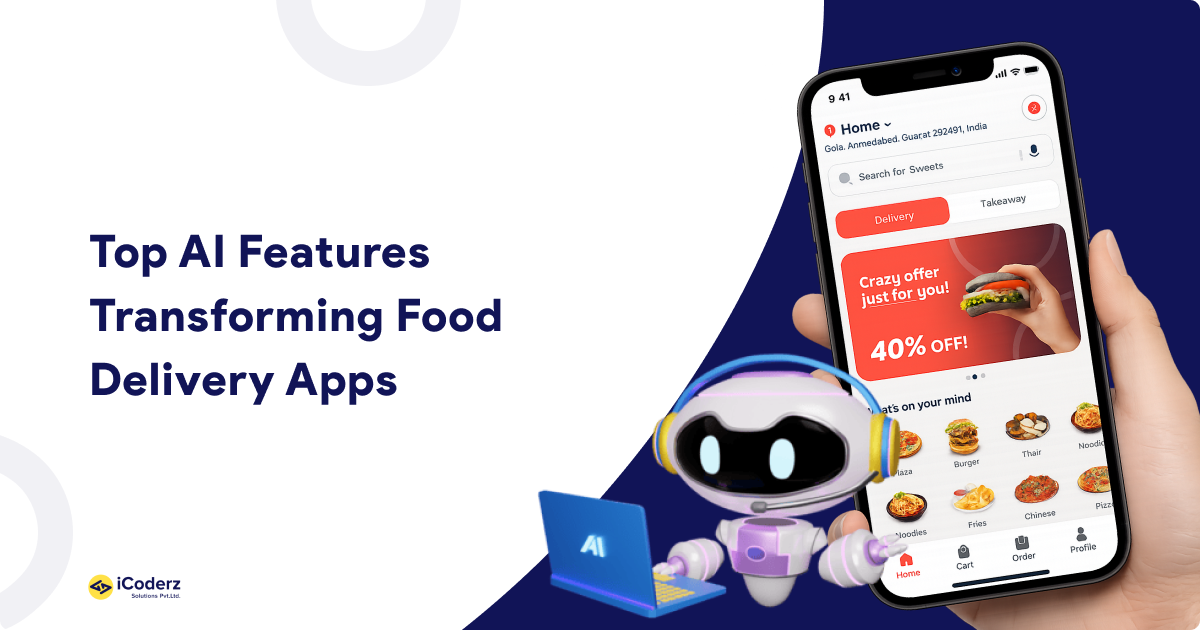
The food delivery industry is experiencing a technological revolution. AI-powered food delivery apps are no longer futuristic concepts—they’re practical business necessities that define market leaders. If you’ve ever wondered why some food delivery platforms feel intuitive, predict exactly what you want, and deliver faster than others, the answer is artificial intelligence in food delivery apps.
Today’s customers expect more than just a digital menu. They want personalized recommendations, accurate delivery times, instant support, and seamless experiences. According to recent industry reports, AI-enabled food delivery platforms can boost customer retention by up to 35% while reducing operational costs by 20-30%.
The growing adoption of AI features in food delivery apps is helping businesses deliver smarter customer experiences, optimize logistics, automate operations, and increase profitability. From intelligent recommendations and predictive analytics to AI-powered chatbots and route optimization, these advanced capabilities are reshaping the future of food delivery.
Whether you’re a startup founder planning your MVP or an established restaurant chain looking to modernize, understanding AI features in food delivery apps isn’t optional—it’s critical for survival. This guide explores 15 essential smart food delivery app features powered by AI that can transform your business, improve customer satisfaction, and increase revenue.
The Rise of AI in Food Delivery Apps
How AI is Transforming Food Ordering and Delivery
The global AI food delivery solutions market is projected to reach $20+ billion by 2028, driven by increasing smartphone penetration and changing consumer behaviors. Machine learning in food delivery apps analyzes millions of data points—from browsing patterns and order history to weather conditions and local events—to create hyper-personalized experiences.
Major players like DoorDash, Uber Eats, and Grubhub invest heavily in AI to optimize everything from menu recommendations to delivery logistics. This isn’t just about staying competitive—it’s about meeting baseline customer expectations in 2024.
Benefits for stakeholders:
- Customers get faster deliveries, personalized suggestions, and better support
- Restaurants reduce waste, optimize inventory, and increase average order values
- Delivery partners follow optimized routes and earn more through efficient operations
- Business owners make data-driven decisions that directly impact profitability
Why Food Delivery Startups Need AI
In a saturated market where customer acquisition costs continue rising, AI integration in food delivery apps offers several competitive advantages:
Differentiation: Stand out with features like voice ordering and image-based food search that competitors lack.
Retention: Personalized experiences keep customers coming back. It costs 5-7x more to acquire new customers than retain existing ones.
Efficiency: Automation reduces dependency on large support teams, cutting operational expenses by 40-60%.
Scalability: AI systems improve as your user base grows, unlike manual processes that become bottlenecks.
Without AI, you’re competing on price alone—a race to the bottom that benefits no one. With AI, you compete on experience, convenience, and value.
Benefits of AI-Powered Food Delivery Apps
Enhanced Customer Experience
AI recommendation systems for food delivery learn individual preferences over time. Whether someone is vegetarian, prefers spicy food, or always orders late at night, the app adapts. This personalization increases satisfaction and order frequency by understanding customers better than they understand themselves.
Faster Delivery Operations
AI route optimization for delivery cuts average delivery time by 15-25%. Real-time traffic analysis, multi-stop route planning, and intelligent driver assignment ensure food arrives hot and fresh. Every minute saved translates directly to higher customer ratings and repeat business.
Better Business Decisions Through Data
Predictive analytics in food delivery apps forecast demand patterns, helping restaurants prepare ingredients efficiently. This reduces waste and ensures popular items never run out during peak hours. Data-driven insights replace guesswork with precision.
Increased Revenue and Customer Loyalty
Personalized food recommendations apps increase average order value by 20-30% through smart upselling and cross-selling. When customers feel understood, they’re 3x more likely to become repeat buyers and brand advocates.
Top AI Features Every Food Delivery App Should Have
1. Personalized Food Recommendations
How AI Analyzes User Preferences
The AI menu recommendation engine tracks past orders, favorite cuisines, time-of-day patterns, seasonal preferences, dietary restrictions, price sensitivity, and restaurant ratings. This data creates a unique taste profile that improves with every interaction.
Advanced systems even detect subtle patterns—like craving comfort food on rainy days or ordering healthier options at the start of the month.
Benefits of Personalized Suggestions:
- Increased order value: Relevant recommendations boost cart size by 25-40%
- Better engagement: Users spend 60% more time exploring personalized menus
- Customer satisfaction: Feeling “understood” builds emotional loyalty that transcends price competition
At iCoderz Solutions, we’ve implemented recommendation engines that increased client conversion rates by 32% within the first quarter of deployment.
2. AI-Powered Search and Discovery
Traditional keyword search fails when users search for “something spicy” or “healthy lunch under $15.” AI-powered food delivery apps understand intent, not just keywords.
Natural Language Search allows users to type conversational queries like “Best Italian near me open now” or “Vegan options under 500 calories,” and the AI interprets context, filters results, and ranks them by relevance.
Voice-Based Food Search is exploding in popularity. The voice ordering food delivery app trend serves busy professionals and hands-free situations. Users can say “Order chicken tikka masala with extra rice” while driving or multitasking.
Integrating Alexa, Google Assistant, or custom voice AI makes ordering effortless and positions your app as technologically advanced.
3. Intelligent Chatbots and Virtual Assistants
AI chatbots for food delivery apps handle 70-80% of common queries without human intervention—order status checks, menu questions, delivery address updates, and refund requests.
24/7 Customer Support means customers get instant answers at 3 AM without maintaining night shift support staff. This dramatically improves customer satisfaction while reducing support costs by 40-60%.
Order Tracking Assistance allows customers to ask “Where’s my order?” and receive real-time updates with delivery partner location, eliminating the frustration of waiting blindly.
Advanced AI customer support for food delivery uses natural language processing to understand complex issues and escalate to humans only when necessary, ensuring quality service at scale.
Our AI development services include custom chatbot integration that maintains your brand voice while handling thousands of conversations simultaneously.
4. Predictive Order Recommendations
AI order prediction in food delivery identifies patterns like “User orders pizza every Friday evening” or “This customer reorders from Thai Spice monthly.” The app proactively suggests: “Want your usual Thursday night order from Burger Palace?”
One-tap reordering increases conversion by 45% because it eliminates decision fatigue. Customers appreciate the convenience of not scrolling through menus when they want their favorite meal.
Personalized Promotions and Offers move beyond generic discounts. AI targets offers based on likelihood to convert—new restaurants matching your taste profile, discounts on cuisines you browse but haven’t tried, and loyalty rewards timed when you’re most likely to order.
This precision marketing increases promotion ROI by 3-5x compared to blanket campaigns.
5. AI-Based Route Optimization
AI route optimization for delivery is game-changing for logistics. The system analyzes current traffic conditions, predicts congestion based on time of day, considers weather impacts, and optimizes multi-order pickup/drop sequences.
Unlike static GPS, AI-powered delivery tracking updates dynamically. If an accident occurs, the system reroutes instantly—saving minutes that mean the difference between hot and cold food.
Benefits for delivery drivers and businesses:
- Drivers complete 15-20% more deliveries per shift
- Fuel costs drop by 10-15%
- Customer satisfaction increases with faster arrivals
- Fewer missed delivery windows mean fewer refunds
Our team has built intelligent delivery management systems that reduced average delivery time by 8 minutes across urban markets—a significant competitive advantage.
6. Accurate Delivery Time Predictions
Nothing frustrates customers more than inaccurate delivery estimates. AI-powered delivery tracking provides precision by analyzing traffic conditions, weather, order volume, kitchen preparation time, delivery partner availability, distance, and route complexity.
Advanced algorithms update ETAs every 30-60 seconds, giving customers realistic expectations. This transparency reduces support tickets by 25-30% and builds trust through reliable communication.
The AI learns from historical data—if a particular restaurant consistently takes 5 minutes longer during dinner rush, predictions automatically adjust.
7. Demand Forecasting and Inventory Planning
AI demand forecasting for restaurants analyzes historical order data, local events (sports games, concerts, holidays), weather patterns, and marketing campaign schedules to predict peak ordering times.
This helps restaurant partners prepare adequately without overstaffing or wasting ingredients. AI suggests inventory levels based on predicted demand: “Stock 40% more chicken wings this Sunday for the game” or “Reduce lettuce order midweek based on slow salad sales.”
Accurate forecasting cuts food waste by 20-35%, improving profitability and sustainability—a growing concern for eco-conscious consumers who increasingly choose brands aligned with their values.
8. Dynamic Pricing and Smart Promotions
Dynamic pricing adjusts based on demand (surge pricing during peak hours), competition (matching or beating nearby alternatives), customer price sensitivity, and inventory levels (discounts on surplus items).
Instead of blanket coupons, AI identifies lapsed users who need win-back offers, price-sensitive customers who respond to discounts, and premium users who value convenience over cost.
Smart pricing increases revenue by 8-15% while maintaining customer satisfaction. The key is personalization—what motivates one customer differs from another. Heavy discount users receive offers; premium customers get early access to new restaurants.
9. Fraud Detection and Secure Transactions
AI monitors transactions for fraud patterns—unusual order volumes, multiple failed payment attempts, account creation from suspicious locations, and mismatched delivery addresses.
Machine learning models flag potentially fraudulent transactions before processing, protecting both customers and businesses. Automated fraud detection reduces chargeback rates by 30-50%, saving thousands in processing fees and lost revenue.
This is especially critical as food delivery fraud attempts increase. Sophisticated AI systems learn new fraud patterns continuously, staying ahead of evolving threats.
10. AI-Powered Customer Sentiment Analysis
Generative AI for food delivery platforms analyzes thousands of reviews to identify common complaints (late deliveries, cold food, missing items), trending positive feedback (favorite dishes, standout service), and emerging issues before they become widespread.
Natural language processing detects sentiment in customer messages, emails, and reviews—even sarcasm and nuanced feedback traditional keyword analysis misses.
Actionable insights help you coach delivery partners on identified weaknesses, reward restaurants maintaining high standards, and address systemic issues proactively. This data-driven approach to quality management improves overall service levels continuously.
11. Automated Order Management
AI restaurant delivery apps automatically assign orders to the nearest available driver, drivers with best ratings for the route type, or partners whose shift is ending soon (to maximize earnings and retention).
For restaurants using integrated POS systems, AI optimizes kitchen display orders based on dish preparation time, current kitchen load, and delivery partner ETA. This coordination ensures food is ready exactly when the driver arrives—not sitting cold or making drivers wait.
Automation minimizes mistakes in order routing, billing, and inventory updates—errors that cost time, money, and customer trust.
12. Voice Ordering and Conversational AI
Voice ordering food delivery apps integrate with Amazon Alexa (“Alexa, order my usual from Pizza Hut”), Google Assistant (“Hey Google, order lunch from my favorite Thai place”), and custom in-app voice AI.
This hands-free experience is perfect for multitasking professionals, people driving or commuting, users with accessibility needs, and anyone preferring voice to typing.
As voice recognition accuracy exceeds 95%, expect voice ordering to represent 20-30% of all orders within 3-5 years. Early adopters gain significant competitive advantages.
13. Image Recognition for Food Search
Users upload or snap photos of dishes, and AI technology for restaurant delivery business identifies the dish name, ingredients, and similar available options from nearby restaurants.
Visual search reduces friction for users who know what they want but don’t know dish names—especially helpful for international cuisines. Point your camera at a printed menu or food photo online, and the app finds where to order it locally.
This innovative feature creates “wow” moments that generate social media buzz and word-of-mouth marketing.
14. AI-Powered Loyalty and Retention Programs
Generic “10th order free” programs are outdated. AI-driven customer engagement for restaurants creates individualized rewards—extra points for trying new restaurants, discounts on birthdays or personal milestones, and surprise rewards for loyal weekly users.
AI identifies at-risk customers showing churn signals (decreasing order frequency, lower average order values, negative sentiment in feedback). Proactive outreach with personalized offers wins back 40-50% of at-risk users before they churn completely.
Optimized loyalty programs increase customer lifetime value by 25-40%, turning occasional users into brand advocates who refer friends and family.
15. Delivery Partner Performance Analytics
Track KPIs like average delivery time, on-time percentage, customer ratings, and order acceptance rate. Instead of raw numbers, AI provides context: “Driver’s late deliveries correlate with traffic in Zone 3” or “Performance drops on rainy days—needs route optimization training.”
Data-driven insights help you recognize and reward top performers, provide targeted coaching to struggling partners, and optimize shift schedules based on demand patterns.
This improves workforce satisfaction and retention while ensuring consistent service quality.
Emerging AI Trends in Food Delivery Apps
The future of AI in food delivery industry includes ChatGPT-style conversational interfaces that answer complex culinary questions, suggest recipes based on ordered ingredients, and create personalized meal plans.
Hyper-personalized food recommendations will consider nutritional goals, health conditions, mood and emotional state (via sentiment analysis), and social context (ordering for family vs. solo).
Autonomous delivery technologies—self-driving robots and drones—will handle last-mile delivery in select markets within 2-3 years, dramatically reducing costs.
AI-powered sustainability initiatives will minimize carbon footprints through electric vehicle routing, packaging waste reduction, and carbon-offset integration—appealing to environmentally conscious consumers.
How to Integrate AI into a Food Delivery App
What AI features should a food delivery app have? Start by identifying your biggest pain points. Low customer retention suggests implementing personalized recommendations. High delivery costs point toward route optimization. Support overwhelm indicates deploying AI chatbots.
How to build an AI-powered food delivery app requires choosing appropriate technology: machine learning frameworks (TensorFlow, PyTorch), NLP tools (OpenAI GPT, Google DialogFlow), recommendation engines (Apache Mahout, Amazon Personalize), and computer vision (Google Vision AI, Clarifai).
AI quality depends on data—historical order data, user interaction logs, delivery metrics, and customer feedback. Clean, structured data is essential. Plan 2-3 months for data preparation alone.
Start with MVP features: personalized recommendations, basic chatbot, and delivery time prediction. Test with beta users before full rollout. AI isn’t “set and forget”—monitor recommendation accuracy, chatbot resolution rates, and prediction error margins. Monthly model retraining ensures performance improves over time.
Our food delivery app development services include end-to-end AI implementation support, from data strategy to deployment and optimization.
Challenges of AI Implementation in Food Delivery Apps
GDPR and CCPA compliance requires transparent data collection policies, user consent management, secure data storage and encryption, and right-to-deletion implementation.
AI food delivery app development cost varies widely: basic AI features cost $30,000-$75,000, comprehensive AI integration runs $100,000-$250,000, and enterprise-grade custom AI exceeds $300,000. Costs depend on feature complexity, data volume, and customization needs.
Check our detailed guide on food delivery app development cost for accurate budgeting.
Initial AI models may have 70-80% accuracy. Achieving 90%+ requires extensive training data, regular retraining, A/B testing, and user feedback loops. Different regions have varying AI regulations—ensure your AI-enabled food delivery platform complies with local laws.
Choosing the Right Food Delivery App Development Partner
Look for a food delivery app development company with proven AI project portfolio, in-house data science team, and industry-specific experience (not just generic app development).
We’ve helped businesses across 15+ countries build food delivery apps with advanced AI capabilities.
Avoid one-size-fits-all solutions. Custom AI food delivery app development should address your unique business model (marketplace vs. single restaurant), target audience, regional requirements, and integration needs.
Your app will grow. Ensure your development partner offers cloud-based architecture (AWS, Google Cloud, Azure), microservices design for easy feature additions, and ongoing maintenance and model retraining.
Modern food delivery software with AI should use Node.js or Python backend (for AI/ML), React Native or Flutter mobile (cross-platform efficiency), PostgreSQL or MongoDB database, TensorFlow or AWS SageMaker for AI/ML, and Google Maps API or Mapbox for real-time tracking.
Conclusion
AI has become an essential part of modern food delivery apps, helping businesses deliver personalized experiences, faster deliveries, and improved operational efficiency. Features like AI-powered recommendations, chatbots, and route optimization can boost customer satisfaction and increase revenue. By adopting the right AI solutions, food delivery businesses can stay competitive, enhance user engagement, and drive long-term growth. Partner with iCoderz Solutions to build an AI-powered food delivery app tailored to your business needs.
Build a smarter food delivery app with AI-powered tools.