Online food ordering isn’t a side business anymore — it’s how most people eat. From single-city cloud kitchens to national aggregators, the food delivery market keeps growing every year, and more restaurants, entrepreneurs, and investors want a piece of it. That’s exactly why so many businesses are searching for how to build a food delivery app that can actually compete.
But building a food delivery app isn’t just about hiring a developer and shipping a checkout screen. It involves choosing the right business model, designing four connected experiences (customer, restaurant, delivery partner, admin), picking a technology stack that scales, and budgeting realistically for both development and growth.
This guide walks through the entire food delivery app development journey — the process, must-have features, technology stack, cost, timeline, and monetization — so you can plan your platform with confidence. If you’re ready to explore what a custom build looks like, you can also see how iCoderz Solutions approaches food delivery app development for startups and enterprises.
What Is a Food Delivery App?
A food delivery app is a digital platform that connects customers, restaurants, and delivery partners through a central system, usually managed by an admin panel. Customers browse menus and place orders; restaurants prepare the food; delivery partners handle pickup and drop-off; and the admin oversees payments, commissions, and operations.
There are two broad types:
- Single-restaurant app – built for one brand to manage its own orders and delivery.
- Multi-vendor food delivery app – connects multiple restaurants with customers on one platform, similar to Zomato or DoorDash.
Most startups today choose the multi-vendor route because it scales faster and creates more revenue streams from day one.
How Does a Food Delivery App Work?
Every food delivery app — regardless of business model — follows a similar operational flow:
- Customer searches for nearby restaurants.
- Customer places an order and pays online.
- Restaurant accepts and prepares the order.
- Delivery partner receives the delivery request.
- Delivery partner picks up the order.
- Customer tracks the delivery in real time.
- Order is delivered to the customer’s location.
- Payment is settled and the customer leaves a review.
This loop, repeated thousands of times a day, is what your app’s architecture needs to support smoothly — even during peak-hour surges.
How to Build a Food Delivery App: Step-by-Step Process
1. Define Your Business Model
Before writing a single line of code, decide which model fits your goals: marketplace, restaurant-owned, aggregator, cloud kitchen, or a full multi-vendor platform. This decision shapes every feature and cost estimate that follows.
2. Identify Your Target Market
Research your location, customer demographics, popular food categories, and existing competitors. A hyperlocal app in one city has very different requirements than a multi-region platform.
3. Define the App Requirements
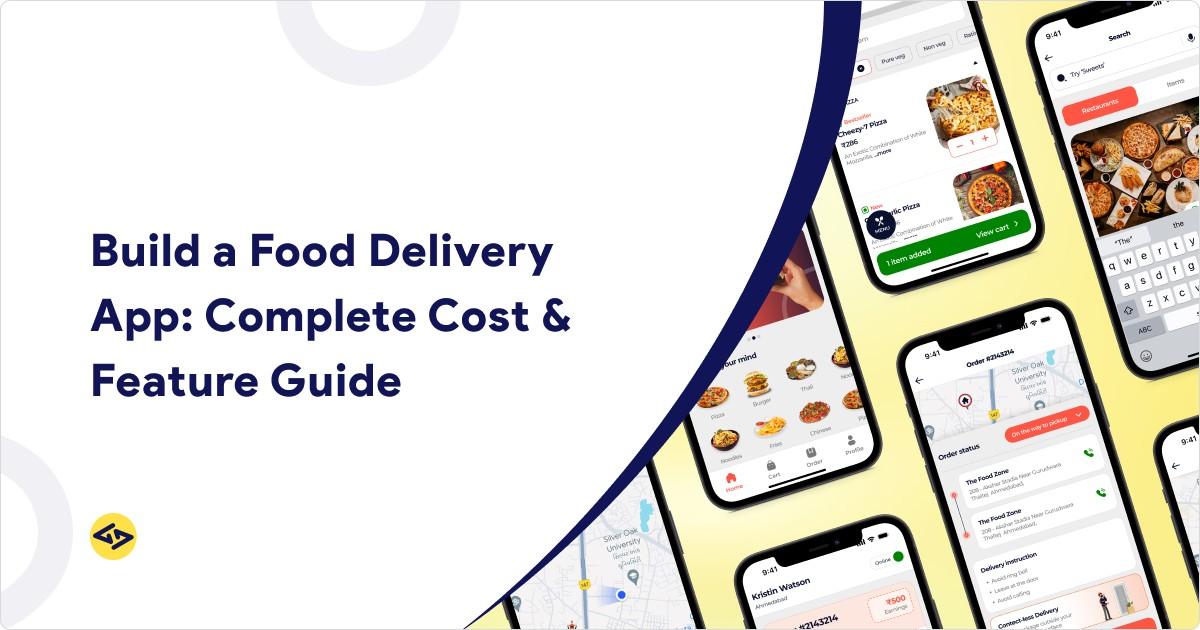
A complete food delivery app development plan usually needs four separate products: a customer app, a restaurant panel or app, a delivery partner app, and an admin dashboard.
4. Design the UI/UX
Prioritize simple navigation, easy restaurant discovery, a frictionless checkout, and clear order tracking. Mobile-first design isn’t optional — most orders happen on phones.
5. Choose the Technology Stack
Your stack determines how well the app performs under load and how easily it scales later (covered in detail below).
6. Develop the MVP
Start with core ordering, payment, and tracking features. Launching a lean MVP lets you validate the business model before investing in advanced functionality.
7. Integrate APIs and Third-Party Services
Maps, payment gateways, SMS, push notifications, and analytics tools all plug into the core app through APIs.
8. Test the App
Run functional, performance, security, payment, and GPS/location testing before launch — food delivery apps fail fast if location or payment accuracy is off.
9. Launch the App
Roll out to app stores and onboard your first batch of restaurants and delivery partners.
10. Maintain and Scale
Post-launch, monitor performance, fix issues quickly, and add features based on real user data. For a closer look at what to avoid at this stage, see this breakdown of common mistakes in food service app development.
Essential Food Delivery App Features
A strong food delivery app development guide should always separate features by user role. Here’s what each side of the platform needs.
Customer App Features
- Registration and login
- Restaurant search
- Filters (cuisine, price, ratings, delivery time)
- Menu browsing
- Cart management
- Online ordering
- Multiple payment options
- Real-time order tracking
- Ratings and reviews
- Order history
- Offers and coupons
- Push notifications
Restaurant Features
- Restaurant profile
- Menu management
- Order management
- Availability management
- Pricing management
- Sales reports
- Offers and discounts
Delivery Partner Features
- Registration and verification
- Delivery requests
- GPS navigation
- Order pickup/drop-off confirmation
- Earnings dashboard
- Delivery history
- Availability toggle
Admin Panel Features
- User management
- Restaurant management
- Delivery partner management
- Order management
- Payment management
- Commission management
- Promotions
- Reports and analytics
For a deeper feature-by-feature breakdown, this guide on essential food delivery app features is a useful next read.
Advanced Features for a Modern Food Delivery App
Once the MVP proves the concept, these advanced features help you compete with established players:
- AI-powered restaurant and dish recommendations
- AI chatbot for customer support
- Real-time GPS tracking
- Voice search
- Personalized offers
- Loyalty programs
- Subscription plans
- Multiple delivery options (scheduled, express, contactless)
- Smart delivery routing
- Fraud detection
- Predictive analytics for demand forecasting
AI in particular is reshaping how these platforms operate — see how AI features are being used in food delivery apps today.
Technology Stack for Food Delivery App Development
The right food delivery app technology stack balances performance, scalability, and development speed.
| Technology | Purpose |
| Flutter / React Native | Cross-platform development |
| Swift | iOS development |
| Kotlin | Android development |
| Node.js / Laravel | Backend |
| React.js | Admin dashboard |
| PostgreSQL / MongoDB | Database |
| AWS | Cloud infrastructure |
| Google Maps API | Location & tracking |
| Stripe / Razorpay | Payments |
| Firebase | Notifications & analytics |
For a full comparison of stack options and when to use each, check this food delivery app tech stack guide.
How Much Does It Cost to Build a Food Delivery App?
Food delivery app development cost depends on several factors:
- Number of platforms (iOS, Android, web)
- App complexity and number of user roles
- UI/UX design requirements
- Backend development effort
- Third-party integrations (maps, payments, SMS)
- Advanced features like AI or predictive analytics
- Development location and team structure
- Ongoing maintenance
Estimated cost ranges:
- Basic MVP: Suitable for testing a single-city launch with core ordering and tracking features.
- Medium-complexity app: Adds loyalty programs, advanced admin reporting, and multiple payment gateways.
- Advanced multi-vendor platform: Enterprise-ready, with AI recommendations, fraud detection, and multi-region scalability.
Because pricing varies widely by scope and region, it’s worth reviewing a detailed food delivery app development cost breakdown before finalizing your budget.
How Long Does It Take to Build a Food Delivery App?
A typical food delivery app development process breaks down into these phases:
- Research & planning
- UI/UX design
- Development (customer, restaurant, delivery, admin)
- API integration
- Testing
- Deployment
An MVP generally takes less time than an advanced, multi-vendor platform with AI features and extensive third-party integrations. For a phase-by-phase timeline estimate, see this food delivery app development timeline guide.
How Does a Food Delivery App Make Money?
Understanding food delivery app monetization early helps you design pricing and commission logic into the platform from day one:
- Restaurant commission on each order
- Delivery fees charged to customers
- Customer service or platform fees
- Restaurant subscription plans
- Customer subscription plans (e.g., free delivery memberships)
- Featured or priority restaurant listings
- In-app advertising
- Surge or dynamic pricing during peak hours
Food Delivery App Business Models
Choosing the right food delivery app business model shapes your revenue and operations:
- Aggregator model – lists restaurants without handling delivery directly.
- Marketplace model – connects multiple restaurants and manages delivery through the platform.
- Restaurant-owned model – a single brand’s dedicated ordering and delivery app.
- Subscription model – customers or restaurants pay recurring fees for benefits.
- Cloud kitchen model – delivery-only kitchens with no dine-in space.
Each model has different infrastructure and marketing needs — this guide on food delivery business models breaks down which one fits different business goals.
How to Build an App Like Uber Eats, DoorDash, Zomato, or Swiggy?
Many startups ask how to build a food delivery app like Uber Eats, DoorDash, Zomato, or Swiggy — but the goal should be building a similar business model and experience, not copying another company’s app. What these platforms share is a multi-vendor architecture, strong delivery management, real-time tracking, seamless payment integration, and the ability to onboard restaurants at scale.
To replicate that success, focus on:
- Multi-vendor architecture from the start
- Reliable delivery logistics and routing
- Real-time order and delivery tracking
- Multiple, secure payment integrations
- Restaurant onboarding and management tools
- Infrastructure built for scalability
For an approach built specifically for multi-restaurant platforms, see this guide on multi-restaurant food delivery app development.
Common Challenges in Food Delivery App Development
Even well-funded platforms run into recurring problems:
- Managing real-time order volume
- Delivery logistics across zones
- Restaurant onboarding at scale
- Peak-time demand spikes
- Payment failures
- GPS accuracy issues
- Scalability under load
- Data security
- Customer retention
How to Overcome These Challenges
- Use load-tested, cloud-based infrastructure to absorb peak-hour traffic.
- Automate restaurant onboarding with self-service tools.
- Build redundancy into payment gateway integrations.
- Use reliable mapping APIs and test GPS accuracy across regions.
- Apply strong encryption and compliance practices to protect customer and payment data.
- Invest in loyalty programs and personalization to improve retention.
Security deserves particular attention as your platform scales — this guide on food delivery app security covers the essentials.
How to Choose a Food Delivery App Development Company
When evaluating a food delivery app development company, look for:
- Proven food-tech experience
- A relevant portfolio
- Technology expertise across your chosen stack
- Strong UI/UX capabilities
- Experience with API integrations (maps, payments, SMS)
- Ability to build for scalability
- Security-first development practices
- A clear development methodology
- Reliable post-launch support
- Transparent cost and timeline estimates
One decision you’ll face early is whether to go custom or white-label — this comparison of white-label vs. custom food delivery app development can help you decide.
Food Delivery App Development: MVP vs. Full-Scale Platform
| Factor | MVP | Full-Scale App |
| Features | Core | Advanced |
| User roles | Basic | Multiple |
| Integrations | Essential | Extensive |
| Development time | Shorter | Longer |
| Cost | Lower | Higher |
| Scalability | Initial | Enterprise-ready |
If you’re planning to grow from MVP into a full platform later, it’s worth looking at a SaaS-based food delivery platform model, which is built for that kind of scaling from the start.
Final Thoughts
Building a food delivery app is a multi-stage journey — from choosing a business model and defining your MVP, to designing four connected user experiences and picking a scalable technology stack. The businesses that succeed are the ones that start lean, validate demand early, and prioritize user experience, security, and reliable delivery management as they grow.
Whether you’re building a single-restaurant app or a multi-vendor platform to rival established players, getting the fundamentals right from day one will save time, budget, and headaches later. If you’re still shaping your go-to-market plan, this guide on how to start a food delivery business is a good companion read.
Ready to build your food delivery app? Partner with iCoderz Solutions to turn your idea into a scalable food delivery platform.
FAQs About Food Delivery App Development
How much does it cost to build a food delivery app?
Cost depends on platform count, feature complexity, and integrations, ranging from a lean MVP budget to a higher investment for an advanced multi-vendor platform with AI features.
How long does it take to build a food delivery app?
An MVP typically takes a few months, while a full-scale, multi-vendor platform with advanced features takes considerably longer due to added integrations and testing.
What features should a food delivery app have?
At minimum, it needs customer ordering and tracking, restaurant order management, delivery partner tools, and an admin dashboard for oversight and reporting.
What technology is used to build food delivery apps?
Common choices include Flutter or React Native for cross-platform apps, Node.js or Laravel for the backend, PostgreSQL or MongoDB for databases, and AWS for cloud infrastructure.
How do food delivery apps make money?
Through restaurant commissions, delivery fees, subscriptions, featured listings, advertising, and surge pricing during high-demand periods.
Can I build a food delivery app like Uber Eats?
Yes — by focusing on a similar multi-vendor business model, delivery management system, and real-time tracking, rather than copying the app itself.
How do I choose the right food delivery app development company?
Look for proven food-tech experience, a strong portfolio, technical expertise in your chosen stack, and reliable post-launch support.
Can I start with an MVP food delivery app?
Yes — starting with an MVP is the recommended approach, letting you validate your business model before investing in advanced features.