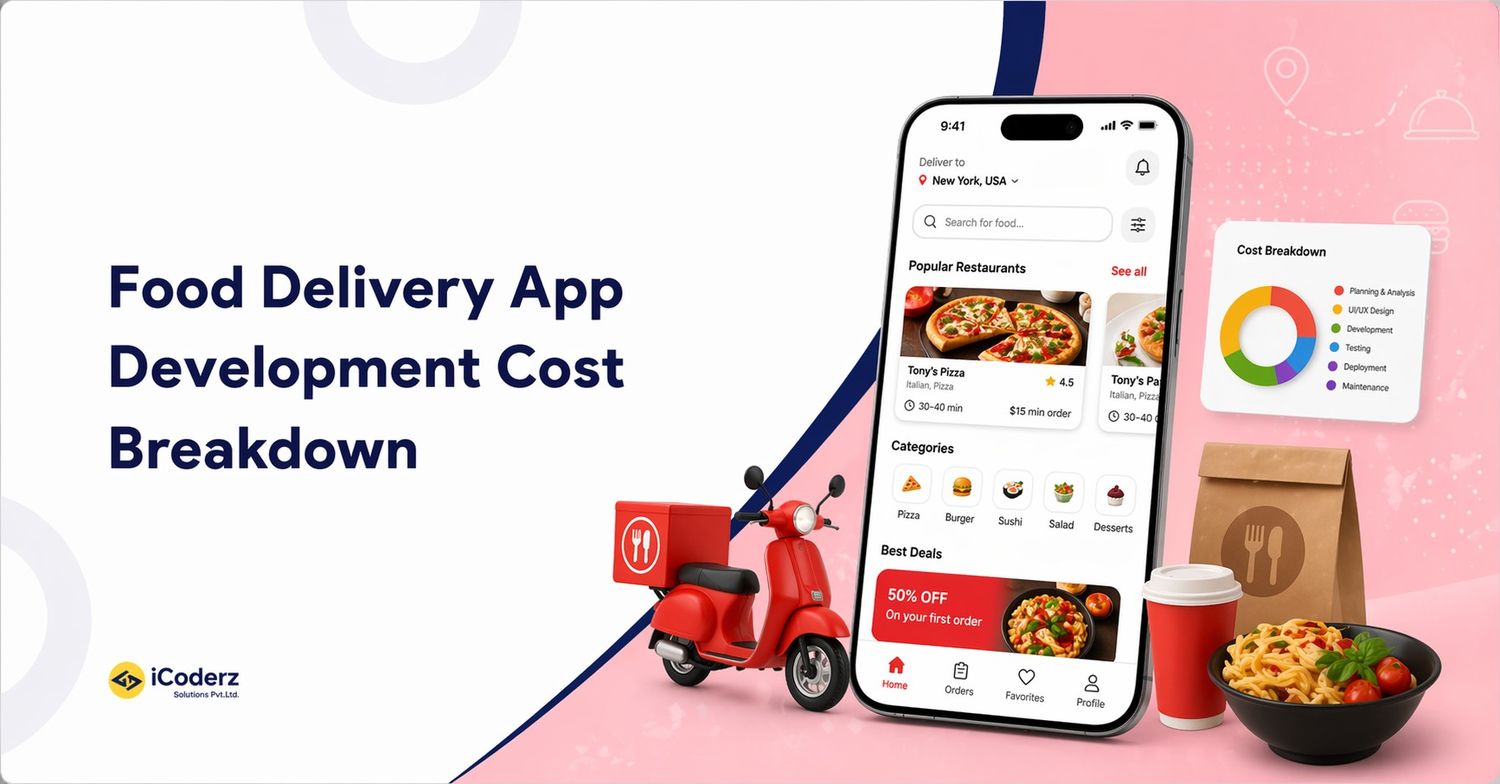
The online food delivery industry hasn’t slowed down — if anything, 2026 has brought more competition, more AI-driven personalization, and more entrepreneurs asking the same question: how much does it actually cost to build a food delivery app?
If you’re planning to enter this space, you already know the market is crowded with giants like Uber Eats, DoorDash, and Zomato. But that hasn’t stopped new players from launching regional, niche, or cloud-kitchen-focused apps that carve out profitable corners of the market. The real barrier isn’t the idea — it’s understanding what you’re going to pay for, and why. And the payoff is real: the benefits for food delivery app for restaurant business owners often outweigh the upfront investment within the first year of operation.
Quick answer: Food delivery app development cost typically ranges from $8,000–$15,000 for a basic MVP, $20,000–$45,000 for a startup-level app, and $60,000–$150,000+ for an enterprise-grade platform with AI features, multi-vendor support, and advanced logistics.
This guide breaks down every factor that affects food delivery app development cost, compares pricing across popular platforms like Uber Eats, Talabat, and Grubhub, and shows you exactly where your budget goes — module by module, feature by feature.
The Food Delivery Market in 2026: Why This Is the Right Time to Invest
Before diving into pricing, it helps to understand the scale of the opportunity. The numbers explain why so many entrepreneurs are willing to invest in a custom platform rather than sit out the competition:
- Market size: The global online food delivery market was valued at $288.8 billion in 2024 and is projected to grow to $355.6 billion in 2026, reaching $505.5 billion by 2030 at a CAGR of 9.4%.
- Regional leader: Asia Pacific dominates the market, accounting for over 41.6% of global revenue.
- Business model split: Platform-to-consumer apps (aggregators like Uber Eats and DoorDash) account for over 71% of the market, showing why marketplace-style apps remain the most common business model.
- Mobile-first ordering: Mobile and tablet apps account for roughly 82.76% of global food delivery transactions, reinforcing why a strong native or cross-platform mobile experience is non-negotiable in 2026.
- AI-driven growth: The adoption of AI, machine learning, and data analytics in food delivery platforms is actively reshaping user experience and operational efficiency — a major reason AI features are no longer optional for competitive apps.
In short: the market is large, still growing at nearly double-digit rates, dominated by mobile-first aggregator models, and increasingly shaped by AI. Whatever budget you land on, building an app aligned with these trends will pay off longer-term.
How Much Does It Cost to Build a Food Delivery App?
The honest answer: it depends on complexity, platforms, and features. But most projects fall into three broad tiers.
| App Type | Estimated Cost | Timeline |
| Basic MVP (single restaurant, core ordering) | $8,000 – $15,000 | 6–10 weeks |
| Startup App (multi-restaurant, payments, tracking) | $20,000 – $45,000 | 3–5 months |
| Enterprise Platform (AI, multi-vendor, analytics) | $60,000 – $150,000+ | 6–9 months |
A basic MVP is ideal if you want to validate your idea with real users before investing heavily. A startup-level app is where most new food delivery businesses land — it includes customer, restaurant, and delivery-partner apps plus an admin panel. An enterprise platform is built for scale, with AI-based dispatch, demand forecasting, and support for thousands of concurrent orders. If you’re comparing this to a simpler online ordering setup, it helps to first understand how a basic food ordering system works before scaling up to a full delivery platform.
Estimate Your Food Delivery App Development Cost
Use this breakdown as a starting calculator — add up the components relevant to your project to get a rough working budget:
| Requirement | Estimated Cost |
| Customer App | $4,000 – $12,000 |
| Restaurant Panel | $3,000 – $9,000 |
| Delivery Partner App | $3,000 – $9,000 |
| Admin Panel | $2,500 – $7,000 |
| GPS & Live Tracking | $1,500 – $4,000 |
| Payment Gateway Integration | $1,500 – $3,500 |
| AI Features (recommendations, chatbot, dispatch) | $2,500 – $10,000 |
| UI/UX Design | $2,000 – $8,000 |
| QA & Testing | $1,500 – $5,000 |
| Estimated Total | $21,500 – $67,500+ |
This table gives you a rough starting range — actual pricing depends on your specific feature list, platforms, and integrations. Want an accurate estimate? Contact our experts for a free project quote tailored to your exact requirements.
What Determines Food Delivery App Development Cost?
The short answer is: it depends on complexity. Here’s how much each factor typically moves the needle:
| Factor | Impact on Cost |
| Platform (iOS/Android/Cross-platform) | High |
| Feature Set | Very High |
| AI Capabilities | Medium |
| UI/UX Design | Medium |
| Backend Development | High |
| Third-Party Integrations | Medium |
| Team Location | High |
Now let’s break down what drives each of these.
Feature Complexity
The more advanced your features — live tracking, in-app chat, AI recommendations — the higher the development effort and cost.
Number of User Panels
Every food delivery app needs multiple interconnected apps:
- Customer App – browsing, ordering, payments
- Restaurant Panel – order management, menu updates
- Delivery App – navigation, order status, earnings
- Admin Dashboard – analytics, commissions, dispute resolution
Each panel adds development hours, so cost scales with how many you build. If your focus is purely on the restaurant side rather than a full marketplace, it may be worth exploring what it takes to develop a restaurant app on its own before committing to a multi-panel platform.
UI/UX Design
Custom, brand-specific design costs more than template-based design but pays off in retention and conversions.
Platform Choice
- Android only – lower cost, faster launch
- iOS only – slightly higher due to App Store guidelines
- Cross-platform (Flutter/React Native) – one codebase for both platforms, often the most cost-efficient choice
Technology Stack
Your backend framework, database, and cloud infrastructure choices affect both development speed and long-term scalability costs.
Third-Party Integrations
Payment gateways, maps/GPS, SMS/email APIs, and push notification services all come with licensing or usage-based fees.
Development Team Location
Hourly rates vary significantly by region — US and UK agencies charge $80–$150/hr, while teams in India or Southeast Asia charge $20–$45/hr for comparable quality, which is why many startups look for a reliable food delivery app development company offshore to stretch their budget further.
Food Delivery App Cost Breakdown by Module
| Module | Approx. Cost Share |
| Customer App | 25–30% |
| Restaurant Panel | 15–20% |
| Delivery App | 15–20% |
| Admin Dashboard | 10–15% |
| Backend Development | 20–25% |
| QA & Testing | 8–10% |
| Deployment | 3–5% |
| Maintenance (ongoing) | 15–20% annually |
Backend development often surprises first-time founders — it’s the invisible engine handling order routing, payments, and real-time tracking, and it typically consumes a quarter of your total budget.
Feature-Wise Cost Breakdown
Here’s roughly how individual food delivery app features contribute to your total spend:
- Authentication & Onboarding – $500–$1,500
- Restaurant Listing & Menu Management – $1,000–$3,000
- Search & Filters – $800–$2,000
- GPS & Live Tracking – $1,500–$4,000
- Payment Gateway Integration – $1,500–$3,500
- In-App Chat – $1,000–$2,500
- Push Notifications – $500–$1,200
- Ratings & Reviews – $600–$1,500
- Coupons & Promo Codes – $700–$1,800
- Loyalty Programs – $1,200–$3,000
- Referral System – $800–$2,000
- AI Recommendations – $2,500–$6,000
- Analytics Dashboard – $1,500–$4,000
For a deeper dive into what each feature does and why it matters, check out this guide on Features of a Food Delivery App.
Food Delivery App Cost by Business Model
Your food delivery app business model significantly shapes cost:
- Single Restaurant App – lowest cost, simplest logic
- Multi-Restaurant Marketplace – higher cost due to vendor management and commission logic (see our detailed guide on multi restaurant food delivery app development for a full cost breakdown)
- Cloud Kitchen App – moderate cost, focused on internal kitchen-to-delivery flow
- Delivery Marketplace/Aggregator – complex, needs strong logistics and dispatch systems
- Subscription-Based Model – requires recurring billing and membership logic
- SaaS Food Delivery Platform – highest upfront cost but scalable across multiple clients/regions
If you’re unsure which model fits your goals, this breakdown of the food delivery business model options is worth reading before you commit to a budget.
Cost by App Type
Here’s a quick-reference comparison across the most common app types businesses build in 2026:
| App Type | Estimated Cost |
| Single Restaurant | $8,000 – $20,000 |
| Multi Restaurant | $25,000 – $60,000 |
| Cloud Kitchen | $15,000 – $40,000 |
| Meal Subscription | $20,000 – $50,000 |
| Grocery + Food Delivery | $35,000 – $90,000 |
| Enterprise Marketplace | $70,000 – $150,000+ |
Grocery-plus-food hybrid apps and enterprise marketplaces cost more because they require additional inventory management, multi-category catalogs, and more complex logistics than a standalone restaurant delivery app.
Food Delivery App Development Cost by Region
| Region | Hourly Rate | Typical Project Cost |
| USA | $100–$180 | $70,000–$180,000+ |
| Canada | $80–$150 | $60,000–$150,000 |
| Europe (UK, Germany) | $70–$140 | $55,000–$140,000 |
| Middle East | $50–$100 | $30,000–$90,000 |
| India | $20–$45 | $15,000–$60,000 |
| Australia | $80–$150 | $60,000–$150,000 |
| APAC (SEA) | $25–$50 | $18,000–$65,000 |
Outsourcing to regions with lower hourly rates doesn’t necessarily mean lower quality — many established firms in India and APAC deliver enterprise-grade apps at a fraction of Western pricing.
Cost Comparison of Popular Food Delivery Apps
| Platform | Estimated Cost | Complexity |
| Uber Eats | $80,000 – $200,000+ | Very High |
| DoorDash | $75,000 – $190,000+ | Very High |
| Grubhub | $60,000 – $150,000 | High |
| Talabat | $40,000 – $100,000 | Medium-High |
| Zomato | $70,000 – $170,000 | Very High |
| Swiggy | $70,000 – $170,000 | Very High |
Most of the platforms above are aggregators that list multiple restaurants under one app — a different model from a single-brand delivery app. If you’re deciding between the two, this comparison of Restaurant delivery vs food aggregator apps breaks down the cost and complexity differences.
Want to know exactly what goes into building a clone of these platforms? We’ve published dedicated breakdowns:
- Cost to develop a food delivery app like UberEATS
- Cost to build an app like Talabat
- Cost to build a food delivery app like Grubhub
Hidden Costs Most Businesses Ignore
Founders often budget for development but forget the ongoing operational costs:
- Cloud hosting & server scaling
- API usage fees (maps, SMS, email)
- App Store & Play Store listing/renewal fees
- Marketing and user acquisition
- Customer support infrastructure
- Security audits and compliance (PCI-DSS for payments)
- Ongoing food delivery app security updates
These recurring costs can add 15–20% of your original development budget every year — plan for them from day one.
How AI Affects Food Delivery App Development Cost
AI has moved from “nice-to-have” to a genuine differentiator in 2026. Common AI food delivery app development additions include:
- AI Chatbots for support ($2,000–$5,000)
- Personalized recommendations ($2,500–$6,000)
- Smart dispatch/routing ($3,000–$7,000)
- ETA prediction models ($2,000–$5,000)
- Demand forecasting ($3,500–$8,000)
- Fraud detection ($2,500–$6,000)
- Voice ordering ($2,000–$5,000)
Each AI module typically adds 15–30% to your baseline development cost, but it pays off through better retention and operational efficiency. See more in our guide on AI features in food delivery apps.
White-Label vs Custom Food Delivery App Cost
| Factor | White-Label | Custom Development |
| Cost | Lower ($5,000–$15,000) | Higher ($20,000–$150,000+) |
| Time to Launch | Fast (2–4 weeks) | Slower (3–9 months) |
| Customization | Limited | Fully flexible |
| Scalability | Restricted by vendor | Unlimited |
| Ownership | Licensed | Full ownership |
Best choice: White-label suits businesses that need to launch fast and test the market. Custom food delivery app development suits businesses planning long-term growth, unique branding, or investor-backed scaling.
Whether you choose a white-label solution or custom development, comparing top food delivery app development companies can help you evaluate providers and select the right approach for your business.
Food Delivery App Development Timeline
A realistic food delivery app development timeline looks like:
- Planning & Discovery – 1–2 weeks
- UI/UX Design – 2–4 weeks
- Development – 8–20 weeks
- QA & Testing – 2–4 weeks
- Launch – 1 week
- Post-Launch Maintenance – ongoing
For a full breakdown of each phase, read Food Delivery App Development Time.
How to Reduce Food Delivery App Development Cost
- Start with an MVP instead of a full-featured platform
- Choose cross-platform frameworks like Flutter or React Native instead of building native apps separately
- Prioritize must-have features first, add nice-to-haves post-launch
- Reuse pre-built components where possible instead of custom-coding everything
- Choose the right development partner who understands the food delivery domain, not just generic app development
Avoiding common pitfalls also saves money — see our list of mistakes to avoid in food service apps.
Why Choose iCoderz Solutions?
At iCoderz Solutions, we’ve helped restaurants, cloud kitchens, and delivery startups turn ideas into scalable platforms. Here’s what sets us apart:
- Experience – years of building on-demand delivery platforms across markets
- Custom Solutions – no cookie-cutter templates, every app is built around your business model
- AI Integration – smart dispatch, recommendations, and forecasting built in from day one
- Scalable Architecture – apps designed to handle growth from hundreds to millions of orders
- Post-Launch Support – ongoing maintenance, updates, and feature enhancements
Whether you need to develop a food app from scratch or want to explore a SaaS food delivery platform, our team can guide you through every stage.
Conclusion
Food delivery app development cost in 2026 isn’t a single number; it’s shaped by your business model, feature set, platform choices, and how much you invest in AI and scalability. The smartest first step is defining your requirements clearly: are you launching an MVP to test the market, or building a full-scale platform to compete with the big players?
Whichever path you choose, getting expert guidance early can save you from costly rework later. If you’re ready to turn your idea into a working platform, iCoderz Solution can help you scope, design, and build a food delivery app that fits your budget and growth plans.
Build Your Food Delivery App Within Your Budget
Get a detailed cost estimate, the right tech stack, and expert guidance to launch a scalable food delivery app that fits your startup budget.

Frequently Asked Questions
How much does it cost to build a food delivery app?
Costs range from $8,000 for a basic MVP to $150,000+ for an enterprise-grade platform, depending on features, platforms, and integrations.
How long does development take?
Most projects take 3–6 months from planning to launch, though MVPs can launch in as little as 6–10 weeks.
What affects food delivery app development cost?
Feature complexity, number of user panels, platform choice, technology stack, third-party integrations, and your development team’s location all influence the final price.
How much does maintenance cost?
Expect to budget 15–20% of your original development cost annually for hosting, updates, bug fixes, and security patches.
How much does it cost to build an app like Uber Eats?
An Uber Eats-level app typically costs $80,000–$200,000+ due to its scale, AI features, and logistics complexity.
How much does a Talabat-style app cost?
Building an app with Talabat’s feature set generally costs $40,000–$100,000.
How much does a Grubhub-style app cost?
A Grubhub-comparable platform typically runs $60,000–$150,000.
Can I build an MVP first?
Yes — an MVP is the recommended starting point for most new food delivery businesses, letting you validate demand before scaling investment.
Should I choose Flutter or React Native?
Both are strong cross-platform choices. Flutter often has a slight edge for custom UI-heavy apps, while React Native is popular for its large developer ecosystem — either can reduce cost compared to native development.
How much does AI increase the cost?
AI features typically add 15–30% to your base development cost, depending on how many AI modules (chatbots, recommendations, forecasting) you include.