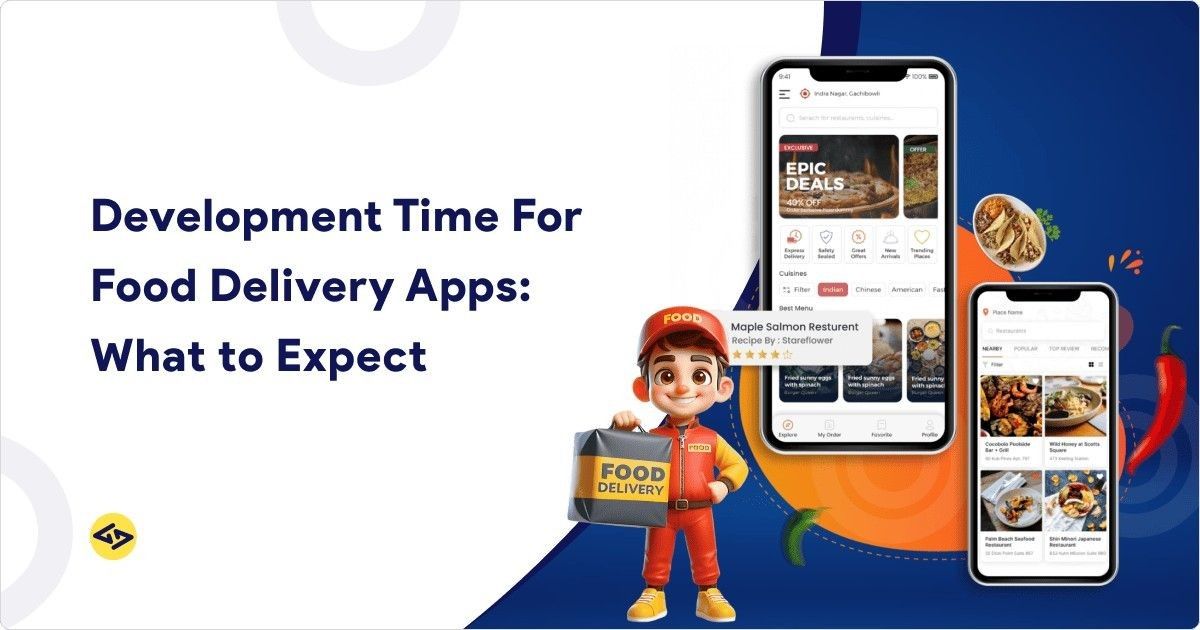
Online food ordering has moved from a convenience to an expectation, and that demand is exactly why so many restaurants, cloud kitchens, and startups are asking the same question: how long does food delivery app development actually take? The answer matters more than it seems. A timeline that runs long can mean missed market windows, blown budgets, and investors who lose patience, while a rushed build can ship a buggy app that damages your brand before it even gets a fair shot.
Development duration isn’t fixed. It shifts based on your feature list, chosen platforms, integrations, and whether you build custom or start from a white label food delivery app. This guide breaks down the full food delivery app development timeline, phase by phase, so you can plan your launch with confidence instead of guesswork.
Quick Answer: How Long Does It Take to Develop a Food Delivery App?
A food delivery app typically takes 3 to 9 months to develop, depending on complexity, features, supported platforms, and integrations. A basic MVP can launch in 8–12 weeks, while an advanced, AI-powered platform may need 6–9 months. Choosing to build a food delivery app with a clear scope from day one is the single biggest factor in hitting your target date.
Food Delivery App Development Timeline at a Glance
| App Type | Estimated Timeline |
| Basic MVP | 8–12 Weeks |
| Standard App | 3–5 Months |
| Advanced App | 5–7 Months |
| Enterprise Platform | 7–9+ Months |
These ranges assume a dedicated development team and a reasonably stable set of food delivery app features agreed upon before coding begins. Scope changes mid-project are the fastest way to push any of these numbers higher.
What Factors Affect Food Delivery App Development Time?
Project Scope
A single-restaurant ordering app takes far less time than a multi-vendor marketplace with dozens of moving parts.
Number of Features
Every added feature, loyalty programs, live chat, subscriptions, adds design, build, and testing hours.
App Complexity
Real-time tracking, dynamic pricing, and multi-role dashboards increase both backend and frontend complexity.
Design Requirements
Custom UI/UX with animations and branded design systems takes longer than using proven design templates.
Platform Selection (iOS, Android, or Cross-Platform)
Native development for two platforms roughly doubles frontend effort; cross-platform frameworks can shorten this.
Third-Party Integrations
Payment gateways, maps, SMS, and delivery APIs each need setup, testing, and error handling time.
Backend Infrastructure
A scalable backend architecture for high order volumes takes longer to build than a simple database setup.
Testing & Quality Assurance
Payment flows, live tracking, and multi-app syncing all demand rigorous, time-intensive QA cycles.
Team Size & Expertise
A larger, experienced team can run design, backend, and frontend work in parallel, shortening the overall calendar.
Regulatory & Security Requirements
Data protection, PCI compliance, and regional food-delivery regulations can add review and audit time, especially for food delivery app security requirements around payments and user data.
Step-by-Step Food Delivery App Development Process & Timeline
Discovery & Requirement Analysis (1–2 Weeks)
Defining goals, user personas, competitors, and the full feature list.
UI/UX Design (2–4 Weeks)
Wireframes, prototypes, and final designs for every app (customer, delivery, restaurant, admin).
Backend Development (3–6 Weeks)
Building the server, database, APIs, and core business logic.
Customer App Development (3–6 Weeks)
The ordering, browsing, checkout, and tracking experience end users interact with.
Delivery Partner App Development (2–4 Weeks)
Order acceptance, navigation, earnings, and status updates for riders.
Restaurant Panel Development (2–4 Weeks)
Menu management, order handling, and analytics for restaurant partners — a core piece if you plan to build a restaurant app alongside the main platform.
Admin Panel Development (2–3 Weeks)
Centralized dashboard for managing users, orders, payouts, and platform settings.
API & Third-Party Integrations (1–3 Weeks)
Connecting payment gateways, maps, notifications, and analytics tools.
Testing & Bug Fixing (2–4 Weeks)
Functional, performance, security, and usability testing across all four apps.
Deployment & Launch (1 Week)
App store submissions, server go-live, and final production checks.
Food Delivery App Development Timeline by App Type
Single Restaurant App
The simplest build — one menu, one location — typically ready in 8–10 weeks.
Multi-Restaurant Marketplace
A multi vendor food delivery app with many restaurant partners usually takes 4–6 months due to added vendor management.
Cloud Kitchen Platform
Focused on delivery-only brands; timelines run 3–5 months depending on multi-brand support.
Grocery & Food Delivery App
Inventory management and combined catalogs add 1–2 months over a standard food app.
White-Label Food Delivery App
Pre-built and customizable, often launch-ready in 6–10 weeks.
Custom Food Delivery App
Built from scratch for full control and scalability, generally 4–9 months depending on scope.
Timeline Breakdown by Essential Features
| Feature | Estimated Development Time |
| User Registration | 3–5 Days |
| Restaurant Listings | 5–7 Days |
| Order Placement | 7–10 Days |
| Live Order Tracking | 10–14 Days |
| Payment Integration | 7–10 Days |
| Push Notifications | 3–5 Days |
| Ratings & Reviews | 4–6 Days |
| Loyalty Programme | 7–10 Days |
| AI Recommendations | 14–21 Days |
AI-driven personalization takes the longest to implement well, but it’s increasingly a differentiator — see how AI features in food delivery apps are reshaping retention and order value.
How Long Does It Take to Build an App Like Uber Eats or DoorDash?
Replicating an Uber Eats or DoorDash-level platform means building four coordinated products: a customer app for browsing and ordering, a restaurant app for menu and order management, a delivery partner app for navigation and earnings, and an admin dashboard for platform-wide control. Add AI-driven recommendations and dynamic delivery-fee logic, and you’re looking at genuine enterprise-grade complexity.
Estimated total timeline: 6–9 months for a fully custom build. Many businesses shorten this by starting from a proven food delivery app clone framework and customizing branding, features, and integrations on top of it, cutting months off the schedule without sacrificing core functionality.
Custom vs White-Label Food Delivery App: Which Saves More Time?
| Factor | White-Label | Custom |
| Development Time | 6–10 weeks | 4–9 months |
| Customisation | Limited | Full control |
| Cost | Lower upfront | Higher upfront |
| Scalability | Moderate | High |
| Ownership | Shared/licensed | Full ownership |
| Time to Market | Fast | Slower |
There’s no universal winner here; see this detailed white label food delivery app vs custom development comparison to match the choice to your growth stage and budget.
Common Reasons Food Delivery App Projects Get Delayed
- Frequent scope changes mid-development
- Poor upfront planning
- Weak communication between stakeholders and developers
- Repeated design revisions
- Complex or poorly documented third-party integrations
- Inadequate or rushed testing
- Changing business requirements after development starts
- Limited or inexperienced development resources
Avoiding these pitfalls early is often more valuable than any single time-saving tactic; many of these mistakes to avoid in food service app projects come down to planning, not technology.
How to Reduce Food Delivery App Development Time
- Start with an MVP instead of a fully-loaded app
- Prioritize essential features over nice-to-haves
- Use cross-platform frameworks like Flutter or React Native
- Choose an experienced development partner
- Reuse proven, pre-built components where it makes sense
- Plan third-party integrations early in the process
- Define clear, locked project requirements before coding
- Conduct continuous testing instead of one QA phase at the end
Many of these steps double as smart moves for an food ordering system easy way that’s easy for both users and your internal team to manage post-launch.
Technology Stack That Impacts Development Time
Frontend
Flutter or React Native for cross-platform speed; Swift/Kotlin for native performance.
Backend
Node.js, Python (Django), or Laravel for scalable server-side logic.
Database
PostgreSQL or MongoDB depending on data structure needs.
Cloud Hosting
AWS, Google Cloud, or Azure for scalable, reliable infrastructure.
Maps & Navigation
Google Maps API or Mapbox for real-time tracking and route optimization.
Payment Gateway
Stripe, Razorpay, or PayPal, chosen based on target markets.
Push Notifications
Firebase Cloud Messaging for order and promotional alerts.
AI & Analytics
Machine learning models for recommendations, paired with analytics tools for order and behavior tracking.
A well-matched stack, especially for a saas food delivery platform development approach, can meaningfully shrink both build time and future maintenance effort.
How Much Does It Cost to Develop a Food Delivery App?
| App Type | Estimated Cost Range |
| Basic MVP | $8,000 – $15,000 |
| Standard App | $15,000 – $35,000 |
| Advanced App | $35,000 – $70,000 |
| Enterprise Platform | $70,000+ |
Cost generally rises in step with timeline — more features and integrations mean more development hours. Ongoing maintenance (server costs, updates, bug fixes) typically runs 15–20% of the initial build cost annually. For a full breakdown, see the complete guide to cost to develop a food delivery app.
Why Choose iCoderz Solutions for Food Delivery App Development?
- 14+ years of experience delivering mobile and web applications across industries
- Deep expertise in food delivery and on-demand app development
- Both custom and white-label solutions to match your timeline and budget
- AI-powered food delivery platforms with smart recommendations and demand prediction
- Scalable architecture built to handle growth from launch through enterprise scale
- End-to-end development — from discovery to deployment
- Reliable post-launch support and maintenance
- A strong, proven portfolio in food delivery app development across markets
Ready to scope your project? Talk to our team about a tailored timeline for your app.
Conclusion
Timelines vary widely, from an 8–12 week MVP to a 7–9 month enterprise platform, but the pattern is consistent: complexity, features, integrations, design depth, and development approach all shape your launch date. Starting lean with an MVP lets you validate demand quickly and scale with real user feedback instead of guesswork, a strategy that’s worked well for many top food delivery startups.
If you’re ready to turn a rough idea into a working launch plan, connect with iCoderz Solutions for expert guidance and a development roadmap built around your actual timeline and budget.
Frequently Asked Questions (FAQs)
How long does it take to develop a food delivery app?
Most projects take 3–9 months, depending on complexity, features, and whether you choose custom or white-label development.
Can I launch an MVP in under three months?
Yes. A focused MVP with core ordering, payment, and tracking features can typically launch in 8–12 weeks.
What affects food delivery app development time the most?
Feature count, platform choice, third-party integrations, and design complexity have the biggest impact on timeline.
How long does it take to build an app like Uber Eats?
A full four-app ecosystem (customer, restaurant, delivery, admin) similar to an app like Swiggy or Uber Eats generally takes 6–9 months to build from scratch.
Is a white-label food delivery app faster than custom development?
Yes, white-label apps can launch in 6–10 weeks since core functionality is already built, while custom apps take months longer.
How many developers are needed to build a food delivery app?
A typical team includes 4–8 members: project manager, UI/UX designer, backend developers, frontend/app developers, and QA engineers.
Does adding AI features increase development time?
Yes, AI-driven recommendations and predictive features can add 2–4 weeks depending on the model complexity and data available.
Which platform is faster to develop: Flutter or React Native?
Both are comparable in speed for cross-platform builds; the better choice depends on your team’s expertise and specific app requirements.
How can I reduce food delivery app development time?
Start with an MVP, lock your feature scope early, use cross-platform frameworks, and work with an experienced development partner.
How much does it cost to develop a food delivery app?
Costs range from roughly $8,000 for a basic MVP to $70,000+ for an enterprise-grade platform, generally scaling with timeline and feature depth.