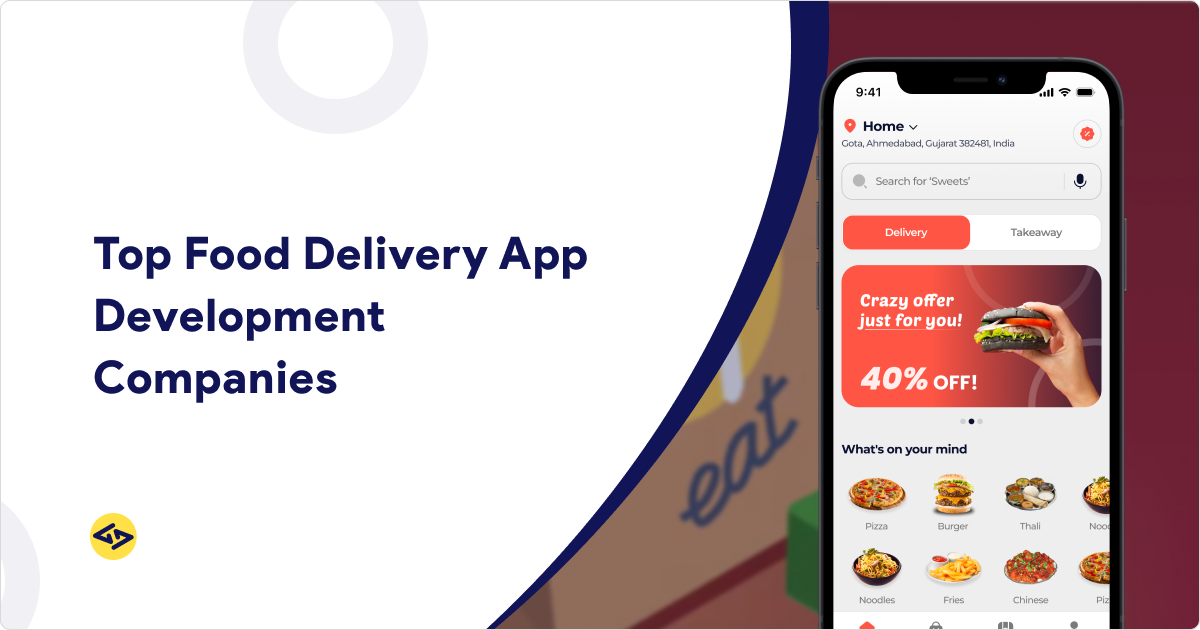
Choosing between food delivery app development companies is hard, because many of them promise the same features. This guide compares seven food delivery app development companies, explains what they build, and shows how to pick the right partner for 2027.
Food delivery app development is the process of building the customer app, restaurant panel, delivery partner app, and admin panel that run an online ordering business. The market is growing fast. According to Grand View Research, the global online food delivery market was valued at $288.8 billion in 2024. It is projected to reach $505.5 billion by 2030, a 9.4% CAGR. This growth is increasing demand for platforms that support ordering, payments, restaurant operations, dispatch, and delivery tracking.
Disclosure: iCoderz Solutions publishes this guide, so we list ourselves first. The order of the list is not a ranking. We describe every other company from its public website.
If you are planning a custom platform, see our food delivery app development services for the process, features, and solution options.
Quick Answer
The right food delivery app development company depends on your business model, budget, timeline, and the level of customization you need. The companies in this guide offer different approaches, from custom development and mobile engineering to white-label and ready-made platforms. Compare their food delivery experience, portfolio, technology skills, pricing, source code ownership, and post-launch support before you choose.
How We Selected These Food Delivery App Development Companies
We looked for proof, not promises. We reviewed each company’s official website. Each company needed:
- A dedicated food delivery service page or visible food delivery work
- Mobile app skills, including Flutter or React Native
- Custom, white-label, or on-demand delivery options
- Customer, restaurant, delivery partner, and admin functionality
- Published company experience and office locations
- Pricing or estimates, where they are publicly available
- US offices or US clients, since many buyers compare food delivery app development companies USA
Company details, pricing, and portfolios can change. Verify current information directly with each provider before you decide.
Food Delivery App Development Companies at a Glance
This table summarizes the food delivery app development companies below. It lists what each company publishes about itself.
| Company | Published focus | Notable published offering | Listed offices |
| iCoderz Solutions | Food delivery and on-demand apps | Pre-built modules, full source code ownership | Not listed in this guide |
| Nimble AppGenie | Food delivery apps | Clone-style and white-label apps | Houston, London, Toronto, Dubai |
| Elluminati Inc. | On-demand delivery platforms | Ready-to-deploy white-label platform | Seattle (US) |
| Vention | Engineering and custom software | Platform modernization, complex integrations | New York |
| iQlance | Mobile app development | Swift, Kotlin, Flutter, and React Native | Dallas, New York, Austin |
| VT Netzwelt | Mobile and web development | Wide technology stack | US, Germany, India |
| JetRuby | Custom software development | Ruby on Rails, AI-assisted workflow | San Francisco |
Top Food Delivery App Development Companies for 2027
Below are seven food delivery app development companies to consider. These food delivery app development agencies are included based on their published food delivery services, capabilities, and public company information.
1. iCoderz Solutions
Overview: iCoderz Solutions is a food delivery app development company with 15+ years in on-demand apps and clients in 35+ countries, according to its food delivery app development page. For Pierush Pizza, a USA-based pizzeria, the team built an iOS ordering app with menu browsing, order customization, secure payments, and live delivery tracking.
Key Strengths:
- Food delivery focus with pre-built modules
- Full source code ownership after payment
- Custom food delivery app development, including multi-restaurant and Uber Eats style builds
Food delivery example: Pierush Pizza, a USA-based pizzeria project covering menu browsing, order customization, secure payments, and live delivery tracking.
Services: Food delivery app development services cover UI/UX design, POS and payment integrations, and support.
2. Nimble AppGenie
Overview: According to its website, Nimble AppGenie has offices in Houston, London, Toronto, and Dubai. It reports 350+ delivered solutions across 50+ countries.
Key Strengths:
- Clone-style apps inspired by Zomato, DoorDash, Grubhub, and Deliveroo
- ISO 27001 and PCI-DSS credentials listed on its site
Services: Apps for startups, white-label apps for restaurant chains, cloud kitchen apps, and dedicated developer hiring.
3. Elluminati Inc.
Overview: According to its website, Elluminati reports 14+ years in business, 850+ projects, and clients in 100+ countries. It has a US office in Seattle.
Key Strengths:
- Ready-to-deploy white-label platform, with launch in about two to three weeks
- Optional AI add-ons such as chatbots and demand forecasting
Services: Custom, white-label, on-demand, cloud kitchen, and aggregator apps.
4. Vention
Overview: According to its website, Vention is a New York-based engineering firm with 20+ years of experience. Its food clients include Freshly, a meal delivery service, and Heycater, a catering marketplace.
Key Strengths:
- Strong fit for rebuilding legacy delivery platforms
- Complex integrations and scalable backends
Services: Consulting, custom apps, restaurant and vendor apps, delivery partner apps, modernization, and maintenance.
5. iQlance
Overview: According to its website, iQlance is a US-focused app company with offices in Dallas, New York, and Austin. It lists 1,500+ projects.
Key Strengths:
- Swift, Kotlin, Flutter, and React Native skills
- Free consultation and NDA-protected projects
Services: Customer, driver, and restaurant apps with menu management, table reservation, and QR code ordering. Pricing is quoted per project.
6. VT Netzwelt
Overview: According to its website, VT Netzwelt was founded in 2013. It has 150+ experts and offices in the US, Germany, and India.
Key Strengths:
- Wide stack, including Swift, Kotlin, Flutter, React Native, and Node.js
- E-commerce skills that help if you also sell retail products
Services: Mobile apps, including food delivery, plus web development, QA, and AI services.
7. JetRuby
Overview: According to its website, JetRuby is headquartered in San Francisco and was founded in 2010. It says it has worked with 200+ companies.
Key Strengths:
- Ruby on Rails expertise
- AI-assisted workflow it says can speed delivery up to eight times
Services: Apps for restaurants, home delivery services, food trucks, and fast-food brands, with real-time tracking.
What Does a Food Delivery App Development Company Build?
A food delivery app development company builds four connected products that take an order from tap to doorstep.
Customer App
Customers browse menus, pay, and track orders live.
Restaurant/Vendor Panel
Restaurants accept orders, update menus, and review payouts.
Delivery Partner App
Drivers receive assignments, navigation, and earnings summaries.
Admin Panel
Owners manage users, commissions, delivery zones, and reports.
Types of Food Delivery Apps
Your business model decides the app type. This matters for food delivery app development for restaurants and startups alike.
Single-Restaurant App
One brand takes direct orders and avoids marketplace commissions. It suits food delivery app development for small business owners.
Multi-Vendor Food Delivery App
Many restaurants sell on one platform. Multi vendor food delivery app development needs vendor onboarding, commissions, and payouts. Read our multi-vendor food delivery app guide for details.
Cloud Kitchen App
Delivery-only brands run several menus from one kitchen.
On-Demand Food Delivery App
On demand food delivery app development adds live dispatch and real-time driver matching.
White-Label Food Delivery App
White label food delivery app development means rebranding a ready product. It suits food delivery app development for startups that need a fast, low-cost launch.
Subscription-Based Food Delivery App
Customers pay monthly for meal plans or free delivery.
Food Delivery Marketplace
An aggregator lists many restaurants and earns from each order.
Successful Food Delivery Apps to Learn From
Study the leaders before you copy them. Uber Eats clone app development, DoorDash clone app development, Zomato clone app development, and Swiggy clone app development are common starting points. You still need a clear difference.
Uber Eats
It shows the value of simple ordering, live tracking, and a large courier network.
DoorDash
DoorDash is a major US food delivery marketplace. It is useful to study for restaurant onboarding, marketplace operations, and delivery logistics. Restaurants can list on its marketplace and still use their own drivers.
Zomato
It began with restaurant discovery and reviews, then added delivery.
Swiggy
It is known for hyperlocal delivery in India. It is useful to study for fast delivery from nearby restaurants.
Essential Food Delivery App Features
Food delivery app development features depend on your model, but every platform needs a solid core. Our food delivery app features guide covers each panel in depth.
Customer App Features
Easy sign-up, search filters, secure payments, live tracking, reorder, and ratings.
Restaurant App Features
An order inbox with alerts, menu management, prep-time updates, and payout views.
Delivery Partner Features
Auto-assignment, in-app maps, proof of delivery, and earnings tracking.
Admin Panel Features
Commission settings, zone control, promotions, analytics, and role-based access.
Advanced Food Delivery App Features
AI recommendations, surge pricing, loyalty wallets, scheduled orders, and sponsored listings.
Food Delivery App Development Process
A clear process prevents delays and budget surprises. Most teams follow eight steps.
Step 1: Discovery & Requirements
Define your model, users, and must-have features.
Step 2: UI/UX Design
Create wireframes and clickable prototypes before coding.
Step 3: Frontend Development
Build the apps in Swift, Kotlin, Flutter, or React Native. Flutter food delivery app development and React Native food delivery app development both use one codebase for iOS and Android.
Step 4: Backend Development
Build order logic, dispatch, and databases. Your food delivery app tech stack affects speed and scaling.
Step 5: API & Third-Party Integration
Connect maps, payment gateways, SMS, and POS systems.
Step 6: Testing & Quality Assurance
Test orders, payments, and peak-hour load on real devices.
Step 7: Deployment
Launch on the App Store and Google Play, and set up cloud hosting.
Step 8: Post-Launch Support
Fix bugs, update for new OS versions, and add features.
How Much Does Food Delivery App Development Cost in 2027?
Published ranges vary widely, and they are estimates, not market averages. The table lists only figures that companies publish themselves. Read our food delivery app development cost breakdown before you compare quotes.
| Company | Published pricing information |
| iCoderz Solutions | $25,000 to $50,000 for an MVP. $60,000 to $150,000 or more for a multi-restaurant platform. |
| Nimble AppGenie | $15,000 to $100,000 |
| iQlance | Quoted per project |
| Elluminati, Vention, VT Netzwelt, JetRuby | No figures used in this guide. Request a quote. |
Cost shifts with feature count, platforms, integrations, and design depth. Ask every company to list scope, phases, and change costs in writing.
How Long Does It Take to Build a Food Delivery App?
For planning purposes, iCoderz currently estimates that a focused MVP takes about 10 to 14 weeks. Advanced platforms take four to six months or more. Our food delivery app development time guide explains each phase.
MVP Development Timeline
About 10 to 14 weeks for core ordering, basic partner tools, and a basic admin panel.
Standard App Development Timeline
Roughly 14 to 24 weeks, once you add multi-restaurant onboarding, promotions, and analytics.
Advanced Platform Development Timeline
Four to six months or more for heavy customization, AI features, and multi-city rollout.
Factors Affecting Development Time
The food delivery app development timeline shifts with feature count, platforms, integrations, design depth, and app store approvals.
How to Choose a Food Delivery App Development Company in 2027
Choose a partner with proven food delivery work, clear pricing, and written ownership terms. Compare at least three food delivery app development companies. Decide first whether white-label or custom development fits your budget.
1. Food Delivery Experience
Look for live delivery apps, not general mobile work.
2. Portfolio & Case Studies
Ask for named clients, screenshots, and measurable results.
3. Platform Support
Confirm iOS, Android, and web coverage.
4. Technology Expertise
Check that the food delivery app developers know Swift, Kotlin, Flutter, React Native, Node.js, and maps.
5. Scalability
Ask how the system handles lunch and dinner peaks.
6. Pricing Transparency
A clear food delivery app development company pricing quote lists scope, phases, and change costs.
7. Support & Maintenance
Confirm bug fixes, OS updates, and response times.
8. Security & IP Ownership
Insist on source code ownership, an NDA, and PCI-compliant payments.
9. Communication
Look for one point of contact, regular demos, and shared working hours.
10. Geographic Coverage
A local presence helps US buyers, while offshore teams may cut costs.
Food Delivery App Monetization Models
Most platforms combine several models. Our guide on how on-demand food delivery apps make money shows real examples.
Commission-Based Model
Restaurants pay a share of each order. iCoderz cites 15 to 30 percent per order.
Delivery Fee Model
Customers pay a fee based on distance or order size.
Subscription Model
Customers or restaurants pay monthly for perks or listings.
Advertising & Promotions
Restaurants pay for featured spots and sponsored collections.
Freemium Model
Basic ordering is free, and paid plans unlock extras such as free delivery.
Surge Pricing Model
Delivery fees rise during peak demand.
Questions to Ask Before Hiring a Food Delivery App Development Company
1. What Food Delivery Projects Have You Built?
Ask for live apps and client references. Strong answers name the model, platform, and results.
2. What Technology Stack Will You Use?
The team should explain why it picked each tool for your model and budget.
3. How Will You Handle Scalability?
Look for cloud hosting, load testing, and multi-city zone support.
4. What Is Included in the Development Cost?
Food delivery app development cost in USA 2027 depends on scope. See the pricing section above for published ranges. Ask for a written quote that lists scope, phases, and change costs.
5. Who Owns the Source Code and IP?
You should own the code, designs, and user data once payment is complete. Get it in writing.
6. What Post-Launch Support Do You Provide?
Ask about monitoring, bug fixes, and feature updates.
7. How Will You Handle Security and Data Protection?
Expect encryption, secure authentication, and compliant payment gateways.
8. What Is the Expected Development Timeline?
Ask for milestones, not just a launch date.
Final Thoughts
Strong food delivery app development companies combine food delivery experience, clear pricing, and realistic timelines. Shortlist three food delivery app development companies, ask the questions above, and start with an MVP you can grow.
Planning a food delivery app? Talk to the iCoderz team for a free consultation about your business model, features, timeline, and development requirements.
Turn Your Food Delivery Idea Into an App
Build a scalable food delivery app tailored to your business.