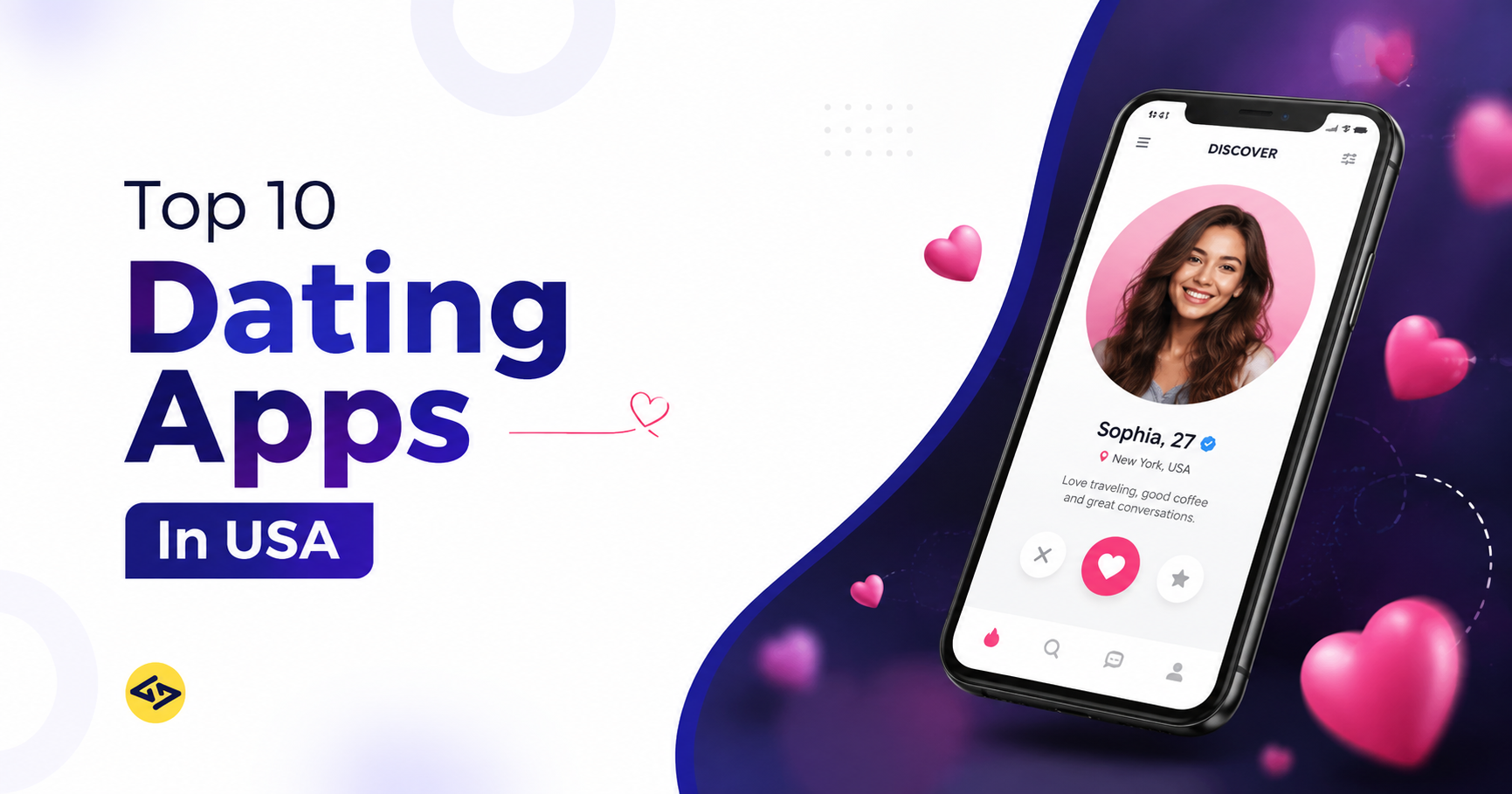
Online dating has become the default way Americans meet new people. Whether you’re looking for a serious relationship, a casual connection, or simply a fun way to expand your social circle, there’s a dating app built for you. With AI-powered matching, video-first profiles, and smarter safety tools, today’s top dating apps in USA look nothing like the swipe-only platforms of a decade ago.
In this guide, you’ll find the best dating apps in USA for every goal — free, LGBTQ, senior, professional, and serious-relationship focused — plus market stats, safety tips, and what it takes to build a dating app of your own.
Online Dating in the USA: Market Overview
Growth of Dating Apps
The U.S. dating app market has matured into one of the most valuable segments of the mobile app economy. The U.S. remains the single largest market by revenue, accounting for approximately 36% of global online dating revenue despite having only 14% of global users, showing how willing American users are to pay for premium features.
Latest Dating App Statistics
- The United States is projected to generate the most dating app revenue globally in 2026, reaching $1.45 billion, with Tinder, Bumble, and Hinge leading platform revenue.
- In the US alone, about 30% of adults have tried a dating app at some point, according to Pew Research.
- LGB adults are significantly more likely to have used dating apps (51%) compared with straight adults (28%).
- Paid services generated nearly 70% of dating app market revenue in 2025, with subscriptions as the leading revenue driver.
- Users aged 30-49 represent 38% of current dating app users and pay for premium features at nearly double the rate of younger users.
Why Millions of Americans Use Dating Apps
Busy schedules, shrinking social circles after college, and comfort with digital-first communication all push singles toward apps. AI matching and identity verification have also made online dating feel safer and more efficient than it did five years ago.
Top 15 Dating Apps in USA (Comparison Table)
| App | Best For | Free Version | Platforms | Rating |
| Tinder | Casual dating, large user base | Yes | iOS, Android, Web | 4.1 |
| Bumble | Women-first matching | Yes | iOS, Android, Web | 4.3 |
| Hinge | Serious relationships | Yes | iOS, Android | 4.4 |
| Match | Long-term relationships | Yes | iOS, Android, Web | 4.0 |
| eHarmony | Marriage-minded singles | Limited | iOS, Android, Web | 4.2 |
| OkCupid | Value & identity-based matching | Yes | iOS, Android, Web | 4.1 |
| Plenty of Fish (POF) | Budget-friendly dating | Yes | iOS, Android, Web | 3.9 |
| Coffee Meets Bagel | Curated daily matches | Yes | iOS, Android | 4.2 |
| Happn | Location-based dating | Yes | iOS, Android | 3.8 |
| HER | LGBTQ+ women & non-binary users | Yes | iOS, Android | 4.5 |
| Grindr | LGBTQ+ men, casual connections | Yes | iOS, Android | 4.0 |
| BLK | Black singles community | Yes | iOS, Android | 4.3 |
| EliteSingles | Professionals & graduates | Limited | iOS, Android, Web | 4.1 |
| The League | Career-driven singles | No | iOS, Android | 3.7 |
| Facebook Dating | Free, interest-based matching | Yes | iOS, Android | 3.6 |
Top Dating Apps in USA
Tinder
Overview: The app that invented the swipe gesture and turned it into an industry standard. Tinder remains the most downloaded dating app in the U.S., with a massive, highly active user base across every age group and city size.
Key features: Swipe matching, Super Likes, Boosts (temporary visibility increase), Rewind (undo last swipe), Tinder Passport for matching outside your area, ID verification pilot, in-app video chat.
Pros:
- Largest user pool of any dating app in the U.S., which means more matches in less time
- Works well in both major cities and smaller towns
- Frequent feature updates, including AI-assisted profile prompts
- Low barrier to entry — sign up and start swiping in minutes
Cons:
- Reputation skews toward casual dating and hookups rather than long-term relationships
- Aggressive upsell prompts for Boosts and Super Likes
- Higher rate of fake or inactive profiles compared to curated apps
- Pricing increases sharply with age on some tiers, which has drawn criticism and legal scrutiny
Pricing: Free to browse and swipe; Tinder Plus, Gold, and Platinum unlock unlimited likes, Passport, and see-who-likes-you features.
Best for: Anyone searching for the most popular dating apps in USA who wants the largest possible pool and the fastest path to a first match.
Bumble
Overview: Bumble flips the traditional messaging dynamic by requiring women (or the same-sex match) to send the first message within 24 hours. It’s grown from a dating app into a broader connection platform with modes for friendship and professional networking.
Key features: 24-hour match expiry to encourage timely conversation, Bumble BFF for friendships, Bumble Bizz for professional networking, photo verification with an AI-driven “Deception Detector,” voice and video calling inside the app.
Pros:
- Reduces unsolicited or aggressive first messages
- Strong safety reputation thanks to mandatory verification prompts
- Multiple modes (dating, friends, business) in one app
- Clean, modern interface that’s easy for beginners to navigate
Cons:
- Smaller match pool outside major metro areas
- 24-hour expiry can feel like added pressure for shy users
- Full messaging and advanced filters require a paid tier
Pricing: Free with optional Bumble Premium and Bumble Premium+ subscriptions for advanced filters and unlimited swipes.
Best for: Women and users who want more control over who initiates contact — a top pick among dating apps for singles in USA who prioritize respectful first interactions.
Hinge
Overview: Hinge markets itself as “designed to be deleted,” meaning its entire product is built around helping users leave the app for a real relationship rather than keep swiping indefinitely.
Key features: Prompt-based profiles instead of pure photo swiping, “Standouts” daily curated picks, AI-suggested icebreakers, voice prompts, “We Met” feedback loop that improves match recommendations over time.
Pros:
- Prompt-based profiles surface personality, not just looks
- Higher intent user base focused on dating apps for serious relationships USA
- AI-driven suggestions genuinely improve match relevance over time
- Feedback tools help the algorithm learn from past dates
Cons:
- Smaller total user base than Tinder or Bumble, especially outside big cities
- Full access to likes and advanced filters requires Hinge+ or Hinge X
- Prompt-based profiles take more time to fill out than a simple swipe profile
Pricing: Free with limited likes; Hinge+ and Hinge X unlock unlimited likes, advanced filters, and see-who-liked-you.
Best for: Serious daters who want depth over quantity and are willing to trade swipe volume for match quality.
Match
Overview: One of the longest-running dating platforms in the U.S., Match has decades of user data behind its matching algorithm and skews toward an older, relationship-focused audience.
Key features: Detailed, in-depth profiles, compatibility questionnaires, in-person Match Events and mixers, “Missed Connections,” daily curated match recommendations.
Pros:
- Long track record and large database of relationship-minded singles
- In-person events add a real-world layer beyond the app
- Detailed profiles reduce mismatched expectations
- Strong option among dating apps for young adults USA looking to graduate from casual swiping
Cons:
- Full messaging is locked behind a subscription
- Interface feels more traditional than newer, gamified apps
- Free users can browse but have limited ability to respond to messages
Pricing: Paid subscription required for full messaging; free trial and limited free browsing available.
Best for: Long-term relationship seekers who want a mature, established platform.
eHarmony
Overview: eHarmony built its reputation on science-backed matchmaking, using an in-depth personality assessment to pair users based on core compatibility factors rather than surface-level swiping.
Key features: Compatibility Matching System, in-depth personality assessment (takes 20–30 minutes), guided communication tools, video date scheduling.
Pros:
- Strong marriage and long-term relationship success claims backed by internal research
- Matching algorithm goes far deeper than photo-based swiping
- Guided communication features help reduce awkward first-message anxiety
Cons:
- Lengthy, detailed sign-up process can feel like a barrier for casual users
- Pricier subscription plans than most competitors
- Smaller, more selective user pool
Pricing: Subscription-based, with tiered plans by commitment length.
Best for: Marriage-minded singles who want a data-driven approach to compatibility.
OkCupid
Overview: OkCupid blends the speed of swiping with the depth of a detailed compatibility quiz, letting users answer thousands of optional questions that generate a percentage match score.
Key features: Personality-based match percentages, thousands of optional compatibility questions, inclusive gender and orientation options (20+ identity choices), Double Take swipe-and-quiz hybrid mode.
Pros:
- Match percentage gives daters real compatibility data before messaging
- One of the most inclusive apps for gender identity and orientation
- Strong free tier compared to many competitors
Cons:
- Interface and design feel dated compared to newer apps
- Longer profile setup if you want accurate match scores
- Free messaging can attract more low-effort or inactive users
Pricing: Free with OkCupid Basic+ and Premium tiers for unlimited likes and advanced filters.
Best for: Singles who want compatibility data before matching and value inclusive identity options.
Plenty of Fish (POF)
Overview: POF remains one of the largest free dating platforms in the U.S., appealing to budget-conscious daters who don’t want to pay for basic messaging.
Key features: Chemistry compatibility test, Live streaming, large free messaging pool, POF Meet Me swipe mode, detailed profile questionnaires.
Pros:
- One of the most generous free tiers among major dating apps
- Very large, active user base across all age groups
- Chemistry test adds a layer of compatibility insight at no cost
Cons:
- Higher rate of spam and fake profiles than premium-first apps
- Ad-supported free experience can feel cluttered
- Match quality can be inconsistent without a paid upgrade
Pricing: Mostly free; optional POF Premium removes ads and unlocks extra visibility features.
Best for: Anyone specifically searching for free dating apps in USA who wants a large pool without paying.
Coffee Meets Bagel
Overview: Instead of endless swiping, Coffee Meets Bagel sends a curated, limited batch of matches (“Bagels”) each day, designed to reduce decision fatigue.
Key features: Daily curated match limit, in-app video chat, “Discover” mode for additional browsing, activity-based icebreaker prompts.
Pros:
- Limited daily matches reduce swipe fatigue and encourage more thoughtful choices
- Higher-intent user base than pure swipe apps
- Video chat feature supports safer, low-pressure first interactions
Cons:
- Slower overall match volume than Tinder or Bumble
- Smaller total user base in less populated areas
- Some premium features require a Coffee Meets Bagel Premium subscription
Pricing: Free with optional Premium for expanded matches and read receipts.
Best for: Users who want quality over quantity and prefer a slower, more intentional dating pace.
Happn
Overview: Happn matches users based on real-world proximity, showing profiles of people you’ve crossed paths with throughout the day.
Key features: Location-based timeline of crossed paths, Crush Time daily highlight, FlashNote priority messages, in-app icebreakers.
Pros:
- Unique location-based matching that feels more organic than random swiping
- Works especially well in dense urban environments
- Easy way to reconnect with someone you noticed in person
Cons:
- Limited usefulness in suburban or rural areas with lower user density
- Smaller overall user base than mainstream competitors
- Some users find constant location tracking a privacy concern
Pricing: Free with paid boosts and FlashNotes.
Best for: Urban singles who want real-world proximity matching over algorithm-only pairing.
HER
Overview: HER was built specifically for LGBTQ+ women, non-binary, and queer users, combining dating features with a genuine social community.
Key features: Community feed for posts and discussions, LGBTQ+ events calendar, inclusive gender and orientation filters, space for both dating and friendship connections.
Pros:
- Purpose-built for LGBTQ+ women rather than a retrofitted mainstream app
- Strong sense of community beyond just matching
- Safe, moderated space with active content moderation
Cons:
- Smaller user base outside major cities
- Fewer matches in lower-population areas
- Some features feel more social-media-like than dating-app-like, which isn’t for everyone
Pricing: Free with HER Premium for advanced filters and unlimited swipes.
Best for: Anyone searching for LGBTQ dating apps USA that center the queer women’s community specifically.
Grindr
Overview: Grindr is the largest and most established dating and social networking app for LGBTQ+ men, built around real-time, location-based browsing.
Key features: Location grid showing nearby users, real-time chat, community-focused events and health resources, optional verified badges via selfie check.
Pros:
- Massive, highly active global and U.S. user base
- Real-time location grid makes it easy to find nearby connections
- Strong community and health-resource integration
Cons:
- Primarily geared toward casual connections rather than long-term dating
- No mandatory identity verification, which raises catfishing risk
- Location-sharing features require careful privacy management
Pricing: Free with Grindr XTRA and Grindr Unlimited subscription tiers.
Best for: LGBTQ+ men seeking connections nearby, from casual meetups to longer-term relationships.
BLK
Overview: Part of the Match Group family, BLK is built specifically for Black singles, combining dating with culturally relevant content and community features.
Key features: Culturally relevant news and content feed, curated match suggestions, community discussion spaces, swipe-based matching with detailed profile prompts.
Pros:
- Strong sense of community and representation absent from mainstream apps
- Culturally relevant content keeps users engaged beyond just matching
- Backed by Match Group’s infrastructure and safety resources
Cons:
- Smaller user pool in rural or less diverse regions
- Fewer advanced filtering options than larger mainstream apps
- Some premium features require a paid upgrade
Pricing: Free with premium upgrades for expanded visibility and filters.
Best for: Black singles seeking community-centered dating with shared cultural context.
EliteSingles
Overview: EliteSingles targets educated, career-focused singles looking for a serious relationship, using a detailed personality assessment to drive curated matches.
Key features: In-depth personality test, curated daily match suggestions (rather than open browsing), education- and career-based filtering, relationship-focused messaging tools.
Pros:
- Highly educated, high-income, professional user base
- Curated matches reduce time spent browsing irrelevant profiles
- Strong fit for dating apps for serious relationships USA searches
Cons:
- Smaller overall pool compared to mass-market apps
- Curated-only matching means less control over who you see
- Subscription required to unlock most core features
Pricing: Subscription-based, with multi-month plans offering better value.
Best for: Anyone specifically looking for dating apps for professionals USA who want an efficient, curated experience.
The League
Overview: The League is an exclusive, application-based dating app for ambitious professionals, using a vetting process to keep its user base highly curated.
Key features: LinkedIn- and resume-style profiles, application and waitlist screening process, career and education filters, curated daily matches.
Pros:
- Highly curated, career-driven user pool
- Screening process reduces low-effort or inactive profiles
- Strong option for professionals who found mainstream apps too broad
Cons:
- Selective approval process means not everyone gets in immediately
- No meaningful free tier — membership is required to use core features
- Smaller total user base than open-access apps
Pricing: Paid membership, with pricing that varies by city and demand.
Best for: Career-driven daters who want exclusivity and a vetted match pool.
Facebook Dating
Overview: Facebook Dating is a free dating feature built directly into the Facebook app, using existing social data to suggest matches beyond a user’s immediate friend circle.
Key features: Matches drawn from shared Facebook Groups and Events, Secret Crush (match with existing Facebook friends or Instagram followers), Instagram integration, no swiping — profiles are shown one at a time.
Pros:
- Completely free with no subscription tier
- Leverages existing Facebook data for potentially more relevant matches
- Secret Crush feature lets users express interest in existing connections privately
Cons:
- Requires an active, real-name Facebook account
- Smaller dedicated dating-focused user base than standalone apps
- Fewer advanced filtering and safety features than purpose-built dating apps
Pricing: Completely free.
Best for: Casual, low-cost dating for users already active on Facebook and Instagram.
Best Dating Apps by Category
| Category | Top Pick |
| Best Free Dating Apps | Plenty of Fish, Facebook Dating |
| Best for Serious Relationships | Hinge, Match, eHarmony |
| Best for Casual Dating | Tinder, Happn |
| Best for Professionals | EliteSingles, The League |
| Best LGBTQ Dating Apps | HER, Grindr, OkCupid |
| Best Senior Dating Apps | Match, eHarmony |
| Best for Young Adults | Tinder, Bumble |
Comparison of the Best Dating Apps in USA
| App | Best For | Free Version | Subscription | AI Matching | Video Chat |
| Tinder | Casual dating | Yes | Yes | Yes | Yes |
| Bumble | Women-led matching | Yes | Yes | Yes | Yes |
| Hinge | Serious dating | Yes | Yes | Yes | No |
| Match | Long-term relationships | Yes | Yes | Limited | Yes |
| eHarmony | Marriage-minded | Limited | Yes | Yes | Yes |
Key Features of Modern Dating Apps
- AI-powered matchmaking and smart recommendations
- Swipe functionality with video profiles
- Voice messages and live video calls
- Profile and photo verification
- Location- and interest-based matching
- Privacy controls and in-app safety reporting
- In-app messaging before number exchange
How to Choose the Right Dating App
- Relationship goals: casual, serious, or open to both
- Budget: free vs. premium subscription tiers
- User demographics: age, community, and location
- Privacy & security: verification and reporting tools
- Match quality: algorithm-based vs. self-directed browsing
- Features: video chat, AI suggestions, events
- User reviews: real experiences on app stores
Safety Tips for Using Dating Apps
- Verify profiles before meeting in person
- Never share financial information with a match
- Meet in public places for early dates
- Share your location with a trusted friend
- Report suspicious or fake accounts immediately
- Keep conversations in-app until you build trust
Among the safest dating apps USA offers, Bumble and Hinge stand out for mandatory verification steps and proactive fake-profile detection.
AI in Dating Apps
AI Matchmaking
Machine learning models analyze swipe patterns, preferences, and behavior to suggest more compatible matches over time.
Compatibility Prediction
AI models score potential matches on shared values, interests, and communication style rather than looks alone.
Fake Profile Detection
Computer vision flags duplicate or AI-generated photos, reducing catfishing risk.
Personalized Recommendations
Apps learn from engagement data to refine daily match suggestions.
AI Chat Assistants
Some platforms now offer AI-generated icebreakers and conversation prompts to reduce first-message anxiety.
Companies exploring build an ai powered dating app capabilities are seeing stronger retention thanks to smarter, more relevant matches.
Dating App Market Trends
- AI-powered and compatibility-based matching
- Video-first and voice-first profiles
- Mandatory identity verification
- Niche and community-focused dating apps
- Privacy-first data practices
- Growth of AI dating apps for conversation support
How Dating Apps Make Money
- Premium subscriptions (weekly, monthly, annual)
- In-app purchases like Super Likes and Boosts
- Advertising on free tiers
- Profile promotion and visibility boosts
- Virtual gifts and micro-transactions
- Premium filters and advanced search tools
Freemium subscriptions remain the dominant model, with roughly 15–20% of dating app users paying for premium features, while in-app purchases and advertising fill the rest of the revenue mix.
How Much Does It Cost to Build a Dating App?
| App Type | Estimated Cost Range |
| Basic app (core swipe/match features) | $25,000 – $45,000 |
| Advanced app (chat, filters, verification) | $45,000 – $80,000 |
| AI-powered app (matchmaking, safety AI) | $80,000 – $150,000+ |
Factors affecting cost:
- Number and complexity of features
- Platforms (iOS, Android, Web)
- UI/UX design quality
- Technology stack and third-party integrations
- AI/ML integration depth
- Ongoing maintenance and updates
For a full breakdown, see this guide on cost to development a dating app.
How to Build a Dating App Like Tinder or Bumble
- Market Research — study competitors and target demographics
- Define Target Audience — casual, serious, niche, or professional daters
- Select Business Model — freemium, subscription, or hybrid
- Design UI/UX — intuitive, swipe-friendly interface
- Choose Technology Stack — scalable backend, real-time chat, geolocation
- Develop MVP — core matching and messaging features
- Testing — QA across devices and match algorithms
- Launch — phased rollout across app stores
- Marketing — ASO, influencer campaigns, referral programs
- Continuous Improvement — analytics-driven feature updates
If you’re comparing global benchmarks first, this roundup of top 10 dating app in the world is a useful reference point, and this piece on how to design a dating app essential tips covers UX best practices in depth.
Why Choose iCoderz Solutions for Dating App Development?
- Proven expertise in daring app development across freemium and subscription models
- AI-powered matchmaking and fake-profile detection solutions
- Custom mobile app development for iOS, Android, and cross-platform
- Secure, scalable architecture built for growth
- Post-launch support, updates, and analytics
Ready to build your own platform? Build Your Dating App with iCoderz Solutions and turn your idea into a market-ready product.
Conclusion
From Tinder’s massive reach to Hinge’s relationship-first design and HER’s LGBTQ-focused community, the top dating apps in USA each serve a different kind of connection. Choose based on your relationship goals, safety needs, and the features that matter most to you — not just download numbers.
For entrepreneurs and businesses, the growing demand for AI-driven matchmaking, safety features, and niche communities represents a real opportunity to invest in custom dating app development. Ready to bring your idea to life? Contact iCoderz Solutions to build a secure, scalable, and feature-rich dating app.
Frequently Asked Questions (FAQ)
Which is the best dating app in the USA?
Tinder leads in downloads and overall users, while Hinge and Match are top choices for serious relationships.
What is the safest dating app in the USA?
Bumble and Hinge are widely regarded as some of the safest dating apps USA offers, due to strict verification and reporting tools.
Which dating app is best for serious relationships?
Hinge, Match, and eHarmony are built specifically for long-term, serious connections.
Are free dating apps worth using?
Yes — apps like Plenty of Fish and Facebook Dating offer large user bases at no cost, though premium tiers unlock more features.
Which dating app has the most users in the USA?
Tinder has the largest overall user base, followed closely by Bumble and Hinge.
What are the best LGBTQ dating apps?
HER, Grindr, and OkCupid are top choices for LGBTQ dating apps USA has to offer.
Which dating app is best for professionals?
EliteSingles and The League cater specifically to career-driven, educated singles.
How much does it cost to build a dating app?
Costs range from $25,000 for a basic app to $150,000+ for an AI-powered platform, depending on features and complexity.
How do dating apps make money?
Primarily through subscriptions, in-app purchases like Boosts and Super Likes, advertising, and premium filters.
Can AI improve dating apps?
Yes — AI enhances matchmaking accuracy, detects fake profiles, personalizes recommendations, and powers conversation assistants.