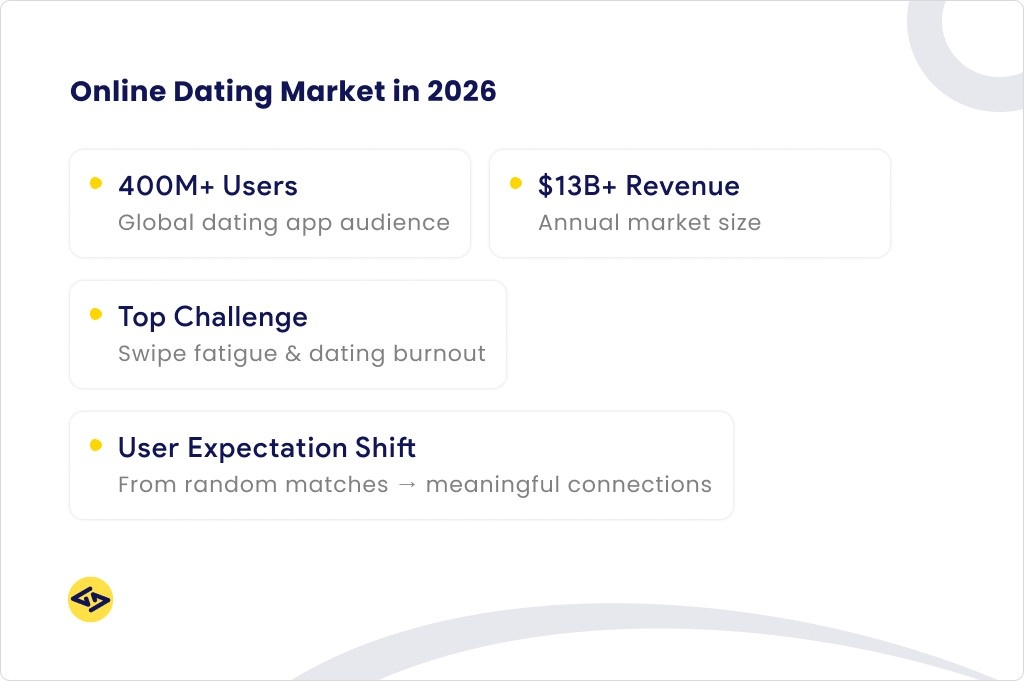
The online dating industry serves nearly 400 million users globally and generates over $13 billion in annual revenue worldwide — yet if you talk to the primary demographic (18-to-34-year-olds), you will hear a common complaint: dating app burnout. Users are exhausted by endless swiping, superficial matches, and ghosting.
To solve this, the next generation of matchmaking is leaning heavily on machine learning. Instead of just showing users random profiles based on location, an AI dating app learns from user behavior to curate highly compatible matches and facilitate actual conversations.
Creating an AI-powered dating app is no longer just a futuristic concept; it is the new baseline for success in the dating app market. To understand just how competitive the landscape has become, explore the top 10 dating apps to see what users already expect.
In this comprehensive guide, we will break down current market trends, what users actually want, the must-have features, development costs, and a step-by-step roadmap to launch.
Current Trends Shaping the AI Dating App Landscape in 2026
If you want to stand out in a crowded market, a simple swipe mechanic will not cut it. Here are the trends redefining the AI dating app landscape:
The “AI Wingman”:
Users often struggle to start conversations. Modern apps act as digital concierges, analyzing both profiles to suggest highly personalized icebreakers rather than generic “Hey” messages.
Anti-Ghosting Algorithms:
AI is now being used to analyze chat response times and patterns. If a conversation stalls, the AI gently prompts users to reply or suggests a real-world date idea, boosting engagement metrics.
Hyper-Niche Matching:
Instead of competing with Tinder’s massive user base, new apps are using AI to match users based on highly specific niches — such as shared astrology, strict dietary lifestyles, or specific introverted personality types.
What Do Users Actually Want?
If you look at raw user feedback — such as recent Reddit AMAs from AI dating app founders — a clear pattern emerges regarding what men and women actually want from AI in dating.
The Male Experience:
Men often face low match rates and struggle to initiate conversations that stand out. For them, AI is highly valued as a profile optimizer (rewriting a basic bio into something engaging) and a conversation starter that helps cure “blank page syndrome.”
The Female Experience:
Women often face an overwhelming number of inbound messages, many of which can be low-effort or inappropriate. For them, AI is best used as a sophisticated filter — detecting toxicity, prioritizing high-intent matches, and ensuring strict safety protocols. They do not want an AI bot talking to them on a man’s behalf; they want AI to curate the best real humans.
Must-Have Features for an AI Dating App
If you are entering the market, here are the core AI and technical features you must implement to compete. For a deeper look at the design decisions behind these features, see our guide on how to design a dating app like Tinder.
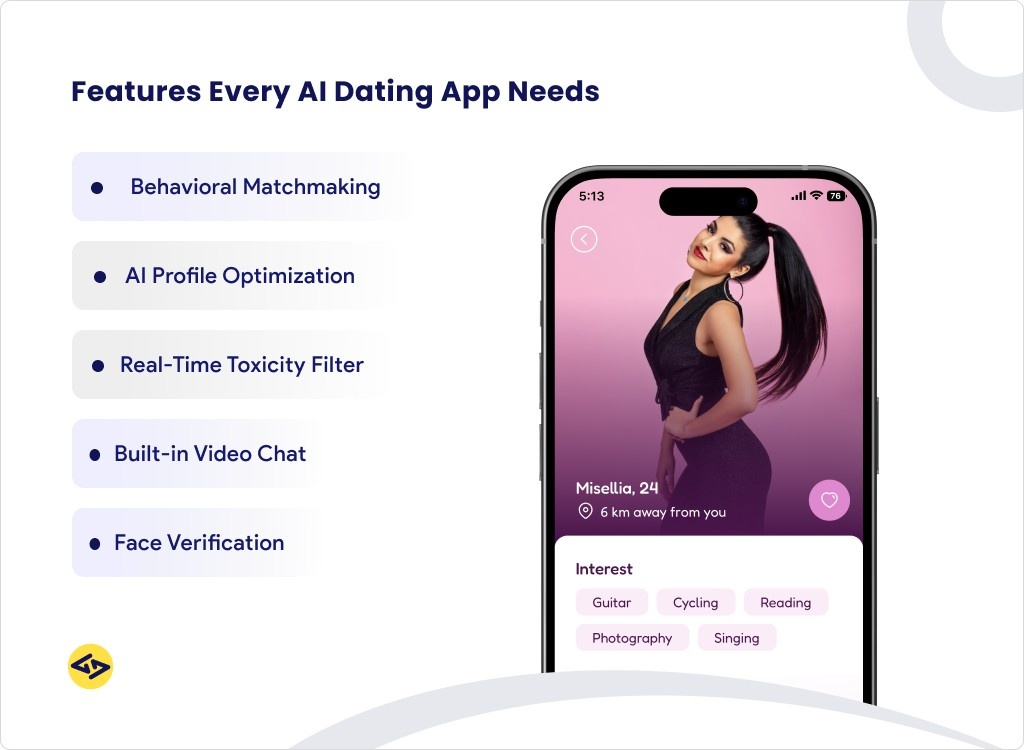
Behavioral Matchmaking:
Moving beyond basic location and age filters, your AI should learn from how long a user lingers on a profile, their messaging habits, and successful past matches to predict genuine compatibility. This requires robust machine learning development from the ground up.
AI Profile Optimization:
Integrate LLM (Large Language Model) tools that help users select their best photos and automatically generate engaging, natural-sounding bios based on a few keywords.
Real-Time Toxicity Filters:
Use NLP (Natural Language Processing) to automatically detect and block abusive messages, unsolicited inappropriate images, and hate speech before they are delivered to a user’s inbox.
Built-in Video Chat:
Gen Z prefers to vet matches via video before meeting in person. Creating an AI-powered dating app with a video chat function built in is a major 2026 trend. By keeping video natively in the app, AI can monitor the visual stream in real time for inappropriate behavior and immediately end the call, ensuring user safety.
Facial Verification:
Use AI selfie-video scans to match a user’s live face to their profile photos, drastically reducing fake accounts and catfishing.
How Top Players Are Actually Using AI
To succeed, you need to understand how the major players are deploying these features in the real world:
Tinder: Tinder launched “Chemistry” (2024), an AI-curated matching system based on Q&A and camera-roll scans. They also lead in safety with on-device AI prompts like “Are You Sure?” — warning users before sending potentially toxic text.
Bumble: Bumble offers AI Profile Guidance to help users put their best foot forward. They are also testing “Dates,” an AI chat assistant designed to understand a user’s core values before matching.
Hinge: Focused on meaningful connections, Hinge uses AI-backed “Convo Starters.” Crucially, their AI is designed for inspiration, not to copy-paste messages, ensuring users remain authentic.
For a full breakdown of what makes each of these platforms tick, read our analysis of the top dating apps in the USA.
The Essential Tech Stack for AI Dating Apps
Building a modern dating platform requires a multi-tier architecture capable of handling real-time data, video, and complex machine learning algorithms.
Mobile Frontend: iOS is usually the priority for the US and European markets due to higher in-app purchase rates. Developers typically use Swift with Apple’s CoreML to run machine learning smoothly on Apple devices — you can hire dedicated Swift developers to handle this layer. Kotlin covers Android app development.
Backend Architecture: Node.js or Go for scalable server operations, paired with Python for running ML models via FastAPI. Our Python developers specialise in building exactly this kind of AI-driven backend infrastructure.
Databases: PostgreSQL (user data), Redis (caching), Elasticsearch (filtering), and Kafka (swipe events).
AI APIs: OpenAI GPT (chat assistants) and AWS Rekognition (facial verification).
How Much Does It Cost to Build an AI-Powered Dating App?
The cost varies widely based on features. An MVP typically ranges from $60,000 to $110,000, while a fully advanced AI dating app can exceed $600,000. For a more detailed breakdown, see our dedicated guide on dating app development cost.
Here is a breakdown of average industry costs:
| Development Component | MVP (Basic AI) | Mid-Level (Video + AI Prompts) | Advanced (Full AI + Chatbots) |
| UI/UX Design | $5K – $10K | $10K – $20K | $20K – $40K |
| iOS & Android Frontend | $20K – $40K | $40K – $80K | $80K – $160K |
| Backend Development | $15K – $30K | $30K – $50K | $60K – $100K |
| AI / ML Development | $10K – $15K | $30K – $50K | $70K – $120K |
| Total Estimated Cost | $60K – $110K | $130K – $260K | $270K – $600K+ |
Note: Building a proprietary ML data pipeline requires ongoing server and API usage costs, typically adding $10K–$50K annually.
For a more granular comparison against established platforms, our guide on the cost to build an app like Tinder breaks down costs feature by feature.
How to Monetize and Grow Your Dating App?
How do you turn a matchmaking algorithm into a profitable business? Most apps operate on a freemium model. For a real-world example of how these strategies are implemented in a live product, see how we built the dating app Blaxity for a client from concept to launch.
Premium Subscriptions: Free users get basic matching, while paid tiers unlock unlimited likes, advanced filters, and visibility boosts.
Microtransactions: Users can purchase one-off perks to “Super Like” a profile or boost their visibility for 30 minutes.
Pay-per-Match: A rising trend where users are only charged a fee upon successfully scheduling a real-life date.
Premium AI Tools: Charging a premium for AI profile optimization or personalized dating coaching.
Growth Tip: Do not try to compete with Tinder globally on day one. Launch with a specific niche (e.g., faith-based, LGBTQ+, or voice-focused) or target a specific geographic city to build a loyal early community. See how successful apps have carved their niches by reviewing how to build a dating mobile app like Tinder.
Why You Need a Specialized Development Partner
Because integrating advanced AI, real-time WebRTC video, and complex matching algorithms is incredibly difficult, most founders do not build this in-house. Opting to hire dedicated developers or partnering with a specialized dating app development company ensures your app has a scalable architecture, adheres strictly to data privacy laws (like GDPR and CCPA), and offers a bug-free UI/UX from day one.
The 12-Month Launch Roadmap
Here is a realistic timeline to bring your product to market from today:
Months 1–3 (Research & Design): Project kickoff, UI/UX prototyping, and defining the behavioral matching algorithm.
Months 4–6 (MVP Development): Build core user profiles, swiping, and text chat. Execute a soft beta launch. As a reference point, an MVP-scoped dating app can realistically go to beta in 4–5 months with a focused feature set.
Months 7–9 (Mid-Tier Features): Integrate WebRTC video chat, introduce AI prompts for bios, and implement profile scoring.
Months 10–12 (Advanced AI & Full Launch): Roll out Face Verification and LLM chat assistants. Finalize monetization (freemium subscriptions and in-app purchases) and scale user acquisition.
Ready to Build the Future of Matchmaking?
The real challenge in dating apps is not the code — it is enabling authentic connection. By combining a niche focus with transparent, safety-driven AI, you can capture an audience eager for something better.
Frequently Asked Questions
Can I create a dating app with AI?
Yes. Modern APIs like OpenAI, AWS machine learning, and Google Cloud AI make it highly accessible to integrate advanced features like behavioral matchmaking, facial recognition, and personalized conversation starters. If you need specialized talent for this, read our guide on how to hire AI developers to find the right fit for your team.
How much does it cost to build an AI-powered dating app?
Building a basic MVP costs between $60,000 and $110,000. For a fully featured platform with built-in video chat, AI wingman features, and advanced toxicity filters, costs typically range from $270,000 to over $600,000.
Is it legal to use AI to build an app?
Yes, provided you comply with data privacy laws like GDPR and CCPA. Transparency is critical. App stores strictly prohibit using AI to create fraudulent bot profiles to trick users. AI should be used to verify real users and enhance connections, not fake them.