Alright, if you’re a fitness app entrepreneur or an investor scouting for serious potential, let’s talk about the digital health and fitness market. It’s not just growing; it’s absolutely exploding! Our phones are now personal trainers and health coaches, driving a global shift in how we approach well-being. Fitness app profitable opportunities are skyrocketing as users increasingly invest in digital solutions for their health goals.
This is not a slowdown trend. Factually, the fitness app market analysis reveals that the global health and fitness app market is anticipated to reach an incredible $240 billion by 2030 (Grand View Research). The rise in smartphone and wearable device usage, the current boom in preventive health, and the demand for personalized digital wellness have driven the market.
However, the challenge is that the market is already crowded with millions of apps competing for users’ attention. Thus, it is important to stand out. Only applications that offer a real innovation through their product, supported by clever thinking and targeted at a particular set of users, will generate users and retain them to a point at which they create tangible profitability. So, how do top apps stand out and turn daily user engagement into steady revenue?
Time to dig up the key revenue models and strategic plays now.
Quick Answer: Are Fitness Apps Profitable?
Yes, fitness apps can be profitable, but profit is concentrated in a small share of apps. Health and fitness is one of the best-monetizing app categories (the median app converts about 2.7% of downloads to paying subscribers within 35 days, per RevenueCat), yet only around 5% of health and fitness apps reach $10,000 in total revenue within two years. Profitability depends on three things: retention, acquisition cost, and subscription pricing.
Key Takeaways
- The global fitness app market was about $12.1 billion in 2025 and is projected to reach $33.6 billion by 2033 (13.4% CAGR), per Grand View Research.
- Roughly three quarters of health and fitness app revenue comes from subscriptions; the rest is mostly advertising (Business of Apps).
- Day-30 retention for health and fitness apps is only about 3% to 4%, so retention, not downloads, decides profit.
- On an illustrative 100,000-install launch, a median app loses money if every install is paid for, while a top-decile app earns a healthy margin (math below).
- The winners are niche, retention-first products with annual plans, wearable integration, and low acquisition costs.
How Big Is the Fitness App Market in 2026?
The fitness app market is large and growing, but the number you see depends on who is measuring and what they count.
| Metric | Figure | Source |
|---|---|---|
| Global fitness apps market size, 2025 | $12.12 billion | Grand View Research |
| Estimated market size, 2026 | $13.9 billion | Grand View Research |
| Projected market size, 2033 | $33.58 billion (13.4% CAGR, 2026 to 2033) | Grand View Research |
| Largest region | North America, 39.8% revenue share (2025) | Grand View Research |
| Largest segment | Exercise and weight loss, 53.7% share (2025) | Grand View Research |
| Leading platform | iOS, about 52% share (2025) | Grand View Research |
| Health and fitness app revenue, 2024 | Over $5 billion, up 14% | Business of Apps |
| Fitness app store revenue, 2025 | About $3.4 billion, up 24.5% (store billing only) | Business of Apps, via secondary reports |
Why the numbers differ: market-research firms such as Grand View Research model total market value, while Business of Apps and Sensor Tower measure what users actually spend through the App Store and Google Play. Treat the figures as complementary, not contradictory.
What is driving growth: smartphone and wearable adoption, demand for personalized digital coaching, and AI-powered training plans (Grand View Research cites apps such as Runna as examples).
Are Fitness Apps Really Profitable? The Honest Picture
Fitness apps are profitable on average per user, but unprofitable for most individual apps. Both statements are true at once.
The good news
- Health and fitness apps earn a median of about $0.63 revenue per install after 60 days, the highest of any category in RevenueCat’s 2025 report; the next closest (business apps) earned $0.29.
- The median health and fitness app converts about 2.7% of downloads to paying customers within 35 days; top-10% apps reach about 12.1% (RevenueCat).
- Health and fitness trial-to-paid conversion benchmarks are strong: about 62% on average in Adapty’s 2026 data, and 68.3% for the top 10% in RevenueCat’s data.
The bad news
- Only about 5% of health and fitness apps reach $10,000 in revenue in their first two years (RevenueCat, 2025).
- The market is winner-take-most: a few giants (MyFitnessPal, Strava, Peloton, Calm, Headspace) capture a large share of revenue.
- New subscription app launches have surged to roughly 14,700 per month (RevenueCat, 2026), so attention is expensive.
What this means: a fitness app is a good business only if you can acquire users cheaply, keep them past day 30, and convert them to annual plans. If you cannot, it is an expensive hobby.
How Do Fitness Apps Make Money? 7 Proven Revenue Models
| Revenue model | How it works | Best for | Watch out for |
|---|---|---|---|
| Subscriptions (freemium or paid trial) | Free core features; recurring fee unlocks premium | Most apps; the dominant model | Churn after the trial; pricing too high or too low |
| In-app purchases | One-off workout programs, meal plans, coaching add-ons | Content-heavy and creator-led apps | Lower repeat revenue |
| Advertising | Display or rewarded ads in the free tier | Very large free user bases | Hurts experience and retention |
| Affiliate and partnerships | Commissions on gear, supplements, gym memberships | Niche communities with trust | Needs high intent and honest recommendations |
| Corporate wellness (B2B) | Sell licenses to employers, insurers, or gyms | Apps with strong engagement data | Long sales cycles; compliance requirements |
| Coaching marketplace | Take a cut of trainer or nutritionist sessions | Apps with a strong community | Quality control; trainer supply |
| Hardware or bundle revenue | App drives sales of devices or accessories | Wearable-linked brands | Capital intensive |
1. Subscriptions (Freemium to Premium)
Subscriptions are the backbone of fitness app revenue. Business of Apps reports that about three quarters of health and fitness app revenue comes from subscriptions. Adapty’s 2026 benchmarks put the median health and fitness price at $9.99 per month or $59.99 per year, and 54% of subscribers choose the annual plan. Showing the annual price as a monthly equivalent increases conversion in Adapty’s data.
2. In-App Purchases (IAP)
IAPs sell individual items such as workout plans, advanced analytics, or meal plans. They work well as an add-on to subscriptions, especially for creator-led apps, but rarely carry an app alone because health and fitness apps use consumable purchases less than categories like gaming.
3. Advertising
Ads can monetize a large free audience, but they compete with your retention goals. Use them sparingly, or reserve ad-free as a reason to upgrade. About a quarter of health and fitness app revenue still comes from advertising (Business of Apps).
4. Affiliate Marketing and Partnerships
Partnering with equipment brands, supplement companies, or gyms can add revenue without changing the product. It works best when recommendations are genuinely useful to your niche and disclosed clearly.
5. Corporate Wellness and B2B Licensing
Selling to employers, insurers, and gym chains creates recurring, higher-value contracts. It requires reporting dashboards, privacy compliance, and a sales process, but it diversifies you away from consumer churn.
6. Coaching and Marketplace Fees
Apps that connect users to trainers, dietitians, or physiotherapists can take a platform fee per session. This model suits community-led apps with credible practitioners.
7. Data Licensing (Handle With Care)
Some apps license anonymized, aggregated data to researchers. This carries real regulatory and reputational risk. Health data is sensitive, and regulators such as the FTC have acted against health apps over data sharing. Treat it as optional, consent-led, and legal-reviewed, never as a core plan.
For a deeper dive on each model, see our guide to how to monetize fitness apps.
Fitness App Profitability Benchmarks (2026)
Use these numbers to sanity-check your own plan.
| Metric | Benchmark | Source |
|---|---|---|
| Download-to-paid conversion (35 days), median | 2.7% | RevenueCat |
| Download-to-paid conversion (35 days), top 10% | 12.1% | RevenueCat |
| Trial-to-paid conversion | About 62% average; 68.3% top 10% | Adapty 2026; RevenueCat |
| Median monthly price | $9.99 | Adapty 2026 |
| Median annual price | $59.99 | Adapty 2026 |
| Subscribers choosing annual plans | 54% | Adapty 2026 |
| Refund rate | 3.4% average (under 2% is good) | Adapty 2026 |
| Cost per install, subscription apps | $1.50 to $4.50 | Adapty 2026 |
| Day-1 retention | About 20% | Phiture compilation of Adjust, AppsFlyer data |
| Day-7 retention | About 8% | Same |
| Day-30 retention | About 3% to 4% (iOS about 3.7%, Android about 2.1%) | Business of Apps; Phiture |
Benchmarks vary by study, platform, and region. Conversion is roughly twice as high on iOS as on Android in RevenueCat’s data, so your platform mix matters.
Factors That Influence Profitability in the Fitness App Industry
Having a good idea is not enough to make it in the fitness app industry. Here are the key drivers of return on investment in fitness apps:
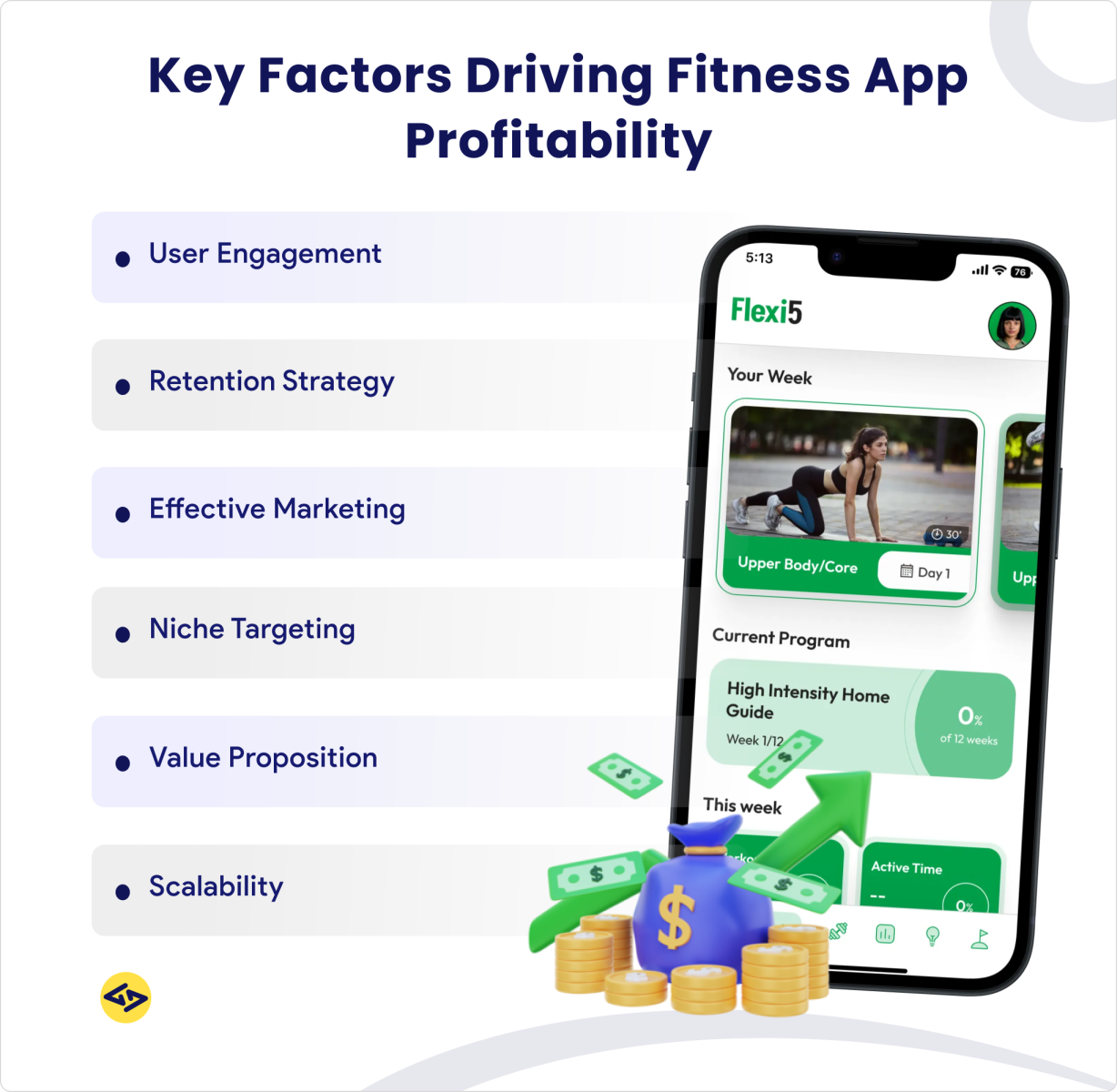
1. User Engagement
- Retention is the ultimate driver of long-term success. Having many downloads does not translate to profitability unless the users remain and engage on a regular basis. High engagement is ensured by using apps incorporating personalized information, daily streaks, and notifications.
- Consider the “stickiness” factor – in what ways does your app maintain its users continuously? This is a better indicator of profitability than first installations.
2. Retention Strategy
- The use of push notifications, gamification, and progress tracking increases retention. It would be extremely beneficial to integrate behavioral psychology, including reward mechanisms and habit loops, to increase user engagement.
- Gamification and behavioral science can be very effective when it comes to retention and monetization. A well-designed app that employs smooth challenges and rewards will retain clients longer into its lifetime, boosting revenue per app.
3. Effective Marketing
By investing in influencing marketing, social proof, app store optimization (ASO), and targeted advertising, it is possible to gain visibility and downloads by a factor of five. Marketing: A strategic difference between a hidden gem and a chart-topper. This has a direct effect on fitness app revenue.
4. Niche Targeting
Rather than serving a broad audience, some successful fitness apps focus on micro-niches such as prenatal yoga, fitness for seniors, or home-based HIIT for busy professionals.
There is better conversion and retention due to micro-niche targeting. Niche solutions tend to address user requirements better than general sites. As an example, a postnatal recovery or a geriatric focused strength training app builds trust and offers better user lifetime value.
5. Value Proposition
What makes your app better or different? Whether it’s world-class trainers, AI personalization, or community features, your value proposition must be clear and compelling. Entrepreneurs need to focus on solving real problems through seamless UX and targeted solutions.
6. Scalability
Apps built on scalable technology and monetization models can grow rapidly with minimal marginal costs. Cloud services, automation, and modular design are critical to this scalability.
How Much Can a Fitness App Make? A Worked Break-Even Example
This illustrative model shows why acquisition cost decides profitability. It is a simplified scenario, not a forecast.
Assumptions: 100,000 installs in year one; annual plan at $59.99 (Adapty median); 15% store commission (a reduced-rate scenario; at 30% results are lower); paid install cost of $3.00 (midpoint of the $1.50 to $4.50 range). Development, server, and team costs are excluded, and year-two renewals are ignored.
| Scenario | Paying users | Net revenue after store fee | Acquisition cost | Result (before dev and team costs) |
|---|---|---|---|---|
| Median app (2.7% conversion), all installs paid | 2,700 | About $138,000 | $300,000 | About -$162,000 |
| Median app, 50% organic installs | 2,700 | About $138,000 | $150,000 | About -$12,000 |
| Top-10% app (12.1% conversion), all installs paid | 12,100 | About $617,000 | $300,000 | About +$317,000 |
| Top-10% app, 50% organic installs | 12,100 | About $617,000 | $150,000 | About +$467,000 |
Takeaway: with all-paid acquisition at these prices, you need roughly 5.9% download-to-paid conversion just to cover ad spend (excluding development costs). The levers that move you from red to black are better onboarding and paywall design, a strong annual plan, organic channels (ASO, content, referrals, community), and retention.
Case Studies: Learning from Fitness App Success Stories
Let’s look at some fitness app success stories to understand what works.
1) MyFitnessPal: The Diet Tracker
- 2023 Revenue: Over $310 million
- 2024 Revenue (Est.): ~$390 million
- Business Model: Freemium. Core: food/calorie tracking. Revenue from “Premium” subscription (advanced features, ad-free).
- App Downloads: 100M+ (Android), high in iOS Health & Fitness.
- Reviews: 4.4 stars (Google Play, ~2.8M reviews), 4.7 stars (App Store, ~2.1M ratings).
- Source: Google Play Store, ElectroIQ, Business of Apps
2) Strava: The Athlete’s Network
- 2023 Revenue: Over $275 million
- Business Model: Primarily premium subscriptions (advanced analytics, training features, exclusive content), strong community, social features, and gamification.
- App Downloads: 50M+ (Android), high iOS Health & Fitness ranking.
- Reviews:
- Google Play: 4.3 stars (~950K reviews) (Download on Google Play)
- App Store: 4.8 stars (~1.7M ratings total) (Download on the App Store)
- Source: Strava Statistics By Revenue, Users and Region – ElectroIQ
3) Fitbit: Health & Fitness
- 2023 Revenue: Estimated $1.04 billion (part of Google, not fully disclosed as a standalone app).
- Business Model: Freemium, integrates with Fitbit devices. Revenue from device sales and premium subscriptions (advanced insights, guided programs).
- App Downloads: 100M+ (Android), high iOS Health & Fitness ranking.
- Reviews:
- Source: Fitbit Revenue and Usage Statistics (2025) – Business of Apps, Fitbit on Google Play Store, Fitbit on Apple App Store
For insights into developing your successful application, explore our services for fitness app development.
What Makes a Fitness App Profitable? 7 Factors
- Retention first. With Day-30 retention around 3% to 4%, small gains compound. Build habit loops: streaks, reminders, progress dashboards, and milestone rewards.
- Fast time-to-value. Adapty data shows renewal rates reach 88% to 90% when users get early wins in their first 30 days. Design onboarding to deliver a first workout or insight in minutes.
- Smart paywall and pricing. Test trial length, annual-first pricing, and monthly-equivalent price display. Roughly half of trial conversions in RevenueCat’s data happen on Day 0, so your first session matters.
- Niche targeting. Prenatal yoga, seniors’ strength training, runners, or busy professionals’ HIIT convert better than generic apps because the value proposition is specific.
- Personalization and AI. Adaptive plans, recovery recommendations, and churn prediction increase engagement. Note that RevenueCat found AI apps can churn faster, so personalization must deliver real value, not novelty.
- Wearable and health-platform integration. Syncing with Apple Watch, Fitbit, Garmin, Apple Health, and Google Health Connect improves data quality and switching costs.
- Community and social proof. Challenges, clubs, and leaderboards drive organic installs and referrals, which lowers cost per install.
Challenges: Why Fitness Apps Fail?
Even with all the success stories, many fitness apps just don’t make it. Knowing why they fail is super important if you’re thinking about creating one or considering a fitness app investment. Here are the main reasons:
Lack of Differentiation:
There are tons of apps out there doing the same thing. If your app isn’t truly special or innovative, users won’t pick it. They simply won’t stick around. You need to stand out from the crowd.
Poor Retention Strategies:
It’s great to get people to download your app, but keeping them is the real challenge. Many apps lose users fast because they don’t offer new or personalized content. They may also fail to keep users motivated as they progress.
Neglecting Marketing:
Even the best app can fail if no one knows about it. If you don’t keep marketing your app smartly, through things like app store ads or social media, it’ll just get lost in the shuffle. Your app truly needs to be seen.
Monetization Missteps:
Figuring out how to charge users is tricky. If you charge too much too soon, people might not try your app. But if you give away too much for free, your fitness app revenue will suffer. You need to find the right balance for your app to make money.
Low Stickiness:
The best apps become part of people’s daily lives. If your app doesn’t have features that make users want to come back every day – like fun challenges or personalized nudges – they’ll stop using it quickly. Your app absolutely needs to be a daily habit.
Learning about these problems isn’t just about avoiding mistakes; it’s about building a smarter plan for success. Apps that succeed in offering great value also have a clear and fair fitness app business model that enables them to generate revenue.
Expansion: Scaling and Innovation for Long-Term Growth
Beyond launching and initial success, scaling a fitness app requires a forward-thinking approach:
Cross-Platform Integration
Integrating with wearables like Apple Watch, Fitbit, and smart scales increases data accuracy and personalization. It also enhances user experience and loyalty. See our blog on fitness app development with wearables.
AI-Driven Personalization
Machine learning can tailor workout recommendations, adjust plans dynamically, and predict when users are likely to drop off. This boosts engagement and long-term profitability.
Community Building
Fostering a supportive community can create organic growth. In-app forums, live classes, leaderboards, and challenges encourage users to return and invite friends.
International Expansion
Targeting emerging markets can be a major growth lever. Apps that localize language, pricing, and workouts for regional audiences unlock new user bases and increase market penetration.
Corporate Wellness Partnerships
Fitness apps can expand their revenue base by partnering with corporations to provide wellness solutions to employees. These B2B contracts can be recurring and high value.
How Much Does It Cost to Build a Fitness App?
Cost depends on scope, platforms, and integrations. The main cost drivers are:
| Cost driver | Why it matters |
|---|---|
| Platforms (iOS, Android, or cross-platform) | Cross-platform frameworks such as Flutter or React Native can reduce build cost |
| Feature depth | Workout libraries, video streaming, and live classes add cost |
| AI and personalization | Recommendation engines and model hosting add build and run costs |
| Wearable and health-data integrations | Each integration needs development and testing |
| Backend, security, and compliance | Cloud infrastructure, authentication, and privacy controls |
| Ongoing costs | App store fees, hosting, content, marketing, and support |
Editor note (iCoderz to complete): Insert your own MVP, mid-complexity, and advanced cost ranges and timelines from real projects. First-party pricing data is a strong E-E-A-T and conversion signal that competitors cannot copy. Do not publish figures you cannot support.
Start lean: an MVP that proves retention and willingness to pay costs far less than a full-featured launch. See our fitness app development services and MVP development.
Is Your Fitness App Idea Likely to Be Profitable? A 10-Point Checklist
- Do you have a specific niche and a one-sentence value proposition?
- Can you name three organic acquisition channels you control?
- Will users get value within their first session?
- Do you have an annual plan and a tested paywall?
- Is your projected download-to-paid conversion above 3%?
- Is your blended cost per install below your first-year net revenue per install?
- Do you have a retention plan beyond push notifications?
- Have you planned wearable and health-platform integrations?
- Is your privacy and consent flow compliant?
- Do you have a second revenue stream (B2B, coaching, or partnerships)?
If you answered “no” to four or more, refine the concept before building.
Conclusion: Making a Fitness App Profitable
So, are workout apps profitable? Yes, they absolutely can be. But only when they’re built and scaled with a clear strategy. This strategy must prioritize user engagement, differentiation, and an excellent user experience. The most profitable fitness apps always balance innovation with simplicity, combining smart monetization with real value.
For entrepreneurs and investors, focusing on long-term retention is key. So are micro-niche targeting and behavior-driven design. If you want to maximize your return on investment fitness app, remember the winning formula. It includes a truly unique concept, a seamless user experience, and a scalable business model.
It transforms a fleeting trend into a lasting digital business. From identifying the right revenue streams to implementing smart retention strategies and gamification, the path to profitability is challenging. Yet, with the right approach, it’s definitely achievable. iCoderz can help you build this winning formula.
Ready to discuss your fitness app vision or investment? Contact us today!
Ready to make your fitness app profitable?
Explore strategies that turn downloads into dollars.