Why Your Meat Delivery App Tech Stack Matters
A meat delivery app tech stack is the mix of frontend frameworks, backend languages, databases, cloud services, APIs, and third-party integrations that runs an online meat ordering platform. It handles weight-based pricing, stock control, payments, and live delivery tracking. The right stack keeps the app fast, secure, and easy to scale as orders grow.
Online meat ordering keeps growing because customers want fresh cuts, clear pricing, and doorstep convenience. But meat is not ordinary grocery. It is perishable, sold by weight, often cut to order, and needs cold storage. A generic e-commerce stack struggles with these rules.
Why does the technology stack matter? Because it decides how well your app handles four daily jobs:
- Inventory: tracking stock by weight, batch, and expiry date
- Payments: charging the right amount even when the final weight changes
- Delivery tracking: showing customers where their order is, in real time
- Order management: moving each order from the customer to the butcher to the rider without manual calls
This guide walks through how meat delivery app development works, the features you need, the best frontend and backend technologies, the essential APIs, and the integrations that improve operations. If you are still shaping the business side, start with our guide to starting an online meat delivery business.
At iCoderz Solutions, our team has built mobile apps and platforms for 15+ years across 650+ projects. The advice below reflects the technical trade-offs we see when food and grocery businesses go digital.
How Does a Meat Delivery App Work?
A meat delivery app connects customers, meat vendors, and delivery partners on one platform. The customer orders by weight and cut, the vendor prepares it, a rider delivers it, and the customer tracks the order live. Each step depends on a specific piece of technology working in the background.
- Customer browses products. The app loads a live catalog from the database, showing only items that are in stock.
- Selects cuts, quantity, and packaging. The customer picks a weight (for example 500 g or 1 kg), a cut style, and packaging preferences.
- Places the order and pays. The payment gateway authorizes the amount. For weight-based items, the final charge may adjust after weighing.
- Vendor receives and processes the order. The vendor or admin panel gets an instant alert, accepts the order, and prepares it.
- Delivery partner picks up and delivers. The system assigns the nearest available rider and gives them route guidance.
- Customer tracks in real time. GPS data and WebSocket updates show the rider’s live location and ETA.
Every step creates data: stock levels, payment status, rider location, and delivery time. A well-designed meat delivery app architecture keeps all of that in sync so customers never order something that is out of stock.
What Are the Core Features of a Meat Delivery App?
A complete meat delivery platform needs three connected apps: a customer app, a vendor or admin panel, and a delivery partner app. Together they cover browsing, ordering, stock control, dispatch, and payouts. Strong meat delivery app features also reduce manual work for your team and cut order errors.
Customer App Features
These customer app features for meat delivery shape the buying experience:
- User registration and login (email, phone, or social)
- Meat product catalog with clear categories (chicken, mutton, fish, seafood, marinated)
- Weight-based product selection
- Custom cuts and packaging preferences
- Shopping cart and fast checkout
- Multiple payment options (cards, UPI, wallets, cash on delivery)
- Real-time order tracking
- Delivery scheduling for slots such as same-day or next-morning
- Ratings and reviews
- Order history and one-tap reorder
Vendor and Admin Panel Features
The meat delivery app admin panel features give your team control. A good meat vendor management dashboard should include:
- Product and category management
- Inventory and stock management, including a meat inventory management system with expiry alerts
- Order management with accept, reject, and status updates
- Dynamic pricing and discounts
- Vendor management (onboarding, commissions, payouts)
- Sales and revenue analytics
- Customer management
- Reports and notifications
Delivery Partner App Features
The meat delivery partner app features keep deliveries fast and traceable:
- Delivery assignment and accept or decline
- GPS navigation with route guidance
- Pickup and delivery status updates
- Real-time location sharing
- Delivery history
- Earnings and payout tracking
Many of these features are shared with other perishable-goods platforms. For a deeper look at how a market leader approaches them, read our breakdown of how to build a meat delivery app like Licious.
Meat Delivery App Technology Stack: What to Use and Why
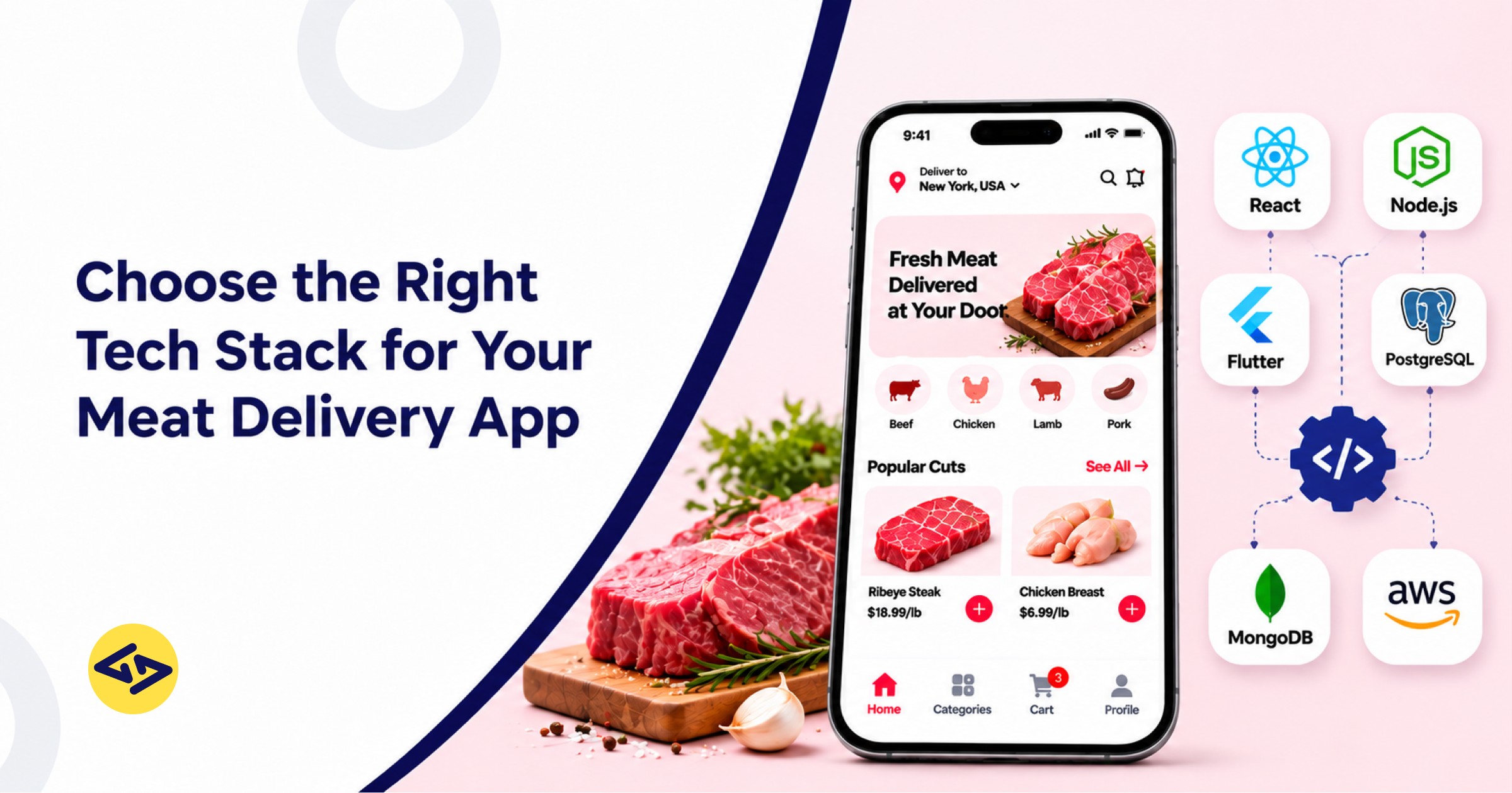
The best technology stack for meat delivery app development is usually Flutter or React Native for the mobile apps, Node.js or Laravel for the backend, MySQL or PostgreSQL for the database, and AWS for cloud hosting. This combination is proven, widely supported, and scales well. The right pick still depends on your budget, team, and order volume.
Below is what each layer does and when to choose it. These are the technologies used to build a meat delivery app at most stages of growth.
Frontend Technologies
The frontend is what customers, vendors, and riders see and tap. For frontend and backend technologies for meat delivery apps, start here.
| Technology | What it does | Choose it when |
|---|---|---|
| Flutter | Builds iOS and Android apps from one codebase | You want fast launch, one team, and a consistent look |
| React Native | Cross-platform apps using JavaScript | Your team already knows JavaScript or React |
| Swift (iOS) | Native iPhone and iPad apps | You need top iOS performance or deep device features |
| Kotlin (Android) | Native Android apps | You need top Android performance or deep device features |
| React.js | Web apps and admin dashboards | You need a browser-based admin panel or customer website |
For most startups, Flutter for meat delivery app development or React Native for a meat delivery app gives the best balance of cost and speed. Go native only when you need advanced features that cross-platform tools handle poorly.
Backend Technologies
The backend is the engine. It runs business logic, pricing rules, order flow, and API connections. Your meat delivery app backend technology choice affects speed, security, and long-term maintenance.
- Node.js: Handles many simultaneous requests and real-time features like live tracking. A strong default for a Node.js backend for delivery apps.
- Laravel (PHP): Fast to build, with built-in security, queues, and admin tooling. Good for Laravel backend development when you want a quick, structured launch and a large talent pool.
- Python: Useful when you plan data science features such as demand forecasting or recommendations.
- Java: Suited to large enterprise systems with strict reliability and compliance needs.
Database Technologies
Meat businesses track stock by weight, batch, and expiry date. That makes the database requirements for meat delivery applications more demanding than many assume.
- MySQL: Reliable and familiar. A solid MySQL database for delivery apps that need structured orders, prices, and inventory.
- PostgreSQL: Stronger for complex queries, reporting, and location data.
- MongoDB: Flexible for catalogs with varied attributes. Many teams use MongoDB for delivery applications alongside a relational database.
- Firebase: Handy for real-time data sync and quick prototypes.
A common pattern is a relational database for orders and payments, plus a real-time layer for rider locations.
Cloud Hosting and Infrastructure
Cloud hosting keeps your app online during peak hours, such as weekends and festival days.
- AWS: The widest service range and a common choice for AWS cloud hosting for delivery apps. Good for auto-scaling and managed databases.
- Google Cloud Platform: Strong in maps, analytics, and AI tools.
- Microsoft Azure: A fit if your business already uses Microsoft tools or has enterprise compliance needs.
A sound cloud infrastructure for meat delivery platforms uses auto-scaling, load balancing, regular backups, and separate staging and production environments.
Security Technologies
Your app stores customer addresses, phone numbers, and payment activity. Security cannot be an afterthought.
- SSL/TLS encryption for all data in transit
- Secure authentication such as OTP login and token-based sessions
- Role-based access control so staff only see what they need
- Data encryption for stored sensitive information
- Secure payment processing through PCI-compliant gateways, so card data never touches your servers
For a detailed overview of the build process, see our guide to meat delivery app development.
Essential APIs for a Meat Delivery App
The essential APIs for meat delivery applications are payment gateways, maps and location services, SMS and OTP verification, push notifications, and delivery or logistics tools. Using proven APIs saves months of development and gives users features they already trust. Most are connected through REST API integration, with WebSockets added for live updates.
Payment Gateway APIs
Payment gateway integration for meat delivery apps should support the methods your customers use most.
- Stripe: Strong developer tools and global card support
- PayPal: Familiar to international customers
- Razorpay: A popular choice in India, with UPI, wallets, and net banking
For weight-based orders, pick a gateway that supports pre-authorization or partial capture, so you can charge the exact amount after weighing.
Google Maps and Location APIs
The Google Maps API for delivery apps powers address search, delivery zones, distance, and ETAs.
- Google Maps Platform: Maps, routes, and distance calculations
- Google Places API: Address autocomplete, which reduces wrong addresses
- Geolocation API: Detects the customer’s or rider’s current position
SMS and OTP Verification APIs
- Twilio: Reliable SMS delivery for OTPs, order updates, and delivery alerts. This is the usual SMS API integration for delivery apps.
- Firebase Authentication: Phone-number login with built-in OTP verification
Push Notification APIs
Push notification integration keeps customers informed from order confirmation to doorstep arrival.
- Firebase Cloud Messaging (FCM): Free, reliable notifications for Android and iOS. Firebase push notifications are the default for most teams.
- Apple Push Notification Service (APNs): Apple’s native service for iOS
Delivery and Logistics APIs
- Third-party delivery integrations: Connect to external fleets when your own riders are busy
- Route optimization APIs: Plan faster routes and batch nearby orders
- Shipment tracking APIs: Share status updates across partners
A GPS tracking API for delivery applications combined with WebSocket connections powers real-time order tracking for meat delivery apps. The rider’s phone sends location every few seconds, the server pushes it to the customer’s screen, and the map updates without a refresh. This is also the basis of any real-time delivery tracking API.
If your business may later add other categories, our on-demand app development approach shows how the same API layer can support several services.
Third-Party Integrations That Improve Meat Delivery Operations
The most useful third-party integrations for meat delivery apps connect your app to inventory, POS or ERP systems, CRM tools, accounting software, and cold chain sensors. They remove double entry, keep stock accurate, and protect product quality from storage to doorstep. APIs move data; integrations make your daily operations run on it.
Inventory Management Integration
Inventory is where meat businesses lose the most money, through spoilage and mismatches. Inventory management API integration gives you:
- Real-time stock updates after every order
- Product availability that hides sold-out items automatically
- Expiry date monitoring with alerts before products go bad
For a closer look at this topic, read our guide on meat delivery app freshness and inventory.
POS and ERP Integration
If you also sell in physical shops, ERP integration for meat delivery businesses keeps online and offline in sync.
- Centralized sales management
- Automated order synchronization
- Inventory synchronization across stores and warehouses
A robust order management API passes orders into these systems automatically, which supports automated order management at scale.
CRM Integration
CRM integration for delivery apps turns order data into customer relationships.
- Customer data management in one place
- Personalized promotions based on past orders
- Customer retention through reminders and loyalty offers
Accounting and Billing Integration
- Automated invoices for every order
- Tax calculations based on product and region
- Revenue tracking by product, store, or vendor
Cold Chain Monitoring Integration
Cold chain monitoring integration is what separates a meat delivery app from a generic grocery app. Temperature-sensitive products need proof of safe handling.
- Temperature monitoring in storage and in transit
- Storage condition tracking across cold rooms and vehicles
- Alerts when temperature moves outside the safe range
Practical example (illustrative scenario): Imagine a regional meat retailer that tracks stock in spreadsheets. Orders keep getting accepted for items that sold out an hour earlier. Connecting the app’s database to a live inventory system, with expiry alerts and a sold-out toggle, usually solves this class of problem. The fix is rarely a new feature. It is a better integration.
How to Choose the Right Technology Stack for Your Meat Delivery Business
Choose your stack by matching it to your business model, expected order volume, budget, and team skills, not by trend. A small local butcher and a multi-city marketplace need very different foundations. Check each factor below before you commit.
- Business model and operations: A single-store app, a multi-vendor marketplace, and a subscription service each need different order and payout logic.
- Expected order volume: Plan for peak days, not average days. Pick a stack and cloud setup that can scale without a rebuild.
- Scalability and future expansion: If you may add cities, categories, or franchise stores, choose modular architecture and a flexible database from day one.
- Development and maintenance costs: Cross-platform tools such as Flutter lower build cost. Also count monthly hosting, API fees, and support.
- Data security and compliance: Confirm payment security, data protection, and food-safety record needs for your region.
- Third-party integration needs: List every system you must connect (POS, ERP, accounting, cold chain) before choosing a backend.
- Your team’s expertise: A stack your developers know well will be built faster and maintained more safely.
Quick rule of thumb: For a new brand, start with Flutter or React Native, Node.js or Laravel, MySQL or PostgreSQL, and AWS. Add complexity only when real usage demands it.
A good development partner will challenge your assumptions here. See our list of meat delivery app development companies for what to compare when you shortlist vendors.
Challenges in Meat Delivery App Development and How Technology Solves Them
Meat delivery has problems that other apps do not: spoilage, weight-based pricing, and strict freshness expectations. Each one has a direct technology answer. Planning for them early is cheaper than fixing them after launch.
| Business challenge | Technology solution |
|---|---|
| Perishable inventory | Expiry and stock tracking |
| Weight-based pricing | Dynamic pricing engine |
| Delivery delays | GPS tracking and route optimization |
| Product quality concerns | Temperature monitoring |
| Inventory mismatches | Real-time database synchronization |
| Order management complexity | Automated order management |
Weight-based meat pricing deserves special care. A customer orders “1 kg of chicken”, but the cut weighs 1.04 kg. Your pricing engine must calculate the final price from actual weight, show it clearly, and capture the payment accordingly. Doing this well builds trust and reduces refund requests.
How Much Does It Cost to Develop a Meat Delivery App?
Meat delivery app development cost depends on features, platforms, integrations, and complexity, so no honest single number fits every project. The more apps, user roles, and integrations you include, the higher the investment. Request a scoped estimate based on your feature list rather than relying on generic figures.
Most projects fall into three tiers:
| Tier | What it usually includes |
|---|---|
| Basic meat ordering app | Customer app, simple catalog, checkout, one payment gateway, basic admin panel |
| Mid-level meat delivery platform | Customer, vendor, and rider apps; real-time tracking; scheduling; push notifications; analytics |
| Advanced multi-vendor solution | Multi-vendor marketplace, dynamic pricing, ERP and CRM integration, cold chain monitoring, AI features |
Factors That Affect Development Cost
- Number of platforms (iOS, Android, web)
- Number of user roles and panels
- Feature depth, such as custom cuts and weight-based pricing
- UI and UX design complexity
- Third-party integrations and custom API work
- Security and testing requirements
- Team location and engagement model
Third-Party API and Infrastructure Expenses
Budget for running costs, not just the build. Common ongoing expenses include cloud hosting, maps and routing API usage, SMS and OTP charges, payment gateway fees, push notification services, and app store accounts. These usually grow with order volume.
Want a realistic estimate? Our top mobile app solutions page explains how we scope and plan projects.
Future Technology Trends in Meat Delivery Apps
AI and IoT are the main shifts ahead. They help meat businesses waste less stock, deliver faster, and personalize the experience. Start with the basics, then add these as your order data grows.
- AI-powered product recommendations: Suggest cuts and bundles based on past orders
- Predictive inventory management: Order stock before shortages happen
- AI-based demand forecasting: Plan purchasing for weekends and festivals
- Automated delivery dispatch: Assign riders by distance, load, and traffic
- IoT-enabled cold chain monitoring: Sensors that log temperature continuously
- Data-driven customer personalization: Offers and reminders tailored to each buyer
Conclusion: Build a Scalable Meat Delivery App with the Right Technology
The right technology stack decides how well your meat delivery app handles weight-based pricing, fresh inventory, live tracking, and growing order volume. APIs for payments, maps, SMS, and notifications save development time. Integrations with inventory, ERP, CRM, and cold chain systems turn the app into a dependable operations tool.
Scalability, security, and operational efficiency should guide every choice. Start with a proven stack, build the features your customers need first, and add advanced capabilities as your data grows. Because every meat business has different products, volumes, and workflows, a custom solution almost always fits better than a ready-made template.
Need help choosing the right stack or scoping your platform? Our team can review your requirements and suggest a practical roadmap. Talk to Our App Experts about custom meat delivery app development.
FAQs About Meat Delivery App Technology Stack
Which technology stack is best for a meat delivery app?
A reliable choice is Flutter or React Native for mobile, Node.js or Laravel for the backend, MySQL or PostgreSQL for data, and AWS for hosting. This stack is cost-effective, scalable, and easy to maintain. The best fit depends on your budget, team, and expected order volume.
What programming language is used to build a meat delivery app?
Common languages are Dart (Flutter), JavaScript (React Native and Node.js), PHP (Laravel), Swift (iOS), and Kotlin (Android). Python and Java are used for data-heavy or enterprise systems. Most teams combine two or three of these across the app and backend.
Which APIs are required for a meat delivery application?
You need payment gateway APIs (Stripe, PayPal, Razorpay), Google Maps and location APIs, SMS and OTP APIs (Twilio), and push notifications (FCM, APNs). Delivery and route optimization APIs are also useful as you scale.
How does a meat delivery app manage inventory?
The app updates stock in real time after every order. It tracks quantity by weight, batch, and expiry date, hides sold-out items, and sends low-stock and expiry alerts to the admin panel. Integration with POS or ERP systems keeps online and offline stock aligned.
Can a meat delivery app support weight-based pricing?
Yes. A dynamic pricing engine calculates the price per kilogram or gram, adjusts the final amount after weighing, and charges the exact total. Payment gateways with pre-authorization or partial capture make this smooth for customers.
How can GPS tracking be integrated into a meat delivery app?
The rider’s app sends location using the phone’s GPS. A backend using WebSockets pushes updates to the customer’s app, and Google Maps displays the rider’s live position and ETA. This gives real-time order tracking without refreshing the screen.
How much does it cost to develop a meat delivery app?
Cost depends on features, platforms, integrations, and complexity. A basic app costs far less than a multi-vendor platform with ERP, cold chain, and AI features. Get a scoped estimate from a development company based on your exact requirements.
How long does it take to build a meat delivery application?
Timelines depend on scope. A basic app typically takes a few months, while a multi-vendor platform with several integrations takes longer. Clear requirements, quick feedback, and phased releases (starting with an MVP) shorten the time to launch.
What database is best for a meat delivery app?
MySQL or PostgreSQL suit orders, prices, and inventory. Many teams add MongoDB or Firebase for flexible catalogs and real-time features. The best choice depends on how complex your reporting and data relationships are.
Is cold chain monitoring necessary for a meat delivery app?
It is not mandatory for a first version, but it is strongly recommended. Temperature sensors and alerts help protect quality, support food safety records, and build customer trust, especially for fresh and frozen products.