Introduction: The Food Delivery Industry in 2026
The food delivery industry has undergone a fundamental transformation. What started as a convenience feature has become a core revenue channel for restaurants, cloud kitchens, and food startups worldwide.
By 2026, the global online food delivery market is projected to surpass $500 billion, driven by shifting consumer habits, AI-powered ordering, and the rapid rise of direct-to-consumer restaurant models.
Customers now expect real-time order tracking, multiple payment options, and instant support — all from a single app or website.
Yet many restaurant owners are still relying on fragmented tools: one app for orders, another for delivery tracking, a spreadsheet for inventory, and a third-party aggregator eating 25–35% of every order.
This is where food delivery management software becomes a game-changer. Whether you run a single restaurant, a multi-location brand, or a cloud kitchen fleet, the right software can centralize your operations, eliminate dependency on costly aggregator platforms, and put you in full control of your customer relationships.
In this guide, we break down everything you need to know — what this software is, who needs it, what features matter most, and how to choose the right solution for your business in 2026.
What Is Food Delivery Management Software?
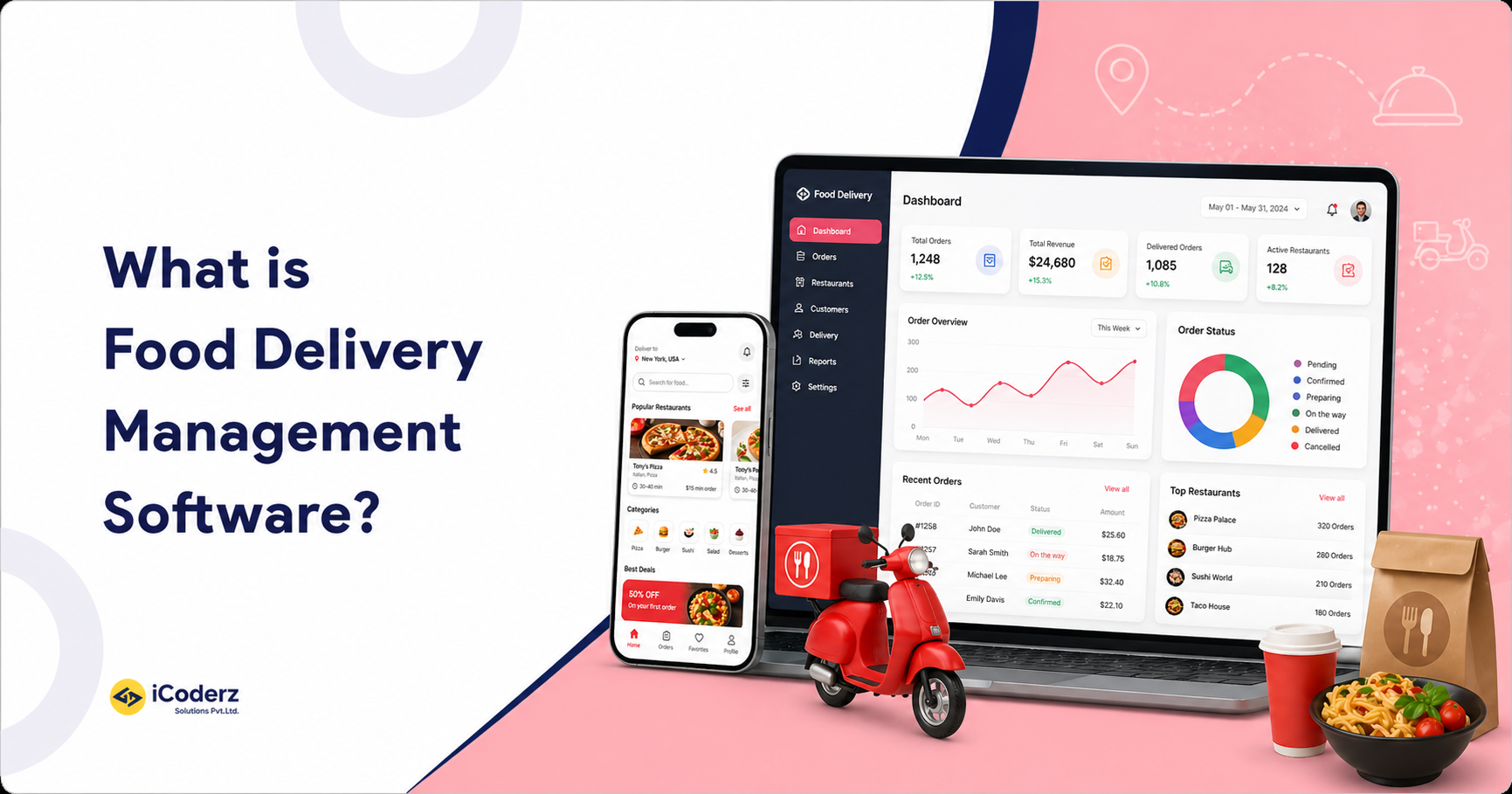
Food delivery management software is a digital platform that helps restaurants, cloud kitchens, and food businesses manage their entire delivery operation — from the moment a customer places an order to the moment it arrives at their door.
At its core, it combines several critical functions into one unified system:
- Online ordering (web and mobile)
- Order management and dispatch
- Real-time delivery tracking
- Driver/fleet management
- Customer relationship management (CRM)
- Reporting and analytics
- Inventory management
- Payment processing
Unlike using multiple disconnected tools, food delivery management software brings all of these under one roof — giving restaurant owners complete visibility and control over their operations.
How Is It Different from a Food Ordering App?
A food ordering app is the customer-facing interface. Food delivery management software is the complete backend and operational system that powers everything behind that app. It includes the admin dashboard, driver app, restaurant panel, and customer-facing ordering system — all integrated together.
Who Needs Food Delivery Management Software?
Food delivery management software is not just for large restaurant chains. In 2026, businesses of all sizes are adopting it to stay competitive.
1. Independent Restaurant Owners
If you’re managing orders from multiple channels — your website, phone, and third-party apps — you’re losing time and revenue to fragmentation. A centralized system brings every order into one place.
2. Multi-Location Restaurant Brands
Managing delivery across five, ten, or fifty locations requires standardized operations, centralized reporting, and scalable infrastructure. Food delivery software gives brand managers real-time visibility across every outlet.
3. Cloud Kitchens and Virtual Restaurants
Cloud kitchens operate entirely on delivery. Without robust software managing orders, dispatch, and tracking, operations break down fast. This software is the backbone of every successful cloud kitchen model.
4. Food Delivery Startups
Entrepreneurs launching new delivery platforms need a proven technical foundation. Building a platform like Ubereats from scratch can cost millions and take years. A white-label food delivery solution like Deonde can have you live in weeks.
5. Multi-Vendor Food Marketplaces
If you’re running a platform where multiple restaurants or vendors list their menus, you need multi-vendor food delivery software that handles vendor management, split payouts, and order routing at scale.
6. Grocery and Dark Store Operators
The quick-commerce model — 10 to 30-minute delivery — requires highly optimized dispatching and routing software that traditional tools simply cannot handle.
Key Features of Food Delivery Management Software
Choosing the right platform means knowing which features actually move the needle. Here are the essential capabilities to look for in 2026:
| Feature | What It Does |
| Online Ordering System | Mobile-friendly ordering for customers via web, iOS, and Android — with scheduled orders, customization, upsells, and multi-payment support. |
| Real-Time Delivery Tracking | Live GPS tracking for both customers and managers. Reduces support calls and increases satisfaction. |
| Smart Order Dispatch | Automated routing assigns orders to the nearest driver. Manual override available for dispatchers. |
| Restaurant Dashboard | Accept/reject orders, update menus, set availability, and monitor daily performance from any device. |
| CRM & Retention Tools | Capture customer data and order history. Power loyalty programs, push notifications, and personalized campaigns. |
| Inventory Management | Track stock in real time with auto-alerts. Integrates with POS systems to update inventory per order. |
| Reporting & Analytics | Insights on top items, delivery zones, peak hours, and profitability — enabling data-driven decisions. |
| Multi-Payment Gateway | Credit/debit cards, digital wallets, UPI, cash on delivery, and BNPL options. |
| Promotions Management | Create discount codes, flash sales, bundle offers, and loyalty rewards from the admin panel. |
| Multi-Language & Currency | Localization support for international or multi-region operations. |
How Food Delivery Management Software Helps Your Business
Centralizing All Orders in One Place
No more switching between Uber Eats, your website, and phone calls. Everything comes into one dashboard, reducing errors and kitchen confusion.
Eliminating Aggregator Dependency
Third-party aggregators charge 25–35% commission on every order. With your own food delivery software, direct orders cost you nothing in commission. Even shifting 30% of your orders to direct channels can dramatically improve your margins.
Faster Delivery Fulfillment
Automated dispatch, optimized routing, and real-time tracking reduce average delivery times. Faster delivery means happier customers and better reviews.
Owning Your Customer Data
When you operate through aggregators, they own the customer relationship. With your own platform, you collect first-party data — order history, preferences, contact information — and use it to build long-term loyalty.
Scaling Without Proportional Cost Increase
Good software is built to scale. Adding a new location, a new delivery zone, or a new restaurant brand should be a matter of configuration — not rebuilding your entire tech stack.
Benefits for Restaurant Owners
Restaurant owners who switch from fragmented tools or pure aggregator dependency to dedicated food delivery management software consistently report:
- Higher profit margins — Reduced commission costs from direct ordering can recover 20–30% of previously lost revenue per order.
- Better customer retention — Loyalty programs, personalized offers, and branded experiences keep customers coming back.
- Fewer operational errors — Centralized order management reduces missed orders and kitchen miscommunications.
- Smarter business decisions — Analytics dashboards replace gut-feel decisions with data-backed insights.
- Stronger brand identity — Your app, your branding, your customer relationship.
- Improved delivery experience — Real-time tracking, accurate ETAs, and proactive communication reduce complaints.
Why Restaurant Brands Are Moving Toward White-Label Platforms
The trend in 2026 is clear: restaurant brands that want to grow are moving away from aggregator-only strategies toward owning their delivery infrastructure.
1. Speed to Market
Building a custom food delivery app from scratch can take 6–18 months and cost $100,000+. A white-label SaaS platform can be configured and launched under your brand in weeks, not months.
2. Lower Total Cost of Ownership
SaaS-based solutions come with ongoing updates, security patches, and feature releases — without the overhead of an in-house development team.
3. Full Branding Control
White-label means your logo, your colors, your domain. Customers interact entirely within your brand experience — building recognition and trust.
4. Built-In Scalability
SaaS platforms are built on cloud infrastructure designed to handle traffic spikes, new locations, and growing order volumes without performance issues.
5. Integrated Features from Day One
Rather than stitching together third-party tools for CRM, tracking, payments, and analytics, white-label platforms deliver these as integrated modules — reducing complexity and integration costs.
Meet Deonde: The White-Label SaaS Food Delivery Solution
For businesses that want to launch fast without sacrificing quality, Deonde is a SaaS food delivery platform — a fully white-labeled, multi-vendor solution that gives you everything you need to run a professional delivery operation under your own brand.
What Deonde Includes
| Module | Description |
| Customer App | iOS & Android ordering app with real-time tracking, loyalty rewards, and push notifications. |
| Restaurant Panel | Dedicated dashboard for restaurant partners to manage menus, orders, hours, and performance. |
| Delivery Driver App | Native app with live navigation, order queue management, and earnings tracking. |
| Super Admin Dashboard | Full platform control — manage vendors, zones, commissions, promotions, and reports. |
| CRM & Marketing Tools | Customer segmentation, push campaigns, referral programs, and coupon management. |
| Advanced Analytics | Revenue reports, zone performance, driver efficiency metrics, and menu insights. |
Who Is Deonde Built For?
- Food delivery startups ready to launch their first platform
- Restaurant groups wanting to move orders from aggregators to a direct channel
- Cloud kitchen operators managing multiple virtual brands
- Entrepreneurs building a local or regional food delivery marketplace
- Existing platforms looking to upgrade their technology without a full rebuild
Why Choose iCoderz Solutions for Custom Food App Development
iCoderz Solutions is a leading food delivery app development company with over a decade of experience building digital products for the food and restaurant industry.
What Sets iCoderz Solutions Apart
- Deep domain expertise — The team understands the operational realities of food delivery: from kitchen workflow to last-mile logistics.
- End-to-end development — From concept and design to development, testing, launch, and post-launch support.
- Custom and white-label options — Fully bespoke platform or faster launch via white-label product.
- Proven technology stack — React Native for mobile apps, robust backend APIs, and cloud-native infrastructure.
- Global delivery experience — Platforms delivered across the US, UK, UAE, India, Southeast Asia, and more.
- Ongoing support and iteration — Post-launch updates, feature additions, and performance optimization.
Ready to Build or Launch Your Food Delivery Platform?
Whether you are a restaurant owner ready to reduce aggregator dependency, a cloud kitchen operator looking for a scalable backend, or a startup founder building the next big food delivery brand, iCoderz Solutions has the expertise and the product to get you there.
The restaurant brands winning in 2026 own their delivery infrastructure.
Frequently Asked Questions
What is food delivery management software?
Food delivery management software is an integrated digital platform that helps restaurants and food businesses manage online ordering, order dispatch, real-time delivery tracking, driver coordination, customer data, and business analytics from a single system.
How does food delivery software help reduce costs?
By enabling direct online ordering, businesses avoid paying 25–35% commission fees to third-party aggregators on every order. The software also reduces operational errors, optimizes delivery routes to save fuel costs, and provides analytics to eliminate underperforming expenses.
What is a white-label food delivery platform?
A white-label platform is a ready-built software solution that a business can rebrand and launch as their own product. Instead of building from scratch, you get a proven system configured with your logo, colors, and domain — cutting launch time from 12+ months to a few weeks.
Can food delivery software scale with my business?
Yes. Modern SaaS food delivery platforms are built on cloud infrastructure designed to handle growth. Whether you add new locations, expand delivery zones, or onboard new restaurant partners, the software scales without requiring a technology rebuild.
What is the difference between food delivery software and a POS system?
A POS (point-of-sale) system handles in-restaurant transactions. Food delivery management software handles the full delivery workflow — ordering, dispatch, tracking, and customer communication. The best setups integrate both systems so inventory and orders stay synchronized.