Online grocery and meat ordering has moved from a convenience to an everyday habit for millions of households. Busy schedules, a growing preference for hygienic and traceable food sourcing, and the success of quick-commerce platforms have all pushed more customers to order fresh meat from their phones instead of visiting a local butcher. For entrepreneurs, this shift has opened a genuine business opportunity: how to start an online meat delivery business that is reliable, profitable, and trusted by customers.
Meat delivery is not the same as general food delivery. It involves perishable inventory, strict cold-chain handling, hygiene regulations, and a customer base that cares deeply about freshness and quality. A single bad delivery can cost a customer permanently, which makes operations and trust-building far more important here than in most other delivery categories.
This guide walks through the complete journey — choosing a business model, understanding legal requirements, planning operations, building the right technology, setting up a revenue model, and marketing the business so it can grow sustainably.
What Is an Online Meat Delivery Business?
An online meat delivery business is a service that allows customers to order fresh, frozen, or processed meat products through a website or app, and have them delivered to their doorstep within a scheduled or on-demand time window.
In a typical online meat ordering business, the customer browses available cuts and quantities, places an order, pays online, and receives the product through a delivery partner who follows cold-chain handling practices to keep the meat fresh in transit.
Four parties are usually involved:
- Suppliers or meat stores – source and prepare the meat
- The platform – manages ordering, payments, and coordination
- Delivery partners – handle pickup and last-mile delivery
- Customers – place and receive orders
It’s worth distinguishing between two common setups. An online meat store typically sells its own inventory directly to customers under one brand. A meat delivery business run as a marketplace, on the other hand, connects multiple butchers or meat suppliers with customers on a single platform, earning commission on each transaction rather than owning the stock itself.
How Does an Online Meat Delivery Business Work?
Most platforms follow a similar order-to-delivery flow, whether they’re a single store or a full marketplace.
1. Customer Browses Meat Products
Customers explore categories such as chicken, mutton, seafood, or ready-to-cook items.
2. Customer Selects Meat, Cut, and Quantity
Buyers choose specific cuts (boneless, curry-cut, whole, fillets) and the quantity needed.
3. Customer Places the Order
The order is added to a cart and checked out with delivery details and a preferred time slot.
4. Order Is Confirmed and Processed
The system confirms stock availability and routes the order to the relevant store or supplier.
5. Meat Is Prepared and Packaged
The product is cut, weighed, and sealed in food-safe, insulated packaging.
6. Delivery Partner Picks Up the Order
A rider collects the order, often using insulated bags or cold boxes.
7. Order Is Delivered to the Customer
The product reaches the customer within the promised delivery window.
8. Payment and Order Settlement
Payment is captured (prepaid or cash on delivery), and the platform settles commissions or payouts with the store and rider.
This simple customer → store → delivery partner → customer loop is the backbone of any online meat delivery business model, regardless of scale.
Choose the Right Meat Delivery Business Model
Before investing in technology or operations, decide which meat delivery business model fits your resources and goals.
Single-Vendor Meat Delivery Model
You hold your own inventory, build your own brand, and sell directly to consumers. This model gives you full control over quality but requires you to manage sourcing, storage, and staff.
Multi-Vendor Meat Marketplace
Multiple local meat sellers list their products on your platform, and you earn a commission on each order. This scales faster since you don’t own inventory, but it requires strong vendor onboarding and quality checks.
Meat Delivery Aggregator Model
Here, the platform helps customers discover various suppliers and may or may not manage delivery itself, acting more as a discovery and ordering layer.
Subscription-Based Meat Delivery Model
Customers sign up for weekly or monthly meat boxes, which creates predictable, recurring revenue and simplifies demand planning.
Hybrid Meat Delivery Model
Many successful businesses combine direct sales, a vendor marketplace, and subscriptions to capture different types of customers at once.
Getting this decision right early shapes almost everything that follows — from your online meat delivery business model to your technology requirements and cost structure.
How to Start an Online Meat Delivery Business
This is the core, step-by-step section for anyone figuring out how to start a meat delivery business from the ground up.
Step 1: Research Your Target Market
Study your target location, customer demographics, meat preferences, order frequency, existing competitors, and how quickly customers expect delivery in your area.
Step 2: Decide What Meat Products to Sell
Common categories include chicken, mutton or lamb, beef (where legally permitted), fish and seafood, processed meat, ready-to-cook products, and specialty cuts. Choose a catalog that matches local demand rather than trying to cover everything at once.
Step 3: Choose Your Suppliers
Work with local suppliers, meat shops, farms, or wholesalers who can guarantee consistent quality and enough supply capacity to support your order volume without frequent stockouts.
Step 4: Define Your Pricing Strategy
Factor in product cost, packaging, delivery expenses, platform fees, competitor pricing, and the margin you need to stay profitable.
Step 5: Plan Storage and Cold-Chain Logistics
Reliable refrigeration and freezer storage, temperature monitoring, hygienic handling practices, insulated packaging, and tight delivery times are non-negotiable for a fresh meat delivery business. Any weak link in the cold chain directly affects product quality and customer trust.
Step 6: Set Up Your Legal and Business Requirements
Register your business, secure food-related licenses, obtain local permits, register for applicable taxes, and follow food safety, hygiene, packaging, and labeling requirements relevant to your region. If you’re focused on how to start a meat delivery business in India, pay particular attention to FSSAI requirements, covered in more detail below.
Step 7: Build Your Online Ordering Platform
At minimum, you’ll need a customer-facing website or app, an admin dashboard, a vendor or store panel (for marketplace models), and a delivery partner app.
Step 8: Launch Your MVP
Start with a limited delivery area and a focused product catalog. Test your order fulfillment process closely and collect customer feedback before expanding.
Step 9: Market Your Business
Combine local SEO, social media, paid advertising, referral programs, influencer marketing, first-order offers, and direct customer communication through channels like WhatsApp.
Step 10: Measure and Scale
Track orders, repeat customers, average order value, delivery time, cancellation rate, customer acquisition cost, and retention before expanding into new areas or product lines.
Licenses and Requirements for an Online Meat Delivery Business
Meeting regulatory requirements is one of the most searched — and most overlooked — parts of setting up this business.
Business Registration
Register your company under the appropriate legal structure for your country or state.
Food Safety License
Most regions require a dedicated food safety or hygiene license before you can legally sell meat products.
Local Business Permissions
Municipal or local trade permissions may be required depending on where you operate or store inventory.
Tax Registration
Register for applicable local, state, or national tax requirements tied to food businesses.
Meat Handling and Hygiene Requirements
Staff training, sanitation protocols, and safe handling procedures are typically mandated for any business selling raw meat.
Storage and Transportation Requirements
Regulations often specify minimum standards for refrigerated storage and transport to prevent spoilage or contamination.
Packaging and Labeling Requirements
Meat products usually need to be packaged and labeled with details like weight, cut type, and sourcing information.
Note: Regulatory requirements differ significantly by country and even by local jurisdiction. Always confirm current rules with your local food safety authority rather than treating any single country’s requirements as universal.
How Much Does It Cost to Start an Online Meat Delivery Business?
Rather than a single number, it’s more useful to break the meat delivery business startup cost into categories.
| Cost Area | What It Covers |
| Business Setup | Registration and permits |
| Inventory | Initial meat stock |
| Storage | Refrigerators/freezers |
| Packaging | Food-safe and insulated packaging |
| Delivery | Riders, vehicles, fuel, logistics |
| Website/App | Ordering platform |
| Marketing | Launch campaigns and promotions |
| Staff | Operations and customer support |
| Technology | Hosting, maintenance, third-party services |
Factors That Affect Startup Cost
- Single-store vs. marketplace model
- Local vs. multi-city operation
- Website vs. dedicated mobile apps
- Owning a delivery fleet vs. relying on third-party delivery
- Whether you own inventory or work with vendors
- Number of products in your catalog
- Delivery radius and area density
If technology is a major cost driver for you, it’s worth getting a clear estimate of meat delivery app development cost before committing to a build.
How Does a Meat Delivery Business Make Money?
A meat delivery business typically earns through a mix of product margins, delivery fees, and platform-level revenue streams rather than a single source.
Product Margins
The core revenue source — the difference between your buying and selling price on meat products.
Restaurant/Butcher/Vendor Commissions
Marketplace models earn a percentage commission on every order placed with a listed vendor.
Delivery Fees
Charged to customers per order, sometimes waived above a minimum order value.
Platform or Service Fees
A small fixed or percentage fee added to cover platform operations.
Subscription Plans
Recurring revenue from customers who sign up for regular meat boxes or delivery passes.
Featured Listings
Vendors pay extra to appear higher in search results or featured sections.
Advertising
Banner placements or promoted products within the app.
Premium Products and Add-Ons
Higher-margin specialty cuts, marinades, or value-added products.
Must-Have Features of a Meat Delivery App
Customer App
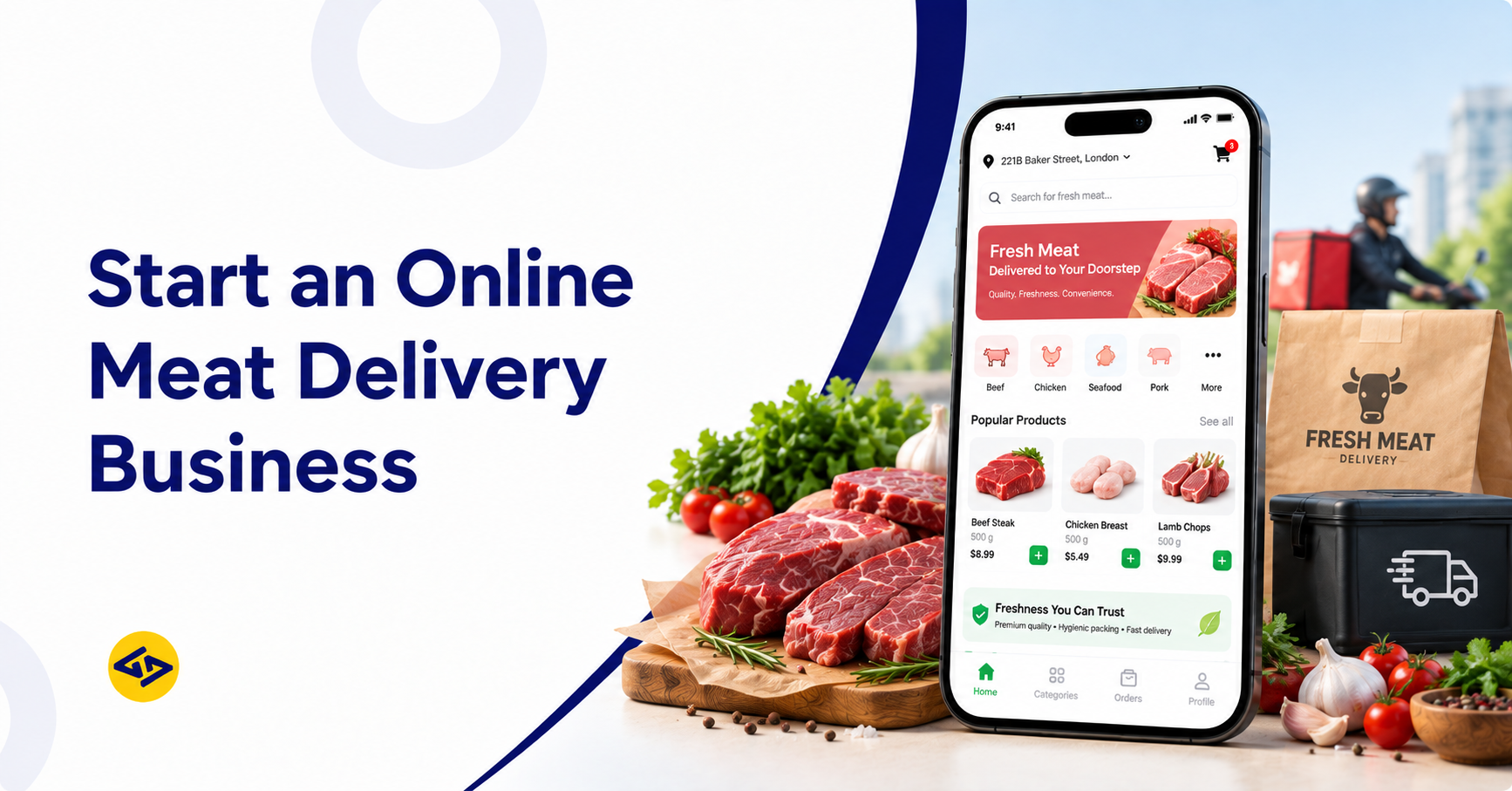
User registration/login, product categories, meat cuts and variants, weight selection, product customization, cart, checkout, multiple payment options, delivery scheduling, order tracking, reviews and ratings, offers and coupons, reordering, and order history.
Vendor/Store Panel
Product management, inventory management, order management, pricing controls, availability toggles, promotions, and sales reports.
Delivery Partner App
New order requests, pickup details, navigation, delivery status updates, earnings tracking, and order history.
Admin Panel
Customer management, vendor management, delivery management, product management, commission management, order management, payments, promotions, and analytics.
Getting these modules right from day one is central to solid meat delivery app development, and working with a team experienced in meat delivery app development can help you avoid costly rework later.
Technology Needed to Build a Meat Delivery App
A meat delivery platform relies on several technology components working together: mobile applications for customers and delivery partners, an admin dashboard, a secure backend and database, a payment gateway, maps and location services for tracking, real-time order tracking, push notifications, analytics for business insights, and scalable cloud infrastructure to handle order spikes.
Understanding these pieces up front makes it much easier to plan how to build a meat delivery app that performs reliably as order volumes grow.
How to Build a Meat Delivery App for Your Business
Define Your Business Model
Lock in whether you’re building for a single store, a marketplace, or a hybrid model before writing a single feature list.
Plan the MVP
Identify the smallest feature set that lets you test real orders in a limited area.
Design the User Experience
Prioritize a fast, simple ordering flow — customers deciding between cuts and weights need clarity, not clutter.
Develop Customer, Vendor, Delivery, and Admin Modules
Build each panel to match the workflows of the people who’ll actually use it daily.
Integrate Payments and Location Services
Support multiple payment methods and accurate, real-time location tracking for deliveries.
Test Ordering and Delivery Workflows
Run test orders end-to-end, including edge cases like out-of-stock items or delivery delays.
Launch
Go live in a controlled area with a manageable order volume.
Improve Based on Customer Data
Use real order and feedback data to refine the catalog, pricing, and delivery experience.
If you’d rather study proven approaches first, it can help to look at how established players operate — for instance, guides on how to build a meat delivery app like licious break down what makes those platforms work at scale.
How to Market an Online Meat Delivery Business
Growth depends on a consistent mix of channels: local SEO and an optimized Google Business Profile to capture nearby search intent, social media marketing to build brand visibility, paid search and social ads for faster customer acquisition, referral programs to turn existing customers into new ones, first-order promotions and subscription offers to encourage trial and repeat purchases, email and WhatsApp marketing for direct engagement, genuine customer reviews to build trust, and ongoing content marketing to support long-term organic growth.
Challenges of Running an Online Meat Delivery Business
Running this kind of business isn’t risk-free, and it’s worth going in with eyes open. Common challenges include maintaining meat freshness across every order, managing a consistent cold chain from storage to doorstep, minimizing inventory waste on perishable stock, avoiding delivery delays that compromise quality, enforcing quality control across suppliers, staying compliant with evolving food safety regulations, earning and keeping customer trust, ensuring supplier reliability during demand spikes, controlling rising customer acquisition costs, and scaling delivery operations without sacrificing speed or quality.
How to Make an Online Meat Delivery Business Successful
Success here comes down to operational discipline rather than any single trick. Focus on maintaining consistent product quality across every order, offering accurate and detailed product information so customers know exactly what they’re buying, providing flexible delivery slots that fit real schedules, optimizing delivery routes to protect both speed and freshness, building customer trust through transparency about sourcing and handling, encouraging repeat orders through good service rather than discounts alone, using order data to optimize inventory and reduce waste, and introducing subscription options once demand is predictable enough to support them.
Key Metrics to Track
| KPI | What It Tells You |
| Total Orders | Overall demand |
| Average Order Value | Customer spending |
| Repeat Purchase Rate | Customer retention |
| Customer Acquisition Cost | Marketing efficiency |
| Customer Lifetime Value | Long-term customer value |
| Cancellation Rate | Order/operations issues |
| Delivery Time | Logistics performance |
| Product Waste | Inventory efficiency |
| Gross Margin | Product economics |
| Subscription Retention | Recurring customer activity |
Final Thoughts
Starting an online meat delivery business takes more than listing products on a website. The businesses that succeed tend to:
- Select the right business model for their resources and goals
- Establish reliable sourcing and cold-chain operations
- Understand and follow local regulatory requirements
- Build an easy-to-use ordering platform
- Start with an MVP and a limited delivery area
- Track operational and customer metrics closely
- Scale only once the model and fulfillment process are validated
If you’re comparing providers for your technology build, reviewing a list of the best meat delivery app development companies is a useful starting point before you commit to a partner.
Planning to Launch a Meat Delivery App?
Build a scalable meat delivery platform with customer ordering, vendor management, delivery tracking, payments, and admin controls tailored to your business model. Learn more about how iCoderz Solution can help you develop a meat delivery app built around your specific goals.
FAQs About Starting an Online Meat Delivery Business
Is an online meat delivery business profitable?
It can be, provided you control cold-chain costs, minimize product waste, and maintain steady repeat orders. Margins are typically slimmer than dry goods, so operational efficiency matters more than in many other delivery categories.
How much does it cost to start an online meat delivery business?
Costs vary widely based on inventory ownership, delivery fleet, and technology choices, but generally span business setup, storage, packaging, delivery, platform development, marketing, and staffing.
How do meat delivery businesses make money?
Mainly through product margins, delivery fees, vendor commissions (in marketplace models), subscription plans, and platform or advertising fees.
What license is required for a meat delivery business?
Requirements vary by country, but typically include business registration, a food safety license, local permits, and compliance with hygiene, storage, and labeling regulations.
How can I sell meat online?
Start by defining your product range and sourcing, set up compliant storage and packaging, choose a business model, build or use an ordering platform, and launch in a limited area before scaling.
How do I build a meat delivery app?
Define your business model, plan an MVP, design the ordering experience, build customer/vendor/delivery/admin modules, integrate payments and location tracking, and test thoroughly before launch.
What features should a meat delivery app have?
At minimum: product browsing with cut and weight selection, cart and checkout, multiple payment options, delivery scheduling and tracking, plus vendor, delivery partner, and admin panels for operations.
How can I deliver meat while maintaining freshness?
Invest in proper cold storage, insulated packaging, temperature monitoring, and tight delivery time windows, and design delivery routes to minimize time between pickup and drop-off.
What is the best business model for online meat delivery?
There’s no single best model — single-vendor, marketplace, subscription, and hybrid approaches each suit different resources and goals. The right choice depends on your inventory strategy and growth plans.
How can I attract customers to a meat delivery business?
A combination of local SEO, social proof through reviews, first-order incentives, referral programs, and consistent product quality tends to work best for customer acquisition and retention.