Have you ever wondered why some businesses are always ahead?
They understand what customers need, fix issues before they happen, and make smart choices to grow. It’s not just luck.
In most situations, these moves are fueled silently through artificial intelligence.
42% of companies globally use AI to increase speed, decision-making, and overall business efficiency (IBM’s 2023 AI Adoption Index).
It’s not enough to have AI tools.
Imagine that you owned a high-performance car but were unable to drive it.
Without direction or destination, even the most powerful car won’t take you anywhere.
The same goes for AI. No strategy means no results from technology.
In this blog, you’ll learn how to develop an AI strategy that truly fits your business goals.
At iCoderz, we offer a custom AI Strategy for businesses to simplify and enhance operations.
You’ll learn each step clearly and straightforwardly.
What Is an AI Strategy?
An AI strategy is a defined and integral outline of how a company will implement artificial intelligence (AI) in its operations. The purpose is to ensure AI complements the company’s overall business objectives.
It is a guide to help discern the best ways to use AI, create useful solutions, acquire relevant skills and resources, and overcome any identified risks or challenges.
Ultimately, it supports the company in extracting actual benefits from AI. A clear AI strategy also ensures that AI is used responsibly, ethically and efficiently.
Choose from a range of AI software development services to ensure your technology matches your business needs.
Why Does Your Business Need an AI Strategy?
- An AI strategy ensures your projects align with business goals, like increasing profits or improving service.
- The benefits are vast: AI enhances productivity, cuts costs, and finds new opportunities.
- With no clear AI plan, companies will waste time and money on unrelated projects.
- AI automates repetitive tasks, allowing your team to do more meaningful work.
- It also sets ideas for the betterment of products and services.
- Many companies utilize AI to make smart recommendations, keeping ahead of competitors.
- AI uses data to assist you in making fact-based decisions.
- Customer satisfaction and loyalty are enhanced by tools such as chatbots.
- AI identifies fraud and security threats to keep your business safe.
- It also enhances supply chain management by lowering waste and costs.
- The rate of AI adoption is very high and without a plan, your business may lag.
- A strong AI strategy leads to growth and long-term success.
Learn how our AI Consulting Services can help you draft a roadmap tailored to your business.
Key Components of a Successful AI Strategy for Businesses
To create an effective AI strategy, businesses must focus on clear objectives, data quality, and the right tools. A winning AI strategy typically includes these essential elements:
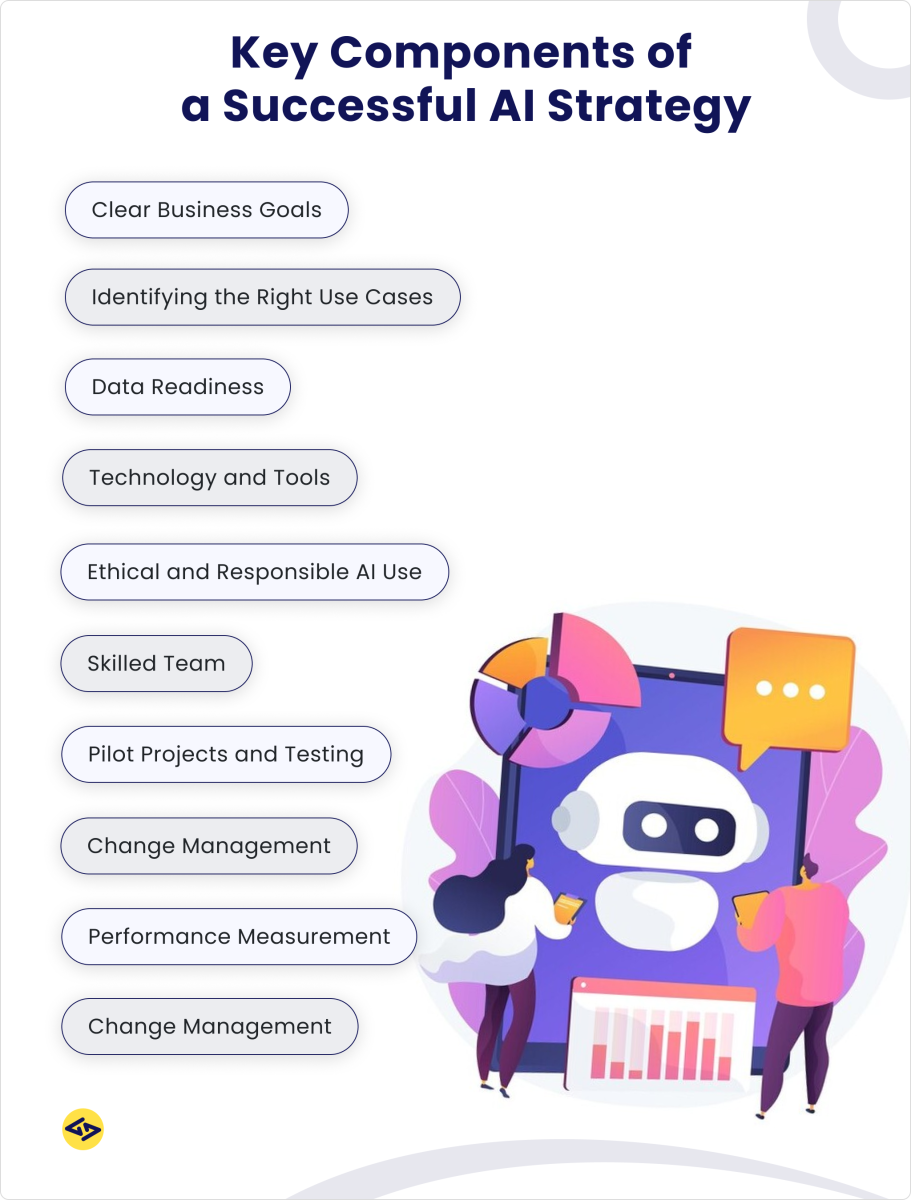
Clear Business Goals:
State what AI will be used to deliver, i.e., enhance customer service or productivity.
Identifying the Right Use Cases:
Find areas where AI could add value, such as automation or decision-making.
Data Readiness:
Provide access to clean, accurate, and well-organized data.
Need help with data processing? Check our AI-Driven Data Analytics.
Technology and Tools:
Select AI technologies and platforms that are suitable for you.
See our AI Software Development Services.
Skilled Team:
Investment in building or hiring AI, data science, and industry experts.
Ethical and Responsible AI Use:
Make AI fair, transparent, and legal.
Pilot Projects and Testing:
Begin with little test projects to learn before scaling.
Change Management:
Assist staff in adjusting by providing them with training and modifying workflows.
Performance Measurement:
Measure track results using KPIS to determine AI’s effect.
Continuous Improvement:
Continue updating AI systems and approaches as technology changes.
Step-by-Step Guide to Developing Your AI Strategy
Here’s a detailed step-by-step guide to help you formulate your AI strategy.
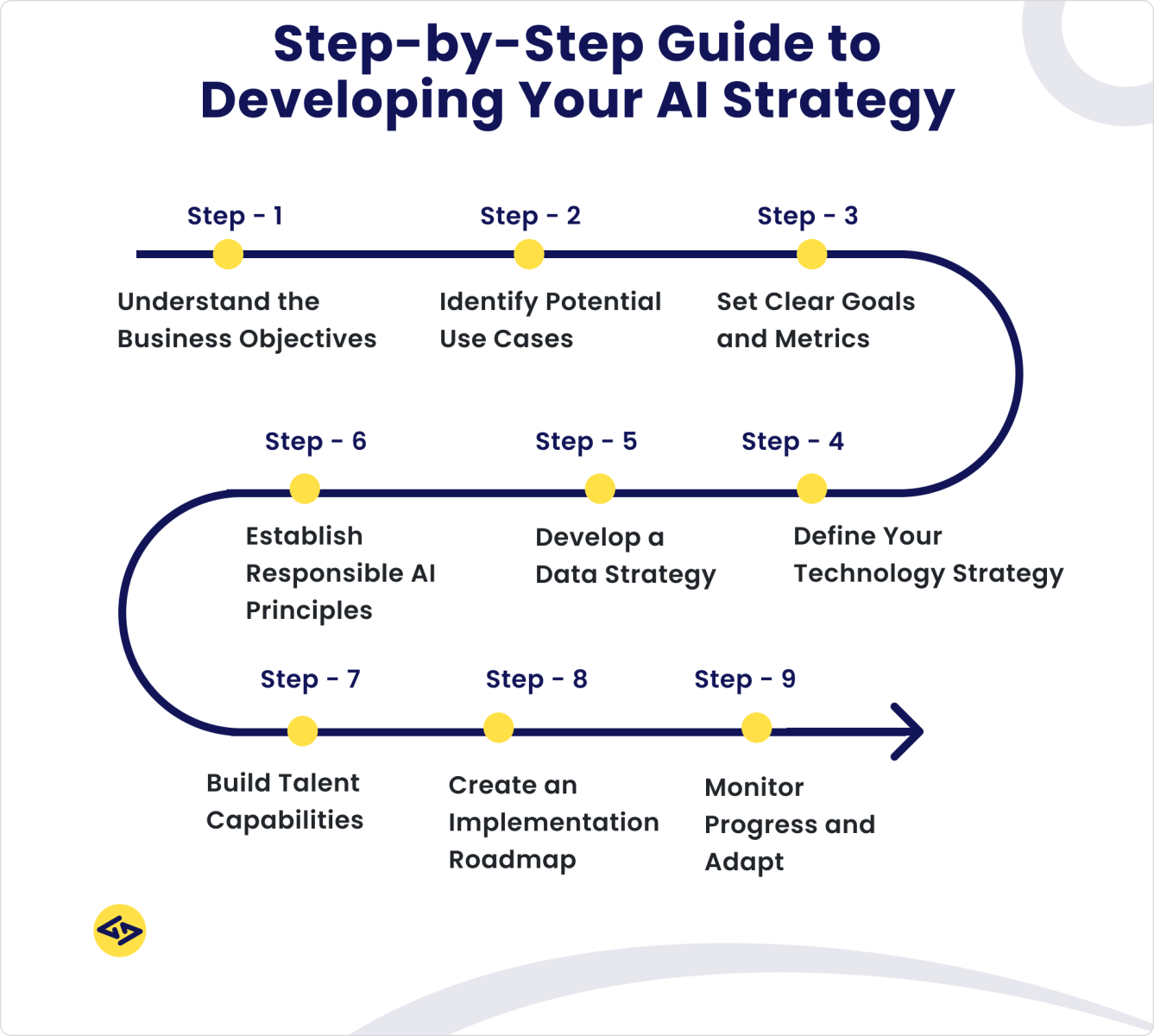
1. Understand the Business Objectives
First, ensure your AI plans align with your firm’s key goals. Discuss these goals with leaders and teams throughout the organization to understand what kind of success they want and where they see issues. Understanding these goals lets you optimize your AI strategy for what matters most to your business.
2. Identify Potential Use Cases
Then, define the areas where AI can help make a difference. These may be routine duties, procedures that can be automated, or areas where more effective data analysis could be made. Focus on generative AI in business for content creation, customer communication, code generation, and product innovation, along with AI that analyzes existing data for insights.
Explore our blog on Uses of AI in Business Intelligence for practical ideas.
3. Set Clear Goals and Metrics
For every AI use case, identify what success would look like. Define measurable objectives – for example, to shorten customer response time or decrease costs. Determine how you intend to track progress with specific metrics, such as percentage improvements or time saved, to know whether your AI projects yield results.
4. Define Your Technology Strategy
Select your appropriate tools and platforms for your AI projects. Consider what is possible, cost- and work-wise: ready-made software, customizable platforms, or even creating your own solutions. The selected technology should correspond to your team’s skills and business needs.
5. Develop a Data Strategy
AI requires good data to operate properly. Ensure that you have the right data and that it’s clean, accurate, and well organized. Establish rules about collecting, storing, and processing data and ensure you comply with privacy or legal requirements.
6. Establish Responsible AI Principles
It’s important to use AI ethically and responsibly. Create guidelines to prevent bias, ensure transparency, and comply with laws. Assign someone to monitor these practices and use tools to help keep your AI fair and trustworthy.
7. Build Talent Capabilities
Check if your team has the skills needed for AI projects. You may need to train current staff, hire new experts, or work with outside partners. Having the right talent ensures your AI strategy can be implemented effectively.
8. Create an Implementation Roadmap
Plan out how you will roll out your AI projects. Make a timeline, assign resources, and set milestones for each stage. Start with smaller projects to test your ideas, then expand as you learn what works best.
9. Monitor Progress and Adapt
Once your AI projects run, keep track of their performance using your chosen metrics. Get feedback from users and stakeholders, and be ready to make changes if needed. Flexibility helps your AI strategy stay effective as technology and business needs evolve.
Common Pitfalls to Avoid in AI Implementation for Business Intelligence.
AI for business intelligence can deliver significant benefits, but certain common errors might prove troublesome. These are the key ones to look out for:
1. Poor Data Quality
AI depends on clean, good data to perform well. If your data is messy, unfinished, and scattered in different locations, AI won’t provide accurate answers. Ensure that your data is proper and valid before proceeding.
2. Data Silos
It’s difficult to understand the business well when different teams maintain their own separate data. Attempt to maintain data in one location so that all can utilize the same data.
3. No Clear Plan or Goals
Jumping into AI can cost time and money without a clear idea of what you want to accomplish. When deploying AI, never begin without clear business objectives and a plan on how AI will support.
4. Relying Only on AI
AI is strong but not perfect. It still requires human input to monitor its work and make final decisions. Don’t wait for AI to do everything by itself.
5. Poor Integration
If your existing systems and workflows don’t match AI tools, they won’t be very helpful. Ensure AI seamlessly integrates with the tools your team is already using.
6. Stuck in Pilot Stage
Several AI projects will have impressive starts, but will never leave testing. Focus on building AI solutions that can be used across the entire business, not just in small trials.
7. Lack of Skills
It’s difficult to make the whole company benefit if not many experts understand AI. Train your team and facilitate cooperation among technical and business people.
8. Ignoring Ethics and Fairness
AI can sometimes be biased or unfair. The use of AI must be prudent, respect privacy and be open about how it operates.
9. Not Sharing Insights Clearly
Even the smartest AI insights are useless if people don’t understand them. Use basic reports and visuals; teach users how to utilise AI information best.
Avoid these mistakes by partnering with our Machine Learning and Deep Learning experts.
Real-World Examples of AI Strategies That Worked
Healthcare:
Hospitals use AI tools to examine medical images, such as X-rays and scans. This helps doctors find problems faster and more accurately.
Retail:
Stores use AI to show customers products they might like, manage stock better, and change prices based on demand. This increases sales and keeps customers happy.
Manufacturing:
Factories use AI to spot machine problems before they break. This helps avoid delays and keeps production running smoothly.
Finance:
Banks use AI to catch fraud, check risks, and answer customer questions through chatbots. This keeps money safe and improves service.
Future Trends in AI Strategy
Generative AI
Generative AI uses artificial intelligence technology to produce new content, including text, images, or designs, independent of any external contributions. For instance, it can automatically create articles, marketing materials, or products, thus saving time and improving business creativity.
Ethical AI
Ethical AI is the ethical, transparent, and responsible use of artificial intelligence. It recognises that AI decisions must be unbiased, protect privacy, and obey rules, which allows people to trust and safely use AI technologies.
Discover how our Ethical AI Practices guide smarter decisions.
AI in Business Intelligence
AI in business intelligence applies superior algorithms to analyse voluminous data, identify patterns and forecast trends. This helps companies make better decisions, become more efficient, and remain competitive in a data revolution.
Conclusion – AI-Powered Business Growth
AI adoption for businesses refers to using AI to make work easier and make decisions quicker. New tools such as generative AI can generate content, code and designs to assist businesses.
If your business applies these successful AI transformation strategies, you can realise true value from AI in the forthcoming years.
Companies are also helping to ensure AI is fair and the right rules are followed.
Shortly, AI will be more than an additional tool—it will be incorporated into everyday business processes.
At iCoderz, we offer custom AI solutions for businesses to simplify and enhance operations.
We help you make better decisions and become faster.
Looking to automate your business using AI?
Contact us today!
Ready to transform your business with AI?
Start building your successful AI strategy today!