Online grocery shopping has moved from a convenience to a habit. Every order captures a customer’s name, address, phone number, payment card, and shopping preferences, data that’s valuable to attackers and expensive to lose. That’s why grocery delivery app security has quietly become one of the top priorities for any business running or building an on-demand grocery platform.
This guide breaks down the real threats grocery apps face, the security features and compliance standards you need, and a practical checklist you can use before launch. Whether you’re a startup founder or already running a live app, you’ll leave with a clear picture of how to keep customer data safe.
Why Grocery Delivery App Security Matters
A grocery app isn’t just a shopping cart; it’s a database of personal, financial, and location data sitting on a server somewhere. If that data leaks, the damage isn’t only technical.
Increasing Cybersecurity Threats
Retail and delivery apps are increasingly targeted because they combine payment data with personal identifiers, making them attractive to attackers running fraud and phishing campaigns.
Protecting Customer Trust
Customers share sensitive details expecting they’ll be protected. One visible breach is often enough to push them to a competitor’s app permanently.
Financial & Reputational Risks
Beyond regulatory fines, breaches bring lawsuits, chargebacks, and the cost of rebuilding a damaged brand, often far higher than the cost of prevention.
Regulatory Compliance
Laws like GDPR and CCPA make data protection a legal requirement, not just a best practice, for any app handling customer information.
Preventing Data Breaches
Proactive security — encryption, monitoring, and testing, is dramatically cheaper than breach response, notification, and remediation after the fact.
A well-planned grocery delivery app is built with these risks addressed from day one, not patched in afterward.
What Customer Data Does a Grocery Delivery App Collect?
Definition: A grocery delivery app typically collects any information needed to place, personalize, pay for, and deliver an order.
This usually includes:
- Personal information (name, age, gender)
- Phone numbers
- Email addresses
- Delivery addresses
- Payment information (card details, UPI/wallet IDs)
- Order history
- Device information (OS, IP address)
- Real-time location data
- Shopping preferences and browsing behavior
Each data point above is a potential target, which is exactly why encryption and access controls need to cover all of it — not just payment fields.
Common Security Threats for Grocery Delivery Apps
Data Breaches
Unauthorized access to servers or databases exposing customer records in bulk.
Payment Fraud
Stolen card data, fake orders, or manipulated refunds during checkout.
Account Takeover Attacks
Attackers reuse leaked credentials from other breaches to log into customer accounts.
API Vulnerabilities
Poorly secured APIs between the app, backend, and third-party services (maps, payments) are a common entry point.
Malware & Ransomware
Malicious code that locks systems or exfiltrates data, often via compromised admin devices.
DDoS Attacks
Flooding servers with traffic to crash the app during peak ordering hours.
Phishing & Social Engineering
Fake emails or messages tricking customers or staff into giving up credentials.
Insider Threats
Employees or vendors misusing legitimate access to customer or payment data.
Many of these risks grow as an app scales, which is why understanding the challenges faced by online grocery delivery store operations helps in planning defenses early.
Essential Grocery Delivery App Security Best Practices
End-to-End Data Encryption
Encrypt data both in transit and at rest so intercepted or stolen data is unreadable without keys.
Secure User Authentication
- Multi-Factor Authentication (MFA): Adds a second verification step beyond passwords.
- Biometric Login: Fingerprint or face ID reduces reliance on passwords.
- OTP Verification: One-time codes confirm identity during login or checkout.
Role-Based Access Control (RBAC)
Limits what each user type — customer, delivery partner, admin — can access or modify.
Strong Password Policies
Enforce minimum complexity and block commonly leaked passwords.
Secure Session Management
Auto-expire idle sessions and invalidate tokens on logout or device change.
Data Backup & Recovery
Regular, encrypted backups ensure business continuity after an incident.
Regular Security Audits
Scheduled internal or third-party reviews catch issues before attackers do.
Vulnerability Assessments
Ongoing scans identify outdated libraries, misconfigurations, and weak points.
These grocery delivery app security best practices work together — skipping even one, like session management, weakens everything else. Reviewing the core feature of grocery delivery app development alongside security requirements helps teams build both correctly from the start.
Secure Payment Processing
Payment data is the most sensitive layer of any grocery app, so it deserves dedicated safeguards:
- PCI DSS Compliance: Industry standard for handling card data securely.
- Tokenization: Replaces card numbers with non-sensitive tokens for processing.
- Payment Encryption: Protects transaction data end-to-end.
- Secure Payment Gateways: Use established, compliant providers rather than custom-built ones.
- Fraud Detection Systems: Flag unusual transaction patterns in real time.
- Digital Wallet Security: Apply the same encryption and authentication standards to wallet balances.
A secure payment gateway for grocery app checkout directly affects both compliance and customer trust — and it’s a major factor in grocery delivery app monetization since failed or unsafe payments cost revenue.
API Security Best Practices
APIs connect your app to payment gateways, maps, and inventory systems — making grocery app API security critical:
- OAuth 2.0: Industry-standard authorization framework.
- JWT Authentication: Verifies each API request’s identity securely.
- API Rate Limiting: Prevents abuse and brute-force attempts.
- Input Validation: Blocks malicious data from entering your system.
- API Gateway: Centralizes security policies across all endpoints.
- Secure API Keys: Rotate and restrict keys by environment and scope.
- Logging & Monitoring: Tracks unusual API activity in real time.
Choosing the best tech stack for grocery app development from the start makes implementing these API safeguards significantly easier.
Database Security for Grocery Delivery Apps
Your database holds everything — so grocery app database security deserves layered protection:
- Database Encryption: Protects stored records even if the server is compromised.
- Secure Backups: Encrypted, access-controlled, and regularly tested.
- Access Controls: Restrict database access strictly by role.
- Data Masking: Hides sensitive fields from non-authorized staff and systems.
- SQL Injection Prevention: Use parameterized queries and input sanitization.
- Audit Logs: Record who accessed or changed what, and when.
Cloud Security for Grocery Delivery Apps
Most grocery apps run on cloud infrastructure, so cloud configuration is a core part of grocery app cloud security:
- AWS Security Services: IAM, GuardDuty, and Shield for layered protection.
- Google Cloud Security: Security Command Center and VPC controls.
- Microsoft Azure Security: Azure Security Center and Defender for Cloud.
- Cloud Firewalls: Filter traffic before it reaches application servers.
- Identity & Access Management (IAM): Enforce least-privilege access across teams.
- Data Encryption at Rest and in Transit: Non-negotiable across all cloud providers.
Businesses scaling to multiple regions or grocery delivery app development for retail chains especially need cloud architecture reviewed for security at every stage of growth.
AI-Powered Security for Grocery Delivery Apps
AI in grocery app security is moving from “nice to have” to standard practice:
- Fraud Detection: Flags suspicious orders or payment patterns instantly.
- AI-Based Threat Monitoring: Continuously scans for anomalies across systems.
- User Behavior Analytics: Learns normal usage to spot deviations.
- Suspicious Login Detection: Flags logins from new devices or locations.
- Anomaly Detection: Catches unusual order volumes or refund patterns.
- Predictive Security Analytics: Anticipates risks before they become incidents.
Teams exploring AI grocery delivery app development are increasingly building these capabilities in from the architecture stage rather than adding them later.
Compliance Standards Every Grocery Delivery App Should Follow
GDPR
Applies to any app handling EU customer data; requires clear consent and data rights. Nearly all consumer apps with international users should comply.
PCI DSS
Mandatory for any app processing card payments. Non-compliance risks fines and loss of payment processing ability.
CCPA
California’s privacy law grants residents rights over their personal data. Relevant for any app serving US customers.
ISO 27001
An international standard for information security management systems, valuable for enterprise credibility.
SOC 2
Demonstrates that a company securely manages customer data — often required by enterprise partners and investors.
Compliance isn’t just legal box-ticking — it signals maturity to partners and reduces long-term legal exposure. Estimating the cost to develop a grocery delivery app should always factor in compliance and audit costs, not just development hours.
Security Features Every Grocery Delivery App Must Have
- Secure login
- Two-factor authentication
- End-to-end encryption
- Real-time fraud monitoring
- Secure payment gateway
- Admin access controls
- Device management
- Push notification security
- Audit logs
- Data backup
Looking at how the best ten grocery delivery app platforms operate, nearly all of them treat these ten features as baseline, not optional extras.
Security Checklist Before Launching Your Grocery Delivery App
| Checklist Item | Status |
| SSL/TLS enabled | ☐ |
| MFA configured | ☐ |
| APIs secured | ☐ |
| Database encrypted | ☐ |
| Payment gateway tested | ☐ |
| Vulnerability scan completed | ☐ |
| Penetration testing performed | ☐ |
| Backup strategy verified | ☐ |
| Compliance reviewed | ☐ |
| Monitoring tools configured | ☐ |
This grocery delivery app security checklist applies whether you’re running a single-city app or a multi vendor grocery marketplace development platform; the fundamentals don’t change with scale.
Common Security Mistakes to Avoid
- Storing passwords in plain text
- Weak authentication (no MFA)
- Ignoring API security until after launch
- Delaying security patches and updates
- Poor cloud configuration (open buckets, default credentials)
- Skipping penetration testing before going live
- Weak access control for admin panels
- Lack of employee security training
Businesses that studied how to build a bigbasket clone app often find that established players avoid these exact mistakes by treating security as a continuous process, not a launch-day checkbox.
Future Trends in Grocery Delivery App Security
- Zero Trust Security: Verify every request, regardless of source.
- Passwordless Authentication: Biometrics and device-based login replacing passwords.
- AI Cybersecurity: Faster, automated threat detection at scale.
- Behavioral Biometrics: Identifying users by typing and interaction patterns.
- Blockchain for Secure Transactions: Tamper-proof transaction records.
- Privacy-First Application Design: Minimal data collection by default.
- Automated Threat Detection: Real-time, self-healing security responses.
Founders exploring new grocery app development ideas should factor these trends into their roadmap, since security expectations are rising as fast as customer expectations.
How to Build a Secure Grocery Delivery App
- Define security requirements upfront, not after launch.
- Choose a secure, well-supported technology stack.
- Implement encryption and authentication from day one.
- Secure APIs and databases before scaling traffic.
- Integrate secure, PCI DSS–compliant payment gateways.
- Perform security testing before every major release.
- Ensure compliance with relevant regional laws.
- Monitor and update continuously post-launch.
Businesses evaluating whether to invest in readymade online grocery app systems should confirm these eight steps have already been addressed in the existing codebase.
Why Choose iCoderz Solutions for Secure Grocery Delivery App Development
At iCoderz Solutions, security isn’t an afterthought — it’s part of how we architect every grocery delivery app from day one. Our approach includes:
- Deep expertise in grocery delivery app development across markets
- Secure-by-design development, not bolted-on patches
- Compliance-focused solutions covering GDPR, PCI DSS, and CCPA
- AI-powered fraud detection built into the platform
- Secure cloud deployment on AWS, GCP, or Azure
- End-to-end testing, including penetration testing before launch
- Ongoing security updates and monitoring post-launch
Ready to protect your customers and your business? Request a Free Security Consultation with iCoderz Solutions today.
Conclusion
Protecting customer data isn’t a one-time feature, it’s an ongoing commitment that has to be built into every stage of grocery app development, from architecture to post-launch monitoring. The businesses that treat security as core infrastructure, not an add-on, are the ones that keep customer trust intact when threats inevitably emerge.
If you’re building or scaling a grocery delivery app, now is the time to adopt modern security practices, comply with the standards your customers expect, and monitor continuously rather than reactively. Contact iCoderz Solutions to build a secure, scalable grocery delivery app your customers can trust.
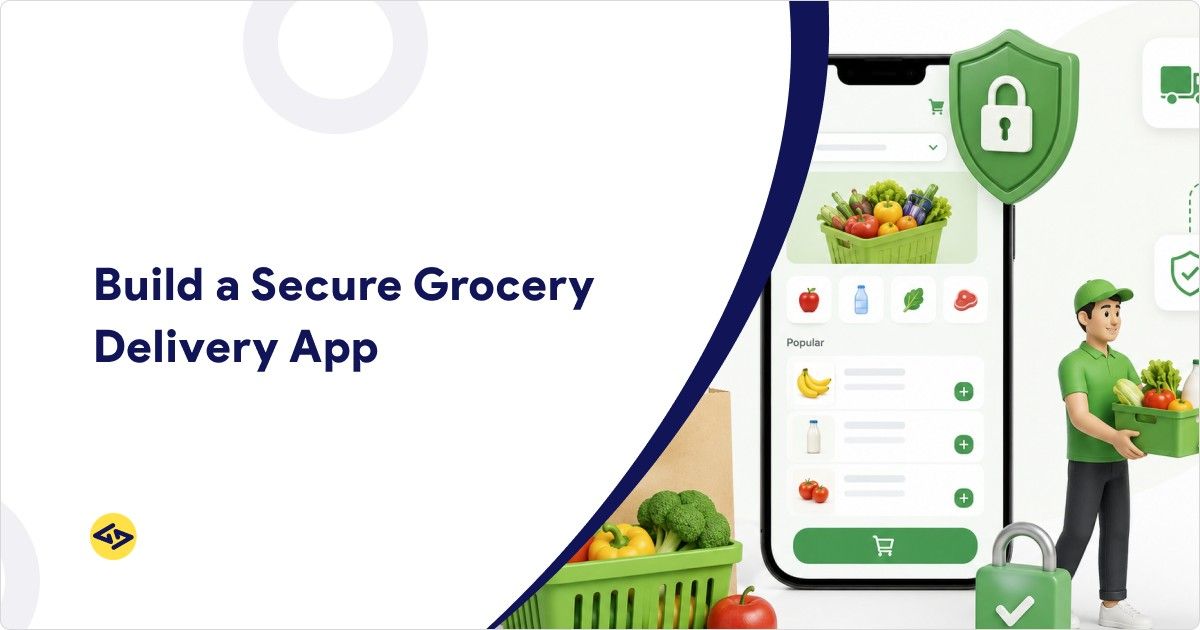
Build a Secure Grocery Delivery App
Create a trusted grocery delivery platform with robust security, protected customer data, and scalable architecture.

Frequently Asked Questions (FAQ)
Why is grocery delivery app security important?
It protects sensitive customer data — payment details, addresses, and order history — from breaches, fraud, and misuse, while also keeping the business compliant with data protection laws and maintaining customer trust.
How can grocery delivery apps protect customer data?
Through end-to-end encryption, strong authentication (MFA, biometrics), role-based access control, secure APIs, encrypted databases, and regular security audits and penetration testing.
What security features should a grocery delivery app include?
Secure login, two-factor authentication, encryption, real-time fraud monitoring, a secure payment gateway, admin access controls, and audit logs are considered baseline requirements.
How do grocery delivery apps prevent payment fraud?
By using PCI DSS–compliant payment gateways, tokenization, real-time fraud detection systems, and monitoring transaction patterns for anomalies.
What is the best authentication method for grocery delivery apps?
Multi-factor authentication combined with biometric login (fingerprint or face ID) offers strong security without adding excessive friction for customers.
What compliance standards should grocery delivery apps follow?
GDPR and CCPA for data privacy, PCI DSS for payment handling, and ISO 27001 or SOC 2 for broader information security management, depending on target markets.
How often should grocery delivery apps undergo security testing?
At minimum, quarterly vulnerability scans and at least one annual penetration test, with additional testing after major feature releases or infrastructure changes.
Can AI improve grocery delivery app security?
Yes — AI enables real-time fraud detection, behavioral anomaly detection, and predictive threat monitoring that traditional rule-based systems can’t match in speed or accuracy.
How much does it cost to build a secure grocery delivery app?
Costs vary based on features, compliance needs, and scale, but security-focused development (encryption, compliance, testing) typically adds to overall app development costs — a worthwhile investment against breach costs.
Which technology stack is best for secure grocery delivery app development?
A stack with strong native security support, active community maintenance, and proven scalability — commonly involving frameworks like Flutter or React Native for the frontend and secure cloud backends for data handling.