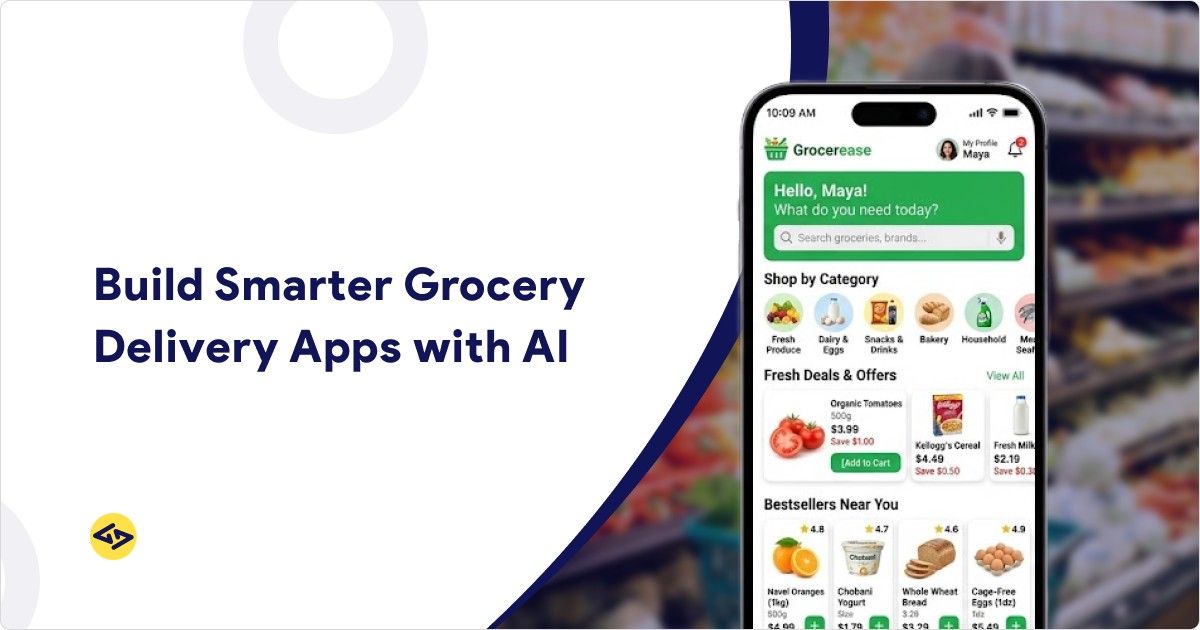
Online grocery shopping has moved from a convenience to an expectation. Customers want their milk, vegetables, and weekly essentials delivered in minutes, not hours — and they want the app to know what they need before they even search for it. That’s exactly what AI Grocery Delivery App Development makes possible.
If you’re a startup founder, retail business owner, or enterprise CTO exploring this space, here’s the short answer: AI doesn’t just digitize grocery shopping — it makes the entire supply chain smarter, from stocking shelves to dropping bags at the doorstep. This guide walks through what these apps are, why businesses are investing in them, the features that matter, the tech stack, and what it actually costs to build one.
If you’re building from scratch, our guide on how to build a hyperlocal grocery delivery app is a useful companion read.
What is an AI-Powered Grocery Delivery App?
An AI-powered grocery delivery app is a platform that uses artificial intelligence and machine learning to automate and optimize grocery ordering, inventory, delivery routing, and customer experience — instead of relying purely on manual rules and static workflows.
Traditional vs. AI-enabled apps, in short:
| Traditional Grocery App | AI-Powered Grocery App |
| Manual inventory updates | Real-time, predictive inventory management |
| Fixed delivery routes | AI-based route optimization |
| Generic product listings | Personalized recommendations |
| Static pricing | Dynamic, demand-based pricing |
| Basic order tracking | Predictive ETAs and live tracking |
In simple terms, AI turns a digital storefront into a self-improving system that gets faster and more accurate the more it’s used.
For a broader view of how the ordering-to-delivery cycle works, see our breakdown of how online grocery delivery apps work.
Why Businesses Are Investing in AI Grocery Delivery Apps
A few clear market forces are pushing grocery delivery app development toward AI:
- Convenience is non-negotiable. Customers compare grocery delivery to food delivery speed — and expect similar turnaround.
- Competition is fierce. From hyperlocal players to national chains, everyone is racing to reduce delivery time and cost.
- Manual logistics don’t scale. Route planning, stock checks, and demand prediction become unmanageable past a certain order volume without automation.
- Customers expect personalization. A one-size-fits-all catalog feels outdated next to apps that “just know” your weekly list.
This is why AI grocery app development has shifted from a competitive edge to a baseline requirement for serious players.
Benefits of AI in Grocery Delivery App Development
For Businesses
- Smarter inventory management — AI flags low stock and predicts replenishment needs before shelves go empty.
- Optimized delivery routes — Reduces fuel cost and delivery time simultaneously.
- Lower operational costs — Automation reduces manual labor in planning and forecasting.
- Accurate demand forecasting — Helps avoid overstocking or stockouts during seasonal spikes.
For Customers
- Personalized recommendations based on past orders and browsing behavior.
- Faster deliveries through optimized dispatching.
- Real-time order tracking with predictive ETAs.
- A smoother, more relevant shopping experience overall.
These benefits of AI in grocery delivery app development directly translate into higher retention and repeat orders — the two metrics that matter most in this business.
Must-Have Features of an AI-Powered Grocery Delivery App
Customer App Features
- User registration & login
- Product search with smart filters
- AI-based product recommendations
- Cart & seamless checkout
- Multiple payment options
- Real-time order tracking
- Ratings & reviews
Delivery Agent Features
- AI-driven route optimization
- Delivery scheduling
- Order status updates
Admin Panel Features
- Analytics dashboard
- Inventory management
- Order management
- Customer relationship tools
These grocery delivery app features form the foundation — AI layers on top to make each one smarter rather than replacing the basics.
AI Features That Make Grocery Apps Smarter
- AI-powered recommendations — Suggests items based on purchase history and seasonal trends.
- Predictive demand forecasting — Anticipates spikes (festivals, weekends) before they happen.
- Smart inventory management — Auto-updates stock levels across multiple warehouses or dark stores.
- Dynamic pricing — Adjusts prices based on demand, time, or inventory levels.
- Chatbots & virtual assistants — Handle order queries and support without human intervention.
- Fraud detection — Flags suspicious payment or account activity in real time.
- AI-based route optimization for grocery delivery — Cuts delivery time using live traffic and order-clustering data.
Together, these AI features for grocery delivery apps are what separate a basic ordering app from a genuinely smart grocery platform.
How to Develop an AI-Powered Grocery Delivery App
A reliable grocery delivery app development process generally follows these steps:
- Market Research — Understand your target audience, competitors, and local delivery logistics.
- Define Features — Prioritize must-haves vs. nice-to-haves based on budget and timeline.
- UI/UX Design — Design an intuitive, fast checkout flow — friction kills grocery conversions.
- Choose Tech Stack — Pick technologies that support scale and AI integration (see below).
- App Development — Build customer, delivery agent, and admin modules in parallel.
- AI Integration — Layer in recommendation engines, route optimization, and forecasting models.
- Testing & Launch — Test for load handling, payment accuracy, and real-world delivery scenarios before going live.
For inspiration on feature scope, our case study on building a grocery app like Instacart breaks down a real-world example.
Technology Stack Required
A solid grocery delivery app tech stack typically includes:
- Frontend: Flutter or React Native (cross-platform, faster time-to-market)
- Backend: Node.js or Laravel (scalable, handles high order volume)
- Database: MongoDB or PostgreSQL (flexible for inventory and order data)
- AI/ML: Python, TensorFlow, OpenAI APIs (powers recommendations and forecasting)
- Cloud: AWS or Google Cloud (reliable scaling during peak demand)
Want a deeper technical comparison? Check our detailed guide on the best tech stack for grocery apps.
Cost of AI-Powered Grocery Delivery App Development
Grocery delivery app development cost depends on several factors:
- App complexity and number of modules
- Number and depth of features
- Level of AI integration (basic recommendations vs. full predictive analytics)
- Development team location (offshore vs. local agencies)
- Platform choice (iOS, Android, or both)
Estimated Cost Range
| App Type | Estimated Cost |
| Basic App | $15,000 – $30,000 |
| Mid-Level App (with some AI features) | $30,000 – $60,000 |
| Advanced AI-Powered App | $60,000+ |
These figures reflect general grocery app development pricing trends — your exact grocery delivery software development cost will vary based on your specific feature list and AI scope. For a tailored estimate, exploring on-demand grocery delivery app development services is a good starting point.
Challenges in Grocery Delivery App Development
- Real-time inventory syncing across multiple stores or warehouses
- Delivery logistics in dense urban or scattered rural areas
- Customer retention in a price-sensitive, low-switching-cost market
- Managing peak demand during festivals or sales events
- AI implementation complexity — building accurate models needs clean, sufficient data
Anticipating these challenges early in the grocery delivery app development guide stage saves significant rework later.
Future Trends in AI Grocery Delivery Apps
- Hyper-personalization — Tailoring entire shopping experiences per user, not just product suggestions
- Voice commerce — Ordering groceries through voice assistants
- Autonomous delivery — Drones and robots handling last-mile delivery
- Smart warehouses — AI-managed dark stores with automated picking
- Predictive shopping — Apps that reorder essentials before you run out
These trends point to where smart grocery delivery app solutions are headed over the next few years — and early adopters will have a clear head start.
Why Choose Professional Grocery App Development Services
Partnering with an experienced grocery app development company offers:
- Faster development through proven workflows and reusable components
- Scalable architecture built to handle growth from day one
- Better security for payment and customer data
- Long-term support for updates, bug fixes, and feature additions
Whether you need a custom grocery delivery app development build or a white-label grocery delivery app solution to launch faster, working with the right grocery delivery app development services provider makes a measurable difference in time-to-market and app stability. For related capabilities, see our food & beverage software solutions.
If you’re researching the competitive landscape first, our list of top 10 grocery delivery apps is a helpful reference.
Conclusion Why AI Grocery Delivery App Development Is the Future
AI is no longer optional in grocery delivery — it’s shaping how businesses manage inventory, plan routes, and retain customers. Companies that adopt AI-powered retail delivery solutions early are positioning themselves for long-term competitive advantage, while those relying on outdated, manual systems risk falling behind on speed and customer expectations.
Investing in AI-powered grocery delivery app development today is a future-ready move — not just a trend to watch from the sidelines.
Need help building your own AI-powered grocery delivery app? Talk to our team about your project requirements and get a tailored development roadmap.
Ready to Build Your AI-Powered Grocery Delivery App?
Transform your grocery business with AI-driven automation, smart recommendations, and faster delivery management.

Frequently Asked Questions
What is an AI-powered grocery delivery app?
It’s a grocery ordering platform that uses AI and machine learning to automate inventory management, personalize recommendations, optimize delivery routes, and forecast demand.
How much does AI-powered grocery app development cost?
Costs typically range from $15,000 for a basic app to $60,000+ for an advanced AI-integrated platform, depending on features and complexity.
What features should a grocery delivery app have?
Core features include product search, AI recommendations, real-time tracking, multiple payment options, route optimization for delivery agents, and an analytics-driven admin panel.
Which tech stack is best for grocery delivery app development?
A common stack includes Flutter or React Native for frontend, Node.js or Laravel for backend, MongoDB or PostgreSQL for databases, and Python/TensorFlow for AI integration.
How long does it take to build a grocery delivery app?
Depending on complexity, development typically takes 3 to 9 months, with AI integration adding additional time for model training and testing.
What are the benefits of AI in grocery delivery apps?
AI improves inventory accuracy, reduces delivery time through route optimization, personalizes the shopping experience, and helps forecast demand more accurately.
Can I build a white-label grocery delivery app instead of a custom one?
Yes. A white-label grocery delivery app solution lets you launch faster at a lower cost, though customization options are more limited than a fully custom build.
Is AI grocery app development suitable for startups?
Yes — many startups begin with core AI features like recommendations and route optimization, then scale up to predictive analytics and dynamic pricing as they grow.
What industries benefit most from AI-powered grocery delivery solutions?
Supermarkets, hyperlocal delivery startups, dark store operators, and enterprise retail chains all benefit from AI-driven grocery delivery platforms.
How do I choose the best grocery delivery app development company?
Look for proven experience with AI/ML integration, a strong portfolio in retail or delivery apps, transparent pricing, and a clear post-launch support plan.