Country Delight has grown into a prominent direct-to-consumer (D2C) dairy and grocery delivery brand in India, built around a recurring need: fresh essentials delivered to the doorstep. If you’re building a D2C startup, its journey offers a practical playbook — how it makes money, why its subscription model works, and how it turned a low-margin category into a scalable business.
This is where the Country Delight business model becomes genuinely useful to study. It shows how subscription-led delivery, direct customer relationships, and cross-selling can be combined into a repeatable growth engine — even in a category as thin-margin as dairy.
In this Country Delight case study, you’ll learn:
- Key lessons for D2C startups
- How Country Delight works
- How it makes money and its revenue streams
- Its Business Model Canvas
- Customer acquisition and retention strategy
- Whether Country Delight is profitable
What Is Country Delight?
Country Delight was co-founded by Chakradhar Gade and Nitin Kaushal in 2013. Chakradhar Gade serves as CEO. The company began with a focus on delivering fresh milk directly to urban households and has since expanded into dairy, fruits, vegetables, and other grocery categories.
Country Delight describes a model where products are collected from farms, quality-tested and packed at its own facilities, and delivered within hours through its app-based ordering and delivery network. Its target customer is the urban household that wants consistent, quality-checked dairy and groceries without a daily trip to the store.
Country Delight’s Core Value Proposition
- Freshness — products sourced and delivered within hours
- Convenience — doorstep delivery on a fixed schedule
- Subscription-based ordering — no need to reorder manually
- Direct relationship — a direct link between the company and the customer, supported by its own sourcing and delivery network
How Does the Country Delight Business Model Work?
The customer journey is straightforward:
sign up → choose a subscription → place an order → products are sourced, quality-tested, processed/packed → delivered through a local distribution network → customer renews.
Direct-to-Consumer Model
By managing sourcing, quality checks, and delivery itself rather than relying on a traditional retail chain, Country Delight can maintain closer oversight of quality and collect first-party customer data that a retail-first dairy brand typically wouldn’t have access to.
Subscription-Based Delivery Model
Recurring orders create predictable demand, and customers can pause, skip, or modify deliveries — reducing the friction of daily reordering.
Hyperlocal Delivery Network
Local sourcing and last-mile delivery hubs keep products fresh and delivery costs manageable, which is core to the Country Delight milk delivery business model.
Country Delight Business Model Canvas
A quick look at the Country Delight business model canvas across its nine building blocks:
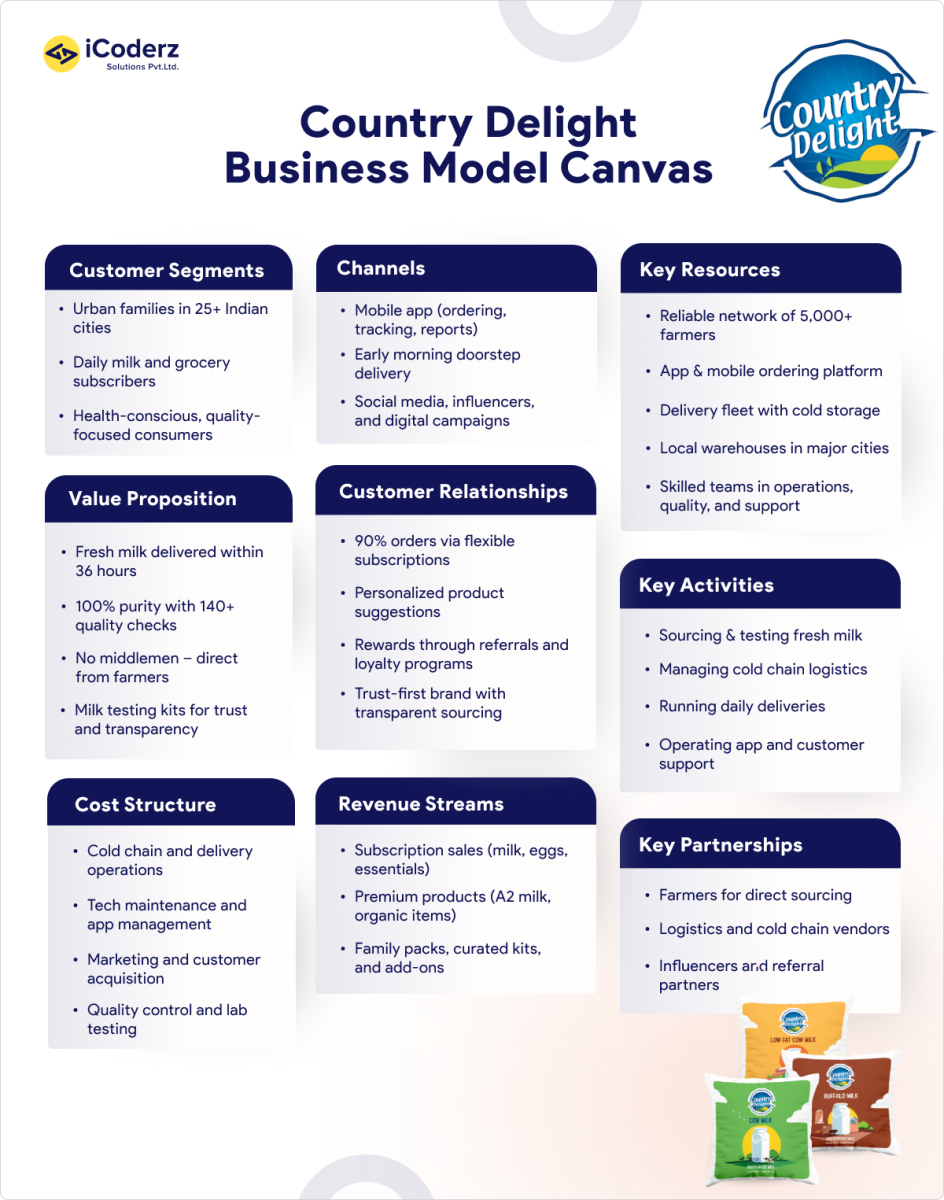
1. Customer Segments
Country Delight is a subscription-based, vertically integrated D2C brand that delivers fresh dairy and essential groceries directly to customers. Founded in 2015 by Chakradhar Gade and Nitin Kaushal, both IIM Indore alumni, it emerged to tackle inefficiencies and a lack of trust in India’s dairy sector.
The company serves over 2 million households across more than 15+ cities in India and has built an app-based ecosystem for recurring orders. With a “farm-to-door in 36 hours” model, the company ensures transparency, freshness, and convenience. Customers typically subscribe to early morning milk deliveries and manage preferences through a highly rated mobile app.
From milk, curd, and paneer to cold-pressed oils and chemical-free veggies, Country Delight has built a habit-forming ecosystem where customers wake up to a basket of essentials at their doorstep. This reliability is the cornerstone of its brand promise.
2. Value Proposition
Country Delight’s competitive edge lies in its end-to-end control over the entire value chain. This full-stack, vertically integrated model delivers exceptional quality, consistency, and operational efficiency—making it a true “farm-to-fridge D2C revolution.”
Direct Farmer Sourcing: The Foundation of Purity
Country Delight directly partners with over 5,000 farmers, removing traditional middlemen who often compromise on quality. This approach allows the brand to:
- Offer fair pricing to farmers, encouraging long-term, high-quality supply relationships.
- Conduct rigorous quality checks at the source—covering more than 140 parameters, including purity, fat content, SNF, absence of detergents, urea, antibiotics, and artificial hormones.
- Ensure full traceability, with each milk batch traceable back to its source farm, enhancing transparency and accountability.
Trust Through Transparency
To reinforce quality, new customers receive a milk testing kit with their first order, empowering them to verify purity themselves. This move builds trust, addresses concerns about adulteration, and establishes transparency as a core brand promise.
3. Channels
Cold Chain Logistics: Preserving Freshness, End-to-End
A consistently maintained 4°C cold chain ensures milk stays fresh from farm to doorstep. The system includes:
- Regional chilling centers near farms for rapid post-harvest cooling.
- A proprietary fleet of over 1,500 IoT-enabled vehicles for real-time temperature monitoring during transit.
- Urban micro-fulfillment centers act as local storage and dispatch points.
- Early morning deliveries (4–7 AM) to guarantee freshness before perishables are affected by heat.
Mobile-First Platform: Seamless Customer Experience
The Country Delight app is central to customer engagement and order management. Key features include:
- Real-time delivery updates and flexible subscription management.
- Personalized product recommendations based on user behavior.
- Batch-specific milk quality reports, addressing consumer concerns about adulteration and reinforcing brand trust.
4. Customer Relationships
Subscription-Based Demand: Predictable Revenue and Customer Loyalty
About 90% of orders are recurring, powered by a robust subscription model. This brings:
- Stable cash flow and operational predictability, enabling better resource planning and infrastructure investment.
- AI-powered forecasting using historical data and demand patterns to optimize inventory and reduce waste.
- A habit-forming experience, where fresh essentials become a part of the customer’s morning routine—boosting loyalty and retention.
Customer Acquisition & Marketing: Building Trust and Driving Growth
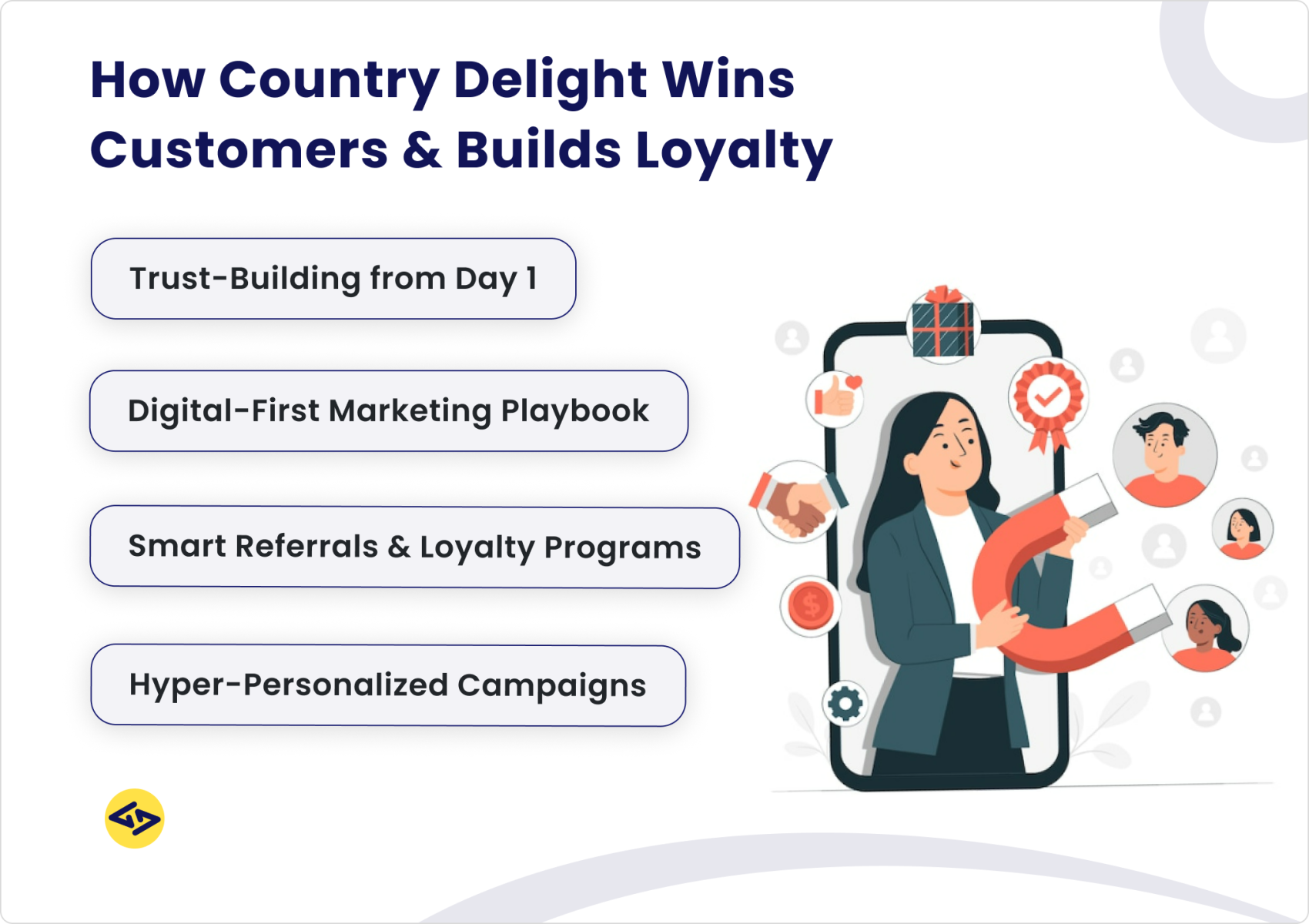
Country Delight’s marketing success stems from its trust-first strategy, digital-first execution, and deep customer insights.
Trust-Building Initiatives
Early adoption was fueled by word-of-mouth and milk testing kits in first orders—directly addressing consumer concerns around purity and adulteration.
Digital-First Strategy
The brand actively leverages:
- Social Media (Instagram, Facebook) to promote freshness and build community
- Content & Influencer Marketing to educate and engage health-conscious users
- SEO & Email Campaigns to drive traffic and retention
- Ad Campaigns like “Technology ka Kamaal” to reinforce its D2C value
Referrals & Loyalty
In-app referral programs reward users, encouraging word-of-mouth and lowering CAC effectively.
5. Revenue Streams
Country Delight’s subscription-first D2C model has enabled impressive growth:
Fiscal Year Revenue (INR Cr):
FY18: 19
FY19: 65
FY20: 175
FY21: 321
FY22: 543
FY23: 900+
FY24: 1,380
The company has raised over $ 221 million from investors such as Temasek, Elevation Capital, Matrix Partners, Orios Ventures, and Venturi Partners, including the $108 million Series D in May 2022 and the ₹ 212.5 crore Series E in March 2025.
Diverse Revenue Streams: Beyond Just Milk
While milk is the core product, Country Delight has smartly diversified its revenue model:
- Subscriptions (90% of revenue): Recurring orders for milk, eggs, bread, and other essentials
- Premium SKUs: Offerings like A2 milk, organic vegetables, and artisanal products
- Bundled Essentials: Curated kits and family packs
- High-Margin Add-ons: Ghee and paneer
6. Key Resources
Technology as a Growth Driver: The Digital Backbone
Country Delight is a tech-first D2C milk delivery brand, operating 17+ proprietary platforms that power sourcing to doorstep delivery
(Source: Retail Economic Times)
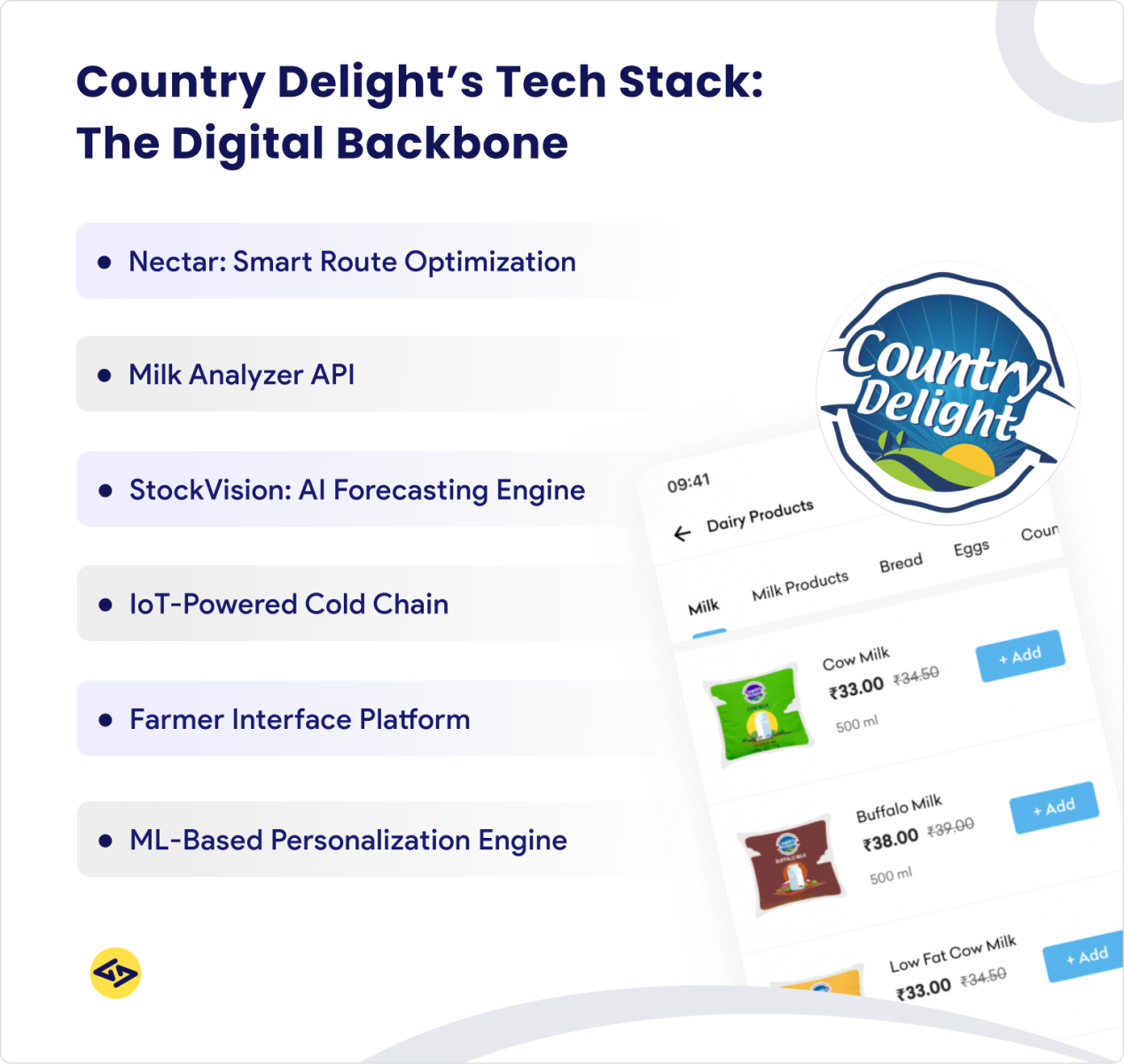
Nectar: Smart Route Optimization
Optimizes last-mile delivery based on live traffic, weather, and time windows.
Milk Analyzer API
Tests milk across 140+ parameters.
IoT-Powered Cold Chain
Real-time temperature control in chilling units and vans.
Farmer Interface
Farmers get real-time quality reports, payment updates, and logistics info.
ML-Based Personalization
App experience is tailored using machine learning and user data.
7. Key Activities
All core operational and strategic functions, including:
- Sourcing raw milk from farmers
- Testing for quality and safety
- Maintaining a 4°C cold chain from farm to doorstep
- Forecasting demand and inventory
- Operating the mobile platform
- Running customer engagement and marketing automation
8. Key Partnerships
- 5,000+ farmers directly integrated through their proprietary supply network
- Logistics tech and IoT vendors
- Influencers and affiliates for acquisition and trust-building
9. Cost Structure
Strong Unit Economics: A Path to Profitability
Main cost drivers include:
Cold chain logistics infrastructure
Technology development & maintenance
Customer acquisition (marketing, influencers, referrals)
Delivery and operations workforce
Lab testing and QA management
Country Delight’s business thrives on habitual, high-frequency purchasing, resulting in robust unit economics:
- Gross Margins: 35–50%
- CAC Payback: 2–3 months
- LTV per User: ₹6,000–₹10,000/year
- Spoilage: <1%, compared to the industry average of 6–7%
How Does Country Delight Make Money?
A common question when researching the brand is how its Country Delight revenue model actually works. Here’s the breakdown.
Milk & Dairy Product Sales
Milk is the anchor product, and curd, paneer, ghee, and butter extend the basket further — expanding revenue beyond milk without a separate acquisition effort.
Grocery & Fresh Produce Sales
Fruits, vegetables, and grocery essentials increase basket size and customer lifetime value once trust is established through milk delivery.
Subscription & Membership Revenue
Recurring subscriptions are the structural backbone of the business — they convert one-time buyers into predictable, repeat revenue.
Cross-Selling & Upselling
Once a customer trusts Country Delight for milk, introducing adjacent products raises average order value with minimal extra acquisition cost.
Repeat Purchases & Customer Lifetime Value
Subscription renewals and repeat purchases compound over time, making customer retention as important to revenue as new customer acquisition.
Note: Country Delight does not publicly break down exact revenue-share percentages by category, so this section focuses on the mechanics rather than unverified numbers.
Country Delight’s Subscription Business Model
Subscription is arguably the single biggest differentiator in the Country Delight subscription model.
How It Works
Customers pick products, set a delivery schedule, and receive recurring deliveries — with the flexibility to pause or adjust. Country Delight’s own app and website promote this as a hassle-free, customizable subscription experience.
Why Subscription Works for Dairy
Milk is a frequently purchased household staple, making it naturally suited to recurring delivery — unlike discretionary D2C categories where subscriptions can feel forced.
Benefits for Country Delight
Predictable demand, better delivery planning, higher retention, and stronger customer lifetime value.
Benefits for Customers
No repetitive ordering, consistent supply, and a personalized purchasing experience.
If you’re evaluating whether to build something similar, this subscription based milk delivery app breakdown covers the core building blocks in more depth.
Country Delight’s Customer Acquisition Strategy
- Digital marketing — search, social, and performance campaigns
- Referral & word-of-mouth — trust-driven growth through existing customers
- Hyperlocal marketing — targeting specific serviceable pin codes
- Product-led acquisition — trial offers that convert into subscriptions once customers experience the quality difference
How Country Delight Retains Customers
Retention matters more than acquisition in a subscription business, and Country Delight leans on:
- Subscription convenience and flexibility
- Consistent product quality
- Personalized recommendations
- Responsive customer service
- Cross-selling to deepen the relationship
- Habit-based consumption — milk is a frequently purchased staple, so recurring consumption naturally creates recurring engagement
Country Delight’s Supply Chain & Delivery Model
- Sourcing & procurement — direct farmer and supplier relationships with quality checks
- Processing & packaging — pasteurization, quality testing, and packing at its own facilities
- Order management — demand forecasting based on subscription data
- Last-mile delivery — hyperlocal routes optimized for speed
- Freshness — a shorter, faster supply chain from source to doorstep
Startups exploring this space often start by studying the milk delivery business model before building their own operations.
Country Delight’s Technology & Digital Infrastructure
Customer App
Product discovery, subscription management, order modification, payments, delivery preferences, and notifications.
Subscription & Order Management
Recurring orders, skip/pause functionality, order cut-off times, and billing.
Delivery Management
Route planning, delivery assignments, location management, and delivery status tracking.
Data & Analytics
Demand forecasting, customer purchasing patterns, retention/churn analysis, and product recommendations.
Country Delight’s app currently supports customizable subscriptions, order modification, payments, and scheduled delivery — the kind of functionality any team building a milk delivery app development product needs to plan for from day one.
Country Delight’s Key Business Metrics
Rather than speculate on unverified numbers, here are the metrics that actually define a business like this:
- Customer Acquisition Cost (CAC)
- Customer Lifetime Value (LTV)
- Subscription retention rate
- Average Order Value (AOV)
- Order frequency
- Churn rate
- Delivery cost per order
- Gross margin
The goal, as with any subscription D2C business, is to grow LTV while keeping CAC, delivery costs, and churn under control.
Why Country Delight’s D2C Model Works
- Recurring customer need — milk and dairy are frequently purchased staples
- Direct customer relationship — closer oversight of the sourcing-to-delivery chain than a retail-mediated brand
- Predictable demand — subscriptions make forecasting easier
- Higher LTV — repeat purchases build long-term relationships
- Cross-selling opportunities — trust in one category opens the door to others
- Convenience as a competitive advantage — doorstep delivery, recurring orders, and flexible subscriptions reduce purchase friction and encourage repeat usage
Is Country Delight Profitable?
A common question when evaluating the business is whether Country Delight is profitable. The company has historically operated with a strong focus on growth and has reported losses in earlier financial years. Publicly reported figures put FY24 revenue at around ₹1,380 crore, though Country Delight is a private company, and detailed, current financial information isn’t as readily available as it would be for a listed business. The company has previously discussed its path toward EBITDA breakeven, so profitability is best evaluated using the latest available financial disclosures rather than assumed from older reporting.
Challenges in Country Delight’s Business Model
No case study is complete without the trade-offs:
- Last-mile delivery costs
- Maintaining freshness at scale
- Supply chain complexity across regions
- Customer churn
- Rising customer acquisition costs
- Competition from online grocery and quick-commerce players
- Scaling quality consistently across new cities
- Balancing demand and supply in a perishable category
Country Delight vs Traditional Dairy Distribution
| Factor | Traditional Dairy Model | Country Delight D2C Model |
| Distribution | Multi-layer | Direct-to-consumer focused |
| Customer relationship | Retailer-mediated | Direct |
| Ordering | Retail purchase | App/subscription |
| Customer data | Limited | Direct customer data |
| Delivery | Retail/local channels | Doorstep delivery |
| Revenue pattern | Primarily transaction-based | Recurring + repeat purchases |
| Personalization | Limited | Greater potential |
Country Delight vs Traditional D2C Brands
Beyond dairy specifically, it’s useful to compare Country Delight’s model against typical D2C brands built on discretionary products:
| Factor | Traditional D2C | Country Delight |
| Purchase frequency | Low/medium | High |
| Subscription fit | Varies by category | Strong |
| Product type | Discretionary + essentials | Daily/frequent essentials |
| Customer retention | Campaign/product driven | Habit + subscription driven |
| Delivery frequency | Occasional | Frequent |
| Cross-selling | Product-led | Basket-led |
What D2C Startups Can Learn From Country Delight
- Build around a recurring need — subscriptions work best on things people buy repeatedly anyway
- Subscription creates predictable revenue — but only if the category supports frequent consumption
- Own the customer relationship — direct customer relationships give D2C brands greater access to first-party behavioral and purchasing data
- Focus on retention, not just acquisition — a loyal subscriber is worth more than a one-time buyer
- Use cross-selling to increase LTV — expand the basket once trust is earned
- Build operational efficiency alongside growth — scaling a perishable supply chain is harder than scaling software
- Technology should solve operational problems — not just look good in a pitch deck
- Build a strong anchor category before expanding the basket — Country Delight’s milk business is a good example: it earned trust in one essential category first, then used that trust to introduce dairy, produce, and grocery items
How to Build a D2C Subscription Delivery App Like Country Delight
If you’re inspired to build something similar, a platform like this typically needs four components:
- Customer app — registration, subscriptions, payments, tracking, notifications
- Admin panel — customer, product, order, and subscription management
- Delivery partner app — route navigation, order status, earnings
- Supplier/operations panel — procurement, inventory, quality management
Checking features of a milk delivery app beforehand helps scope the MVP correctly before development begins.
How Much Does It Cost to Build an App Like Country Delight?
Cost depends on scope, but the major line items are consistent:
- UI/UX design
- Customer, delivery, and admin apps
- Backend and subscription engine
- Payment gateway integration
- GPS and location services
- Push notifications and analytics
- Third-party integrations
- Cloud infrastructure
For a detailed breakdown by feature and complexity, this guide on the cost to develop a milk delivery app is a useful starting point before budgeting your build.
Conclusion
Country Delight’s model comes down to a simple formula: D2C + subscription + recurring consumption + direct customer relationship + doorstep delivery. None of these ideas is individually new; what makes it work is how tightly they’re combined around a category people buy frequently.
For D2C startups, the strongest business models don’t just sell products; they create repeatable customer relationships around recurring needs.
Need help designing and building a platform like this? iCoderz Solution can help you plan the app, backend, and logistics systems from the ground up.
Launch Your D2C App Like Country Delight
Need a custom app to manage subscriptions, logistics, and daily delivery?

FAQs About Country Delight’s Business Model
What is Country Delight’s business model?
It’s a subscription-led, direct-to-consumer dairy and grocery delivery model that manages sourcing, quality checks, and delivery to bring products to customers’ doorsteps.
How does Country Delight make money?
Primarily through recurring milk and dairy subscriptions, grocery and produce sales, and cross-selling to existing subscribers.
Is Country Delight a D2C company?
Yes. It manages sourcing, processing, and delivery directly to consumers rather than relying solely on retail intermediaries.
How does Country Delight’s subscription model work?
Customers select products and a delivery schedule, then receive recurring deliveries that they can pause, skip, or modify as needed.
What are Country Delight’s main revenue streams?
Milk and dairy products like curd, paneer, and ghee, grocery and produce sales, and cross-selling to existing subscribers.
Why does the subscription model work for milk delivery?
Because milk is a frequently purchased household staple, which makes recurring delivery genuinely convenient rather than an artificial subscription.
Is Country Delight profitable?
It has historically reported losses in earlier financial years while prioritizing growth, and has discussed a path toward EBITDA breakeven; exact current profitability figures are not consistently public since it’s a private company.
Who is the owner of Country Delight?
It was co-founded by Chakradhar Gade, who serves as CEO, and Nitin Kaushal. Institutional investors hold a majority of shares, with founders retaining a meaningful stake.
What can D2C startups learn from Country Delight?
That recurring-need categories, direct customer relationships, and disciplined retention efforts can turn a low-margin product into a scalable subscription business.
How much does it cost to build an app like Country Delight?
Costs vary by scope, but typically cover app development for customers, delivery partners, and admins, plus backend infrastructure, payments, and analytics.