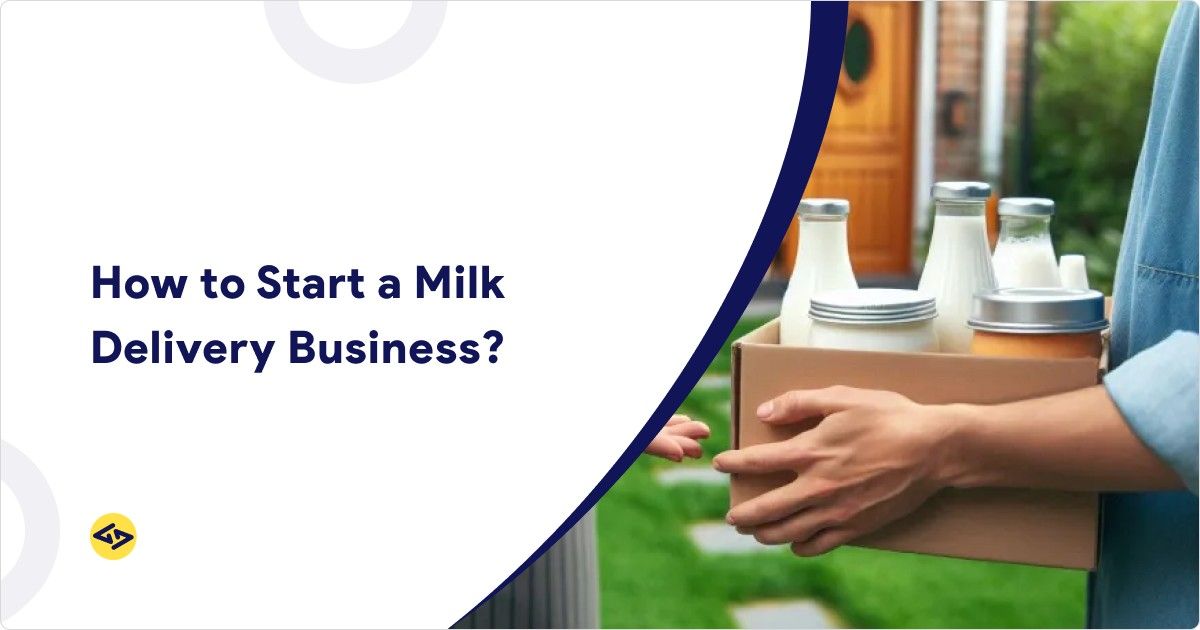
Imagine delivering fresh, locally sourced milk right to customers’ doorsteps. As lifestyles become busier, customers increasingly seek reliable delivery services.
There needs to be a dependable, on-demand milk delivery app. The best online dairy milk delivery solutions facilitate ordering, subscription, and tracking, allowing for smooth operation and customer satisfaction. Daily milk delivery applications like Country Delight and bbdaily are examples of the latest trends in home milk delivery services.
The COVID-19 situation has made online milk delivery famous, and the demand for such services is still growing.
The global online milk delivery market is booming, valued at approximately USD 10.5 billion in 2023 and projected to reach USD 25.8 billion by 2032.
In this blog, we discuss the beginning of your own online milk delivery business. It also provides a special guide to milk delivery app development to help you stand out.
Quick answer: To start a milk delivery business, choose a model (direct, aggregator or subscription), register with FSSAI and for GST, secure a reliable milk supplier, set up cold-chain delivery routes, launch a subscription app or WhatsApp ordering, and acquire customers society by society. A small local operation can start with a few lakh rupees, while an app-led city launch needs a larger budget.
Milk is a daily purchase, which makes it one of the most predictable categories in retail. Brands such as Country Delight have shown that customers who start with a milk subscription often add other products over time. This guide explains how to build the same kind of business at your own scale: the steps, the licences, the costs, the technology and the mistakes to avoid.
In this guide: market snapshot, 10 launch steps, business models, startup cost, profit, licences, app features, marketing, mistakes, and FAQs.
What is a milk delivery business?
A milk delivery business sources fresh milk and dairy products from farms or dairies and delivers them to homes or businesses on a schedule. Customers order through an app, website or messaging channel, usually on a daily, alternate-day or weekly subscription. Revenue comes from the margin between procurement and selling price, plus delivery fees and add-on products such as paneer, curd, ghee, eggs and bread.
Is the milk delivery business profitable?
It can be, but margins on milk itself are thin, so profit depends on volume, route density and low wastage. Subscription demand is predictable, which helps planning and cash flow. Most operators make money by serving many customers within a small area, keeping returns and spoilage low, and adding higher-margin products. See the illustrative example in the cost section below.
Milk delivery market snapshot (2026)
- India’s dairy market is estimated at about US$158.1 billion in 2026, growing to about US$304.2 billion by 2033 (Persistence Market Research). Liquid milk holds roughly 48% share.
- Subscription-led players show how large the category can get. Country Delight reported revenue of about ₹1,380 crore in FY24 according to Entrackr, citing a report by The ARC (the company had not filed official FY24 accounts at the time).
- Quality and adulteration concerns drive demand for branded, traceable fresh milk. Newer product lines such as high-protein milk and degradable packaging show where the category is heading.
- Regulation is tightening: FSSAI issued an advisory in March 2026 requiring milk producers outside cooperatives and milk vendors to hold the right registration or licence.
Use one market-size source throughout the article and cite it with a date. Remove the older conflicting figures.
How to start a milk delivery business: 10 steps
1. Research your local market
Decide your area, customer type and price point before you buy anything. Walk through 5 to 10 housing societies, talk to residents about what they pay, when they need delivery and what they dislike about their current milkman or app. Check competitors such as local vendors, Amul and Mother Dairy booths, and apps like Country Delight, Milkbasket or BB Daily. Look for gaps: A2 milk, organic, lactose-free, early-morning slots or reliable service in an underserved society.
Time: 1 to 2 weeks. Common mistake: choosing a city-wide launch instead of a dense pilot area.
2. Choose your business model
Pick one model to start, then add others. The three common models are compared below.
| Model | How it works | Best for | Main risk |
|---|---|---|---|
| Direct delivery | You buy from farms or a dairy and deliver yourself | Local startups, farm owners | Limited reach and product range |
| Aggregator (marketplace) | A platform lists multiple dairies and handles ordering and delivery | Tech-led founders with capital | Quality control across suppliers |
| Subscription | Customers pre-book daily, alternate-day or weekly delivery | Almost every new operator | Churn if service is inconsistent |
Most successful operators run a subscription core and add on-demand top-ups for other products.
3. Write a business plan with numbers
Your plan should cover target area, expected subscribers, milk volume per day, procurement price, selling price, delivery cost per order, monthly fixed costs and break-even subscribers. Keep it practical: a one-page plan with a 12-month forecast is enough for a first launch, and investors will want the same unit economics.
4. Register your business and get licences
Register the entity (sole proprietorship, partnership or private limited), open a current account, get GST registration if required, and apply for FSSAI registration or licence before you sell. Details are in the licences section below.
5. Source milk and dairy suppliers
Sign with local dairies, farms or cooperatives that can supply consistent quality every morning. Ask for fat and SNF test reports, hygiene practices, cold-chain capability and backup supply. Start with two suppliers so a single failure does not stop deliveries. If you promise “farm fresh” or “organic”, keep proof, because labelling claims are regulated.
6. Set up cold chain and packaging
Milk spoils fast, so plan storage and transport before launch. You need a clean chilling or storage area, insulated crates or refrigerated vehicles, and food-grade packaging (pouches, bottles or reusable glass). Reusable bottles and returnable crates can cut plastic use and appeal to eco-conscious customers.
7. Plan delivery logistics
Delivery windows are narrow, usually 5 to 8 am. Use fixed routes, group customers by society, and give each rider a manageable route. Route optimisation software and live tracking become important once you pass a few hundred customers. Electric two-wheelers lower running cost per delivery in dense areas.
8. Build your ordering system: app, website or WhatsApp
Start simple, then upgrade. A WhatsApp or form-based setup works for the first 50 to 100 customers. Beyond that, a subscription app with auto-billing, pause and resume, wallet payments and delivery tracking saves hours of manual work and reduces billing disputes. See the app features and build-versus-buy sections below.
9. Launch and acquire your first 100 customers
Go society by society. Offer a free trial pack or a first-week discount, set up stalls in housing societies, ask early customers for referrals, and use local Facebook, Instagram and WhatsApp groups. Local SEO matters: create a Google Business Profile with your service area, photos and reviews.
10. Measure, improve and scale
Track on-time delivery rate, complaints per 1,000 orders, wastage, churn and cost per delivery. Expand to nearby societies only when existing routes are profitable. Add products (paneer, curd, ghee, eggs, bread) to raise order value without adding routes.
How much does it cost to start a milk delivery business?
Cost depends on scale, so treat the table as an indicative planning range and replace it with local quotes.
| Cost item | Small local setup | App-led city launch |
|---|---|---|
| Registrations and licences (FSSAI, GST, others) | Low (a few thousand rupees) | Low to moderate |
| Storage, chilling and crates | Basic fridge or chiller and crates | Dedicated cold storage |
| Vehicles | Rider-owned or 2 to 3 two-wheelers | Fleet or leased EVs |
| Initial stock and packaging | One to two weeks of milk | Several weeks of buffer |
| Technology | WhatsApp or low-cost SaaS | Custom app or SaaS with branding |
| Marketing and launch offers | Local activation | City campaigns and referral credits |
| Working capital | 1 to 2 months of costs | 3 to 6 months of costs |
Illustrative unit economics (example only)
The numbers below are assumptions, not a benchmark.
- 500 households buying 1.5 litres per day = 750 litres per day
- Selling price ₹70 per litre, procurement ₹60 per litre
- Monthly revenue: 750 x 70 x 30 = about ₹15.75 lakh
- Gross margin: ₹10 per litre = about ₹2.25 lakh per month
- Monthly operating costs (riders, packaging, storage, software, marketing, other): about ₹1.75 lakh
- Operating profit: about ₹50,000 per month
The example shows why scale and add-ons matter: a small drop in margin or a rise in wastage can erase the profit. Adding higher-margin products and raising route density is how operators improve results.
Licences and registrations required
Requirements depend on location and turnover, so confirm with your local authority or a compliance professional.
| Requirement | Why you need it |
|---|---|
| FSSAI registration or licence | Mandatory for food businesses, including milk vendors and distributors |
| GST registration | Required once turnover or inter-state sales cross the threshold |
| Shop and Establishment registration | Needed for your business premises in most states |
| Trade licence (local body) | Required in many municipalities |
| Weights and measures compliance | Applies if you sell packaged goods by quantity |
FSSAI thresholds from 1 April 2026: basic registration for annual turnover up to ₹1.5 crore, state licence for ₹1.5 crore to ₹50 crore, and central licence above ₹50 crore. Dairy processing and chilling units have additional capacity-based rules. These limits come from the FSSAI order of 13 March 2026. A separate FSSAI advisory of March 2026 requires milk vendors and independent milk producers (outside dairy cooperatives) to register or hold a licence. The 2026 amendment regulations also provide perpetual validity for registrations and licences, subject to risk-based inspections. Check the FSSAI portal (FoSCoS) for your exact category.
Outside India: in the US and UAE you will need local food and dairy permits, health department approvals and cold-chain compliance. Check state or emirate rules before launch.
Milk delivery app: features and technology
A milk delivery app turns a manual route business into a scalable one. Core features:
- Customer app: subscription plans, pause and resume, one-time add-ons, wallet and UPI payments, delivery tracking, order history, ratings
- Delivery partner app: daily route list, delivery confirmation, empty-bottle collection, cash and COD tracking
- Admin panel: subscriber management, inventory, supplier management, billing, route planning, reports
- Smart features: auto-billing, low-balance alerts, personalised recommendations, referral and loyalty programmes, WhatsApp notifications, multi-language support
Build a custom app or use SaaS?
| Option | Best for | Trade-off |
|---|---|---|
| Ready-made SaaS | Early-stage and single-city operators | Faster and cheaper, less customisation |
| Custom milk delivery app | Brands planning to scale or differentiate | Higher upfront cost, full control and branding |
A custom build makes sense when you need your own branding, unique workflows or integrations. Our team builds white-label and custom solutions; see our milk delivery app development services and our guide on how to build a milk delivery app like Country Delight.
Typical cost and timeline: as indicative iCoderz estimates for a standard scope (customer app, delivery partner app and admin panel), an MVP costs about $15,000–$25,000 and takes 2 to 3 months, a standard build about $25,000–$50,000 in 3 to 4 months, and an advanced build $50,000–$100,000+ in 4 to 6 months. A white-label app usually costs less and launches faster. Final quotes depend on features, platforms and integrations. Get a quote for your scope.
How to price milk subscriptions
- Offer daily, alternate-day and weekly plans with clear per-litre pricing.
- Use a prepaid wallet to cut payment collection effort and bad debt.
- Offer small discounts for longer commitments and bundles (milk plus curd or eggs).
- Keep delivery free above a minimum monthly order value, or build it into price.
- Allow easy pause and skip, because flexibility reduces cancellations.
How to get your first customers
- Societies and apartments: stalls, free trial packs, resident WhatsApp groups
- Referrals: credit for both the referrer and the new customer
- Local SEO: Google Business Profile with service area, photos and reviews
- Social media: short videos of farm sourcing, testing and your morning delivery
- B2B: cafes, offices, tiffin services and small restaurants with bulk contracts
Case snapshot: Country Delight
Country Delight began as a milk delivery startup built around trust in a market where adulteration is a concern. It grew with a subscription-first model, app-based delivery and batch-level quality information, then added other fresh products. The lesson for new operators: consistency and trust bring retention, and retention supports expansion into new categories. Entrackr, citing The ARC, reported FY24 revenue of about ₹1,380 crore, up from an estimated ₹900 crore in FY23.
Common mistakes to avoid
- Launching across a whole city instead of a dense pilot zone
- Ignoring FSSAI registration until after launch
- Relying on a single supplier
- Weak cold chain, which causes spoilage and complaints
- Manual billing that leads to disputes and churn
- Underpricing without calculating delivery cost per order
- Expanding routes before existing ones are profitable
Conclusion
Starting a milk delivery business in 2026 comes down to a few disciplines: licences in place, reliable supply, a tight cold chain, dense routes and a simple way for customers to subscribe and pay. Start small, prove your unit economics in one area, and add technology as volume grows.
If you are planning a branded app, our team can help you scope features, cost and timeline. Talk to our milk delivery app experts for a free consultation.
Start Your Milk Delivery App Today
Get a custom app solution designed for seamless milk delivery operations.

Frequently asked questions
How do I start a milk delivery business?
Choose your model, register with FSSAI and for GST, find a reliable milk supplier, set up cold-chain delivery, launch an ordering system (WhatsApp or app) and acquire customers society by society.
How much does it cost to start a milk delivery business?
A small local setup can start with a few lakh rupees for stock, storage, packaging and working capital. An app-led city launch costs more. Your exact cost depends on city, scale, vehicles and technology.
Is a milk delivery business profitable?
It can be profitable at scale. Margins per litre are thin, so profit depends on route density, low wastage and add-on products.
What licence is required for a milk delivery business in India?
You need FSSAI registration or a licence, depending on turnover, along with GST (when applicable) and local shop or trade registrations. Check the FSSAI portal for your category.
Can I start a milk delivery business from home?
Yes, many operators start with a home base and a few riders, but you still need FSSAI registration and hygienic, temperature-controlled storage.
What are the best business models for milk delivery?
Direct delivery, aggregator and subscription. Subscription is the most common starting point because it gives predictable demand.
What features should a milk delivery app have?
Subscription management, pause and resume, wallet payments, delivery tracking, delivery partner app, admin panel, auto-billing and notifications.
Should I build a custom milk delivery app or use SaaS?
Use SaaS to validate quickly and cheaply. Build a custom app when you need your own branding, workflows and scale.