Introduction: Why Build an Instacart-Like App in 2026?
Imagine launching a grocery delivery app that doesn’t just copy Instacart—it outperforms it. In 2026, the on-demand grocery market is no longer a blue ocean; it’s a mature, trillion-dollar industry. Yet, paradoxically, the opportunity has never been bigger.
Customers are frustrated. Vendors are squeezed. Existing platforms like Instacart, Shipt, Peapod, and FreshDirect are showing their age: high fees, inconsistent inventory, and a one-size-fits-all experience.
This discontent creates a massive opening for Instacart-like app development that is smarter, leaner, and more customer-centric. Whether you are a startup aiming to disrupt hyperlocal delivery or an enterprise looking to white-label a solution, building an app like Instacart in 2026 means you can avoid the mistakes of the incumbents and leapfrog directly to what the market actually wants.
Did you know? By 2026, 65% of U.S. households are expected to order groceries online at least twice a month. But 48% of them cite “lack of personalisation” and “unexpected fees” as reasons they would switch to a competitor.
In this guide, we will show you exactly how to develop a grocery app like Instacart—but better, faster, and more profitably.
We’ll cover features, costs, business models, and the exact tech stack used by top grocery delivery app development companies. Plus, we’ll share insider strategies to beat the giants on their own turf.
What Is an Instacart-Like Grocery App?
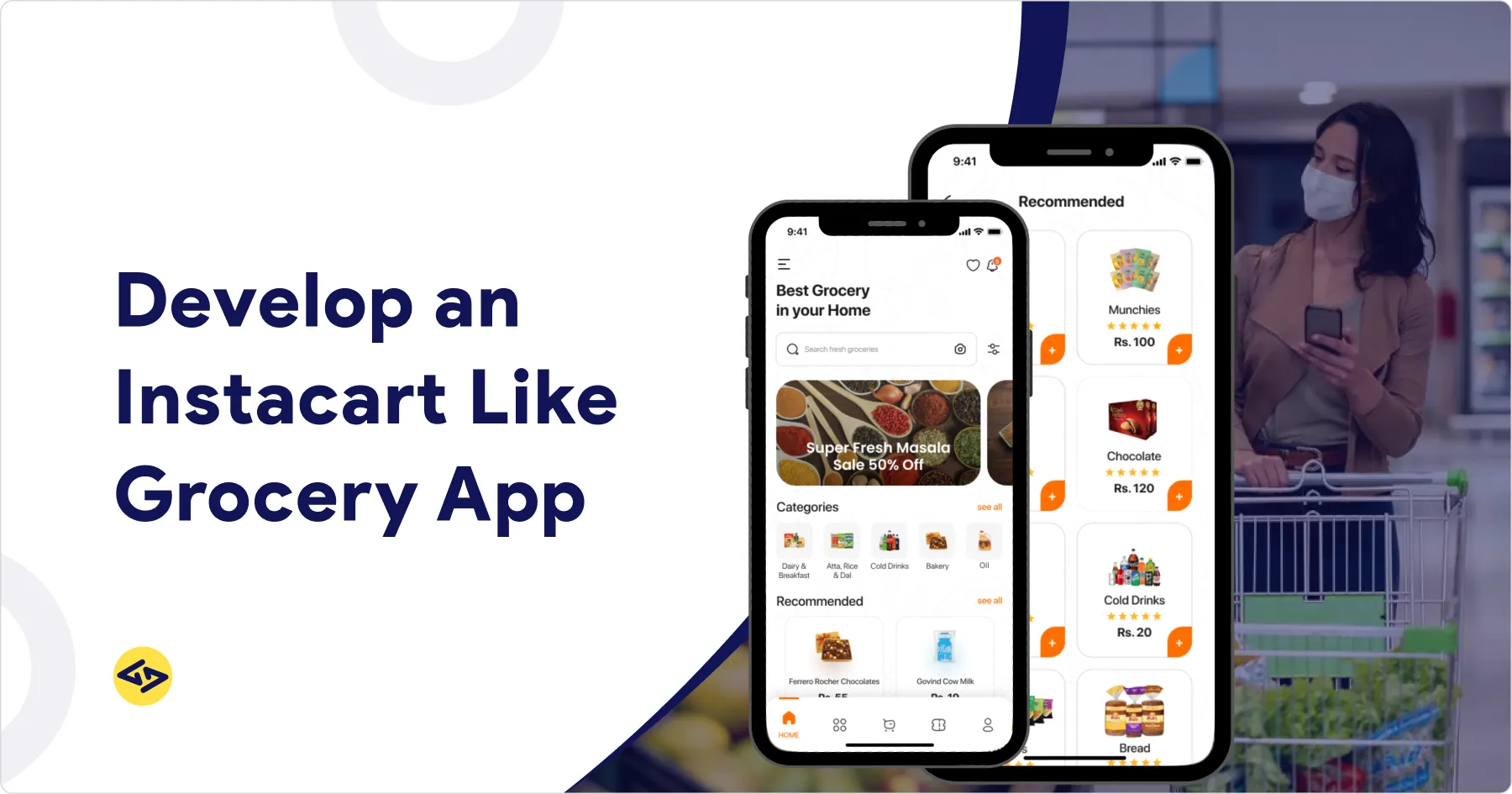
An Instacart-like grocery app is an on-demand grocery app development solution that connects consumers with local grocery stores, personal shoppers, and delivery drivers through a seamless mobile platform.
How the Major Players Work
Instacart operates as an aggregator, partnering with existing grocery chains without owning inventory. Shipt follows a similar model with a membership-based approach. Peapod and FreshDirect use hybrid models, combining warehouse inventory with local partnerships.
Aggregator vs. Inventory Models
| Model | Pros | Cons |
| Aggregator (Instacart, Shipt) | Lower upfront costs, faster scaling | Less control over quality, higher fees |
| Inventory-Based (FreshDirect) | Better margins, quality control | Higher operational costs |
| Hybrid | Balanced approach | Complex management |
Understanding these models is crucial when planning your custom grocery app development strategy. The model you choose directly impacts your grocery app business model and long-term profitability.
Why Build an App Better Than Instacart?
Before investing in Shipt-like app development or Peapod-like app development, you need to understand why the market is hungry for alternatives.
Limitations of Current Platforms
High Fees & Vendor Dependency
Instacart charges vendors commissions between 15-30%, eating into already thin grocery margins. Retailers lose direct customer relationships and data ownership.
Lack of Personalization
Current platforms offer generic experiences. They fail to serve niche markets like organic-only shoppers, dietary-restricted consumers, or local food enthusiasts.
Limited Customization
Vendors can’t differentiate their brand experience within existing platforms. Your store looks like every other store.
The best alternative to Instacart isn’t just a clone—it’s a solution that solves these fundamental problems while delivering superior value to all stakeholders.
Market Opportunities in Grocery Delivery
Smart entrepreneurs are identifying untapped opportunities that established players ignore:
Hyperlocal Grocery Delivery
Focusing on specific neighborhoods with hyperlocal grocery delivery apps enables faster delivery times and stronger community connections.
Subscription Grocery Services
Recurring revenue through weekly meal kits, pantry staples subscriptions, and household essentials auto-replenishment.
B2B Grocery Supply
Restaurants, offices, and institutions need reliable grocery sourcing—a market segment largely ignored by consumer-focused apps.
Sustainable and Organic Models
Eco-conscious consumers willingly pay premium prices for verified organic, locally-sourced, and sustainably-packaged groceries.
Each opportunity requires specific features and positioning. A dedicated grocery delivery app development company can help you identify and capitalize on these niches.
Must-Have Features of an Instacart-Like App
When you develop a grocery app like Instacart, your feature set determines success. Here’s the complete grocery app features list organized by user type:
User App Features
| Feature | Purpose |
| User registration & profile | Personalized experience, order history |
| Smart search & filters | Quick product discovery |
| Real-time tracking grocery app | Transparency, reduced anxiety |
| Multiple payment options | Convenience, conversion optimization |
| AI-based recommendations | Increased basket size, retention |
Shopper/Delivery App Features
- Order assignment with smart matching
- Route optimization for efficiency
- Earnings dashboard with real-time updates
- In-app chat for customer communication
- Substitution management tools
Admin Panel
- Vendor management and onboarding
- Commission settings and payouts
- Analytics dashboard with actionable insights
- Marketing & promotions engine
- Inventory and fulfillment monitoring
For a deeper dive into essential capabilities, explore our comprehensive guide on the features of Instacart app alternatives.
Advanced Features to Beat Instacart
The must-have features for grocery delivery app success go beyond basics. Here’s what separates market leaders from copycats:
Voice-Based Ordering
Integration with Alexa, Google Assistant, and Siri for hands-free shopping—perfect for busy parents and accessibility needs.
Smart Pantry Integration
IoT connectivity with smart refrigerators that automatically suggests reorders when items run low.
Predictive Reordering
AI features in grocery apps that learn purchase patterns and proactively suggest reorders at optimal times.
Dynamic Pricing
Real-time price adjustments based on demand, inventory levels, and competitive positioning.
Loyalty & Referral Systems
Gamified rewards programs that increase customer lifetime value and organic acquisition.
These advanced features transform a basic FreshDirect-like app development project into a genuinely innovative platform that commands market attention.
Technology Stack for Instacart-Like App Development
Choosing the right grocery app tech stack is critical for scalability, performance, and maintenance costs.
Recommended Technologies
| Layer | Technology Options |
| Frontend | Flutter (cross-platform), React Native |
| Backend | Node.js, Django, Laravel |
| Database | MongoDB (flexible), PostgreSQL (relational) |
| APIs | Google Maps, Stripe, Twilio |
| Cloud | AWS, Azure, Google Cloud |
Flutter grocery app development has become increasingly popular for grocery apps due to faster development cycles and consistent cross-platform experiences. Learn more about the best tech stack for grocery app development and whyFlutter for grocery delivery app development is gaining traction.
For businesses seeking faster time-to-market, a SaaS grocery delivery platform likeDeOnDe’s solution offers pre-built infrastructure with customization options.
Business & Revenue Models
Your grocery app revenue model determines long-term sustainability. Here’s what works:
Commission-Based Model
Charge vendors 10-25% per transaction. Lower than Instacart to attract partners.
Subscription Model
Monthly/annual memberships for free delivery and exclusive discounts.
Delivery Fee Model
Transparent per-order fees based on distance, order size, and delivery speed.
In-App Advertising
Sponsored placements and promoted products within search results.
White-Label Licensing
License your white-label grocery app to other retailers for recurring revenue.
Understanding how to start grocery delivery business models helps align technology investments with revenue goals.
Cost to Develop an Instacart-Like App
The question “how much does it cost to build a grocery app” depends on multiple factors:
MVP vs. Full-Scale Platform
| Development Type | Cost Range (USD) | Timeline |
| Grocery app MVP development | $40,000 – $80,000 | 3-4 months |
| Mid-Range Platform | $80,000 – $150,000 | 5-7 months |
| Enterprise Solution | $150,000 – $300,000+ | 8-12 months |
Cost by Region
- North America: $150-250/hour
- Western Europe: $100-180/hour
- Eastern Europe: $50-100/hour
- South Asia: $25-60/hour
Cost by Feature Complexity
Basic features cost less than advanced AI integrations, real-time tracking, and multi-vendor grocery marketplace app capabilities.
For detailed pricing breakdowns, explore our guides on cost to build app like Instacart and general grocery app development pricing.
An Instacart clone script or Instacart clone app cost typically runs lower ($15,000-$40,000) but offers limited differentiation—fine for validation, problematic for long-term competition.
Challenges in Building Instacart-Like Apps
Real-world on-demand delivery app cost isn’t just development—it’s solving operational challenges:
Logistics & Fulfillment
Coordinating inventory, shoppers, and drivers in real-time requires sophisticated systems and constant optimization.
Vendor Onboarding
Convincing grocery stores to join your platform requires compelling value propositions and easy integration.
Customer Acquisition
Competing with established brands demands significant marketing investment and differentiated positioning.
Scalability
Systems that work for 100 orders daily often break at 10,000. Architecture decisions made early have long-term consequences.
Experienced on-demand app development partners anticipate these challenges and build solutions accordingly.
Step-by-Step Development Process
Here’s the proven process for successful grocery delivery app solution development:
- Market Research: Analyze competitors, identify gaps, validate demand
- Business Model Design: Choose revenue streams, define value propositions
- UI/UX Prototyping: Create wireframes, test with potential users
- MVP Development: Build core features, launch for early feedback
- Testing & QA: Rigorous testing across devices, scenarios, load conditions
- Launch & Growth: Staged rollout, marketing activation, continuous improvement
Each phase requires specific expertise. Rushing through early stages creates expensive problems later.
How to Choose the Right Development Partner
When selecting a grocery delivery app development company, evaluate:
Experience with On-Demand Apps
Generic development experience isn’t enough. Look for specific on-demand grocery delivery app portfolios.
Portfolio & Case Studies
Request examples of similar projects, client references, and measurable outcomes.
Custom vs. Clone Solutions
Custom grocery app development costs more but delivers differentiation. Clone solutions work for validation but limit long-term potential.
Post-Launch Support
Apps require ongoing maintenance, updates, and optimization. Ensure your partner offers comprehensive support packages.
Ready to discuss your project? Contact experienced grocery app developers to explore your options.
Future Trends in Grocery App Development (2026+)
Stay ahead by incorporating emerging trends:
AI-Driven Shopping
Machine learning that understands dietary preferences, budget constraints, and household patterns to deliver truly personalized experiences.
Drone & Robotic Delivery
Autonomous delivery solutions reducing last-mile costs and enabling faster fulfillment.
Dark Stores
Fulfillment-only locations optimized for speed rather than customer browsing.
Quick Commerce
15-30 minute delivery expectations becoming standard in urban markets.
Sustainable Logistics
Electric vehicles, optimized routing, and eco-friendly packaging as competitive differentiators.
Explore top grocery delivery apps to understand how market leaders are adopting these trends.
Conclusion
The opportunity to create grocery delivery app solutions that outperform Instacart, Shipt, Peapod, and FreshDirect has never been better. Market growth continues accelerating while incumbent limitations create openings for innovative challengers.
Success requires more than copying existing models. It demands understanding customer pain points, building superior technology, and executing with precision.
Whether you’re pursuing Instacart vs Shipt app features parity or creating something entirely new, the right development partner makes all the difference.
The best time to build was yesterday. The second-best time is now.
Ready to transform your grocery app vision into reality? Partner with iCoderz Solutions—experienced grocery app developers who understand what it takes to build apps that don’t just compete, but dominate.