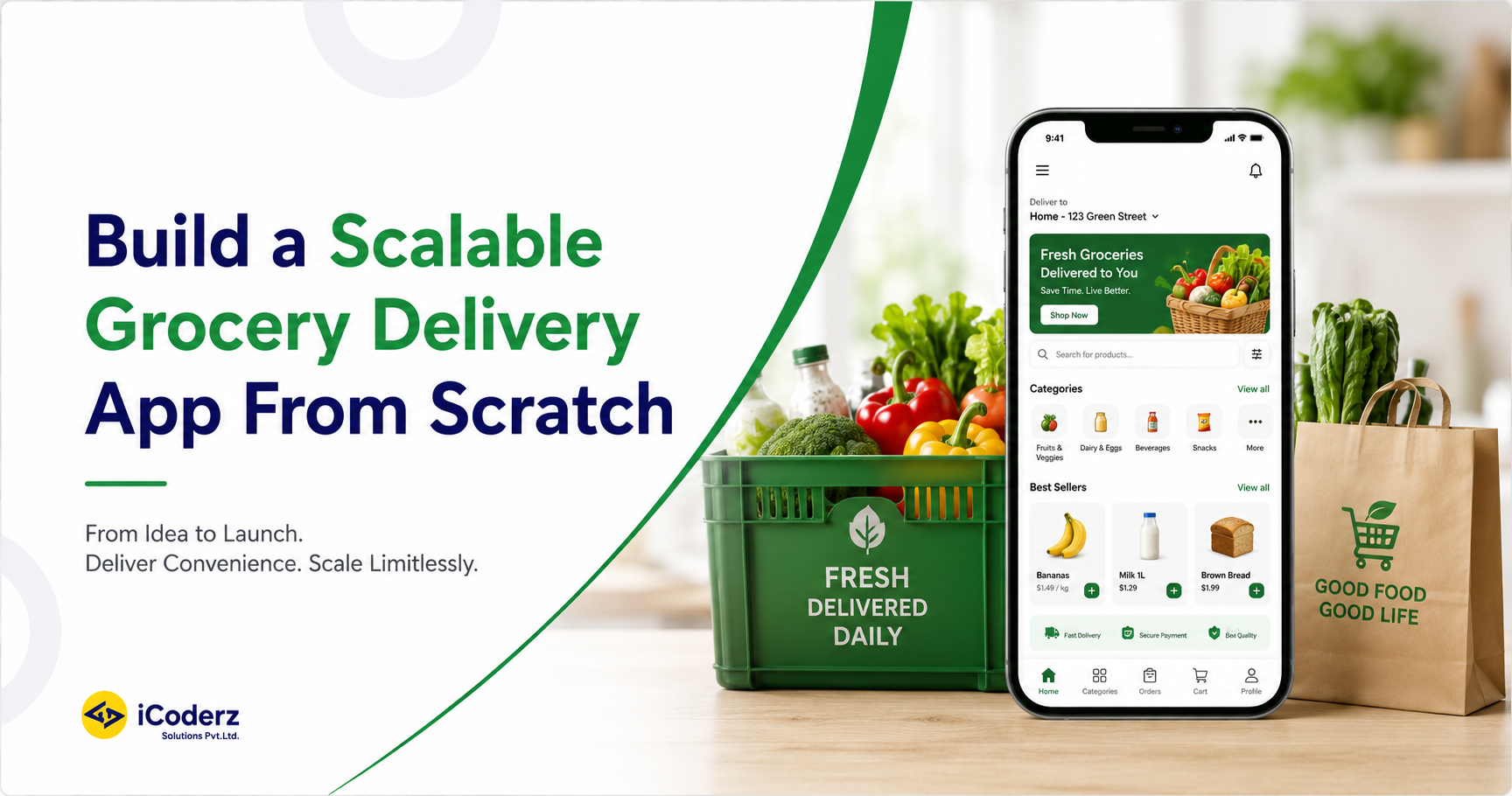
The online grocery market has moved from a “nice to have” to a daily habit for millions of shoppers. If you’re a founder, CTO, or business owner exploring grocery delivery app development, you’re likely asking three questions: what will it cost, what features actually matter, and which business model will make the app profitable. This guide answers all three — in plain language, with real numbers, and without the fluff.
Whether you want to build a hyperlocal delivery app, a 10-minute quick commerce platform, or a full-scale marketplace like Instacart or BigBasket, this is the only resource you’ll need before you start.
Why the Grocery Delivery App Market Is Booming
Online grocery shopping has grown from a pandemic-era convenience into a permanent shift in consumer behavior. Shoppers now expect fresh produce, packaged goods, and household essentials delivered within hours — sometimes minutes.
A few reasons businesses are investing heavily in grocery app development:
- Rising smartphone and internet penetration in tier-2 and tier-3 cities
- Growing demand for hyperlocal grocery delivery app experiences
- Success stories from Blinkit, Zepto, Instacart, and BigBasket proving the model works
- Investors actively funding quick commerce app development startups
- Retailers wanting a direct-to-consumer digital channel instead of relying on aggregators
If you’re weighing whether to enter this space, the short answer is: demand is real, but execution — features, tech stack, and business model — determines whether you win or burn cash.
Related read: Top Grocery Delivery Apps
What Is Grocery Delivery App Development?
Grocery delivery app development is the process of building a digital platform (mobile app + admin panel + delivery panel) that lets customers browse, order, and receive groceries without visiting a physical store.
At its core, three components work together:
- Customer app — for browsing, ordering, and tracking
- Delivery partner app — for accepting orders and navigation
- Admin/vendor dashboard — for inventory, order, and payout management
The market scope isn’t limited to metro cities anymore. Small grocery chains, supermarkets, and even single-store owners are investing in online grocery app development to compete with large platforms and retain customers directly.
Related read: How Grocery Delivery Apps Work
Types of Grocery Delivery Apps
Not every grocery app is built the same way. Choosing the right model early saves significant development cost later.
| Type | Best For | Example |
| Single Vendor | One store/chain selling directly | A local supermarket app |
| Multi-Vendor | Marketplace connecting many stores | BigBasket-style platform |
| Hyperlocal | Store-to-door delivery within a small radius | Neighborhood grocery apps |
| Quick Commerce | 10–15 minute delivery via dark stores | Blinkit, Zepto |
- Single vendor apps are simpler and cheaper — ideal for one brand.
- Multi-vendor grocery delivery app development suits businesses aggregating multiple sellers under one platform.
- Hyperlocal grocery delivery app models focus on speed and proximity.
- Quick commerce app development requires dark stores, tight logistics, and real-time inventory sync.
Related reads: Build a Hyperlocal Grocery App | Dark Store Grocery App
Popular Grocery Delivery App Business Models
Picking the right grocery delivery app business model shapes your revenue strategy from day one.
- Marketplace model — commission charged per order from partner stores
- Subscription model — customers pay a monthly/annual fee for free or discounted delivery
- Commission-based model — percentage cut on every transaction
- Quick commerce model — owns inventory via dark stores, earns on delivery fees + margins
There’s no single “best” model — it depends on your capital, target city, and competition. Blinkit and Zepto, for example, took very different monetization paths while operating in the same space.
Related reads: Blinkit Business Model | Zepto Business Model
Must-Have Grocery Delivery App Features
What are the must-have features in a grocery delivery app? At minimum, your app needs three connected panels — customer, delivery, and admin — each with features that reduce friction and increase order completion.
Customer Panel
- Product search & category browsing
- Real-time inventory visibility
- Multiple payment options
- Live order and delivery tracking
- AI-powered recommendations based on past orders
Delivery Panel
- Order acceptance and route optimization
- Navigation and earnings dashboard
- In-app chat/call with customer
Admin Panel
- Real-time inventory management
- Vendor and order management
- Analytics and reporting
- Promotions and discount engine
Skipping any of these often leads to poor retention post-launch, regardless of how good the app looks.
Related read: Must-Have Grocery App Features
Best Tech Stack for Grocery App Development
Choosing the right grocery app development technology stack affects speed, scalability, and long-term maintenance cost.
- Frontend (mobile): Flutter or React Native — both support cross-platform development, cutting cost and time
- Backend: Node.js — handles real-time order processing well
- Admin panel/web: Laravel — reliable for dashboards and vendor management
- Database: MongoDB or PostgreSQL depending on data structure needs
- Third-party integrations: Payment gateways, maps/route optimization APIs, push notification services
Flutter is increasingly preferred for hyperlocal grocery delivery app and quick commerce builds because it renders a native-like experience while keeping one codebase for iOS and Android.
Related reads: Best Tech Stack for Grocery App | Flutter for Grocery App Development
Grocery Delivery App Development Cost
This is usually the first question founders ask, so here’s a direct answer: grocery app development cost typically ranges based on feature complexity, platforms, and team location.
| App Tier | Features | Approx. Cost Range |
| Basic | Single vendor, core ordering, basic panels | Entry-level budget |
| Mid-level | Multi-vendor, payment integrations, analytics | Moderate investment |
| Advanced | AI recommendations, dark store logistics, real-time tracking at scale | Higher investment |
Factors that push cost to build a grocery delivery app up or down:
- Number of platforms (iOS, Android, Web)
- Custom UI/UX vs. template-based design
- Third-party API integrations (maps, payments, SMS)
- Team location and engagement model (in-house vs. outsourced)
For an exact quote, it’s best to share your specific feature list with a development partner rather than relying on generic estimates.
Related reads: Cost to Develop Grocery App | Instacart App Cost
Clone App Development: Instacart, BigBasket & Blinkit
Many startups don’t want to reinvent the wheel — they want proven models adapted to their market. This is where clone app development comes in.
- Instacart clone app development — ideal for markets with multiple retail partners and a delivery-personnel network
- Build a BigBasket clone app — suited for large-scale multi-category grocery marketplaces
- Build app like Blinkit — best for founders targeting the quick commerce, dark-store model
- Grocery delivery app like Zepto — for ultra-fast, hyperlocal delivery focused on speed as the core differentiator
A “clone” doesn’t mean a copy — it means using a validated business logic and feature set, then customizing branding, workflows, and monetization to fit your market.
Related reads: Instacart Clone App | BigBasket Clone App | Build App Like Blinkit
AI in Grocery Delivery Apps
AI grocery delivery app development is no longer optional for platforms competing at scale. AI is used across three key areas:
- AI-powered recommendations — suggesting products based on purchase history and browsing behavior
- Demand prediction — forecasting which items will sell out, especially useful for dark stores
- Smart inventory management — automatically flagging restocking needs before shortages happen
A smart grocery delivery app that uses AI well typically sees higher average order value and fewer stockout-related cancellations — both of which directly affect margins.
Related read: AI Grocery Delivery App Development
Grocery Delivery App Monetization Strategies
Building the app is half the job — grocery delivery app monetization determines whether it becomes a sustainable business.
Common revenue streams:
- Delivery fees — flat or distance-based charges per order
- Commission — percentage cut from vendor sales
- Subscription plans — recurring revenue for free/discounted delivery
- Advertising & featured listings — vendors pay to appear higher in search results
- Surge pricing — dynamic fees during high-demand periods
Most successful platforms combine two or more of these rather than relying on a single stream.
Related read: Grocery App Monetization
Common Challenges in Grocery Delivery App Development (& Solutions)
Every grocery platform hits similar roadblocks. Knowing them upfront helps you plan around them:
- Inventory mismatches → solved with real-time sync between store and app inventory
- Delivery delays → solved with route optimization and better rider allocation
- High operational costs in quick commerce → solved with strategic dark store placement
- Customer retention → solved with personalization and loyalty programs
These aren’t unique to any one company — even the largest players continuously refine their systems to address them.
Related read: Challenges Faced by Online Grocery Delivery Stores
Why Choose iCoderz Solutions for Grocery Delivery App Development?
Building a grocery delivery app isn’t just about writing code — it’s about combining the right business model, features, and technology stack for your specific market. iCoderz Solutions works with startups and enterprises to design, build, and scale grocery and quick commerce platforms — from MVPs to full-scale marketplace apps like Instacart, BigBasket, and Blinkit alternatives.
If you’re ready to turn your grocery delivery idea into a working platform, our team can walk you through the right approach for your budget and timeline.
Need help planning your grocery delivery app? Reach out to discuss your requirements and get a tailored cost estimate.
Need Expert Grocery App Development?
Let our experts help you build a custom grocery delivery app designed for growth, better user engagement, and long-term success.

Frequently Asked Questions
How much does grocery app development cost?
Cost depends on features, platforms, and design complexity — basic apps cost less than AI-enabled, multi-vendor platforms with dark store logistics.
What is the best tech stack for grocery app development?
Flutter or React Native for the app, Node.js for backend, and Laravel for admin panels is a commonly used, scalable combination.
How long does it take to build a grocery delivery app?
Timelines vary by scope — a basic single-vendor app takes less time than a full quick commerce platform with AI and multi-vendor support.
What is the difference between a hyperlocal and quick commerce grocery app?
Hyperlocal apps connect nearby stores to customers, while quick commerce apps typically use dedicated dark stores to guarantee ultra-fast delivery.
Can I build an app like Instacart or Blinkit on a limited budget?
Yes — starting with core features and scaling up (rather than building every feature at launch) keeps initial costs manageable.
What features are essential for a grocery delivery app?
Real-time inventory, secure payments, order tracking, and a reliable delivery panel are non-negotiable for any grocery app.
Which grocery delivery app business model is most profitable?
It depends on your market — marketplace and commission models work well for aggregators, while quick commerce suits high-density urban areas.
Do I need a white label grocery delivery app or a custom build?
White label solutions launch faster and cost less upfront; custom builds offer more flexibility and scalability long-term.
How does AI improve a grocery delivery app?
AI enhances product recommendations, predicts demand, and helps manage inventory more efficiently — reducing stockouts and boosting sales.
Should startups hire an in-house team or a grocery app development company?
Most startups partner with an experienced grocery app development company to reduce cost, speed up launch, and avoid technical missteps.