The grocery retail landscape is changing fast. Consumers no longer want to wait a day, or even an hour, for their groceries. They want delivery in 10 to 30 minutes, and dark stores are how modern businesses are making that happen. If you’re exploring how to build a dark store grocery delivery app, this guide walks you through everything, from features and tech stack to development cost and launch strategy.
What Is a Dark Store Grocery Delivery App?
A dark store is a retail fulfilment centre that looks like a supermarket on the inside but is closed to the public. Instead of serving walk-in shoppers, it serves online orders exclusively, enabling faster picking, packing, and dispatch.
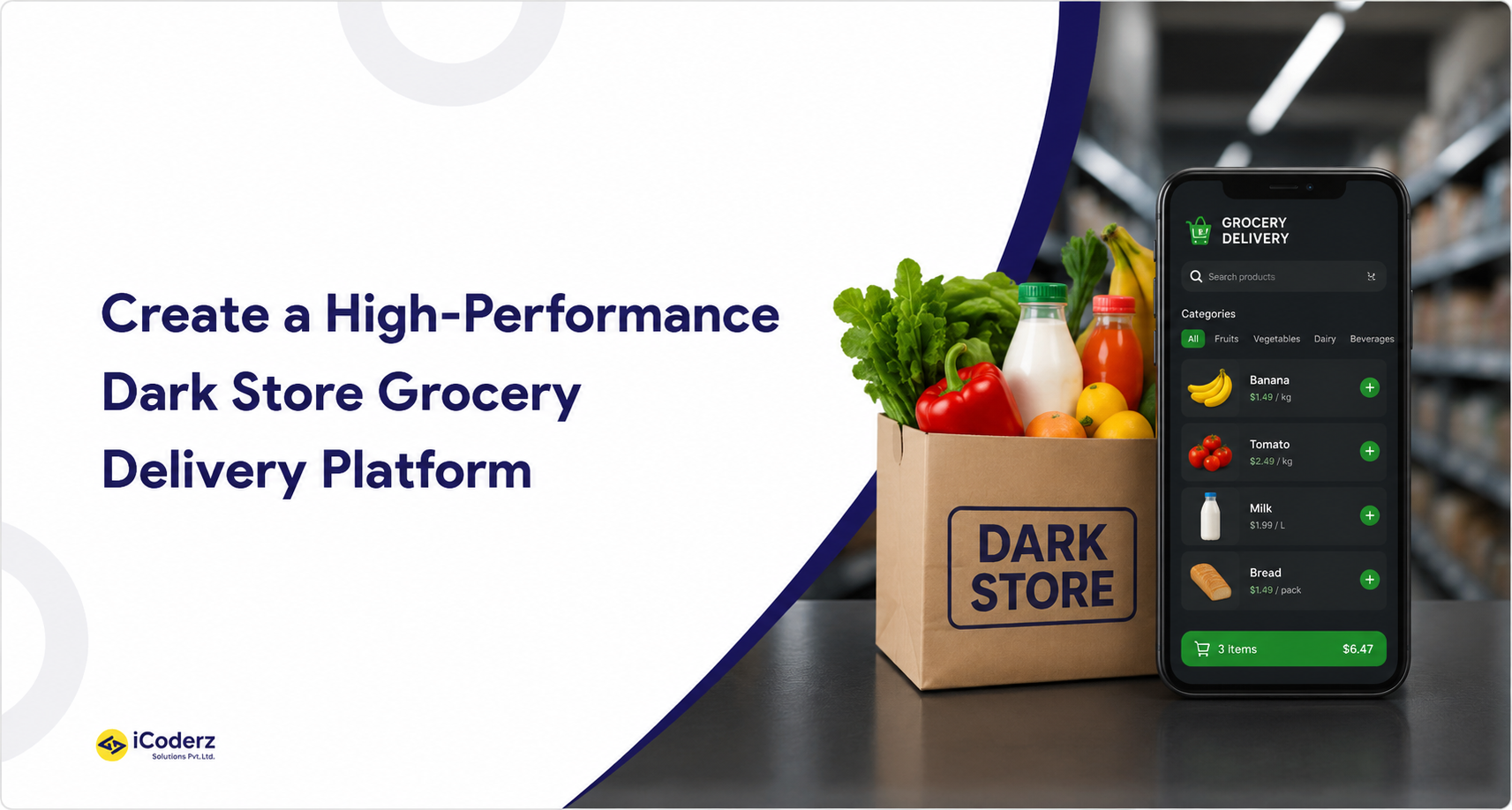
A dark store grocery delivery app is the digital layer that connects customers, store staff, and delivery partners into one seamless system. It’s what powers brands like Blinkit, Zepto, and Getir, all of which have redefined grocery delivery through quick commerce app development.
Unlike traditional grocery delivery models that rely on existing retail outlets, dark stores are purpose-built for speed and efficiency. Every shelf layout, every process, and every software system is optimized for order fulfilment, not foot traffic.
How Does a Dark Store Grocery Delivery App Work?
Here’s the end-to-end flow of a typical on-demand grocery delivery app built around dark store operations:
1. Customer Places an Order: The customer browses the app, adds items to cart, and checks out. Payment is processed in real time.
2. Order Is Routed to the Nearest Dark Store: The system automatically assigns the order to the closest fulfillment center based on geolocation, reducing delivery time.
3. Inventory Is Verified in Real Time: The app checks live stock levels. If an item is unavailable, the customer is immediately notified with a substitute suggestion.
4. Store Staff Picks and Packs the Order: Pickers receive the order on their staff app with a prioritized pick list. Barcode scanning confirms accuracy.
5. Delivery Partner Receives the Assignment: Once packed, the nearest available delivery agent is notified with route details.
6. Real-Time Tracking and Delivery: The customer tracks the order live on the app until it arrives at their door.
This six-step loop, when powered by the right dark store software development, can be completed in under 20 minutes.
Benefits of Building a Dark Store Grocery Delivery App
Faster Deliveries: Dark stores are strategically located in high-density areas, cutting last-mile distance significantly. Deliveries in 10–30 minutes are standard.
Improved Inventory Control: A centralized real-time inventory management for grocery apps eliminates the guesswork. You always know what’s in stock, what’s running low, and what needs reordering.
Lower Operational Costs: No storefront rent, no visual merchandising, no cashier queues. Dark stores strip operations down to what matters: fulfillment.
Better Customer Experience: Speed, accuracy, and live tracking create an experience that traditional grocery models simply can’t match.
Increased Order Accuracy: Barcode-driven picking reduces human error dramatically compared to manual retail processes.
Scalability Across Multiple Locations: A well-built multi-store grocery delivery app development platform lets you add new dark store nodes without rebuilding the system.
Must-Have Features of a Dark Store Grocery Delivery App
Customer App Features
A great customer-facing app needs to feel fast and frictionless:
- User registration and social login
- Smart product search with filters and categories
- Cart management and one-tap checkout
- Multiple payment methods (UPI, cards, wallets, COD)
- Real-time order tracking with delivery ETA
- Push notifications for order updates
- Ratings, reviews, and reorder functionality
Delivery Agent App Features
- Order request acceptance and management
- GPS-based route optimization
- Live navigation integration
- Earnings dashboard and history
- Delivery status updates with photo confirmation
Dark Store Staff App Features
- Order picking queue and prioritization
- Barcode scanning for item verification
- Live inventory update on pick
- Packing workflow and handoff to delivery
Admin Panel Features
The backend of any serious dark store grocery delivery app development project includes:
- Central dashboard with real-time KPIs
- Inventory and stock management across locations
- Order management and dispute resolution
- Customer management and segmentation
- Delivery fleet tracking and performance
- Promotions, discount engine, and coupon management
For a deeper look at what drives strong grocery app performance, explore this breakdown of grocery app development ideas that are gaining traction.
Advanced Features for a Competitive Dark Store App
Want to go beyond the basics? These advanced capabilities separate market leaders from the rest:
AI-Powered Product Recommendations: Personalized suggestions based on purchase history and browsing behavior increase average order value.
Predictive Demand Forecasting: Machine learning models analyze historical sales data to predict demand spikes, helping stores stock up before they run out.
Smart Inventory Management: Automated reorder triggers, expiry date alerts, and waste reduction tools powered by AI. This is one of the most impactful AI features in grocery delivery apps available today.
Dynamic Pricing Engine: Adjust pricing based on demand, time of day, or inventory levels — common in mature quick commerce models.
Delivery Route Optimization: Algorithms that cluster nearby orders and minimize travel distance for agents, reducing delivery times and fuel costs.
Voice Search Integration: Hands-free ordering through voice commands improves accessibility and convenience.
Loyalty and Rewards Programs: Points, cashback, and subscription plans that drive repeat orders and reduce churn.
Technology Stack for Dark Store Grocery App Development
Choosing the right grocery delivery app tech stack is critical for performance and scalability. Here’s a proven breakdown:
| Layer | Recommended Technologies |
| Front-End (Mobile) | React Native, Flutter |
| Front-End (Web) | React.js, Next.js |
| Back-End | Node.js, Django, or Laravel |
| Database | PostgreSQL, MongoDB, Redis |
| Cloud Infrastructure | AWS, Google Cloud, or Azure |
| Payment Gateway | Stripe, Razorpay, PayU |
| GPS & Mapping | Google Maps API, Mapbox |
| Real-Time Communication | Socket.io, Firebase |
| Analytics | Mixpanel, Google Analytics, Segment |
For a more detailed technical breakdown, see this guide on the best tech stack for grocery app development.
Step-by-Step Process to Build a Dark Store Grocery Delivery App
Step 1 – Conduct Market Research
Analyze your target city’s demand patterns, competitors, and delivery radius viability. Study apps like Blinkit to understand what works at scale.
Step 2 – Define Business Model and Requirements
Decide on commission structure, delivery fee model, subscription options, and your dark store location strategy. Document every functional requirement before touching design.
Step 3 – Create UI/UX Design
Build intuitive, fast-loading interfaces. Prioritize the checkout and tracking flows, these are where users drop off the most.
Step 4 – Develop MVP Features
Start lean. Build the core loop: order placement → fulfillment → delivery → tracking. Get this right before adding advanced features.
Step 5 – Integrate Third-Party Services
Connect payment gateways, maps, SMS notifications, and analytics. Use battle-tested providers to reduce development time and security risk.
Step 6 – Test and Optimize the App
Run performance testing under simulated peak loads. Test real-time features (inventory sync, live tracking) under stress conditions.
Step 7 – Launch the Platform
Start with a single dark store in a high-density urban zone. Control quality before scaling.
Step 8 – Gather Feedback and Scale
Instrument everything. User behavior data from week one should drive your feature roadmap for month three.
Cost to Build a Dark Store Grocery Delivery App
Factors Affecting Development Cost
The dark store app development cost depends on several variables:
- App complexity: Number of user roles, flows, and integrations
- Number of platforms: iOS only, Android only, or both plus web
- Feature set: MVP vs. full-featured enterprise platform
- Technology stack: Off-the-shelf vs. custom-built components
- Development team location: Offshore teams (India, Eastern Europe) cost significantly less than US or UK teams
Estimated Development Cost
| App Type | Estimated Cost |
| MVP Version | $10,000 – $25,000 |
| Mid-Level Solution | $25,000 – $60,000 |
| Enterprise Platform | $60,000 – $150,000+ |
For a detailed breakdown by feature and team type, read this comprehensive guide on grocery delivery app development cost.
Challenges in Dark Store Grocery App Development
Real-Time Inventory Synchronization: Keeping stock data accurate across dozens of concurrent orders requires event-driven architecture and conflict resolution logic. This is the most technically demanding part of dark store inventory management system development.
Managing Peak Order Volumes: A flash sale or bad weather day can multiply order volume 5x in minutes. Your backend infrastructure needs auto-scaling to handle this without degrading performance.
Last-Mile Delivery Optimization: Matching delivery agents to orders dynamically, accounting for traffic, agent availability, and order urgency, is a hard optimization problem.
Multi-Store Operations Management: As you open more dark store locations, you need centralized visibility into each node’s stock, staff performance, and delivery metrics.
Customer Retention and Engagement: Quick commerce is a low-loyalty category. Speed is expected; push notifications and personalization are what keep users coming back.
Best Practices for Building a Successful Dark Store Grocery App
- Obsess over delivery speed: Every second counts. Benchmark your pick-pack-dispatch time weekly.
- Maintain accurate inventory data: A single out-of-stock substitution erodes trust. Real-time sync is non-negotiable.
- Optimize the user experience relentlessly: Reduce checkout to under three taps. Remove every unnecessary screen.
- Leverage AI and automation: From demand forecasting to route optimization, automation is what makes quick commerce margins work.
- Use scalable cloud infrastructure: Design for 10x your current volume from day one.
- Monitor analytics continuously: Track funnel drop-off, repeat order rates, and NPS every week, not quarterly.
Future Trends in Dark Store Grocery Delivery Apps
AI-Driven Automation: From automated picking robots to AI-managed reordering, the labor cost in dark stores is declining fast.
Micro-Fulfillment Centers: Smaller, hyper-local nodes embedded in apartment complexes or parking structures to cut delivery radius below 1 km.
Autonomous Deliveries: Drone and sidewalk robot pilots are already live in select markets. Expect broader rollouts by 2026–27.
Hyper-Personalization: AI that knows your weekly grocery habits, predicts what you’ll need before you order, and nudges you at the right moment.
Sustainable Delivery Operations: Electric delivery vehicles, biodegradable packaging, and carbon-neutral fulfillment are becoming competitive differentiators, not just CSR checkboxes.
Why Choose a Professional Grocery Delivery App Development Company?
Building a dark store ecommerce app isn’t a weekend project. It requires deep expertise in real-time systems, logistics optimization, mobile UX, and scalable cloud architecture. Partnering with an experienced grocery delivery app development company gives you:
- Faster time-to-market: Pre-built modules for common features cut development time by 30–50%
- Custom feature development: Build exactly what your business model requires, not a generic template
- Scalability and security: Enterprise-grade infrastructure from day one
- Ongoing support and maintenance: Post-launch iterations are where most of the value is created
- Industry expertise: A team that has built in this space understands the edge cases that sink first-time builds
If you’re ready to explore your options, iCoderz Solutions is a proven dark store app development company with a dedicated on-demand grocery delivery app practice.
Conclusion
Dark stores are the infrastructure backbone of the quick commerce revolution. Building a competitive dark store grocery delivery app requires more than just a mobile interface — it demands real-time inventory sync, intelligent routing, AI-powered forecasting, and a team that understands the operational realities of hyperlocal fulfillment.
Whether you’re a startup testing a new dark store business model or an enterprise scaling a hyperlocal grocery delivery business, the investment in a well-architected platform pays back quickly through faster deliveries, lower error rates, and higher customer retention.
Ready to launch your dark store grocery delivery platform? Connect with iCoderz Solutions to discuss your requirements and get a free development estimate.
Ready to Launch Your Dark Store Grocery Delivery App Today?
Build a scalable, feature-rich grocery delivery platform with real-time inventory management, fast order fulfilment, and seamless customer experiences.

Frequently Asked Questions
How long does it take to build a dark store grocery delivery app?
An MVP typically takes 3–5 months. A full-featured enterprise platform with admin panel, multiple user apps, and AI features can take 6–12 months depending on scope and team size.
What is the average cost of developing a dark store app?
Costs range from $10,000 for a basic MVP to $150,000+ for a fully custom enterprise platform. The biggest cost drivers are feature complexity, number of platforms, and development team location.
What technologies are used in dark store app development?
Common choices include React Native or Flutter for mobile, Node.js or Django for backend, PostgreSQL and Redis for databases, Google Maps API for routing, and AWS or GCP for cloud infrastructure.
Can I launch a dark store grocery app with an MVP?
Yes, and it’s recommended. Start with the core order-fulfill-deliver loop in one location. Use real user feedback to prioritize your next features rather than building everything upfront.
How do dark stores manage inventory in real time?
Through event-driven inventory systems that decrement stock on order placement, trigger restock alerts at threshold levels, and sync across admin, staff, and customer-facing apps instantly using WebSockets or similar real-time protocols.
What are the essential features of a quick commerce app?
The essentials are: fast product search, one-tap checkout, real-time order tracking, live inventory sync, delivery agent management, and an admin panel with analytics. Everything else is an enhancement.
How can AI improve dark store grocery delivery operations?
AI contributes in three major areas: demand forecasting (reducing stockouts and waste), route optimization (reducing delivery time and agent idle time), and personalization (increasing order frequency through relevant recommendations).
What is the difference between dark stores and traditional grocery delivery?
Traditional grocery delivery picks orders from retail shelves shared with walk-in customers, creating inefficiencies. Dark stores are purpose-built for online order fulfillment only, enabling faster picking, better stock management, and 10–30 minute delivery windows.
How many dark store locations do I need to start?
One well-located dark store in a high-density urban area is enough to validate the model. Focus on perfecting operations at one node before expanding.
Is a white-label grocery delivery app solution better than custom development?
White-label solutions are faster and cheaper to launch but limit customization. Custom development offers full control over features, UX, and scalability — making it the better choice for businesses building a long-term dark store business plan.