Quick answer: how does Blinkit make money? Blinkit buys products from brands, stores them in its own dark stores and sells them to customers at retail prices. This inventory-led (1P) model accounts for about 90% of its order value. It adds income from advertising, delivery and handling fees, private labels and a small marketplace commission. In Q1 FY27 it earned ₹102 crore adjusted EBITDA on ₹17,132 crore net order value (NOV).
Blinkit is India’s largest quick-commerce platform, delivering groceries, fresh produce, electronics and daily essentials from a network of local dark stores. It began in 2013 as Grofers, rebranded as Blinkit in 2021, and is now part of Eternal Ltd (formerly Zomato). Analyst estimates put its share of Indian quick commerce at roughly half.
This guide explains how Blinkit works, how its business model and revenue streams changed with the move to an inventory-led model, what its unit economics look like, and what founders can learn. If you are planning your own platform, see our guide on how to make an app like Blinkit. All figures below come from Eternal’s Q1 FY27 results (quarter ended 30 June 2026) unless stated otherwise.
Blinkit at a glance (Q1 FY27)
| Metric | Q1 FY27 figure | Context |
| Net Order Value (NOV) | ₹17,132 Cr | +86% year on year |
| Adjusted EBITDA | ₹102 Cr profit | About 0.6% of NOV; Q1 FY26 was a ₹162 Cr loss |
| Dark stores | 2,443 | +200 in the quarter, +899 in a year |
| Gross margin | 27.5% of NOV | Up from 23.6% a year earlier |
| Net average order value | ₹518 | ₹525 in Q4 FY26, ₹521 in Q1 FY26 |
| NOV per store per day | ₹8.27 lakh | Roughly 13% higher year on year |
| Inventory loss | 1.8% of NOV | About ₹308 Cr, mostly perishables |
| Own-inventory (1P) share | ~90% of NOV | Rest is third-party marketplace sales |
Sources: Eternal Q1 FY27 shareholder letter and earnings-call coverage. Figures are rounded.
What is Blinkit? History and 2026 updates
Blinkit sells a wide assortment through one app: perishables (fruit, vegetables, bakery), everyday essentials (groceries, personal care, baby care, electronics) and niche or premium lines (private labels, pet care, organic food). Orders are packed at the nearest dark store and delivered by gig riders.
| Year | Milestone |
| 2013 | Albinder Dhindsa and Saurabh Kumar found Grofers, starting as a grocery service with next-day delivery. |
| 2021 | Grofers rebrands as Blinkit and pivots to hyperlocal, ultra-fast delivery. |
| 2022 | Zomato acquires Blinkit in an all-stock deal. |
| 2025 | Zomato’s parent company is renamed Eternal Ltd. In Q2 FY26 Blinkit begins shifting from a marketplace to an inventory-led model. |
| Jan 2026 | Blinkit changes its tagline from a 10-minute promise to a 30,000+ product catalogue message. |
| Feb 2026 | Albinder Dhindsa becomes Group CEO of Eternal; Deepinder Goyal moves to a non-executive Vice Chairman role. |
| Q3 FY26 | First adjusted EBITDA profit: ₹4 Cr, with 2,027 dark stores. |
| Q1 FY27 | ₹102 Cr adjusted EBITDA, ₹17,132 Cr NOV and 2,443 dark stores. |
Why the 10-minute tagline was dropped
In January 2026, following discussions between quick-commerce platforms and the Union Ministry of Labour about pressure on gig workers, Blinkit moved its brand message from a time-bound promise to catalogue size. Eternal said delivery times are not shown to delivery partners and that the change does not reflect slower deliveries.
Leadership: why it matters
Dhindsa’s elevation to Group CEO shows how central quick commerce has become to Eternal’s strategy. Blinkit now contributes roughly 55% of Eternal’s consumer net order value.
How Blinkit works: the user journey
In short: dense dark stores, AI-driven inventory and hyperlocal delivery zones let Blinkit pick, pack and deliver orders within minutes of a customer tapping “Pay”.
Step 1: Search or browse
Customers open the app or website and browse categories or search. Filters, deals and live stock availability are shown, and demand forecasting keeps popular items on the shelf.
Step 2: Select
Product pages show images, prices, descriptions and alternatives. If an item is unavailable, customers can accept a substitute. The expected delivery time reflects the nearest dark store and rider availability.
Step 3: Pay
UPI, cards, wallets and cash on delivery are supported. Free-delivery thresholds nudge customers toward larger baskets.
Step 4: Dark store picks and packs
The nearest dark store receives the order, and staff pick, pack and verify it. Replenishment of perishables is prioritised to limit out-of-stock items.
Step 5: Delivery
A rider is assigned in real time and routed by the fastest path. Delivery time depends on distance, traffic and rider availability.
Step 6: After delivery
Customers can rate the order and report missing or damaged items, and refunds or replacements are handled in-app. Blinkit also cross-promotes Bistro and its Recipes page to drive repeat orders.
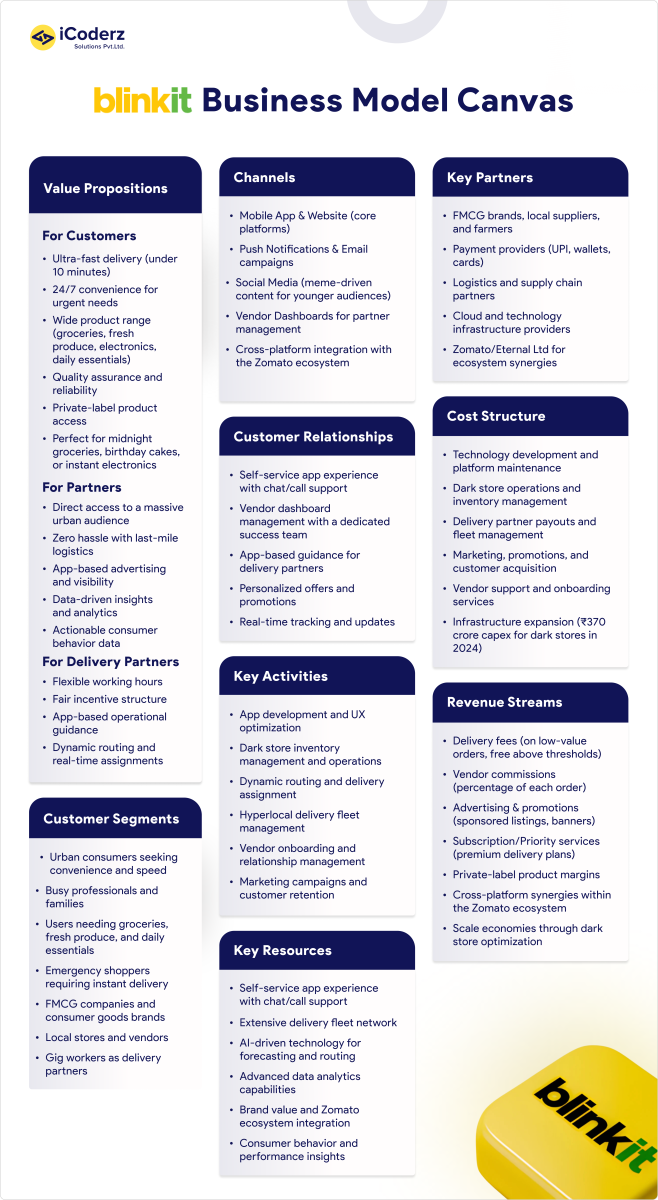
Blinkit Business Model Canvas (Detailed Breakdown)
Blinkit’s success lies in a well-structured business model that efficiently creates, delivers, and captures value within India’s rapidly growing quick-commerce ecosystem.
1. Customer Segments
Blinkit serves three primary customer groups:
• End Consumers: Urban users seeking groceries, fresh produce, bakery items, electronics, daily essentials, and private-label products delivered quickly. Convenience, speed, and product quality drive demand.
• Vendors & Brands: FMCG companies, local stores, and consumer goods brands leverage Blinkit to reach millions of households. They benefit from data-driven promotions, insights, and visibility. Note: As of Q2 FY26, ~90% of Blinkit’s sales now flow through its own inventory (1P model), with third-party vendor listings accounting for the remaining ~10%.
• Delivery Partners: Gig workers form the backbone of Blinkit’s hyperlocal delivery network. They earn flexible income through app-based guidance, dynamic routing, and real-time assignment. Eternal Ltd spent over ₹100 crore on insurance coverage alone for delivery partners in 2025.
2. Value Propositions
Blinkit delivers unique value to each segment:
For Consumers: Ultra-fast delivery, convenience, reliability, quality assurance, and access to private-label products. Perfect for urgent needs like midnight groceries, birthday cakes, or electronics delivered instantly.
For Vendors/Brands: Direct access to a massive urban audience, better visibility through app-based advertising, zero hassle with last-mile logistics, and actionable insights.
For Delivery Partners: Flexible earning opportunities, fair incentives, and operational guidance through app-based tools.
3. Channels
Blinkit engages stakeholders through multiple touchpoints:
Mobile App & Website: Core platforms for browsing, ordering, and tracking.
Push Notifications & Emails: Personalized offers, recurring order reminders, and flash deals.
Social Media Campaigns: Meme-driven content keeps Blinkit top-of-mind for younger audiences.
Vendor Dashboards: Real-time insights, performance analytics, and inventory management tools
4. Customer Relationships
• Consumers use the app independently, with chat or call support for issues.
• Vendors manage inventory and promotions via dashboards, assisted by a dedicated vendor success team.
• Delivery partners receive app-based guidance, real-time updates, and helpline support.
5. Revenue Streams
📢 2026 Business Model Shift: From Marketplace to Inventory-Led (1P)
Until 2025, Blinkit operated primarily as a marketplace — brands listed products and Blinkit earned commissions. In Q2 FY26, Blinkit shifted to an inventory-led (first-party) model, where it now purchases, owns, and sells inventory directly — like a retailer.
By Q3 FY26: ~90% of Net Order Value came from Blinkit’s own inventory.
Why it matters:
→ Revenue recognition changed: Blinkit now records the full sale value, not just a commission.
→ Margins improved: The 1P shift contributed over half of an expected ~1 percentage point EBITDA improvement.
→ Better pricing and quality control across all product categories.
Source: Eternal Ltd Q3 FY26 Shareholder Letter, January 2026 (primary source, Deloitte-reviewed).
Blinkit employs a diversified model:
Direct Product Sales (Primary): Blinkit purchases inventory wholesale and sells at retail prices, capturing the full product margin. This is now the dominant revenue stream (~90% of NOV).
Delivery Fees: Charges on low-value or priority orders; free delivery above minimum thresholds.
Vendor Commissions: Applicable to the ~10% of third-party listings on the platform. Private-label products add additional margin as Blinkit controls pricing and sourcing.
Advertising & Promotions: Brands pay for sponsored listings, banners, and in-app placements. Flash sales and seasonal campaigns provide additional monetization opportunities.
Subscription / Priority Services: Premium plans offering reduced delivery charges, exclusive offers, and faster slots — generating predictable recurring revenue.
Cross-Platform Synergies: As part of Eternal Ltd, Blinkit leverages shared infrastructure with Zomato Food Delivery, Hyperpure (restaurant supply), District (going-out), and Bistro — driving higher customer lifetime value.
Scale Economies & Dark Store Optimization: Higher utilization reduces per-order costs, improving margins.
6. Key Activities
- App development, UX improvements, and personalization
- Dark store inventory management, picking, and packing
- Dynamic routing & real-time assignment for delivery partners
- Logistics and hyperlocal delivery fleet management
- Vendor onboarding and support
- Marketing, retention campaigns, and promotions
- Every activity is optimized for speed, accuracy, and customer satisfaction.
7. Key Resources
• Dark Stores: 2,027 strategically placed micro-warehouses in dense urban areas (Q3 FY26)
• Delivery Fleet: Thousands of riders ensuring hyperlocal reach across 153+ cities
• AI-Driven Technology: Forecasting, routing, inventory management, and demand analytics
• Hyperpure Integration: Eternal’s restaurant supply arm acts as a strategic sourcing engine for Blinkit’s fresh produce — enabling better margins through backward integration and lower wastage. No other Indian platform replicates this at national scale.
• Brand Value & Eternal Ecosystem: Trust, visibility, and shared infrastructure
8. Key Partnerships
• Fresh produce suppliers, FMCG brands, and local vendors
• Payment providers (UPI, wallets, cards) for seamless transactions
• Logistics partners for fleet and supply chain support
• Cloud and technology providers for scalability
Eternal Ltd (Zomato, Hyperpure, District, Bistro) for marketing, tech synergies, and cross-platform advantages
9. Cost Structure
• Cost of goods sold (now the largest cost line, reflecting the 1P inventory model)
• Technology development and maintenance
• Dark store operations, staff, and infrastructure
• Rider payouts, fleet management, and incentives
• Marketing, promotions, and customer acquisition
• Capex on dark store expansion — management projects 40%+ ROCE on these investments
(Source: Eternal Q3 FY26 Letter)
How Blinkit makes money: revenue streams
The 2026 shift: from marketplace to inventory-led (1P)
Until 2025, Blinkit mainly operated as a marketplace: brands listed products and Blinkit earned a commission. In Q2 FY26 it moved to an inventory-led model, where it buys stock, owns it and sells it like a retailer. By Q3 FY26 about 90% of net order value came from its own inventory.
- Revenue recognition changed. Blinkit now books the full sale value rather than only a commission.
- Margins improved. Management expected the shift to add about one percentage point of EBITDA margin, with over half captured by Q3 FY26.
- Better control. Owning inventory gives tighter control over pricing, quality and availability.
Source: Eternal Q3 FY26 shareholder letter (January 2026).
1. Direct product sales (primary)
Blinkit buys wholesale from brands and sells at retail prices, keeping the full product margin. This is the dominant stream at roughly 90% of NOV, and the main reason gross margin rose to 27.5% of NOV.
2. Advertising and promotions
Brands pay for sponsored listings, banners and in-app placements, and for launch or seasonal campaigns. Advertising is high-margin income that sits on top of product sales.
3. Delivery, handling and small-cart fees
Customers pay small fees on low-value or priority orders, while free delivery above a minimum basket encourages bigger carts.
4. Marketplace commissions
Third-party sellers, about 10% of sales, pay a percentage of each order fulfilled.
5. Private-label products
Where Blinkit controls sourcing, pricing and branding, it keeps a higher margin than on branded goods.
6. Subscriptions and priority services
Memberships such as Blinkit Gold offer reduced delivery charges and exclusive offers, creating predictable recurring revenue and loyalty.
7. Ecosystem synergies and scale
Blinkit shares technology and customers with Zomato, District and Bistro, and sources fresh produce through Eternal’s Hyperpure arm, which helps margins and cuts wastage. As each dark store handles more orders, fixed costs spread thinner. Eternal said mature areas such as Gurgaon and Noida were running at about 5% EBITDA margin in Q3 FY26, which is the template for the rest of the network.
Blinkit unit economics
Unit economics show whether each order and each store makes money. These are the numbers founders and investors watch most closely, and the average order value, inventory-loss and store-count figures below are also covered in MediaNama’s summary of the Eternal Q1 FY27 earnings call.
| Metric | Q1 FY27 | What it tells you |
| Net average order value | ₹518 | Slightly lower than ₹525 in Q4 FY26, though user growth and order frequency rose |
| Gross margin | 27.5% of NOV | Up 3.9 points in a year from the 1P shift, ads and mix |
| Adjusted EBITDA margin | ~0.6% of NOV | Positive but far below the 6% long-term target |
| NOV per store per day | ₹8.27 lakh | Store productivity is rising as new stores mature |
| Inventory loss | 1.8% of NOV | The cost of owning perishable stock |
| Capex per store | Target ₹2.5 Cr (from ₹1 Cr) | Larger stores with deeper assortment and more warehouse technology (Business Standard) |
Illustrative per-order economics
Dividing reported figures by the average order value gives a rough picture of one typical order. These are our own approximations, not company-reported numbers.
| Item | Approx. per order | How derived |
| Average order value | ₹518 | Reported |
| Gross profit | ~₹142 | ₹518 × 27.5% |
| Inventory loss | ~₹9 | ₹518 × 1.8% |
| Adjusted EBITDA | ~₹3 | ₹518 × 0.6% |
| Orders per store per day | ~1,600 | ₹8.27 lakh ÷ ₹518 |
Approximation only: NOV and AOV are defined slightly differently and these ratios are blended across all stores. Use for direction, not precision.
Takeaway: Blinkit earns a healthy gross margin per order, but delivery, dark store, staff and marketing costs absorb nearly all of it. Profit now depends on raising orders per store and keeping inventory loss low.
Is Blinkit profitable?
Yes, at the adjusted EBITDA level, and the trend is improving every quarter. Management raised its long-term adjusted EBITDA margin target to 6% of NOV, so there is still a long way to go.
| Quarter | Adjusted EBITDA | Dark stores |
| Q1 FY26 | ₹162 Cr loss | 1,544 |
| Q2 FY26 | ₹156 Cr loss | 1,816 |
| Q3 FY26 | ₹4 Cr profit (first ever) | 2,027 |
| Q4 FY26 | ~₹37 Cr profit (derived) | 2,243 (derived) |
| Q1 FY27 | ₹102 Cr profit | 2,443 |
Q2 FY26 store count is derived from Q3 (2,027 minus 211 added). Q4 FY26 figures are derived from reported quarter-on-quarter changes.
Marketing and branding playbook
- “Last-minute app” positioning. Messaging focuses on everyday emergencies such as forgotten groceries, midnight cravings and surprise guests. The viral “Doodh mangoge, doodh denge” billboard campaign is a good example of humour driving recall.
- Meme-first social content. Relatable, shareable posts and seasonal hand-drawn delivery-bag art keep the brand top of mind with younger users.
- Hyperlocal and OOH campaigns. City-specific creatives tied to local festivals and foods, such as the Mysuru campaign, make the brand feel local.
- Partnerships and festival tie-ups. Examples include the boAt Diwali campaign and the Fortune Foods Ramadan campaign.
- Loyalty and cross-selling. Personalised push notifications, Blinkit Gold and promotion of Bistro and Recipes encourage repeat orders.
- Sustainability messaging. Initiatives such as compostable packaging support trust.
Technology behind Blinkit
- Demand forecasting and inventory: AI predicts top sellers, trims out-of-stocks and tunes the SKU mix, including private labels.
- Routing and rider assignment: orders go to the nearest dark store, and algorithms calculate the fastest route in real time.
- Dark store management: software guides picking, packing and stocking, and semi-automation speeds up high-demand and perishable items.
- Apps and tracking: a customer app with live tracking and personalisation, plus a separate rider app for routing and updates.
- Analytics and scale: dashboards monitor delivery performance, cancellations, rider efficiency and store utilisation, and the backend handles peak loads and flash sales.
Blinkit vs Zepto vs Swiggy Instamart
Competition remains intense. JioMart and Flipkart Minutes are also expanding, while Zepto has reportedly postponed its IPO and Instamart has just crossed contribution-margin breakeven, as Inc42 reported from Swiggy’s Q1 FY27 results.
| Metric | Blinkit | Zepto | Swiggy Instamart |
| Market share (Datum, 2025) | ~48% | ~22% | ~24% |
| Dark stores (June 2026) | 2,443 | Private; latest public count not available | 1,171 across 131 cities |
| Q1 FY27 order value | NOV ₹17,132 Cr | Not publicly reported | GOV ₹7,907 Cr (+40% YoY) |
| Profitability | Adjusted EBITDA +₹102 Cr | Loss-making; IPO reportedly deferred | Contribution breakeven in May 2026; adjusted EBITDA loss ₹778 Cr |
| Model | Inventory-led (~90% 1P) | Marketplace-led | Marketplace, moving toward inventory-led |
| Parent ecosystem | Eternal (Zomato, Hyperpure, District, Bistro) | Independent | Swiggy (food delivery, Genie) |
NOV (Eternal) and GOV (Swiggy) are defined differently, so compare them directionally. Market share figures are third-party estimates.
Key observations
- Blinkit is the only one of the three with a reported adjusted EBITDA profit, backed by store scale and 1P margins.
- Instamart is closing the unit-economics gap: over 45% of its dark stores were contribution-positive in Q1 FY27, though it still trails Blinkit on scale.
- Eternal’s management argues that growth built on heavy discounting is a costly trap, and Blinkit has leaned on assortment and infrastructure instead.
- Read more in our Zepto business model guide.
Blinkit SWOT analysis
| Details | |
| Strengths | Market leader with ~48% share; 2,443 dark stores; inventory-led control of pricing and quality; first-mover adjusted EBITDA profit; Hyperpure sourcing; strong Eternal ecosystem; growing advertising income. |
| Weaknesses | Thin 0.6% EBITDA margin; 1.8% inventory loss on perishables; average order value drifting down; reliance on gig labour; rising capex per store. |
| Opportunities | Tier-2 and tier-3 expansion; larger stores with deeper assortment; private labels; ads; Bistro and electronics; higher order frequency. |
| Threats | Instamart, Zepto, JioMart and Flipkart Minutes; renewed discounting wars; gig-worker regulation; dark store rent and zoning pressure. |
Challenges and risks
- Thin margins. A 0.6% adjusted EBITDA margin leaves little buffer if costs or competition rise.
- Perishable inventory risk. Owning stock means Blinkit now carries wastage, which reached about ₹308 crore in Q1 FY27.
- Rising capex. Larger stores and warehouse technology lift capex per store, so productivity must keep improving.
- Gig-worker regulation. Scrutiny of delivery pressure led to the January 2026 tagline change and could bring further rules.
- Competition. Rivals with deep pockets can restart discounting at any time.
Lessons for founders
- Speed wins, but sustainable speed wins more. Fast delivery shapes preference; pressure on riders is a regulatory risk.
- Dark stores work. Hyperlocal fulfilment gives reliability and density.
- Control inventory. Owning stock lifted Blinkit’s gross margin, but you must manage wastage.
- Use data. Forecasting, routing and personalisation drive efficiency and basket size.
- Diversify revenue. Add ads, private labels and subscriptions; fees alone are not enough.
- Leverage an ecosystem. Shared supply, tech and customers lower costs.
- Balance growth and profit. Blinkit reached profit without a discount war.
- Focus on retention. Loyalty programmes and personalised offers raise order frequency.
Future outlook
- Store expansion: management had set a target of 3,000 stores by March 2027 (Q3 FY26 letter); Blinkit had 2,443 by June 2026.
- Bigger stores: existing stores are being upgraded and new ones opened at larger sizes, with capex per store rising toward ₹2.5 crore.
- Profitability: the long-term adjusted EBITDA target is 6% of NOV, against about 0.6% today.
- Catalogue growth: electronics, cosmetics, premium goods and private labels aim to lift order value.
- Geography: expansion into tier-2 and tier-3 cities with adapted delivery models.
- Automation: semi-automation and robotics for picking, packing and cold storage.
Build your own quick-commerce platform
Blinkit shows that dense dark stores, strong unit economics and a smooth customer experience matter more than speed alone. If you are planning something similar, iCoderz builds quick commerce apps and grocery delivery apps with logistics integration and AI-driven inventory. You can also read what is Q-commerce for the basics.
Book a free 30-minute technical assessment with our team to scope your quick-commerce app.
Build an App Like Blinkit
Create a Blinkit-like app with seamless ordering and delivery

Frequently asked questions
How does Blinkit make money?
Blinkit makes most of its money by buying products from brands and selling them to customers at retail prices through its own dark stores, which is about 90% of its net order value. It also earns from advertising, delivery and handling fees, private-label products, a small marketplace commission and its subscription programme. In Q1 FY27 this produced ₹102 crore of adjusted EBITDA.
Is Blinkit profitable?
Yes, at the adjusted EBITDA level. Blinkit posted its first adjusted EBITDA profit of ₹4 crore in Q3 FY26 and reached ₹102 crore in Q1 FY27, about 0.6% of net order value. Management targets a long-term adjusted EBITDA margin of 6% of NOV, so profitability is still thin today.
Who owns Blinkit?
Blinkit is owned by Eternal Ltd, formerly Zomato. Zomato acquired the business, founded as Grofers in 2013 and rebranded as Blinkit in 2021, in 2022, and the group was later renamed Eternal. Eternal also runs Zomato food delivery, Hyperpure, District and Bistro.
What is Blinkit’s market share?
Blinkit leads Indian quick commerce with roughly 46-50% share. Datum Intelligence data for 2025 put Blinkit at about 48%, Swiggy Instamart at 24% and Zepto at 22%. These are third-party estimates, because no player publishes audited market-share data.
What is Blinkit’s business model?
Blinkit runs an inventory-led (1P) quick-commerce model. It buys stock from brands, stores it in local dark stores and delivers through gig riders within minutes. About 90% of its net order value now comes from its own inventory, with the rest from third-party marketplace sellers.
What is a dark store?
A dark store is a small warehouse in a dense neighbourhood that fulfils online orders only and has no walk-in customers. Staff pick and pack from shelves arranged for speed, and riders deliver from there. Blinkit operated 2,443 dark stores as of June 2026.
Does Blinkit still promise 10-minute delivery?
No. In January 2026 Blinkit moved its tagline away from a 10-minute promise and toward its 30,000+ product catalogue, after discussions with India’s Labour Ministry about pressure on gig workers. Eternal said delivery times are not shown to riders and that actual speeds have not slowed.
Who are Blinkit’s main competitors?
Blinkit’s main rivals are Swiggy Instamart and Zepto, with JioMart and Flipkart Minutes also expanding. Instamart had 1,171 dark stores in June 2026 and reached contribution-margin breakeven in May 2026, while Zepto is private and has reportedly deferred its IPO.