The global online grocery market is projected to surpass $2 trillion by 2030, driven by rising smartphone adoption, quick commerce, and changing shopping habits. Multi-vendor grocery marketplaces are becoming the preferred business model because they let multiple retailers serve customers through a single platform while minimizing inventory risk. Quick commerce alone, grocery delivery in under 30 minutes, has grown into a multi-billion-dollar category on its own, pushing more retailers and entrepreneurs toward the marketplace model rather than building single-store apps.
This shift is exactly why multi-vendor grocery marketplace development has become one of the most in-demand business ideas for entrepreneurs and retail chains alike. A multi-vendor grocery marketplace lets multiple local stores, supermarkets, and vendors sell through a single platform, giving customers more choice and giving business owners a scalable, lower-risk way to enter the online grocery space. Platforms like Instacart, BigBasket, and Blinkit have proven the model works at scale.
In this guide, you’ll learn what a multi-vendor grocery marketplace is, the features it needs, how much it costs to build, which technology stack to use, and how to avoid the mistakes that sink most grocery marketplace projects.
What Is a Multi-Vendor Grocery Marketplace?
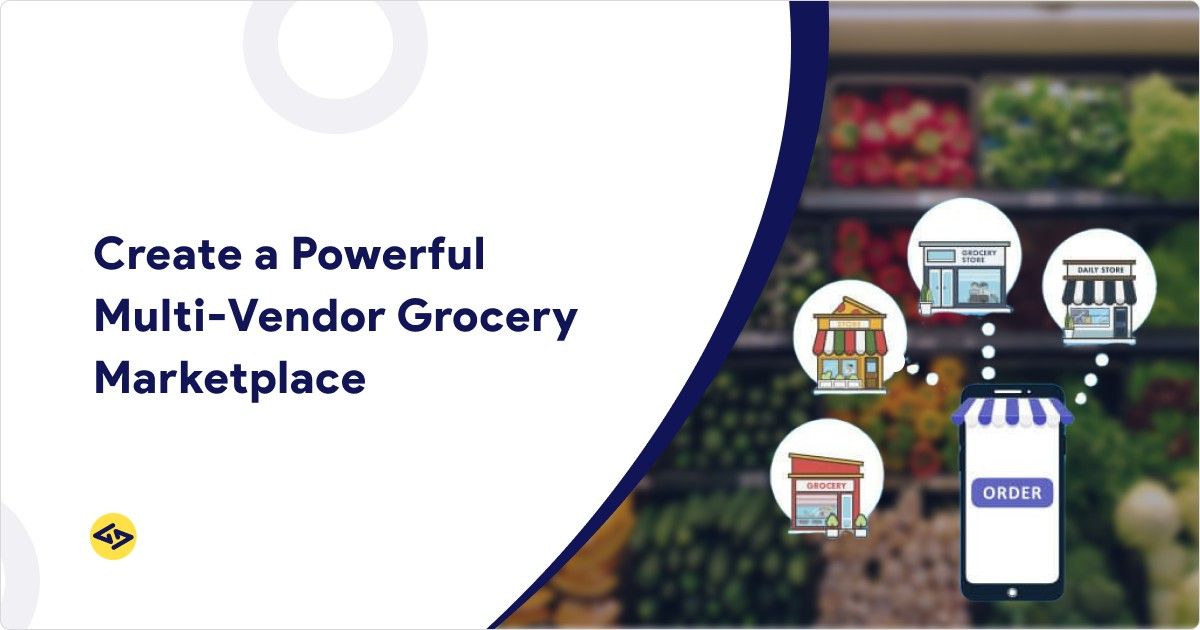
A multi-vendor grocery marketplace is a platform where multiple independent grocery stores or vendors list and sell their products to customers through one shared app or website, rather than customers having to visit separate apps for each store.
How It Differs From a Single-Store Grocery App
A single-store grocery app sells inventory from one business only. A grocery marketplace app development project, by contrast, connects many vendors, each managing their own catalog, pricing, and stock, while the platform owner earns through commissions rather than product sales.
Single-Store Grocery App vs. Multi-Vendor Grocery Marketplace
| Feature | Single Store | Multi-Vendor Marketplace |
| Vendors | 1 | Unlimited |
| Revenue | Product Sales | Commissions + Ads + Subscription |
| Scalability | Medium | High |
| Customer Choice | Limited | Extensive |
| Inventory | Owned | Vendor Managed |
| Operational Cost | Higher | Lower |
How It Works
- Customer — browses products across vendors, places orders, and pays through the app
- Vendor — lists products, manages inventory, and fulfills orders
- Delivery Partner — picks up and delivers orders, often across multiple vendors
- Admin — oversees vendor approvals, commissions, disputes, and platform operations
Popular Examples
Instacart, Amazon Fresh Marketplace, Walmart Marketplace, BigBasket, and Blinkit are among the most recognized examples of this model working at scale, each combining wide vendor networks with fast delivery.
Why Businesses Should Invest in a Multi-Vendor Grocery Marketplace
The online grocery market continues to grow steadily worldwide, and a marketplace model lets businesses capture that demand without carrying inventory risk.
- Multiple revenue streams — commissions, subscriptions, ads, and delivery fees
- Lower inventory risk — vendors manage their own stock, not the platform
- Faster geographic expansion — onboard local vendors instead of opening warehouses
- Higher customer retention — one app, more variety, fewer reasons to switch
- Better vendor ecosystem — vendors bring their own existing customer base
Who Should Build a Multi-Vendor Grocery Marketplace?
This model isn’t right for every business, but it’s especially well-suited to:
- Entrepreneurs looking to enter online grocery without owning inventory
- Grocery startups validating demand before committing to a single-store build
- Supermarket chains wanting to bring independent local vendors under one digital roof
- Hyperlocal delivery businesses aiming to serve dense neighborhoods quickly
- Retail associations representing multiple independent grocers
- Franchise grocery brands looking to unify multiple outlets under one app
Benefits for Every Stakeholder
Customers
Wide product selection, competitive pricing from multiple vendors, faster delivery options, and easy price comparison in one place.
Vendors
Access to a larger customer base, increased sales without building their own app, a ready-made digital storefront, and built-in marketing opportunities.
Admin (Platform Owner)
Steady commission income, optional subscription revenue, straightforward business scalability, and centralized control over the entire ecosystem.
Essential Features of a Multi-Vendor Grocery Marketplace
Understanding multi-vendor grocery app features across each panel is the foundation of good grocery marketplace app development.
Customer App
Registration/login, smart search, product categories, wishlist, cart, multiple payment options, real-time order tracking, ratings and reviews, order history, and push notifications.
Vendor Panel
Vendor onboarding, product management, inventory management, pricing management, promotions and discounts, order management, an earnings dashboard, and customer communication tools.
Delivery Partner App
Accept/reject orders, in-app navigation, route optimization, delivery status updates, an earnings report, and an availability toggle.
Admin Dashboard
Vendor approval, customer management, order management, commission management, coupon management, reports and analytics, CMS, and payment management, together these form the backbone of the grocery marketplace admin panel features most platforms need.
Advanced Features That Make Your Marketplace Stand Out
- AI-powered product recommendations
- Voice search
- Smart inventory prediction
- Dynamic pricing
- Loyalty programs and subscription memberships
- Personalized offers and in-app chat support
- Multiple languages and currencies
- Live delivery tracking
- Referral programs
- Wallet integration
These features aren’t essential for an MVP, but they’re what separates a functional app from a competitive one as you scale. For a deeper look at AI-driven capabilities, see this guide on AI grocery delivery app development.
Multi-Vendor Grocery Marketplace Business Model
Choosing the right grocery marketplace business model determines how sustainable your platform will be. Most successful marketplaces combine two or three of the following:
- Commission-Based Model — a percentage cut on every vendor sale
- Subscription Model — recurring vendor or customer membership fees
- Featured Vendor Listings — vendors pay for better visibility
- Sponsored Products — paid product placement within search results
- Delivery Charges — flat or distance-based delivery fees
- Advertising Revenue — banner ads and promoted placements
- Membership Plans — free delivery or exclusive deals for paying customers
- Value-Added Services — packaging, express delivery, or gifting add-ons
If you want a deeper breakdown of how these streams work together, this article on grocery delivery app monetization covers it in detail.
Technology Stack for Multi-Vendor Grocery Marketplace Development
The right grocery marketplace technology stack affects app performance, scalability, and long-term maintenance cost.
| Layer | Common Choices |
| Frontend | Flutter, React Native |
| Backend | Node.js, Laravel |
| Database | PostgreSQL, MongoDB, MySQL |
| Cloud | AWS, Google Cloud, Azure |
| APIs | Google Maps, Stripe, Razorpay, Twilio, Firebase |
This combination supports the kind of grocery marketplace architecture needed for real-time order tracking, multi-vendor inventory sync, and secure payments at scale. For a more detailed comparison, check out this breakdown of the best tech stack for grocery app development.
Must-Have Third-Party Integrations
Beyond the core stack, most marketplaces rely on a common set of integrations to handle payments, notifications, and analytics:
| Integration | Purpose |
| Google Maps | Navigation & delivery tracking |
| Stripe | Payments |
| Razorpay | Payments |
| Twilio | OTP / SMS verification |
| Firebase | Push notifications |
| SendGrid | Transactional emails |
| Mixpanel | Product analytics |
| Google Analytics | User tracking |
| AWS S3 | File & image storage |
| Cloudflare | CDN & security |
Step-by-Step Multi-Vendor Grocery Marketplace Development Process
- Market Research — study demand, regional buying habits, and category trends
- Competitor Analysis — evaluate existing players’ features, pricing, and gaps
- Business Model Selection — pick your primary and secondary revenue streams
- Vendor Acquisition Strategy — plan how you’ll recruit and onboard your first vendors
- Requirement Gathering — document detailed functional and technical requirements
- UI/UX Design — prioritize speed, simple navigation, and quick checkout
- MVP Development — build core ordering, vendor, and delivery flows first
- QA Testing — test across devices, payment flows, and peak load
- Beta Launch — go live in one city or region with a limited vendor set
- Marketing — acquire both vendors and customers simultaneously
- Analytics & Optimization — track KPIs and refine based on real usage data
- Scaling — expand to new regions, vendors, and advanced features
[Suggested visual: Horizontal development timeline infographic showing all 12 stages]
To understand how the operational side comes together after launch, this piece on how a grocery delivery app works end-to-end is a useful companion read.
MVP vs. Full Enterprise Marketplace
Most businesses don’t need every feature at launch. Here’s how a lean MVP compares to a full enterprise build:
| Aspect | MVP | Enterprise Version |
| Features | Basic ordering & vendor tools | AI-powered recommendations |
| Payment Gateway | One gateway | Multiple gateways |
| Analytics | Basic reporting | Advanced BI dashboard |
| Language Support | One language | Multi-language |
| Delivery | Basic assignment | Route optimization |
Starting with an MVP lets you validate demand and vendor interest before investing in the enterprise-level features on the right.
How Much Does It Cost to Build a Multi-Vendor Grocery Marketplace?
Grocery marketplace development cost depends on several variables rather than a single fixed number.
Cost Factors
- Platform — Android, iOS, or Web (or all three)
- Number of features included
- Number of user panels (customer, vendor, delivery, admin)
- Third-party integrations (payments, maps, SMS)
- Technology stack chosen
- Development team location
- Security and compliance requirements
- Ongoing maintenance and support
Estimated Cost Table
| Project Type | Estimated Cost |
| MVP | $20,000–$40,000 |
| Medium Complexity | $40,000–$80,000 |
| Enterprise Marketplace | $80,000–$200,000+ |
These figures are directional starting points — for a precise, itemized estimate, see this detailed cost to develop a grocery delivery app breakdown, or request a custom quote based on your exact feature list.
Security & Compliance Considerations
A grocery marketplace handles sensitive customer and payment data, so security can’t be an afterthought, especially for enterprise buyers and investors evaluating the platform.
- GDPR compliance for handling EU customer data
- PCI DSS compliance for storing and processing card payments
- SSL encryption across the entire platform
- Two-factor authentication for vendor and admin accounts
- Secure payment gateways with tokenized transactions
- Data encryption at rest and in transit
- Regular backup and recovery procedures
- Fraud detection for suspicious orders and payment activity
Challenges in Multi-Vendor Grocery Marketplace Development
Building a scalable grocery marketplace solution comes with real operational hurdles:
- Vendor onboarding and verification at scale
- Keeping inventory synchronized across many vendors in real time
- Coordinating order management when a single cart spans multiple vendors
- Solving last-mile delivery efficiently
- Scaling infrastructure during peak demand
- Protecting customer and payment data
- Reconciling payments across vendors, delivery partners, and the platform
- Retaining customers in a competitive category
Key Metrics (KPIs) to Track After Launch
Once your marketplace is live, these metrics tell you whether the business is actually working:
- Customer Acquisition Cost (CAC)
- Lifetime Value (LTV)
- Average Order Value (AOV)
- Vendor Retention Rate
- Delivery Time
- Order Completion Rate
- Repeat Purchase Rate
- Cart Abandonment Rate
Tracking these from day one makes it far easier to spot problems early and prioritize the right features during your next development phase.
Best Practices for Building a Successful Grocery Marketplace
- Start with an MVP instead of a full feature set
- Focus on UX — grocery shopping should feel effortless
- Optimize search so customers find products in seconds
- Enable quick, minimal-step checkout
- Use AI for personalized recommendations
- Ensure consistently fast delivery
- Offer multiple payment methods, including wallets and cash on delivery
- Monitor analytics to catch drop-off points early
- Build vendor trust through fair commissions and clear payouts
- Gather user feedback continuously and iterate
Common Mistakes to Avoid
- Ignoring vendor experience in favor of only the customer app
- Poor inventory management leading to out-of-stock frustration
- Slow app performance during peak hours
- Limited payment options that cause cart abandonment
- Weak customer support for order issues
- No scalability planning from day one
- Overly complicated vendor onboarding
- Inadequate testing before launch
If you’re weighing a dark store model instead of (or alongside) a marketplace, this guide on how to build dark store grocery delivery app solutions explains the key differences.
Future Trends in Multi-Vendor Grocery Marketplaces
- AI-powered shopping assistants
- Agentic AI for automated order placement and reordering
- Computer vision for product recognition and shelf scanning
- Predictive inventory and demand forecasting
- Drone and autonomous delivery vehicles
- Voice commerce
- Quick commerce (Q-commerce) — 10 to 30 minute delivery windows
- Smart, automated warehousing
- IoT-enabled inventory tracking
- Blockchain for supply chain transparency
- AR-powered grocery shopping experiences
- Sustainable, eco-friendly delivery solutions
Retail chains exploring this space may also find value in this guide to grocery delivery app development for retail chains, which covers trends specific to larger operations.
Why Choose iCoderz Solutions for Multi-Vendor Grocery Marketplace Development?
iCoderz Solutions brings over 14 years of app development expertise, including hands-on experience building grocery and on-demand platforms for clients across markets. Our team offers:
- Custom marketplace development tailored to your business model
- Scalable architecture built to handle growth from day one
- End-to-end development services, from planning to post-launch support
- UI/UX-focused design that prioritizes conversions
- Dedicated support and maintenance after launch
- An agile development process with transparent milestones
We’ve also helped clients build apps modeled on category leaders, see our guide on how to app like blinkit for reference, or explore more best grocery app development ideas if you’re still shaping your concept.
Conclusion
Building a successful multi-vendor grocery marketplace comes down to a handful of decisions that matter more than the rest:
- Multi-vendor marketplaces scale more easily than single-store apps, since vendors carry their own inventory risk.
- Choose a revenue model — commissions, subscriptions, ads, or a mix — that aligns with your business goals.
- Prioritize core features in an MVP before adding AI, multi-language, or advanced analytics.
- Select a flexible technology stack that can support growth without a rebuild.
- Work with an experienced development partner to reduce technical risk and get to market faster.
Whether you’re a startup validating an idea or an established retailer moving online, the fundamentals in this guide apply. If you’re ready to move from planning to building, Grocery delivery app development with a team that understands both the technical and business side can save months of trial and error.
Ready to build your multi-vendor grocery marketplace? Partner with iCoderz Solutions for custom, scalable grocery marketplace development, from MVP to enterprise-grade platform. You can also read our complete Develop a grocery delivery app development guide for a broader look at the space.
Build Your Grocery Marketplace
Launch a scalable multi-vendor platform with advanced features, secure payments, and seamless order management.

Frequently Asked Questions (FAQs)
What is a multi-vendor grocery marketplace?
A multi-vendor grocery marketplace is a platform where multiple independent grocery vendors sell products to customers through one shared app or website, with the platform owner managing operations and earning through commissions.
How does a multi-vendor grocery marketplace work?
Customers browse and order from multiple vendors in one app, vendors manage their own inventory and orders, delivery partners handle pickup and drop-off, and the admin oversees the entire platform, including commissions and payouts.
How much does it cost to build a grocery marketplace?
Costs typically range from $20,000–$40,000 for an MVP, $40,000–$80,000 for medium complexity, and $80,000–$200,000+ for an enterprise-grade marketplace, depending on features, platforms, and integrations.
How long does development take?
An MVP usually takes 3–5 months, while a full-featured, multi-panel marketplace can take 6–10 months depending on complexity and team size.
Which features are essential for a grocery marketplace app?
Core essentials include vendor onboarding, product and inventory management, multi-payment checkout, real-time order tracking, delivery partner tools, and an admin dashboard for commissions and reporting.
What technology stack is best for grocery marketplace development?
A common stack includes Flutter or React Native for frontend, Node.js or Laravel for backend, PostgreSQL or MongoDB for the database, and AWS or Google Cloud for hosting — paired with APIs like Google Maps, Stripe, and Twilio.
How do grocery marketplaces make money?
Revenue typically comes from vendor commissions, subscription fees, featured listings, sponsored products, delivery charges, and membership plans.
Is a multi-vendor grocery marketplace profitable?
Yes, when the commission structure, vendor mix, and delivery logistics are well-planned, marketplaces can be profitable due to multiple revenue streams and low inventory overhead compared to single-store models.
Can I start with an MVP and scale later?
Yes, and it’s the recommended approach — launching an MVP with core features lets you validate demand and vendor interest before investing in advanced functionality.
How do I choose the right grocery app development company?
Look for a team with proven experience in on-demand and marketplace apps, a transparent development process, post-launch support, and the ability to show relevant past projects or case studies.