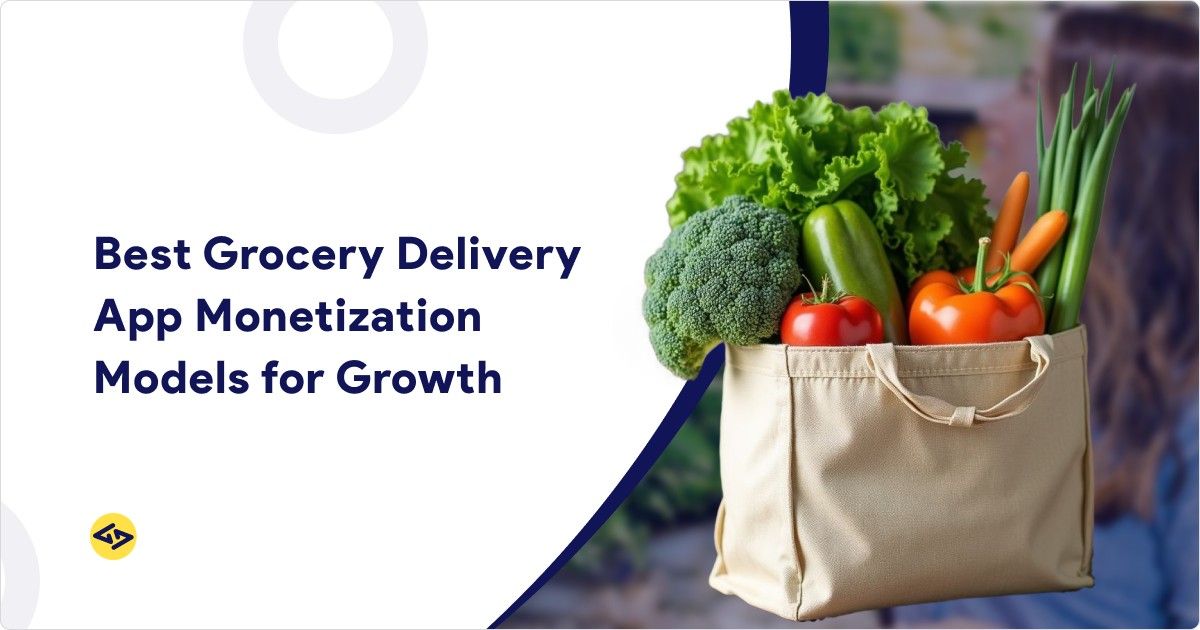
The global online grocery delivery market was valued at roughly $0.91 trillion in 2026 and is projected to reach $2.43 trillion by 2031, growing at a compound annual growth rate of nearly 22% (Mordor Intelligence). In the U.S. alone, 61% of households now buy groceries online, and instant delivery is growing faster than any other delivery model. That’s not a niche trend anymore — it’s a massive, fast-moving market with real revenue on the table.
But bigger demand also means fiercer competition. Dozens of new grocery apps launch every year, and the rising demand for grocery delivery apps in the USA keeps pulling in new players. Most of them struggle with the same question: how do you actually turn daily orders into consistent profit? The answer isn’t a single revenue stream; it’s usually a mix, carefully chosen based on your market, your vendors, and your customers’ willingness to pay.
This guide breaks down every proven Grocery Delivery App Monetization Model, backs each one with real examples from companies already using it, and helps you decide which combination fits your business.
Understanding Grocery Delivery App Monetization
What is app monetization? App monetization is the strategy a business uses to generate income from its app, through fees, commissions, subscriptions, ads, or a combination of these.
For a grocery platform, monetization isn’t just “how do we charge customers.” It also covers how you charge vendors, how you price delivery, and how you tap into your user base for secondary Grocery App Revenue Streams like advertising or brand promotions. If you’re still shaping your core platform, it helps to first get the fundamentals right with a well-planned on-demand grocery delivery app, monetization only works as well as the app it’s built into.
Why monetization matters for long-term growth: A grocery delivery business runs on thin margins and high order volume. Without a clear Grocery Delivery App Business Model, even an app with strong daily traffic can struggle to cover delivery costs, staffing, and technology upkeep.
Key factors affecting revenue generation in grocery apps include:
- Order frequency and average basket size
- Number of active vendors on the platform
- Delivery radius and logistics cost
- Customer price sensitivity
- Local competition and market saturation
Why Monetization Strategy Matters for Grocery Delivery Apps
A well-planned Grocery Delivery App Monetization Strategy does more than generate income, it shapes the entire health of the business.
- Impacts profitability: The right pricing mix determines whether each order is profitable or a loss-leader, directly affecting your Grocery Delivery App Profit Margin.
- Supports operational scalability: – Predictable revenue streams make it easier to expand into new cities or add dark stores.
- Improves customer retention: Transparent pricing, without hidden fees, keeps users coming back.
- Creates sustainable revenue streams: Diversified income reduces dependency on any single source, like delivery fees alone.
Think of monetization as the financial engine behind the app, the UI gets people in, but the revenue model keeps the business running.
Core Monetization Models
Commission-Based Model
How it works
This is the most widely used Grocery Delivery App Commission Model. The platform charges partner grocery stores or vendors a percentage, typically 10% to 30%, on every order placed through the app.
Real-world example
Instacart built its entire marketplace on this model, connecting shoppers to partner grocery chains and earning commission plus service fees on every order. In 2025, Instacart’s net sales reached an estimated $37.2 billion, up more than 11% year-over-year, a clear sign of how far a commission-driven Grocery Marketplace Commission Structure can scale.
Benefits
- Recurring revenue with every transaction
- Highly scalable as vendor count grows
- Low upfront investment for the platform owner
Best for
Marketplace-style apps that connect multiple local stores to shoppers. Understanding Vendor Commission in Grocery Apps and Grocery App Marketplace Revenue is essential before onboarding your first partner store.
If you’re building a marketplace model from scratch, this breakdown of how to build a hyperlocal grocery delivery app covers the technical side in detail. Large marketplace platforms like BigBasket run on this same commission logic, if that’s the direction you’re headed, our guide on how to build a BigBasket clone app walks through the model in more depth.
Subscription-Based Model
How it works
A Subscription-Based Grocery Delivery App offers customers a monthly or yearly membership in exchange for added perks, essentially a loyalty program with a price tag.
Real-world example
Amazon Fresh, bundled into Amazon Prime, and Walmart+ both use subscription access to free delivery as their primary retention lever. Customers pay once, then order more frequently because delivery already feels “paid for”, a textbook example of how a Grocery Delivery Premium Subscription increases order frequency, not just revenue per order.
Revenue opportunities
- Free or discounted delivery on every order
- Exclusive member-only discounts
- Faster or priority delivery slots
Best for
Apps with a loyal, repeat customer base. Since Grocery App Membership Plans rely on retention rather than one-time transactions, this model works best once you already have consistent order volume, and it creates a steady Grocery App Recurring Revenue Model that smooths out seasonal dips.
Delivery Fee Model
How it works
Customers are charged based on distance, order size, or delivery time slot. This is the most direct Grocery Delivery Service Fee Model and often the first revenue stream a new app implements.
Common pricing structures
- Flat fee – A fixed charge regardless of order size
- Dynamic pricing – Fee adjusts based on distance or demand
- Peak-hour pricing – Higher fees during high-traffic delivery windows
This ties directly into your broader Grocery App Delivery Charges Strategy and Grocery App Fee Structure, both of which need to balance profitability against customer price sensitivity, especially in a market where the average online grocery order already runs well above in-store basket sizes.
Surge Pricing Model
How it works
Similar to ride-hailing apps, surge pricing raises delivery or service fees during high-demand periods — bad weather, holidays, or dinner-rush hours.
Real-world example
Uber Eats popularized this approach in food delivery, and several grocery platforms have adapted the same logic for peak grocery-shopping windows, like weekend mornings or the hours before a holiday. It’s a proven way to manage demand spikes without turning away orders.
Benefits
- Better revenue during predictable peak hours
- Improved delivery efficiency, since surge pricing naturally spreads out demand
Used carefully, surge pricing complements your Grocery App Convenience Fee Model without alienating regular customers, as long as pricing changes stay transparent.
In-App Advertising Model
In-app advertising has quietly become one of the most profitable Grocery App Revenue Streams available, retail media placements can generate gross margins of 70% to 90%, according to Mordor Intelligence, far higher than delivery fees or even commissions. Here’s how apps typically structure it:
CPC ads (cost-per-click)
Brands pay only when a shopper clicks their ad or product listing, common for banner placements and category-page promotions.
CPM ads (cost-per-impression)
Brands pay based on how many times their ad is shown, regardless of clicks, typically used for homepage banners and app-wide visibility campaigns.
Sponsored search placement
FMCG brands pay to appear at the top of search results for specific keywords (for example, a cereal brand bidding to appear first when a shopper searches “breakfast”). This is one of the fastest-growing formats because it captures intent at the exact moment a customer is ready to buy.
Other revenue sources
- Featured store placements on the home screen
- Category takeovers during promotional periods
Best for
Apps with a large, active user base. Once you hit meaningful daily traffic, Grocery Delivery App Advertising Revenue and Grocery App Sponsored Listings can become a genuinely significant income stream, often with minimal added operational cost, since you’re monetizing attention you already have.
Freemium Model
How it works
Basic ordering and delivery stay free, while premium features carry a price tag.
Examples:
- Priority delivery slots
- Personalized offers based on shopping history
- Premium customer support
This model works well alongside a subscription tier, giving price-sensitive users a free entry point while still capturing revenue from power users.
Partner Promotions & Brand Collaborations
FMCG (fast-moving consumer goods) brands are always looking for shelf space, and your app’s home screen is digital shelf space. This model includes:
- Paid promotions from grocery and packaged food brands
- Featured placements for new product launches
- Sponsored seasonal campaigns
This is a strong contributor to your overall Grocery App Promotional Revenue and Grocery Delivery App Marketing Revenue, especially once you have shopper data to offer brands for targeting.
White-Label Grocery App Licensing
Instead of running the platform yourself, you can license your app solution to independent grocery stores or regional chains who want their own branded app without building one from scratch. This generates recurring SaaS-style revenue and turns your technology into a product of its own, a smart move for anyone exploring Profitable Grocery Delivery App Ideas beyond a single-market business. It also opens the door to serving adjacent categories through broader food & beverage software solutions, rather than staying limited to a single grocery vertical.
Choosing the Right Model
How to Choose the Best Monetization Model
There’s no universal “best” model; the right fit depends on your specific situation. Before deciding, consider:
- Target audience – Price-sensitive shoppers vs. convenience-focused urban users
- Order volume – Higher volume supports thinner commission margins
- Delivery radius – Wider radius often needs distance-based fees
- Market competition – Saturated markets may require lower fees to stay competitive
- Business goals – Fast growth vs. steady, sustainable profitability
Quick comparison
| Monetization Model | Revenue Potential | Best For |
| Commission | High | Marketplace apps with many vendors |
| Subscription | Medium–High | Apps with loyal, repeat users |
| Delivery Fee | Medium | New apps building initial revenue |
| Surge Pricing | Medium | Apps with predictable demand spikes |
| Advertising | Medium–High | High-traffic apps with large user base |
| Hybrid | Very High | Scalable, multi-revenue businesses |
Best Practice: Hybrid Monetization Strategy
Most successful grocery apps don’t rely on just one revenue stream. Combining models spreads risk and captures revenue from multiple points in the customer journey.
Common combinations:
- Commission + Subscription
- Delivery Fee + Advertising
- Subscription + Brand Promotions
Why hybrid works better: If one revenue stream slows down, say, delivery fee income drops during a promotional period — other streams like commission or subscriptions keep the business stable. This is why most large-scale platforms, including apps similar to Blinkit’s business model and Zepto’s business model, rely on layered revenue rather than a single source. It’s also why a strong Grocery Delivery App ROI almost always traces back to a hybrid approach rather than a single fee.
Challenges in Grocery App Monetization
Every monetization model comes with trade-offs. Common challenges include:
- Customer retention – Fees that feel excessive can push users to competitors
- High operational costs – Delivery staff, dark stores, and logistics eat into margins
- Delivery logistics – Last-mile delivery remains the most expensive part of the business
- Price-sensitive users – Many grocery shoppers compare prices closely, limiting how much you can charge
Understanding your real cost structure, from development to daily operations, is critical here. This comparison of grocery delivery app development cost vs. an app like Instacart is a useful starting point for estimating your own Grocery Delivery App Cost vs Revenue numbers.
Common Mistakes in Grocery App Monetization
Even a solid revenue model can underperform if it’s implemented poorly. These are the mistakes we see most often:
- Overcharging delivery fees – Pushing fees too high too early drives away price-sensitive shoppers before loyalty has a chance to build.
- Ignoring retention metrics – Chasing new downloads while ignoring repeat-order rate leaves money on the table; retained customers are far cheaper to serve than new ones.
- Depending on one revenue source – Relying entirely on commission or delivery fees leaves the business exposed if that single stream slows down.
- Poor pricing transparency – Hidden charges added at checkout are one of the fastest ways to lose customer trust and tank app-store ratings.
- Copying a competitor’s model without testing it locally – A subscription model that works in a dense metro market may fail in a smaller, price-sensitive region.
Avoiding these mistakes early is often more valuable than adding a new revenue stream, a leaner, well-executed Grocery Delivery Startup Business Plan usually outperforms one that’s spread too thin.
Future Trends in Grocery Delivery Monetization
The next wave of Grocery Delivery App Profit Model innovation is being shaped by technology:
- AI-driven pricing – Dynamic pricing based on real-time demand and inventory
- Personalized subscriptions – Membership tiers tailored to individual shopping habits
- Hyperlocal monetization – Neighborhood-specific pricing and dark-store models
- Data-driven promotions – Brands paying for targeted placements based on shopper data, a segment already generating some of the highest margins in the industry
Founders exploring what’s next should look into how AI is transforming grocery delivery app development, as intelligent pricing and personalization are quickly becoming table stakes rather than a competitive edge.
Conclusion
There’s no shortage of ways to answer the question of How Grocery Delivery Apps Make Money, commission, subscriptions, delivery fees, advertising, and brand partnerships all play a role, and real platforms like Instacart, Amazon Fresh, and Uber Eats prove each model works when applied to the right market. But the businesses that protect their profit margin over time are the ones that don’t bet everything on a single stream.
A hybrid approach, built around your specific market, vendor relationships, and customer behavior, gives you the flexibility to grow without being derailed by one underperforming revenue source. Whether you’re validating a new business plan or refining an existing platform, the goal is the same: build a model that scales with your business, not against it.
Need help choosing or implementing the right monetization model for your grocery app? Get in touch with our team for a free consultation.
Ready to Monetize Your Grocery Delivery App?
From commission models to subscriptions, we help you build revenue-driven grocery delivery solutions tailored to your business.

Frequently Asked Questions (FAQs)
What is the most profitable grocery delivery app monetization model?
There’s no single “most profitable” model, the commission-based model is the most widely used because it scales with order volume, but apps that combine commission with subscriptions and advertising typically see the highest overall Grocery Delivery App Profit Margin.
How do grocery delivery apps make money without charging customers directly?
Many apps earn primarily through vendor commissions and advertising revenue, keeping delivery free or low-cost for customers while charging partner stores a percentage per order.
Is a subscription model better than a commission model for grocery apps?
Subscriptions work best for apps with loyal, repeat customers, Amazon Fresh and Walmart+ are good examples, while commissions suit marketplace apps with many vendors, like Instacart. Most successful platforms use both together.
What percentage commission do grocery delivery apps typically charge vendors?
Commission rates usually range from 10% to 30%, depending on the vendor category, order volume, and local market competition.
How much does it cost to build a grocery delivery app with multiple revenue streams?
Costs vary widely based on features and complexity; you can review a detailed cost breakdown in this grocery app development cost guide.
What is a hybrid monetization strategy?
It’s the practice of combining two or more revenue models, such as commission plus subscription, or delivery fees plus advertising, to diversify income and reduce dependency on a single revenue source.
Can advertising alone sustain a grocery delivery app’s revenue?
Advertising works best as a supplementary revenue stream once an app has a large, active user base; retail media margins can be very high, but it rarely sustains a business on its own in the early stages.
What tech stack is recommended for building a monetization-ready grocery app?
The right stack depends on your target platforms and scalability needs; this best tech stack for grocery apps guide covers the options in depth.
How does surge pricing affect customer retention?
When used transparently and only during genuine high-demand periods — the way Uber Eats applies it — surge pricing has minimal impact on retention. Hidden or unpredictable fees tend to hurt retention far more.
Should a new grocery delivery startup start with one revenue model or multiple?
Most startups begin with a single, simple model — usually commission or delivery fees — and layer in subscriptions or advertising once they have consistent order volume and a stable user base.