Introduction: Why Your Restaurant Needs More Than Just an Ordering App
Here’s a number that should stop every restaurant owner in their tracks: acquiring a new customer costs 5 to 7 times more than keeping an existing one.
And yet, most restaurants still pour their marketing budgets into chasing new diners, paying for ads, funding first-order discounts, and listing on third-party delivery platforms that take 25–30% of every transaction. Meanwhile, the customers who already love their food? They’re given no real reason to come back.
The data tells a compelling story. A 2025 Paytronix report found that loyalty program members visit restaurants 20% more frequently and spend 18% more per visit than non-members. According to the National Restaurant Association, 57% of adults say they’d dine out more often if a restaurant offered a loyalty program.
Restaurant ordering apps have evolved far beyond digital menus and order buttons. The world’s leading brands — Starbucks, McDonald’s, Domino’s — have built entire loyalty ecosystems that keep customers engaged between visits, drive direct ordering, and generate first-party data that fuels hyper-personalized marketing.
Whether you run a QSR chain, a standalone café, or a cloud kitchen, this guide breaks down every loyalty and rewards feature your restaurant ordering app needs — backed by the latest 2025–2026 real-world data and case studies you can learn from today.
Why Customer Loyalty Matters More Than Ever in Restaurants
The Real Cost of Ignoring Retention
Restaurant profit margins are notoriously thin — typically 3–9% for full-service restaurants. According to Harvard Business School, increasing customer retention by just 5% can boost profits by 25–95%. In that environment, every repeat customer is a lifeline.
| 📊 Key Retention Statistics (2025–2026) • Loyalty members visit 20% more often and spend 18% more per visit (Paytronix 2025) • Retaining 5% more customers can increase profit by up to 95% (Harvard Business School) • 57% of adults say they’d visit a restaurant more often if it had a loyalty program (NRA 2025) • Loyal customers spend 3× more than non-members (Starbucks Investor Relations, 2025) • Starbucks customer retention rate: 44% vs industry average of 25% |
Direct Ordering vs. Third-Party Dependency
Every order placed through a food aggregator costs you 25–30% in commission, hands the customer relationship to the platform, and feeds their data into their own algorithm. As covered in our deep-dive on building a direct-channel food delivery app, branded ordering apps consistently outperform third-party channels on both margin and customer engagement — because you own the data, the relationship, and the repeat order.
That first-party data is what lets you send a push notification saying “Hey Priya, your usual Paneer Tikka combo — 10% off today only” and convert at 35%+. No aggregator can offer that.
Customer Lifetime Value: The Metric That Actually Matters
Most restaurants track average order value. Winning restaurants track Customer Lifetime Value (CLV). A loyalty program that converts a once-a-month customer into a weekly one doesn’t just increase monthly revenue — it compounds value over months and years. That compounding effect is the true ROI of investing in a restaurant ordering app loyalty program.
Essential Loyalty & Rewards Features for Restaurant Ordering Apps
Here are the core features every competitive restaurant ordering app should include. For the full technical feature breakdown, see our guide on food delivery app features for 2026.
1. Points-Based Rewards System
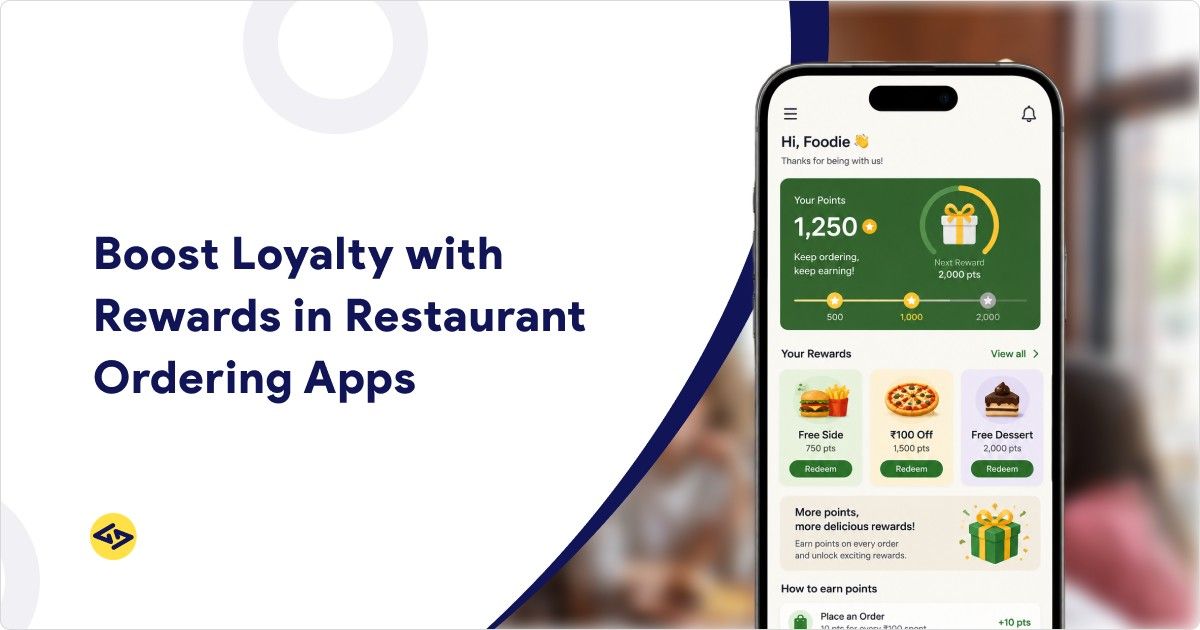
How it works: Customers earn points for every rupee or dollar spent. Points accumulate in their app profile and can be redeemed for discounts, free items, or exclusive offers.
Business benefit: Points create a constant, tangible incentive to return. Research shows customers spend 39% more to reach a reward threshold than they would otherwise — the ‘almost there’ effect is powerful psychology.
Pro tip: Always surface the points balance prominently on the home screen. The more often customers see their progress, the more they think about their next order.
Example: 1 point per ₹10 spent. 100 points = ₹50 off the next order. Simple, transparent, motivating.
2. Tier-Based Membership Programs
How it works: Customers graduate through loyalty tiers — Silver → Gold → Platinum — based on cumulative spending or visit frequency. Each tier unlocks better rewards and exclusive perks.
Business benefit: Tiers create aspiration. A Silver member who sees what Gold members enjoy is incentivized to spend more to level up — driving average order value and visit frequency simultaneously.
Customer psychology: Status matters deeply. Being a ‘Gold Member’ at a favourite restaurant feels meaningful — and switching to a competitor means losing that status, creating powerful retention.
3. Digital Wallet & Cashback System
How it works: Customers preload a digital wallet inside your app, or receive cashback into it after orders. The balance is then used for future purchases.
Business benefit: A preloaded wallet is money already committed to your brand. Customers with active wallet balances visit more frequently and churn far less.
Customer psychology: Preloaded wallets reduce the ‘pain of payment’ at checkout — customers feel like they’re spending money that’s already been set aside, lowering purchase resistance and speeding up decisions.
4. Referral Rewards Program
How it works: Customers refer friends via a unique link or code. Both parties receive a reward when the referred user completes their first order. Our blog on marketing your food delivery app covers referral mechanics in depth — they’re consistently the lowest-cost acquisition channel available, with word-of-mouth conversions far outperforming paid advertising.
5. Gamification Features
How it works: Gamification layers game mechanics — challenges, streaks, badges, scratch cards, spin-to-win wheels — onto the loyalty experience to drive addictive, habitual engagement.
Business benefit: Gamification drives app engagement even when customers aren’t actively hungry. A 7-day streak challenge creates daily app-opening behavior and top-of-mind awareness between transactions.
Gamification mechanics that work:
- Order streaks: Maintain a weekly ordering streak for bonus points
- Scratch cards: After every order, scratch a digital card to reveal a random reward
- Spin-to-win: Occasional in-app reward wheels after order milestones
- Badges & achievements: ‘Pizza Pro’ for 10 pizza orders — shareable on social media
- Seasonal challenges: ‘Summer Sip Challenge’ — try 5 cold drinks and earn a free item
6. Personalized Offers & AI-Driven Recommendations
How it works: The app analyzes order history, food preferences, visit times, location, and promotional response patterns to serve individualized offers and item recommendations to each customer.
Business benefit: Generic discounts are easy to ignore. ‘20% off your next butter chicken — because you’ve ordered it 3 times this month’ is nearly impossible to ignore. As outlined in our guide on how to build a food delivery app, AI-powered personalization consistently outperforms blanket promotions in conversion rates.
7. Digital Stamp Cards
A digital evolution of the classic paper punch card — buy 9, get 1 free. Dead-simple to understand, universally motivating, and low-cost to implement. Works especially well for cafés and QSR brands with high repeat-visit potential. Unlike paper, digital stamps can’t be lost, forged, or left at home. See also how QR codes can amplify in-store engagement alongside digital stamp systems.
8. Birthday & Anniversary Rewards
On a customer’s birthday — or their app anniversary — they receive a special reward: a free item, bonus points, or a discount valid for their birthday week. Birthday rewards generate enormous goodwill and feel genuinely personal even when automated. Starbucks has publicly cited their Birthday Reward as a top driver of new app sign-ups — customers actively download the app specifically to claim it.
9. Push Notifications & Engagement Campaigns
Push notifications carry an 8.5% open rate in food and beverage — significantly higher than email. When personalized based on order history and time-of-day, that number climbs further. Best practices:
- Time notifications to typical ordering windows (lunch: 11:30 AM, dinner: 6:30 PM)
- Name personalization: ‘Raj, your Friday pizza night deal is here 🍕’
- Urgency triggers: ‘Your 50 points expire in 48 hours — redeem now’
- Reorder nudges based on past order history
- Limit to 2–3 notifications per week to avoid opt-outs
10. Subscription & VIP Programs
Customers pay a monthly or annual fee for exclusive benefits — free delivery, priority support, member-only discounts, early access to new menu items. Subscriptions create predictable recurring revenue and dramatically reduce churn. A customer who pays ₹199/month for unlimited free delivery has a strong financial reason to order exclusively through your app every week.
11. Reward Redemption System
The redemption experience is where loyalty programs live or die. If customers find it confusing or difficult to use their rewards, they stop caring about earning them. The redemption UX must be as smooth as the ordering experience itself. Always surface ‘You have rewards available!’ prominently at checkout — show the monetary value in plain language, not just points, and never make customers hunt for the button.
Real-World Case Studies: How the World’s Best Restaurant Apps Build Loyalty
Case Study 1: Starbucks Rewards — The Reimagined Gold Standard (2026)
Starbucks Rewards is widely considered the best loyalty program in food and beverage. With 35.5 million active members in the US (Starbucks official press release, February 2026), rewards members spending 2–3× more than non-members, and loyalty accounting for over 50% of sales at company-operated stores, the program’s scale is unmatched. In Q1 2025 alone, Starbucks generated $3.5 billion in gift card loads.
| 📊 Starbucks Rewards — 2025/2026 Data • 35.5 million active US members (Feb 2026 — Starbucks official press release) • Rewards members spend 2–3× more than non-members • Loyalty accounts for 50%+ of company-operated store sales • Starbucks customer retention rate: 44% vs 25% industry average • $3.5B in gift card loads in Q1 2025 alone• Reimagined 3-tier program (Green / Gold / Reserve) launched March 10, 2026 |
How the Starbucks Rewards Ecosystem Works
The 2026 reimagined Starbucks Rewards program introduced three tiers — Green, Gold, and Reserve — each with faster Star-earning rates and more exclusive benefits as customers engage more:
- Green tier: 1 Star per $1, Birthday Reward (free beverage or food), Free Mod Mondays (free drink customization once/month), bonus Stars on Starbucks Card reloads
- Gold tier: Unlocked at 500 Stars in 12 months. Higher earn rate, Stars that never expire, extended Birthday Reward window, all Green benefits plus exclusive perks
- Reserve tier: Highest earn rate, personalized Reserve Card, exclusive Global Coffee Experiences, premium benefits for the most loyal customers
- New 60-Star redemption tier: $2 off any item — a faster, lower-threshold reward added directly in response to member feedback
Mobile wallet integration: The Starbucks app includes a built-in Starbucks Card digital wallet. Customers preload funds for one-tap payment and simultaneous Stars earning — a powerful lock-in that makes Starbucks the default purchase rather than a considered choice.
AI personalization: Starbucks uses machine learning to serve individually targeted offers. A customer who orders iced lattes three mornings a week receives cold brew triple-star promotions — not generic blasts. Their engine processes millions of data points to serve offers that are genuinely relevant to each individual.
Gamification — Bonus Star Challenges: Limited-time challenges (‘Order 3 times this week for 50 bonus Stars’) create urgency and spike transaction volume. Starbucks for Life (a seasonal sweepstakes game) builds additional engagement during key commercial periods.
Mobile Order & Pay: App-exclusive ahead-ordering with queue-skipping — a massive convenience benefit that drove enormous adoption and has become a default behavior for millions of customers.
Why it works: Starbucks has made loyalty aspirational, habitual, and genuinely valuable. A preloaded wallet, AI-personalized offers, gamification, and a three-tier status system create a loyalty flywheel that is extremely difficult for a customer to walk away from.
Case Study 2: MyMcDonald’s Rewards — Democratized Loyalty at Massive Scale
MyMcDonald’s Rewards launched in the US in 2021 and has grown into one of the largest loyalty programs on the planet. By Q2 2025, the program reached 185 million 90-day active users globally, with McDonald’s publicly targeting 250 million active users by 2027. In 2024, loyalty members generated $30 billion in systemwide sales — a 30% year-on-year increase (McDonald’s Q4 2024 Earnings Call).
| 📊 MyMcDonald’s Rewards — 2025/2026 Data • 185 million 90-day active users globally (Q2 2025) • $30 billion in loyalty-attributed systemwide sales in 2024 (+30% YoY) • Loyalty members return 23% more often than non-members • Target: 250 million active users and $45B loyalty sales by 2027 |
How MyMcDonald’s Rewards Works
Points system: 100 points per $1 spent, redeemable across four tiers: 1,500 pts (hash brown), 3,000 pts (McChicken), 4,500 pts (medium fries), 6,000 pts (Big Mac). Full details on the MyMcDonald’s Rewards program page.
App-exclusive deals — the #1 download driver: The McDonald’s app consistently offers deals unavailable elsewhere — $1 large fries, buy-one-get-one offers, member pricing on limited-time items. These deals are the single biggest driver of app downloads and the primary reason customers choose the direct app over the counter or a third-party platform.
AI-driven personalization: McDonald’s invested heavily in AI infrastructure to personalize the app experience. Based on order history, location, time of day, and weather conditions, the app surfaces relevant offers. A breakfast McCafé regular gets coffee deals; a McSpicy fan gets burger promotions.
Drive-thru & delivery integration: Customers scan their app at the drive-thru speaker to earn points without going inside. Points are earned whether customers eat in, take out, drive-thru, or order for delivery — seamless cross-channel loyalty at scale.
Gamification — Monopoly Returns: The 2025 McDonald’s Monopoly promotion offered 500 bonus points for pre-registering, plus in-game prizes and a digital Bonus Play mechanic — a masterclass in seasonal gamification that drives both app engagement and transaction frequency.
Why it works: McDonald’s understood that at their scale, loyalty had to be simple, accessible, and immediately rewarding. Universal app-exclusive deals, easy point accumulation, and seamless cross-channel integration created a program that works for their entire customer base.
Case Study 3: Domino’s Rewards — Convenience-First Loyalty That Converts
Domino’s Rewards (relaunched September 2023) closed 2025 with 37.3 million active users — up nearly 20% since relaunch (Domino’s Q4 2025 Earnings via CX Dive). Carryout contributed $4.4 billion in sales in 2025, with loyalty named as the primary growth accelerator.
| 📊 Domino’s Rewards — 2025/2026 Data • 37.3 million active loyalty members (end of 2025, Q4 2025 Earnings) • $4.4 billion in carryout sales in 2025 (loyalty cited as key accelerator) • Carryout same-store sales +6.5% in Q4 2025 • 2 million new members joined within months of the 2023 program redesign • Orders with loyalty redemptions doubled in the first half of 2024 vs prior year |
How Domino’s Rewards Works
Direct ordering ecosystem: Domino’s Rewards is available exclusively through their own app and website — a deliberate strategy to own the customer relationship entirely. When you own the channel, you own the data, the margin, and the repeat order.
Lower entry barrier — the design change that drove 2M new members: Per the official Domino’s Rewards relaunch announcement, the 2023 redesign halved the minimum order to earn points from $10 to $5. This single decision doubled the qualifying transaction pool and drove 2 million new members within months.
Redemption tiers: 20 points for a free Cheesy Bread, 40 points for more items, 60 points for a free medium pizza. The faster reward velocity makes loyalty feel achievable on every visit — not a distant goal.
Pizza Tracker — engagement between order and delivery: The Domino’s Pizza Tracker (Order Received → Being Prepared → Quality Check → Out for Delivery → Delivered) creates active engagement between order placement and arrival. It reduces ‘where is my order?’ anxiety and generates genuine pre-delivery excitement. Real-time order tracking is a core feature in every food delivery app we build at iCoderz for precisely this reason.
Emergency Pizza — habit-building mechanic: In late 2023, Domino’s offered a free pizza (redeemable on a future visit) after a qualifying online order. This mechanic guaranteed a second transaction, drove 10% immediate membership growth, and pushed U.S. same-store sales up 2.8% in Q4 2023 — the strongest quarterly performance in two years.
Why it works: Domino’s proved loyalty doesn’t need to be complex. A great ordering experience, real-time tracking, low-barrier point earning, effortless reordering, and consistent direct-channel rewards create a retention engine with measurable, compounding business results.
Common Mistakes Restaurants Make with Loyalty Programs
- Overcomplicated reward structures: If customers need to do math to figure out how to earn a free item, the program has already failed. Simplicity is a product feature. McDonald’s 100 pts/$1 is simple. Starbucks’ Stars are simple. Domino’s 60-pts-for-pizza is simple. Copy the principle.
- Poor redemption value: Customers calculate the math faster than you think. If earning a free item requires 50 visits, they mentally opt out within the first week — even if they stay subscribed.
- No personalization: Sending identical push notifications to every customer is the digital equivalent of a mass mailer. Loyalty data should power personalized, relevant messaging — not spray-and-pray campaigns.
- Zero engagement between orders: Loyalty programs that only activate at the point of transaction miss the biggest opportunity: staying top-of-mind between visits. Gamification, challenges, and targeted notifications fill that gap.
- Generic discounts only: A program that’s just ‘10% off every order’ is a margin killer that builds no brand value or emotional connection. Rewards need to feel special.
- Weak app experience: A loyalty program is only as good as the app it lives in. Slow load times, confusing navigation, and friction at checkout will undermine even the most well-designed rewards program.
Future Trends in Restaurant Ordering App Loyalty (2026 and Beyond)
AI personalization as the new baseline: In 2026 and beyond, customers increasingly expect a restaurant ordering app to know their preferences as well as their regular cashier does. AI-driven recommendation engines, predictive reordering, and behavior-triggered offers will separate leading brands from the rest.
Subscription loyalty growth: The subscription economy has trained consumers to pay for convenience. Restaurant subscription programs — unlimited delivery, weekly free items, priority ordering — consistently deliver higher retention and more frequent ordering than transactional loyalty alone.
Richer gamification mechanics: Simple points-for-purchases are table stakes. The next wave includes collaborative challenges, social sharing rewards, real-world location-based events tied to restaurant outlets, and seasonal reward narratives that become cultural moments.
First-party data as competitive advantage: As third-party cookies phase out globally, restaurants with rich behavioral first-party data from their own apps will have a significant marketing edge. This is one of the strongest arguments for building your own food ordering website or app rather than depending on aggregators.
Hyper-personalized marketing at scale: AI will enable restaurant brands to send thousands of unique, individually relevant offers at the cost of a single mass campaign — dramatically improving conversion while reducing discount wastage.
Wallet ecosystems and digital payments: In markets like India, where UPI and digital wallets are deeply embedded in daily life, integrating restaurant ordering app wallets with broader payment ecosystems creates powerful stickiness and positions loyalty as part of a larger digital lifestyle.
How iCoderz Helps You Build an Advanced Restaurant Ordering App
iCoderz Solutions has been delivering custom restaurant app development for QSRs, restaurant chains, cafés, cloud kitchens, and food delivery startups — building branded, feature-rich ordering apps that drive direct ordering and repeat business.
Our restaurant ordering app development capabilities include:
- Custom loyalty and rewards module development — points, tiers, wallets, referrals, gamification
- AI-powered personalization and recommendation engines
- Push notification and engagement campaign management
- Digital wallet and cashback systems
- Birthday, anniversary, and milestone reward automation
- Subscription and VIP program integration
- Restaurant analytics and customer insights dashboards
- Real-time order tracking and delivery management
- Multi-location loyalty support for restaurant chains — unified across all outlets
- Scalable Android and iOS app architecture
We build for specialized models too — from pizza delivery apps to multi-vendor food delivery platforms.
Not sure about investment? Our food delivery app development cost breakdown covers timelines and budgets in detail.
Whether you’re a single-location café launching your first loyalty program or a multi-city restaurant chain rebuilding your digital ordering ecosystem, iCoderz has the technical expertise and restaurant domain knowledge to build it right.
| Ready to Build Your Restaurant Ordering App? Stop losing customers to aggregators and one-size-fits-all discounts.Build a restaurant ordering app with loyalty and rewards features that drive real repeat business. Contact iCoderz → |
Conclusion: Loyalty Is No Longer Optional — It’s Core Infrastructure
The restaurant industry has permanently changed. Customers have more choices than ever, aggregator commissions continue eroding margins, and the battle for repeat orders is the most important competitive fight a restaurant brand can win.
The numbers from 2025 and early 2026 are unambiguous: loyal customers spend more, visit more often, refer more friends, and cost far less to retain than new customers cost to acquire. Starbucks’ 35.5 million members, McDonald’s 185 million active users, and Domino’s 37.3 million loyalty members weren’t built by accident — they were built feature by feature, redesign by redesign, by brands that treated loyalty as core business infrastructure, not a marketing afterthought.
Start with the fundamentals: a clean points system, personalized push notifications, and a frictionless redemption experience. Then layer in gamification, tier memberships, wallet systems, and AI personalization as your data and customer base grow.
The restaurant that owns its customer relationship wins. In 2026, that relationship lives inside your ordering app.
Frequently Asked Questions (FAQ)
Q1. What are the most important loyalty features for a restaurant ordering app?
The highest-impact features are a well-designed points-based rewards system, personalized push notifications, and a frictionless reward redemption experience at checkout. Together, these form the foundation of any effective restaurant ordering app loyalty program.
Q2. How do loyalty features help reduce dependency on third-party delivery apps?
Loyalty points and rewards are exclusive to your branded app — customers earn only when they order directly from you. App-exclusive deals, wallet systems, and member-only pricing make your direct channel the obvious choice, gradually shifting your order mix away from commission-heavy aggregators toward a channel where you keep 100% of revenue.
Q3. Can small restaurants or single-location cafés benefit from ordering app loyalty features?
Absolutely. Even a simple digital stamp card or basic points system drives measurable repeat orders. iCoderz builds scalable solutions for single-location cafés and large chains alike.
Q4. What’s the difference between a points-based and tier-based restaurant loyalty program?
A points-based program rewards every transaction straightforwardly. A tier-based program adds status and aspiration, motivating higher spending to reach and maintain premium tiers. The most effective programs — like Starbucks Rewards (now Green/Gold/Reserve) — combine both approaches.
Q5. How important is gamification in a restaurant ordering app?
Increasingly essential. Pure transactional loyalty is table stakes in 2026. Gamification — challenges, streaks, seasonal events, scratch cards — creates engagement between orders and gives customers reasons to open your app even when they’re not actively hungry. McDonald’s 2025 Monopoly campaign and Starbucks’ Bonus Star challenges both demonstrated measurable revenue spikes from well-designed gamification.
Q6. What 2025–2026 data proves that restaurant ordering app loyalty programs work?
Starbucks Rewards: 35.5M US members, spending 2–3× more than non-members. MyMcDonald’s Rewards: 185M global 90-day active users, $30B in loyalty sales in 2024. Domino’s Rewards: 37.3M active members at end of 2025, up 20% since their 2023 relaunch. These are not marginal results — they represent foundational business transformation driven by loyalty program design.
Q7. How much does it cost to build a restaurant ordering app with loyalty features?
Costs vary based on scope and complexity. Our food delivery app development cost guide covers everything from MVP pricing to full-featured platform investment — visit icoderzsolutions.com for a project-specific estimate.
Q8. How does iCoderz build loyalty features into a restaurant ordering app?
iCoderz builds fully custom restaurant ordering apps with integrated loyalty modules — points systems, tier memberships, digital wallets, referral programs, gamification, personalized push notifications, birthday rewards, and subscription programs. We support Android and iOS, multi-location chains, and include analytics dashboards from day one. Visit icoderzsolutions.com to start a conversation.