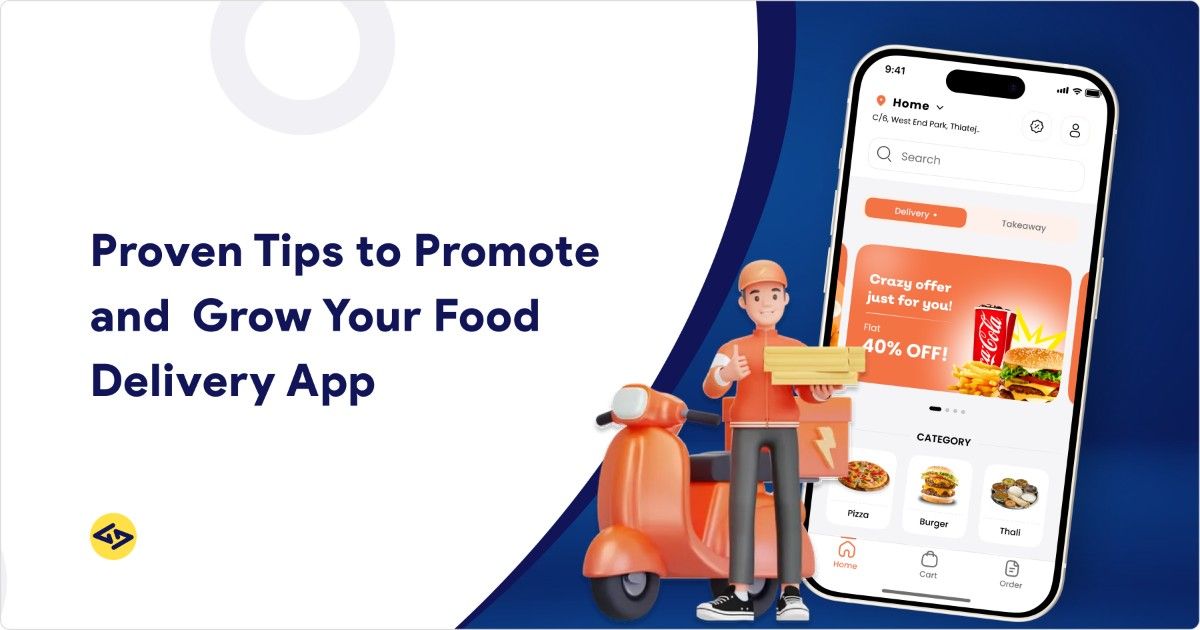
If you want to know how to market your on-demand food delivery app, the short answer is this: you need a mix of app store optimization, SEO, social media marketing, paid ads, influencer partnerships, referral programs, and strong customer retention, all working together, not in isolation.
The online food delivery market has grown at a blistering pace over the last few years, and it shows no signs of slowing down. But here’s the problem most founders run into: they spend months building a polished app, launch it, and then… nothing happens. Downloads trickle in slowly. Customers order once and disappear. Meanwhile, giants like Uber Eats, DoorDash, and Zomato dominate search results and app store rankings.
A great app isn’t enough anymore. Without a solid food delivery app marketing plan, even the best-built product struggles to find its first thousand loyal users. This guide breaks down exactly how to promote a food delivery app, from pre-launch branding to long-term customer retention strategies — so you can turn downloads into repeat customers.
Key Takeaways
- Marketing a food delivery app requires combining ASO, SEO, social media, and paid ads, not relying on just one channel.
- Referral programs and loyalty rewards are the cheapest way to drive repeat orders.
- Customer retention matters more than acquisition once your app has an initial user base.
- Data analytics (CAC, CLV, retention rate) should guide every marketing decision.
- Hyperlocal and influencer marketing outperform generic national campaigns for most delivery startups.
Why Marketing Is Essential for Food Delivery Apps
Intense Competition in the Food Delivery Industry
New food delivery apps are competing directly with entrenched players that already have millions of users, loyalty programs, and marketing budgets to match. Standing out in a crowded market means finding a niche, a city, a cuisine, a delivery speed promise, and marketing it aggressively before trying to go broad.
Benefits of a Strong Marketing Strategy
A well-planned food delivery app growth strategy helps you:
- Increase app downloads
- Boost brand awareness in your target city or region
- Drive repeat orders from existing users
- Improve customer retention over time
- Maximize return on investment (ROI) across every channel
Define Your Target Audience
Identify Your Ideal Customers
Before spending a single rupee or dollar on ads, get specific about who you’re serving:
- Students looking for quick, affordable meals
- Working professionals ordering lunch or dinner
- Families ordering in bulk on weekends
- Corporate users ordering for office meetings
- Health-conscious consumers seeking specific diets
Understand Customer Behavior
Study ordering habits, preferred cuisines, peak ordering hours, and whether your audience orders mostly from iOS or Android. This data shapes everything from your ad targeting to your push notification timing.
Build a Strong Brand Identity
Create a Memorable Brand
Your logo, brand colors, and messaging should be consistent everywhere: the app, social media, packaging inserts, and ads. A recognizable brand builds trust faster than any discount ever will.
Develop a Unique Selling Proposition (USP)
Ask yourself what makes your app different:
- Faster delivery than competitors
- Lower delivery fees
- Exclusive restaurant partnerships
- AI-powered meal recommendations
- Subscription benefits like free delivery
If you’re still finalizing your platform, working with a specialist in Food delivery app development can help bake these differentiators into the product itself, not just the marketing.
Optimize Your App Store Listing (ASO)
App Store Optimization is often the most overlooked piece of food delivery app promotion, yet it’s free organic traffic sitting right in front of you.
- Keyword optimization — use terms like “food delivery,” “order food online,” and your city name in your title and description.
- High-quality screenshots — show the ordering flow, offers, and UI clearly.
- Engaging app description — lead with benefits, not features.
- Promo videos — a 30-second video can lift conversion rates significantly.
- Ratings & reviews — actively prompt happy customers to leave reviews.
- Localization — translate listings for each market you serve.
Build an SEO Strategy for Long-Term Growth
Create High-Quality Blog Content
Publish content around food trends, restaurant guides, and delivery tips. This is exactly the kind of SEO for food delivery apps that compounds over time and reduces your dependence on paid ads.
Optimize Landing Pages, Local SEO, and Technical SEO
Build city-specific and cuisine-specific landing pages, claim your Google Business Profile for local marketing for food delivery apps, and make sure your site loads fast and is mobile-friendly. Round it out with a clear internal linking strategy connecting blogs, landing pages, and your app download link.
Use Social Media Marketing Effectively
Social media marketing for food delivery apps works best when it feels native to each platform:
- Instagram — food photography, Reels, and Stories with swipe-up links
- Facebook — local community groups and geo-targeted ads
- LinkedIn — B2B partnerships with restaurants and corporate catering clients
- YouTube Shorts & Reels — quick unboxing or “what I ordered” style content
- User-generated content — reposting customer photos builds trust
- Community engagement — replying to comments and DMs consistently
Invest in Paid Advertising
Food delivery app advertising across multiple channels accelerates growth when organic alone isn’t fast enough:
- Google Ads for search intent like “food delivery near me”
- Meta Ads (Facebook & Instagram) for visual, discount-driven campaigns
- Apple Search Ads to win App Store search real estate
- YouTube Ads for brand awareness
- Retargeting campaigns to bring back users who installed but didn’t order
Partner with Influencers and Food Bloggers
Influencer marketing for food delivery apps builds trust faster than ads because it comes from a familiar voice.
- Micro-influencers often deliver better engagement-per-dollar than macro-influencers
- Restaurant collaborations let you tap into an existing loyal customer base
- Local food creators drive hyperlocal awareness in specific neighborhoods
- Best practice: give influencers a unique promo code so you can track ROI directly
Launch Referral and Loyalty Programs
Word-of-mouth remains one of the most cost-effective user acquisition channels available.
- Refer-and-earn programs — reward both the referrer and the new user
- Cashback offers — encourage larger order values
- Reward points — turn every order into progress toward a free item
- Membership plans — subscription models for free or discounted delivery
- First-order discounts — remove the friction of trying something new
A well-designed food delivery app loyalty program can meaningfully lower your customer acquisition cost over time. If your current app lacks these features, reviewing the Food Beverages software options available for loyalty and rewards management is a good next step.
Increase Customer Retention
Acquiring a customer is only half the job, food delivery app customer retention strategies are what turn one-time orders into recurring revenue:
- Personalized push notifications timed to ordering habits
- Email marketing with tailored offers and re-engagement campaigns
- In-app promotions during slow hours
- Personalized recommendations based on order history
- Actively collecting and responding to customer feedback
- AI-powered engagement that predicts when a user is likely to churn
Use Data Analytics to Improve Marketing Performance
Every marketing decision should be backed by data:
- Monitor app downloads across platforms and campaigns
- Track Customer Acquisition Cost (CAC) per channel
- Measure Customer Lifetime Value (CLV) to know your real ROI
- Analyze user retention cohort by cohort
- Monitor conversion rates from install to first order
- Continuously optimize campaigns based on what the data shows
Common Marketing Mistakes to Avoid
- Ignoring ASO entirely
- Targeting too broad or the wrong audience
- Weak or inconsistent branding
- Sporadic social media posting
- Overlooking customer retention in favor of new acquisition
- Running paid ads without tracking analytics
- A confusing or lengthy onboarding experience
- Neglecting to respond to negative reviews
Avoiding these pitfalls is just as important as the strategies you actively pursue; see this breakdown of mistakes to avoid in food service app marketing and product design for a deeper look.
Real-World Marketing Strategy Example
Consider a regional food delivery startup that struggled to gain traction against national players. Here’s what turned things around:
- Optimized its App Store listing with city-specific keywords
- Used local SEO to rank for “food delivery near me” searches in its launch city
- Ran influencer campaigns with three local food creators
- Launched a refer-and-earn program offering free delivery credits
- Improved repeat orders with a simple points-based loyalty program
- Increased app downloads through targeted Meta and Apple Search Ads
Within a few months, repeat order rates climbed noticeably, and CAC dropped as referrals began contributing a growing share of new signups.
Organic vs. Paid Marketing Channels: A Comparison
| Channel Type | Examples | Cost | Speed of Results | Long-Term Value |
| Organic | SEO, ASO, social media, referrals | Low | Slow | High |
| Paid | Google Ads, Meta Ads, Apple Search Ads, influencer sponsorships | Medium–High | Fast | Medium (declines without ongoing spend) |
The healthiest food delivery app marketing strategies blend both: paid channels for quick early traction, organic channels for sustainable, lower-cost growth.
The Marketing Funnel for Food Delivery Apps
Awareness → Acquisition → Activation → Retention → Referral
- Awareness: SEO, social media, influencer content introduce your brand
- Acquisition: ASO and paid ads convert interest into app installs
- Activation: First-order discounts get users to complete their first purchase
- Retention: Push notifications, email, and loyalty programs bring users back
- Referral: Refer-and-earn programs turn happy customers into your next marketing channel
Key Metrics to Measure Marketing Success
- App Downloads
- Cost Per Install (CPI)
- Customer Acquisition Cost (CAC)
- Customer Lifetime Value (CLV)
- Conversion Rate
- Retention Rate
- Average Order Value (AOV)
- Return on Ad Spend (ROAS)
90-Day Food Delivery App Marketing Checklist
Days 1–30: Foundation
- Finalize brand identity and USP
- Optimize App Store and Play Store listings
- Set up analytics and tracking (CAC, CPI, retention)
- Launch a first-order discount offer
Days 31–60: Acquisition
- Start Google Ads, Meta Ads, and Apple Search Ads
- Launch 2–3 influencer or local food creator partnerships
- Publish first batch of SEO blog content
- Begin local SEO setup (Google Business Profile, local citations)
Days 61–90: Retention & Referral
- Launch refer-and-earn and loyalty point programs
- Set up personalized push notification and email flows
- Review CAC and CLV data; reallocate budget to best-performing channels
- Collect and respond to app store reviews
Future Trends in Food Delivery App Marketing
- AI-powered marketing automation for personalized offers at scale
- Voice search optimization as more users search by voice
- Hyperlocal marketing targeting specific neighborhoods
- Fully personalized user experiences based on order history
- WhatsApp marketing for order updates and promotions
- Social commerce integration allowing in-app ordering from social platforms
- Predictive analytics to anticipate demand and churn
- AI-generated marketing content for faster campaign creation
Many of these trends are already showing up in newer platforms; this look at ai features in food delivery apps covers how AI is reshaping both the product and the marketing side of the industry.
Conclusion
Marketing a food delivery app successfully means combining SEO, ASO, social media marketing, paid advertising, influencer partnerships, referral programs, loyalty initiatives, and AI-driven personalization into one cohesive strategy. None of these channels work well in isolation; sustainable growth comes from balancing strong customer acquisition with equally strong customer retention.
If you’re still evaluating your platform before scaling marketing efforts, it’s worth reviewing your cost to develop a food delivery app and the features of food delivery app that support these strategies; things like loyalty modules, push notification systems, and referral tracking need to be built into the app itself.
Ready to build and market a scalable food delivery platform? Partnering with an experienced food delivery app development company like iCoderz Solution can help you launch with the right features and marketing foundation from day one.
Ready to Grow Your Food Delivery App?
Launch a food delivery app built for growth and customer retention.

Frequently Asked Questions (FAQs)
How do I market my on-demand food delivery app?
Combine App Store Optimization, SEO, social media marketing, paid advertising, influencer partnerships, and referral programs. Focus on customer retention through push notifications and loyalty rewards once you have an initial user base.
What is the best marketing strategy for a food delivery startup?
There’s no single best strategy — the strongest results come from blending organic channels (SEO, ASO, referrals) with paid channels (Google Ads, Meta Ads) while tracking CAC and CLV closely.
How can I increase food delivery app downloads?
Optimize your app store listing, run targeted paid ad campaigns, partner with local influencers, and offer a compelling first-order discount to convert interest into installs.
How important is App Store Optimization (ASO)?
Very important. ASO is essentially free organic traffic and directly affects how easily potential customers find your app when searching for food delivery options.
Which digital marketing channels work best for food delivery apps?
Local SEO, Instagram and Facebook ads, Apple Search Ads, and referral programs tend to perform especially well because food delivery is inherently local and visual.
How do referral programs help food delivery apps grow?
Referral programs turn existing customers into a marketing channel, lowering your customer acquisition cost while bringing in users who are already primed to trust your app.
How can social media increase food delivery app users?
Consistent, visually appealing content — combined with user-generated posts and active community engagement — builds brand trust and keeps your app top of mind for repeat orders.
What marketing metrics should I track?
Track Cost Per Install, Customer Acquisition Cost, Customer Lifetime Value, conversion rate, retention rate, average order value, and return on ad spend.
What are the biggest mistakes to avoid when marketing a food delivery app?
Ignoring ASO, targeting the wrong audience, weak branding, inconsistent social media activity, and running paid ads without proper analytics tracking are the most common and costly mistakes.
How much should I spend on food delivery app marketing?
Budgets vary widely by market and competition, but most successful startups reserve a meaningful share of early-stage funding specifically for a 90-day acquisition-and-retention push, then reallocate based on CAC and CLV data.