Uber transformed the transportation industry by making ride booking as simple as tapping a button. What started as a startup in 2010 has now become the world’s leading mobility platform. According to Uber Technologies’ full-year 2025 results, the platform serves more than 202 million monthly active users, facilitates over 40 million trips every day, and generated $193 billion in gross bookings in 2025.
This scale proves that demand for app-based transportation continues to grow globally. If you want to start a taxi business like Uber, the key is to build the right business model, onboard reliable drivers, ensure legal compliance, and launch a scalable taxi booking app that can grow city by city.
Partner with a proven taxi booking app development company to build your platform.
Why Start a Taxi Business in 2026?
The ride-hailing and shared mobility market is projected to grow from $257 billion in 2025 to over $548 billion by 2034. In 2026 alone, the market is expected to expand at a CAGR of 8.78%, driven by a shift away from private car ownership and the rise of “mobility-as-a-service” (MaaS) ecosystems.
Beyond metro cities, there is a growing demand in:
- Suburban commuting: Bridging the gap where public transport is sparse.
- Airport transfers: High-margin, scheduled bookings. Uber reports that while airports contribute 15% of mobility bookings, they remain an “enormous opportunity” with only 10% penetration.
- Corporate transportation: Reliable fleets for employee transit with centralized billing.
- NEMT (Non-Emergency Medical Transportation): Specialized rides for healthcare, a niche expected to grow significantly due to aging populations.
Global Case Studies: Lessons in Hyper-Localization
When planning to start a taxi business, the biggest lesson from the last decade is that “global” does not always beat “local.” Regional players have consistently outperformed giants by tailoring their service to the culture.
Grab (Southeast Asia): Winning Through Adaptation
Grab’s victory over Uber in Southeast Asia was fueled by hyper-local features. In regions where credit card penetration was low, Grab prioritized cash payments and GrabPay (a digital wallet). They also launched GrabBike to navigate high-traffic cities like Bangkok and Jakarta where cars were often stuck for hours.
- The Lesson: Success in a ride hailing business depends on matching the vehicle type and payment method to the local infrastructure.
Careem (Middle East): Cultural Connectivity
Careem dominated the Middle East by understanding cultural nuances, such as introducing “LATER” bookings to accommodate family gatherings and prayer times. They also focused heavily on “Captain” (driver) relations, treating drivers as partners rather than just gig workers.
- The Lesson: Your taxi booking app development should include features that reflect the lifestyle and scheduling habits of your target region.
How to Start a Taxi Business in 7 Steps
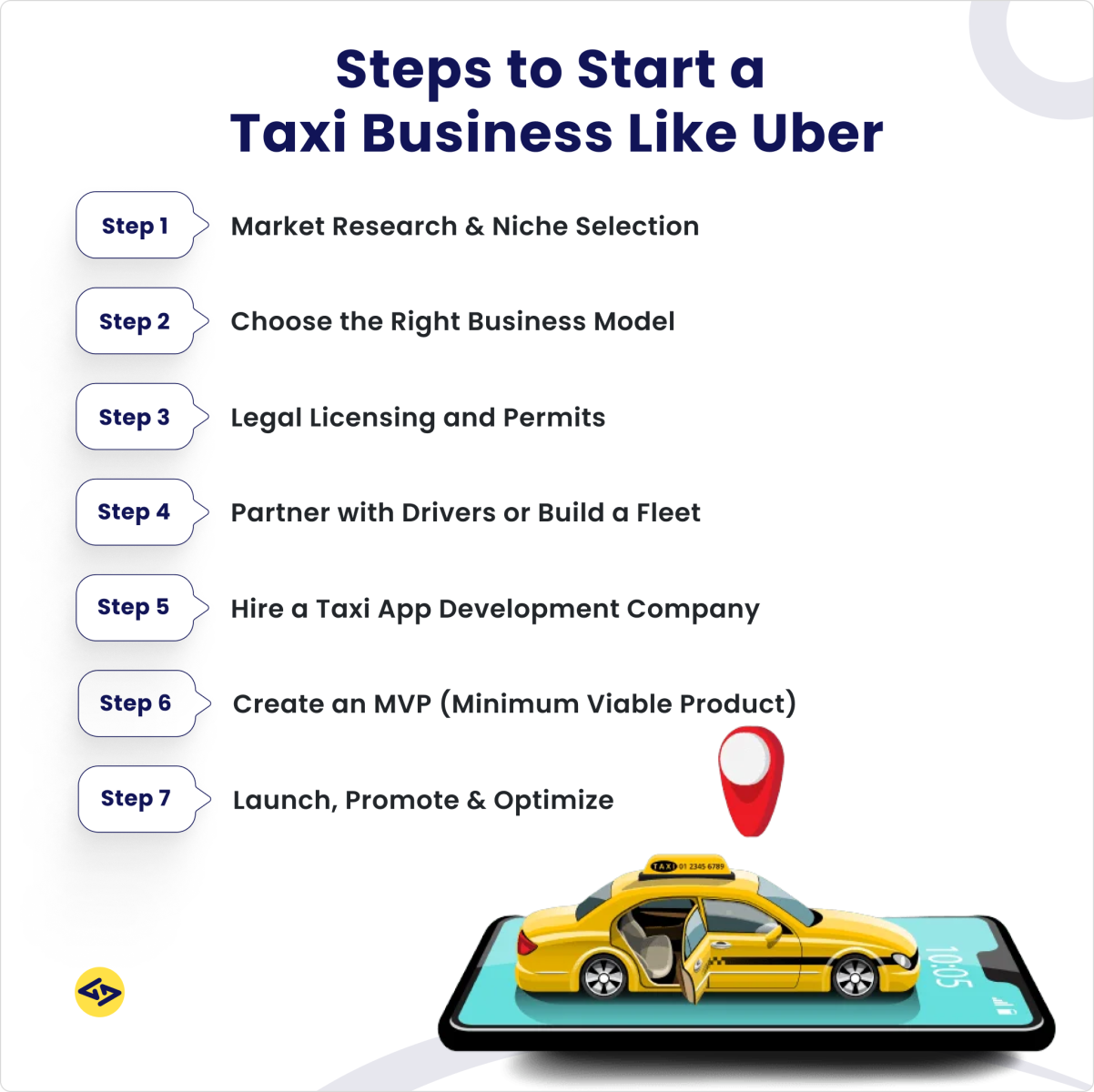
How to Start a Taxi Business in 7 Steps
Step 1: Research Your Market and Niche (The 2026 SWOT Analysis)
To build a resilient business, you must conduct a formal SWOT Analysis (Strengths, Weaknesses, Opportunities, Threats) tailored to the 2026 landscape.
Strengths (Internal)
- Local Expertise: Understanding specific traffic patterns, shortcuts, and neighborhood safety nuances.
- Agile Decision Making: You can implement feedback or change pricing structures faster than a multinational corporation.
- Personalized Service: Building a direct relationship with the community.
Weaknesses (Internal)
- Limited Initial Capital: Scaling requires significant marketing and driver incentives.
- Brand Awareness: Starting from zero compared to household names.
- Tech Maintenance: Ensuring 99.9% uptime for your app requires dedicated technical support.
Opportunities (External)
- EV Adoption: Electric taxis are projected to scale at an 8.05% CAGR through 2031. Transitioning to an EV fleet can lower long-term fuel costs.
- Under-served Markets: Many tier-2 cities still lack reliable app-based services.
- Strategic Partnerships: Collaborating with hotels, airports, and local event venues.
Threats (External)
- Regulatory Changes: 2026 is seeing a “regulatory correction” phase. New VAT reforms (like those in the UK) require platforms to act as principals, which can impact margins.
- Insurance Costs: Rising commercial insurance premiums for transport businesses.
Step 2: Choose the Right Business Model
Selecting the right model dictates your Uber business model strategy and operational costs:
- Aggregator Model: Best for low-asset entry; drivers use their own cars. The platform takes a commission.
- Fleet Model: Better for quality control; you own the vehicles and hire drivers.
- Hybrid Model: A combination—using a core fleet for premium services while aggregating independent drivers for standard city rides.
To understand how the world’s leader structures its operations, read our deep dive into the Uber business model and how it applies to modern startups.
Step 3: Complete Legal and Licensing Requirements
Legal compliance is the “moat” that protects your business from being shut down.
- Operating Authority: Obtain city-specific certificates.
- Commercial Insurance: Mandatory coverage for passengers, drivers, and third-party liabilities.
- Tax Compliance: Stay updated on 2026 “Taxi Tax” reforms that shift VAT burdens onto platforms in various jurisdictions.
Step 4: Build a Reliable Driver Network
In 2026, your value proposition must be strong to compete for the millions of active drivers in the gig economy:
- Instant Payouts: Pay drivers daily through integrated fintech solutions.
- Safety Tools: In-app emergency buttons and driver-behavior monitoring.
- Sustainability Incentives: Offer lower commission rates for drivers using Electric Vehicles (EVs).
- Transparent Earnings: Provide a detailed breakdown of how fares are calculated.
Step 5: Launch Your Taxi Business App (The Tech Stack Deep Dive)
Your technology is the heart of your operations. Choosing between Native and Cross-Platform development is a critical strategic decision that affects your taxi app development cost and long-term scalability.
The Tech Stack Components for 2026
- Backend (The Brain): Use Node.js or Python (Django) for high-performance ride-matching logic. This handles processing thousands of requests per second.
- Real-Time Databases: Use Firebase or Socket.io for the live map “car movement” animation. For data storage, PostgreSQL ensures security and ACID compliance for financial transactions.
- Cloud Infrastructure: AWS or Google Cloud allows your app to scale automatically as traffic grows, ensuring 99.9% uptime.
- Map Integration: Google Maps API or Mapbox for precise navigation and geofencing.
Native vs. Cross-Platform Development
- Native Development (Swift for iOS, Kotlin for Android): Offers the absolute best performance and highest security, but requires maintaining two separate codebases.
- Cross-Platform Development (Flutter or React Native): Highly recommended for 2026 startups. Flutter allows you to launch on both platforms with a single codebase, significantly reducing your initial taxi app development cost without sacrificing UI quality.
Key Features of a Successful Taxi Booking App
To build a taxi business like Uber Technologies, your app must deliver a smooth experience for passengers, drivers, and administrators. The right features directly impact bookings, retention, and customer trust.
Passenger App Features
The rider app should focus on convenience and safety.
Essential features include:
- easy signup and login
- real-time driver tracking
- fare estimation
- multiple payment options
- ride scheduling
- trip history
- ratings and reviews
- SOS emergency support
These features help improve user experience and repeat bookings.
Driver App Features
The driver app should make ride management simple and efficient.
Important features include:
- instant ride notifications
- accept / reject ride option
- GPS navigation
- earnings dashboard
- trip history
- online / offline toggle
- payout tracking
This improves driver productivity and satisfaction.
Admin Panel Features
The admin dashboard helps manage the complete taxi ecosystem.
It should include:
- user management
- driver verification
- trip monitoring
- commission setup
- coupon management
- reports and analytics
- customer support tools
This is essential for business operations and scaling.
Step 6: Run a Soft Launch
Launch in a limited geography first (e.g., a single airport route or business district). This phase is crucial for ensuring that your taxi business app can handle real-world GPS variability and that your intelligent dynamic pricing algorithms are calibrated correctly. Collect driver and rider feedback aggressively during this phase.
Step 7: Scale and Optimize with AI
Modern apps move from MVP to growth using AI-powered features that optimize efficiency:
- Predictive Demand Forecasting: Analyze historical data to position drivers in high-demand zones before the surge happens.
- Smart Route Optimization: AI that accounts for real-time weather, road closures, and traffic patterns to ensure the fastest pickup.
- Fraud Detection: Automated systems to identify fake bookings or driver-passenger collusion.
- Chatbots: AI-driven customer support to handle common queries like “Where is my ride?” or “Payment issues.”
Cost to Start a Taxi Business Like Uber
The taxi app development cost is the most significant upfront investment. In 2026, costs vary by approach:
|
Approach |
Estimated Budget |
Timeline |
|
White Label Solution |
$5,000 – $15,000 |
2 – 4 Weeks |
|
Basic MVP (Custom Build) |
$20,000 – $45,000 |
4 – 6 Months |
|
Mid-Level App (AI Integrated) |
$50,000 – $120,000 |
7 – 10 Months |
|
Enterprise Solution |
$150,000 – $350,000+ |
12+ Months |
For a detailed breakdown of budget factors, check our latest report on taxi app development cost for 2026.
Common Challenges and How to Overcome Them in 2026
1. Driver Retention in a Gig Economy
Drivers often “multiapp” to find the best rates.
- The Challenge:
High turnover and inconsistent fleet availability.
- The Solution:
Implement Instant Payouts and Loyalty Tiers. Use AI-powered analytics to suggest the most profitable zones for drivers, reducing “dead miles” and increasing their hourly earnings.
2. Regulatory Correction & VAT Reforms
2026 is a defining year for taxi regulations globally.
- The Challenge:
New laws require platforms to act as the “principal” for tax purposes, shifting VAT burdens.
- The Solution:
Ensure your admin dashboard is built to handle complex tax compliance and automated reporting to avoid legal penalties and maintain transparent accounting.
3. Safety and Trust
- The Challenge:
Maintaining passenger safety in a peer-to-peer network.
- The Solution:
Move from protection to prediction. Use AI Risk Modeling to detect unusual ride patterns or frequent route deviations and alert the admin panel automatically. Implement two-factor ride verification codes.
Why Choose a White Label Taxi Solution?
For most entrepreneurs, a white label taxi app is the most viable path. It allows you to:
- Launch in weeks instead of months.
- Reduce Technical Risk: Use a platform already optimized for millions of rides.
- Cost Efficiency: Saves up to 70% compared to custom development from scratch.
- Proven Scalability: Systems designed to handle growth from 10 to 10,000 rides daily.
Explore our white-label taxi app solution to see how you can customize our pre-built platform for your brand.
Ready to Launch Your Uber-Like Taxi Business?
Turn your startup idea into a scalable ride-hailing platform with iCoderz’s ready-to-launch taxi booking solution. Whether you need a white-label taxi app for a quick launch or a custom-built platform, our team helps you go live faster with proven technology, modern features, and expert support.
Talk to our taxi app experts today and start building your business.
Frequently Asked Questions
Is a taxi business profitable in 2026?
Yes, especially in niche markets or tier-2 cities where competition is lower and demand for reliable taxi business app services is high. Success depends on maintaining low customer acquisition costs and high driver retention.
How much does it cost to start a taxi business like Uber?
A basic setup can start from $15,000, while a full-scale enterprise solution can exceed $300,000. Using a white-label solution can significantly lower initial capital requirements to under $10,000.
What is the best tech stack for a taxi app in 2026?
Node.js for the backend, Flutter for cross-platform apps, and Firebase for real-time tracking are the current industry standards for balancing performance, speed, and cost.