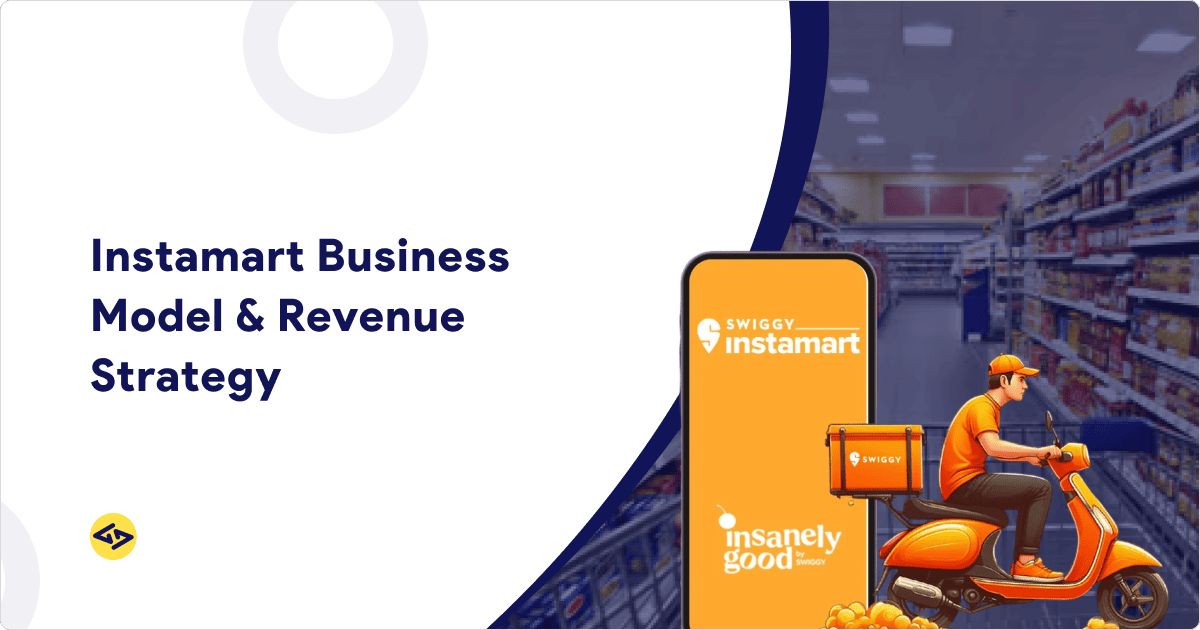
Quick commerce has changed how India shops for groceries, and the Instamart business model sits right at the center of that shift. Swiggy launched Instamart to deliver everyday essentials quickly through a hyperlocal network, and it now competes directly with Blinkit and Zepto for a share of India’s fast-growing quick commerce market.
If you’ve ever wondered how Instamart works, or more importantly, how Instamart makes money while delivering groceries to your door in a matter of minutes, this guide breaks it all down, from dark stores to revenue streams to the tech stack that makes it possible.
What Is Instamart?
Swiggy Instamart is Swiggy’s quick commerce arm that delivers groceries, fresh produce, snacks, and household essentials through a fast, hyperlocal delivery network. You can explore the live platform at Swiggy Instamart.
- How Instamart has evolved: Instamart started as a grocery add-on within the Swiggy app and grew into a standalone quick commerce business with its own dark store network and app experience.
- Instamart’s role in Swiggy’s ecosystem: It complements Swiggy’s food delivery business, cross-selling to the same customer base while tapping into a new use case — quick, everyday grocery needs.
How Does the Instamart Business Model Work?
At its core, the Instamart business model runs on hyperlocal dark stores placed close to customers.
- Customer places an order on the Instamart app.
- Nearest fulfillment location processes the order — the system auto-assigns the closest dark store.
- Products are picked and packed by in-store staff.
- Delivery partner fulfills the order using two-wheelers for last-mile speed.
- Customer receives the order, with delivery times that can vary based on location, store proximity, inventory availability, order volume, traffic, weather, and overall demand.
- Data and technology optimize future orders, refining stock levels and delivery routes for the next cycle.
Instamart relies heavily on a dark-store and inventory-led fulfillment model, while its operating structure and inventory strategy continue to evolve alongside the wider quick commerce business model in India.
Instamart Business Model Canvas
A quick look at the Instamart business model canvas:
| Business Model Canvas Component | Instamart |
| Customer Segments | Urban households, working professionals, students, convenience-focused shoppers |
| Value Propositions | Fast delivery, convenience, product assortment, availability |
| Channels | Swiggy app, Instamart interface, digital marketing, notifications |
| Customer Relationships | Self-service ordering, notifications, support, loyalty benefits |
| Revenue Streams | Product margins, delivery/platform fees, advertising, brand partnerships |
| Key Activities | Inventory management, fulfillment, dark-store operations, delivery, technology |
| Key Resources | Dark stores, inventory, technology, data, delivery network |
| Key Partners | FMCG brands, suppliers, delivery partners, technology/payment providers |
| Cost Structure | Inventory, dark stores, delivery, technology, marketing, operations |
This Instamart business model framework shows why quick commerce is capital-intensive but scalable once density improves.
How Instamart Creates and Captures Value
Before diving into revenue specifics, it helps to see the bigger picture of how the Instamart business model turns operations into income:
- Create Value → Local product assortment, convenience, and availability close to the customer.
- Deliver Value → Dark stores, technology, fulfillment processes, and the delivery network working together.
- Capture Value → Product margins, fees, advertising, and brand partnerships that convert that delivered value into revenue.
This create-deliver-capture flow is what ties the Business Model Canvas above to the actual Instamart revenue model explained next.
How Does Instamart Make Money?
Here’s how Instamart makes money across multiple revenue streams:
- Product sales and retail margins: Instamart can generate gross margin from the sale of products, depending on product category, procurement terms, pricing, promotions, and the underlying inventory arrangement.
- Delivery fees: Charged on smaller basket sizes or during high-demand windows.
- Platform/service fees: Small fixed charges added to most orders.
- Advertising and sponsored listings: Brands pay to appear at the top of search and category pages.
- Brand partnerships: Exclusive launches and co-marketing deals with FMCG companies.
- Subscription ecosystem: Swiggy One can encourage repeat usage by providing eligible customers with benefits across Swiggy’s services, which indirectly supports Instamart order frequency.
Together, these Instamart revenue streams show a shift from pure product margin toward a hybrid quick commerce revenue model that leans increasingly on advertising — a pattern also seen in Blinkit’s business model.
Instamart Dark Store Business Model
- What is a dark store? A dark store is a mini-warehouse closed to walk-in customers, built solely to fulfill online orders.
- How Instamart dark stores work: Each store stocks a curated SKU range based on local demand, staffed by pickers who prep orders quickly for dispatch.
- Why dark stores are important: They shrink delivery radius and time, forming the backbone of the Instamart quick commerce business model.
- Challenges of the dark-store model: High real estate costs, inventory spoilage risk, and constant demand forecasting pressure.
This mirrors patterns seen across Zepto’s business model as well.
Instamart Supply Chain & Fulfillment Model
The Instamart supply chain includes:
- Supplier sourcing from FMCG brands, local vendors, and wholesalers.
- Inventory management using real-time stock tracking across dark stores.
- Demand forecasting powered by historical and seasonal data.
- Order fulfillment through auto-routing to the nearest store.
- Picking and packing optimized for speed with in-store layout design.
- Last-mile delivery via a dedicated delivery network.
This process closely resembles how other apps approach online grocery delivery.
Technology Behind the Instamart Business Model
Technology is what makes the Instamart delivery model viable at scale:
- Demand forecasting and predictive analytics to help estimate what each dark store may need.
- Inventory management for real-time stock visibility.
- Order management to route orders to the right location.
- Route optimization to help delivery partners plan efficient routes.
- Real-time tracking so customers know where their order is.
- Personalization and recommendations to improve the shopping experience.
- Business analytics to continuously refine operations.
Predictive models and automation, including AI-assisted tools, are increasingly used across quick commerce platforms to support several of these functions.
Instamart Cost Structure & Unit Economics
Running quick commerce isn’t cheap. Major costs include:
- Inventory costs — stock across a large network of dark stores.
- Dark-store costs — rent, utilities, and staffing.
- Delivery costs — network management and delivery partner incentives.
- Employee/operations costs — store and regional management.
- Technology costs — app, backend, and analytics infrastructure.
- Marketing costs — customer acquisition in a crowded market.
- Expansion costs — opening new dark stores in new cities.
Quick commerce unit economics typically improve as order density per dark store rises — more orders per store spreads fixed costs thinner, which is a core lever for profitability across the sector.
Instamart vs Swiggy Food Delivery Business Model
| Factor | Instamart | Swiggy Food Delivery |
| Customer Segments | Grocery/essential shoppers | Meal seekers |
| Value Proposition | Fast, hyperlocal delivery | Restaurant variety |
| Fulfillment | Dark stores, inventory-led | Restaurant partners, marketplace model |
| Partners | FMCG brands, suppliers | Restaurants |
| Revenue | Margins, delivery fees, ads | Commission, delivery fees, ads |
| Key Resources | Dark store network | Restaurant network |
| Major Costs | Inventory + real estate | Delivery + partner incentives |
Instamart vs Blinkit vs Zepto
| Factor | Instamart | Blinkit | Zepto |
| Business Model | Dark-store, inventory-led | Dark-store, inventory-led | Dark-store, inventory-led |
| Fulfillment Model | Dark stores | Dark stores | Dark stores |
| Product Assortment | Groceries + essentials | Groceries + essentials + electronics | Groceries + essentials |
| Revenue Opportunities | Margins, ads, fees | Margins, ads, fees | Margins, ads, fees |
| Competitive Positioning | Backed by Swiggy ecosystem | Backed by Eternal (Zomato) | Independent quick-commerce company |
For deeper comparisons, see Zepto’s business model and Blinkit’s business model breakdowns.
Key Growth Strategies in Instamart’s Business Model
Broadly, the strategic approaches shaping Instamart’s growth in the quick commerce business model in India include:
- Dark-store network expansion into new and existing cities.
- Product assortment expansion beyond groceries into adjacent categories.
- Increasing order density to improve store-level economics.
- Improving unit economics through better forecasting and routing.
- Advertising and brand monetization as a growing revenue stream.
These are common strategic directions across the quick commerce sector rather than confirmed internal roadmaps.
Challenges of the Instamart Business Model
- High operating costs from real estate and staffing across a large store network.
- Inventory management complexity across a large SKU catalog.
- Product wastage, especially for perishables.
- Customer acquisition costs in a discount-heavy market.
- Competition from Blinkit, Zepto, and BigBasket — see how BigBasket’s grocery model compares.
- Delivery economics — balancing speed expectations with delivery partner costs.
- Profitability remains a long-term goal across the entire quick commerce sector.
Key Lessons for Startups Building a Quick-Commerce Business
- Prioritize order density over geographic sprawl early on.
- Invest in forecasting technology before scaling dark stores.
- Diversify revenue beyond product margins — advertising matters.
- Build a lean, fast fulfillment process; speed is the product.
- Study proven models like Instacart’s approach for grocery-tech patterns that translate well.
How Much Does It Cost to Build an Instamart-Like App?
Building a quick commerce platform involves several core components:
- Customer app — browsing, cart, checkout, tracking.
- Delivery app — order assignment, navigation, status updates.
- Store/picker panel — order picking and packing workflows.
- Admin panel — inventory, pricing, and analytics dashboard.
- Inventory system — real-time stock sync across stores.
- Order management — routing and status logic.
- GPS/tracking — live location for delivery partners.
- Payment integration — multiple gateways and wallets.
- Backend/API — scalable infrastructure for peak load.
- Analytics and predictive tools — demand forecasting and personalization.
If you’re exploring grocery delivery app development, check out this detailed grocery delivery app development guide and the cost to develop a grocery delivery app for detailed cost breakdowns.
Conclusion
The Instamart business model shows that speed, when backed by a strong dark store network and the right technology, can be turned into a sustainable business. From product margins to advertising, Instamart continues to diversify its revenue streams while competing with Blinkit and Zepto for market share. For businesses and startups eyeing the quick commerce space, understanding this model — and the technology behind it — is the first step toward building something similar.
Need help building a quick commerce or grocery delivery app like Instamart? iCoderz Solutions can help you design, develop, and scale your platform from the ground up.
FAQs
What is the Instamart business model?
It’s a dark-store, hyperlocal quick commerce model where Instamart uses a network of local fulfillment centers to deliver groceries and essentials quickly.
How does Instamart make money?
Through product margins, delivery fees, platform fees, advertising, and brand partnerships.
What is the Instamart Business Model Canvas?
It maps Instamart’s customer segments, value proposition, channels, partners, resources, revenue streams, and cost structure in one framework.
Does Instamart use dark stores?
Yes, dark stores are central to Instamart’s fulfillment model, supporting quick picking, packing, and delivery.
What are Instamart’s main revenue streams?
Product margins, delivery fees, service/platform fees, and advertising revenue from brands.
Is Instamart an inventory-led or marketplace model?
Instamart relies heavily on a dark-store and inventory-led fulfillment approach, though its operating structure continues to evolve.
How much does it cost to build an Instamart-like app?
Costs vary based on features and complexity, ranging from a moderate to a significant investment depending on scope and platform requirements.
How does Instamart deliver groceries quickly?
Through a dense dark store network, demand forecasting, and optimized last-mile delivery routing — though actual delivery time depends on location, demand, and store proximity.
What’s the difference between Instamart and Swiggy food delivery?
Instamart delivers groceries through a dark-store, inventory-led model, while Swiggy food delivery is a marketplace connecting customers to restaurant partners.
How does the Instamart dark store model work?
Dark stores stock curated SKUs based on local demand, allowing staff to pick and pack orders quickly for delivery partners to complete last-mile delivery.