Picture this: It’s 9 PM, you’re hungry, and the last thing you want to do is cook. You grab your phone, scroll through dozens of restaurant options, tap a few buttons, and twenty minutes later, hot food arrives at your door.
That’s Grubhub in action—and it’s happening millions of times every single day across America.
But have you ever wondered how a company that doesn’t cook food, own restaurants, or even employ most of its delivery drivers became worth $7.3 billion?
The answer lies in a brilliantly designed Grubhub business model that turns convenience into cash. Let’s break down exactly how it works.
Whether you’re a restaurant looking to understand platform economics, an entrepreneur exploring the Grubhub revenue model, or a business ready to make a food delivery app, the key is understanding that success comes from solving real problems at scale.
Where Does Grubhub Operate? Geographic Coverage Explained
Before diving into how Grubhub makes money, let’s clarify where you can actually use it.
Primary Market: United States
Grubhub primarily serves the United States, operating in over 4,000 cities across all 50 states. The platform has its strongest presence in:
- Major metropolitan areas: New York City, Los Angeles, Chicago, San Francisco, Boston, Washington D.C.
- Mid-size cities: Austin, Denver, Seattle, Portland, Atlanta, Miami
- Suburban markets: Growing coverage in suburbs surrounding major cities
- College towns: Strong presence near university campuses
International Presence: Limited
Unlike competitors like Uber Eats or DoorDash that have expanded globally, Grubhub maintains a primarily U.S.-focused strategy. The company previously operated in London, UK through its acquisition of Just Eat, but after the 2020 merger with Just Eat Takeaway.com, international operations are now managed under different brand names.
Why This Matters:
If you’re planning to make a food delivery app, understanding geographic strategy is crucial. Grubhub chose to dominate the U.S. market rather than spread resources globally—a strategic decision that helped it build deep restaurant partnerships and brand recognition in American cities.
According to Grubhub’s official website, the platform continues expanding to new U.S. markets, particularly in underserved suburban and rural areas where competition is less intense.
How the Grubhub Founder Built a Food Empire
Back in 2004, Matt Maloney and Mike Evans—the grubhub founder duo—had a simple frustration in Chicago: ordering food meant digging through greasy paper menus stuffed in kitchen drawers or making endless phone calls.
Their solution? Build a website that puts every restaurant menu in one place.
What started in Chicago as a digital menu directory quickly evolved into something much bigger: a full-service food delivery platform connecting hungry customers with local restaurants. By 2014, Grubhub went public. By 2020, it was acquired by Just Eat Takeaway.com for $7.3 billion.
According to Grubhub’s company timeline, the platform now operates in over 4,000 U.S. cities with more than 300,000 restaurant partners.
So how does a company without kitchens or delivery trucks generate billions? Let’s follow the money.
The Grubhub Business Model: Three Sides, One Platform
Think of the Grubhub business model as a matchmaker that brings together three groups:
- Customers who want food delivered quickly
- Restaurants that want more orders
- Delivery drivers who want flexible income
Grubhub doesn’t directly provide the food or always handle delivery. Instead, it builds the technology that connects all three—and takes a cut from each transaction.
This is called a platform business model, and it’s the same strategy used by Uber, Airbnb, and Amazon Marketplace.
Here’s the genius part: Grubhub earns money from multiple revenue streams, which makes the business more stable than companies relying on just one income source.
How Grubhub Makes Money: 5 Revenue Streams Explained
1. Restaurant Commission Fees (The Big One)
Every time you order a $30 burrito bowl through Grubhub, the restaurant doesn’t keep all $30. Grubhub takes a 10-30% commission depending on the Grubhub restaurant plans the business signed up for.
Here’s how it breaks down:
Basic Plan (~10-15% commission)
The restaurant gets listed on Grubhub but handles its own delivery and gets minimal promotion.
Plus Plan (~15-20% commission)
The restaurant gains better visibility in search results and can tap into Grubhub’s delivery network.
Premium Plan (~20-30% commission)
The restaurant gets priority placement, marketing tools, analytics dashboards, and dedicated support.
This commission model is Grubhub’s biggest money-maker. With millions of orders flowing through the platform monthly across U.S. cities, those percentages add up fast.
2. Customer Delivery Fees
When you place an order, you’ll notice a delivery fee—usually between $0.99 and $7.99. This fee varies based on:
- How far the restaurant is from your location
- Time of day (peak hours cost more)
- Whether the restaurant is running promotions
- Geographic market (fees in NYC differ from smaller cities)
Grubhub uses these fees to pay drivers and cover logistics costs. During busy dinner rushes in major metro areas, these fees can spike significantly.
3. Grubhub+ Subscription (Recurring Revenue)
For about $9.99/month, customers can subscribe to Grubhub+ and get unlimited free delivery on orders over $12.
Why does Grubhub offer this? Two reasons:
- Predictable income: Subscriptions create steady monthly revenue
- Customer loyalty: Subscribers order 2-3x more frequently than non-subscribers
It’s the same playbook Amazon used with Prime—get people paying monthly, and they’ll consolidate all their orders on your platform.
4. Restaurant Advertising Fees
Ever notice how certain restaurants always appear at the top of your search results?
They’re paying for that privilege.
Grubhub offers restaurants sponsored placements and featured listings to increase visibility. In competitive markets like New York or Los Angeles with dozens of pizza shops, this advertising can make or break a restaurant’s sales.
5. Corporate Accounts & Gift Cards
Grubhub also generates revenue through:
- B2B corporate meal programs where companies provide employees with food stipends
- Gift card sales through retail partners and online
- Data analytics services sold to restaurant partners
Is Grubhub Profitable? The Real Numbers
Here’s the uncomfortable truth: is grubhub profitable isn’t a simple yes or no.
Grubhub was profitable for several years after going public in 2014. However, intense competition from DoorDash and Uber Eats forced the company to spend heavily on customer acquisition, driver incentives, and promotions—which squeezed profit margins.
Key milestones:
- 2014: IPO at $2.7B valuation
- 2017-2019: Peak profitability years
- 2020: Acquired by Just Eat Takeaway.com for $7.3B
- 2021-2023: Market share decline amid fierce competition
- 2024-2025: Focus shifts to operational efficiency and regional dominance
- 2025: Acquired by the Wonder group
According to Grubhub’s shareholder updates, the company has been trimming costs and optimizing delivery logistics to improve margins.
The lesson? Revenue and valuation don’t always equal profit—especially in competitive platform businesses.
Grubhub Business Model Canvas
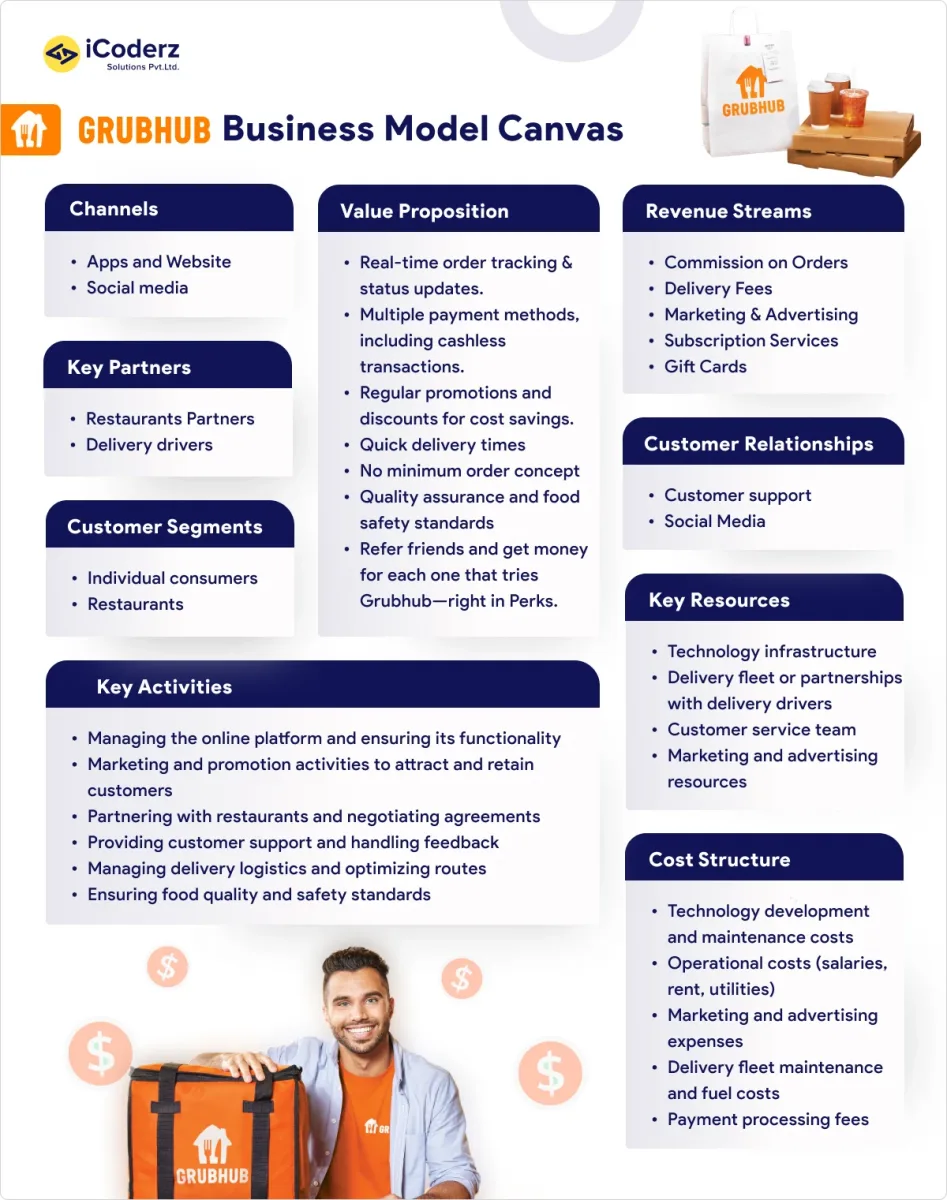
If you’re thinking about how to make a food delivery app, understanding the grubhub business model canvas is essential:
This canvas reveals something important: Grubhub’s costs are primarily variable (they scale with order volume), while many revenues are recurring or margin-based—a favorable structure for growth.
Want to build something similar? Our guide on how to build a Grubhub clone app in the USA walks through the technical requirements.
What Makes Grubhub Different? 4 Key Advantages
1. Deepest Network + B2B Dominance
With 300k+ restaurants, choice is a given. But the real differentiator is Grubhub Onsite and Catering. By embedding directly into corporate offices, they lock in recurring, high-margin orders that competitors miss.
2. The Amazon Prime “Trojan Horse”
While others pay fortune for ads, Grubhub gets customers via Amazon Prime. This integration turns a retail giant into a delivery driver, giving Grubhub instant scale without the typical customer acquisition cost.
3. The “App-less” Presence
You can order Grubhub on Google Maps, Yelp, and Alexa. This “everywhere” strategy means they capture impulsive orders from users who would never download their app.
4. Data-Driven Content Engine
Grubhub’s blog and 2025 Trend Report do more than entertain—they feed their AI. By analyzing food trends and user behavior, they predict demand and personalize menus, making the app stickier over time.
The Restaurant Perspective: Worth the Commission?
Let’s be honest: Grubhub restaurant plans aren’t cheap.
A 20-30% commission on every order can feel painful, especially for restaurants operating on thin margins.
But here’s the trade-off:
What restaurants get:
- Access to millions of potential customers across U.S. cities
- No upfront technology investment
- Marketing and visibility tools
- Delivery infrastructure (if they choose)
- Order analytics and customer insights
What restaurants give up:
- A significant chunk of each sale
- Direct customer relationships
- Control over the delivery experience
For many restaurants, especially during COVID-19, Grubhub became a survival tool. For others with strong direct ordering systems, the commission feels like a tax.
The calculation is simple: Does the incremental revenue from Grubhub orders exceed the commission cost? If yes, it works. If no, restaurants look for alternatives.
What It Takes to Make a Food Delivery App Like Grubhub
If the grubhub business plan inspires you to build your own platform, here’s what you’ll need:
Essential Features:
- User registration and profiles
- Restaurant search with filters
- Real-time order tracking
- Multiple payment options
- Ratings and reviews
- Push notifications
- Admin dashboard for restaurants
Technical Requirements:
- Scalable cloud infrastructure (AWS, Google Cloud)
- Payment gateway integration (Stripe, PayPal)
- Mapping and routing APIs (Google Maps)
- Real-time database (Firebase, PostgreSQL)
- Mobile apps (iOS and Android)
Business Requirements:
- Restaurant partnerships
- Delivery driver network (or third-party integration)
- Legal compliance (food safety, insurance, labor laws)
- Marketing budget for customer acquisition
- Geographic strategy (start local, expand methodically like Grubhub did from Chicago)
The app development timeline typically runs 4-6 months for an MVP, with costs varying widely based on features and geography.
For a detailed breakdown, check out our article on how much it costs to build an app like Grubhub.
What We Can Learn from Grubhub
The Grubhub business model teaches us several valuable lessons:
1. Platform businesses scale differently
By connecting buyers and sellers instead of providing the service directly, Grubhub can grow across 4,000+ U.S. cities without proportional cost increases.
2. Multiple revenue streams create stability
Commissions, delivery fees, subscriptions, and advertising mean Grubhub isn’t dependent on any single income source.
3. Technology is the moat
Grubhub’s real value isn’t in food delivery—it’s in the technology platform that makes ordering seamless for millions of users.
4. Competition compresses margins
Even great business models struggle when competitors flood the market with venture capital and aggressive promotions.
5. Geographic focus matters
Grubhub’s U.S.-focused strategy allowed it to build deeper relationships and better operations than spreading too thin globally.
Ready to Build Your Own Food Delivery Platform?
Grubhub succeeded because it made ordering food dramatically easier for customers while creating a new revenue channel for restaurants—first in Chicago, then across America.
Your opportunity might be in:
- Serving an underserved U.S. market or region
- Focusing on a specific cuisine or dietary need
- Building better economics for restaurants
- Creating superior delivery logistics
Need help bringing your idea to life?
Our team specializes in food delivery software development for startups and enterprises. Check out the Chowman case study.
Contact us today to discuss your project!
Frequently Asked Questions:
How does Grubhub make its money?
Grubhub earns money by charging restaurants a commission on each order and fees to customers, while also offering subscription services like Grubhub+.
What is Grubhub, and how does it work?
Grubhub is a food delivery platform that connects users with local restaurants—customers order via the app or website, and Grubhub handles delivery (or pickup) through its network.
Why is Grubhub so successful?
Grubhub succeeded by being an early mover, offering a user-friendly platform, building strong restaurant partnerships, and focusing on reliable service in urban markets.
What is the revenue model of Grubhub?
Grubhub’s revenue model includes commissions from restaurants, delivery fees from customers, subscription fees (e.g., Grubhub+), and advertising for restaurant visibility.