Introduction — The Rise of On-Demand Grocery Apps
Five years ago, ordering groceries from your phone felt like a luxury. Today, it is a daily habit for millions of Americans.
The pandemic did not create the demand for online grocery delivery in USA — it accelerated it. What started as a safety-driven necessity has now evolved into a permanent shift in how people shop for food. According to Statista, the U.S. online grocery market is projected to surpass $160 billion by 2027, a figure that continues to climb year over year.
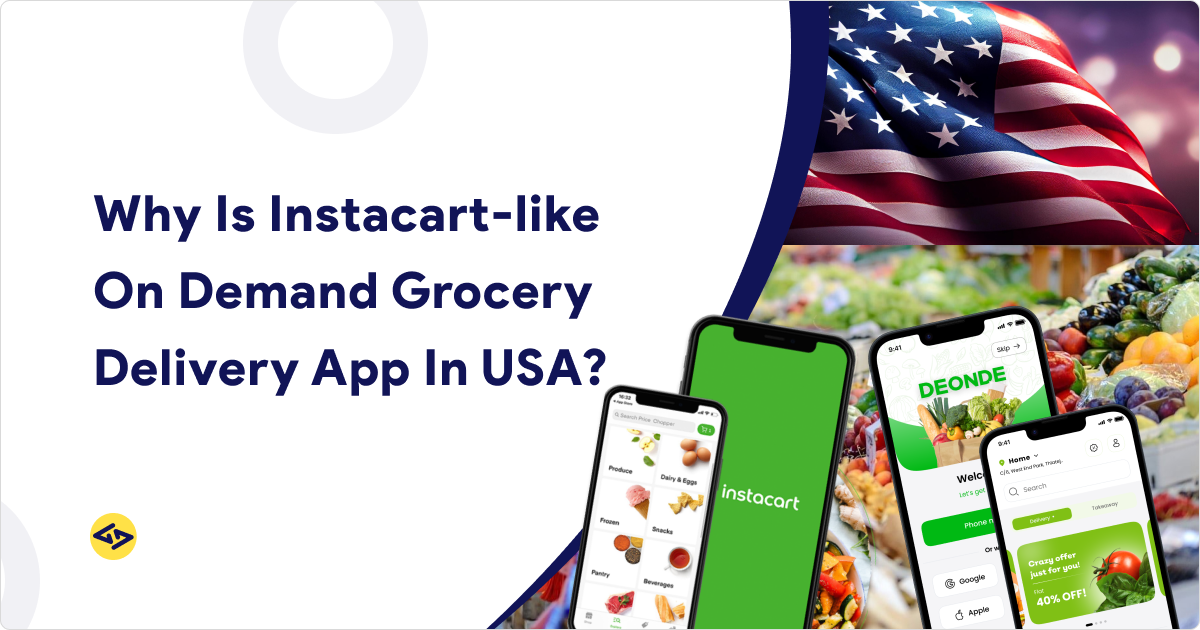
At the center of this revolution sits the Instacart-like grocery delivery app — a platform that connects consumers with local grocery stores, personal shoppers, and fast delivery networks. These apps have fundamentally changed consumer expectations around speed, convenience, and choice.
So, why is Instacart so popular, and why are similar platforms multiplying across the country? This blog breaks down the key reasons, the technology powering these apps, the business models behind them, and what the future holds for grocery delivery services in the USA.
Whether you are exploring grocery delivery startup ideas or evaluating the market as a retailer, this guide covers everything you need to understand.
What Does an Instacart-Like App Do?
Before diving into popularity drivers, let us answer a fundamental question: how does Instacart work, and what defines an Instacart-like app?
An on-demand grocery delivery app operates on a simple three-sided marketplace:
- Customers browse products from local grocery stores, add items to their cart, and place an order.
- Personal shoppers pick items from the store shelves, ensuring freshness and accuracy.
- Delivery drivers transport the order to the customer’s doorstep — often within hours.
The app handles everything in between: real-time tracking in grocery apps, secure payments, order updates via push notifications, and customer support. Most platforms offer same-day grocery delivery, with some promising delivery windows as tight as 30 minutes.
This seamless flow — browse, order, track, receive — is exactly what makes mobile grocery shopping trends so compelling for modern consumers.
Market Landscape: On-Demand Grocery Delivery in the USA
The grocery delivery market size USA tells a powerful story.
- The U.S. online grocery sector generated over $95 billion in 2023 and continues on an upward trajectory.
- Over 60% of U.S. consumers have used a grocery delivery or pickup service at least once (Brick Meets Click, 2024).
- Monthly active users of grocery delivery apps in USA have grown over 40% since 2020.
Compared to traditional grocery shopping — which involves driving, parking, aisle browsing, checkout lines, and carrying bags — on-demand apps eliminate virtually every friction point. The eCommerce grocery trends are clear: consumers prefer the digital aisle.
This shift is not limited to urban areas. Hyperlocal grocery delivery has expanded into suburban and even semi-rural markets, driven by improved logistics and broader retailer partnerships.
Key Reasons for Popularity
This is the core question: why grocery delivery apps are popular — and growing faster than almost any other app category in the USA.
1. Convenience and Time Savings
The number one reason is simple: people are busy.
Between work, childcare, commutes, and personal commitments, a trip to the grocery store can consume 60–90 minutes. An on-demand grocery delivery app compresses that into a few taps on a phone. Orders arrive at the doorstep — no parking, no checkout lines, no heavy bags.
This convenience factor is the single strongest driver behind Instacart app popularity and its competitors.
2. Shift in Consumer Behavior
American consumers have fundamentally changed how they shop. The comfort with mobile ordering, born from years of using Amazon, Uber, and DoorDash, now extends fully into groceries.
Key behavioral shifts include:
- Preference for contactless delivery (post-pandemic habit that stuck)
- Comfort with digital payments and stored cards
- Trust in app-based ratings and reviews
Understanding these shifts is essential if you plan to build an app like Instacart that resonates with today’s buyers.
3. Wide Selection of Grocery Options
Unlike a single store visit, Instacart-like apps aggregate multiple stores in one platform — from Costco to local organic shops. Users access fresh produce, specialty items, bulk goods, and even pharmacy products.
AI in grocery delivery apps further enhances this by offering personalized recommendations based on past orders, dietary preferences, and trending products.
4. Speed and Flexibility
Speed is a defining competitive advantage. Leading platforms offer:
- Same-day grocery delivery as the standard
- Scheduled delivery for specific time slots
- Real-time tracking in grocery apps so customers know exactly when their order arrives
This flexibility — order now or plan for later — accommodates every lifestyle. It is one of the most valued on-demand grocery app features across user demographics.
5. Integration with Modern Technology
Modern grocery delivery app technology goes far beyond a product catalog. It includes:
- AI-based suggestions that predict what a customer needs before they search
- Push notifications for deals, delivery updates, and reorder reminders
- Seamless payment gateways including Apple Pay, Google Pay, credit cards, and digital wallets
The payment gateway for grocery apps must be frictionless — any hesitation at checkout means an abandoned cart.
6. Safety and Health Considerations
Post-COVID, a significant segment of the population — especially seniors and immunocompromised individuals — continues to prefer delivery over in-store visits. The social distancing benefit that drove initial adoption has become a lasting preference for many households.
Benefits for Customers
The benefits of grocery delivery apps extend beyond convenience:
- 24/7 availability — shop at midnight if you want
- Saved shopping lists — reorder weekly essentials in seconds
- Price comparison across multiple stores
- Easy returns and refunds — most apps handle issues within the app itself
- Accessibility — essential for elderly users, people with disabilities, and those without transportation
These benefits explain why your grocery store needs a delivery app — your customers already expect it.
Benefits for Retailers & Grocery Stores
It is not just consumers who win. Retailers adopting on-demand delivery see measurable results:
- Expanded customer reach beyond physical store radius
- Increased average order value — app-based shoppers tend to add more items
- Data-driven marketing — purchase history enables targeted promotions
- Better inventory insights — real-time sales data improves stock management
The grocery app business model creates a win-win: retailers grow revenue while customers get better service. Retailers exploring this space can learn from platforms like BigBasket’s model and adapt it for the U.S. market.
Technology Behind Instacart-Like Apps
Building a competitive Instacart clone app requires a robust technology stack. Here is what powers these platforms:
- Real-time inventory sync — Accurate stock levels prevent order cancellations. Strong inventory management for grocery apps is non-negotiable.
- Geolocation & route optimization — Route optimization for grocery delivery reduces delivery times and fuel costs, directly impacting profitability.
- Secure payment processing — PCI-compliant payment gateway for grocery apps with multi-method support.
- Push notifications & alerts — Order status, deals, and delivery ETAs keep engagement high.
- AI and machine learning — Powering personalized suggestions, demand forecasting, and dynamic pricing.
Choosing the right tech stack for your grocery app is a foundational decision. Frameworks like Flutter are increasingly popular for cross-platform grocery app development due to speed and cost efficiency.
Business Models That Drive Profitability
Understanding the grocery app business model is critical for anyone looking to launch grocery delivery app ventures. Revenue typically comes from:
| Revenue Stream | How It Works |
| Commission from retailers | 10–25% per order from partner stores |
| Delivery fees | Charged to customers per order |
| Subscription plans | Monthly/annual plans for free delivery (e.g., Instacart Express) |
| Featured placements | Brands pay for visibility within the app |
| Advertising | In-app ads and sponsored product listings |
This multi-stream approach is what makes the model sustainable and scalable. For retailers managing in-store operations alongside digital, solutions like POS retail software help bridge the gap between physical and online sales.
Challenges and How Apps Overcome Them
No industry grows without friction. The reasons for growth of grocery delivery apps exist alongside real challenges:
- Last-mile delivery costs — Solved through route optimization, batched deliveries, and dark store models.
- Returns & cancellations — Handled with flexible refund policies and real-time substitution options.
- Inventory inaccuracies — Addressed by real-time API integration with store POS systems.
- Driver retention — Managed through competitive pay, flexible hours, and incentive programs.
Understanding these challenges upfront helps if you are evaluating the cost to develop a grocery delivery app — budget for solutions, not just features.
The Future of On-Demand Grocery Delivery
The future of grocery delivery in USA is being shaped by several emerging trends:
- AI & automation — Smarter demand prediction, automated warehouse picking, and chatbot-driven customer support.
- Autonomous vehicles & drones — Companies like Walmart and Kroger are already piloting autonomous delivery.
- Dark stores & micro-fulfillment centers — Dedicated fulfillment spaces (not open to public) designed purely for speed.
- Subscription growth — Loyalty-driven subscription models will become the primary revenue anchor.
These grocery app trends signal that the industry is nowhere near its ceiling.
Real-World Success Stories
Instacart
The market leader, operating across 5,500+ cities and partnering with 1,400+ retail banners. Its IPO in 2023 validated the business model on a global stage.
Shipt (Target-owned)
Focused on a membership model, Shipt has built a loyal customer base through consistent delivery quality and deep Target integration.
Regional Players
Smaller, city-specific apps are thriving by focusing on hyperlocal grocery delivery — serving niche communities with curated local products that national platforms miss.
For a deeper look at what is working in this space, explore our breakdown of the top grocery delivery apps currently dominating the market.
Conclusion — Why This Trend Is Here to Stay
The popularity of the Instacart-like grocery delivery app is not a pandemic-era anomaly. It is the result of converging forces: shifting consumer behavior, maturing technology, proven business models, and a relentless demand for convenience.
For consumers, it means better prices, more choices, and time saved every week. For retailers, it means expanded reach and data-driven growth. For entrepreneurs, it represents one of the most viable grocery delivery startup ideas in the current market.
The question is no longer whether on-demand grocery delivery will grow — it is how fast and who will lead.
Ready to Build Your Own Grocery Delivery Platform?
If you are looking to build an app like Instacart, the right development partner makes all the difference. At iCoderz Solutions, we specialize in end-to-end grocery delivery app development — from concept to launch.
Whether you need a full-featured Instacart clone app, a custom food delivery platform, or a tailored mobile application, our team has delivered 500+ on-demand solutions globally.
Hire grocery app developers who understand the market, the technology, and the path to profitability.