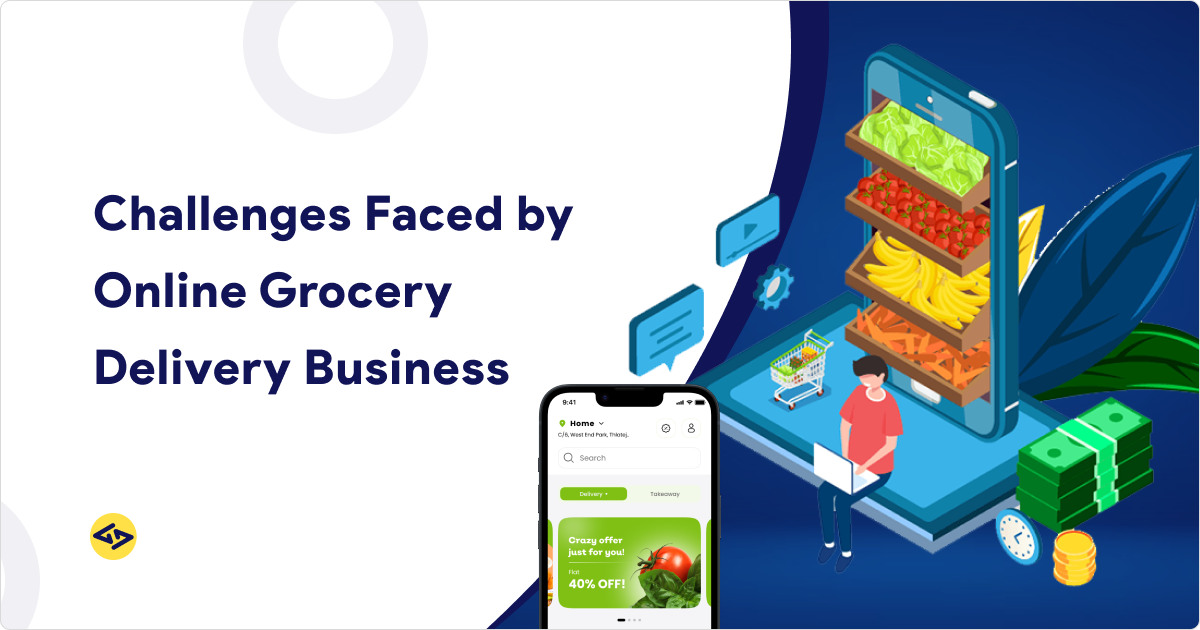
Introduction: The Reality of the Online Grocery Business
The online grocery delivery industry is booming. With the global market projected to surpass $1.1 trillion by 2027, entrepreneurs and established retailers alike are rushing to capture their share. But here’s the hard truth — rapid growth doesn’t guarantee profitability.
Behind every successful grocery delivery app, dozens of online grocery delivery challenges silently drain revenue, frustrate customers, and stall growth. From inventory nightmares to last-mile delivery bottlenecks, the problems in the online grocery business are real, complex, and often underestimated.
The good news? Every challenge has a proven solution. And the businesses that identify these obstacles early — and tackle them strategically — are the ones that thrive.
In this guide, we’ll break down the most common problems in grocery delivery, explore actionable solutions, and show you how the right technology can turn operational headaches into competitive advantages.
How the Online Grocery Delivery Model Works (Brief Overview)
Before diving into challenges, let’s quickly understand how the model operates:
The Customer Journey: Browse products → Add to cart → Place order → Receive delivery
Key Components That Power It:
- Mobile App / Website — The storefront where customers shop. A poorly built app creates immediate friction. That’s why choosing the right grocery delivery app development approach matters from day one.
- Inventory System — Tracks stock levels, manages perishables, and syncs availability in real time.
- Logistics & Delivery — The backbone of fulfillment — from warehouse to the customer’s doorstep.
- Payment Gateway — Handles secure transactions across multiple payment methods.
Each component introduces its own set of grocery eCommerce challenges. Let’s explore them.
Major Challenges Faced by Online Grocery Delivery Stores
1. Inventory Management Issues
Inventory management for online grocery is arguably the most complex operational hurdle.
- Real-time stock updates — Without live inventory syncing, customers order items that are already out of stock. This leads to cancellations, substitutions, and eroded trust.
- Handling out-of-stock products — Poor stock visibility means your team scrambles at the last minute, causing delays and refund requests.
- Perishable goods management — Groceries aren’t like electronics. Fruits, dairy, and meats have expiry clocks ticking. Mismanaging shelf life directly impacts waste and margins.
Real-world example: A mid-sized grocery startup we worked with was losing 18% of revenue to spoilage and stock discrepancies before implementing automated inventory alerts.
2. Last-Mile Delivery Challenges
The challenges in last-mile grocery delivery are where most businesses bleed money.
- Delivery delays — Traffic, weather, and poor scheduling frustrate customers and increase churn.
- High delivery costs — Fuel, driver wages, and vehicle maintenance make per-order delivery expensive — especially for low-value orders.
- Route inefficiencies — Without route optimization for grocery delivery, drivers waste time and fuel covering unnecessary miles.
3. Logistics & Supply Chain Problems
Grocery delivery operational challenges extend deep into the supply chain:
- Supplier coordination — Managing multiple vendors with varying lead times creates fulfillment gaps.
- Demand forecasting — Overstock ties up capital; understock loses sales. Getting it right requires data — lots of it.
- Warehouse management — Disorganized warehouses slow down picking and packing, directly delaying deliveries.
4. Technology & Platform Limitations
Grocery delivery software challenges are more common than most founders expect:
- App crashes or slow performance — A 1-second delay in load time can reduce conversions by 7%. Online grocery app issues like these silently kill revenue.
- Poor UX/UI — Confusing navigation, cluttered product pages, and complicated checkout flows push customers to competitors.
- Integration issues — When your app doesn’t seamlessly connect with inventory, payment, and logistics systems, errors multiply.
Choosing the right tech stack for your grocery app prevents most of these headaches.
5. Customer Retention & Trust
Acquiring a customer costs 5x more than retaining one. Yet issues in online grocery stores consistently undermine loyalty:
- Failed deliveries — Wrong items, missing products, or no-shows destroy trust instantly.
- Poor customer support — Slow response times and unresolved complaints accelerate churn.
- Inconsistent service quality — If the experience varies wildly between orders, customer retention in grocery apps becomes nearly impossible.
6. High Operational Costs
Online grocery business problems often come down to unsustainable unit economics:
- Driver salaries — Full-time delivery staff represents a massive fixed cost.
- Fuel costs — Volatile fuel prices make delivery cost forecasting unreliable.
- Marketing spend — Customer acquisition in a crowded market demands significant budget, often without proportional ROI.
7. Data Security & Payment Risks
- Fraud prevention — Online transactions are vulnerable to chargebacks and fraudulent orders.
- Secure transactions — Customers expect airtight payment security. Any breach is fatal to reputation.
- User data protection — Regulatory compliance (GDPR, PCI-DSS) isn’t optional — it’s a business necessity.
Smart Solutions for Each Challenge
Now let’s flip the script. Here are proven solutions for online grocery delivery — organized to match each challenge above.
1. Inventory Optimization Solutions
- AI-based forecasting — Machine learning models analyze historical sales, seasonality, and trends to predict demand accurately.
- Automated stock alerts — Get notified before items run out, not after customers complain.
- Barcode & ERP integration — Seamless systems eliminate manual tracking errors and sync inventory in real time.
These capabilities are why businesses increasingly invest in a purpose-built grocery delivery app rather than relying on generic platforms.
2. Delivery Optimization Solutions
To improve online grocery delivery and reduce grocery delivery costs, implement:
- Route optimization software — Algorithms calculate the fastest, most fuel-efficient delivery routes automatically.
- Real-time driver tracking — Both dispatchers and customers gain visibility, reducing missed deliveries and support calls.
- Batch deliveries — Grouping nearby orders into single delivery runs dramatically cuts per-order costs.
3. Logistics & Supply Chain Solutions
To optimize grocery delivery operations at the supply chain level:
- Partner with local vendors — Shorter supply chains mean fresher products and faster restocking.
- Micro-fulfillment centers — Small, strategically located warehouses near high-demand areas reduce delivery time and cost.
- Demand prediction tools — Data-driven forecasting aligns procurement with actual customer demand.
4. Technology Improvement Solutions
Grocery delivery business solutions start with solid tech infrastructure:
- Cloud-based infrastructure — Cloud solutions for grocery business ensure uptime, scalability, and performance during peak demand (think holidays and weekends).
- Scalable mobile app development — Build with growth in mind. Frameworks like Flutter enable fast, cross-platform grocery app development without maintaining two separate codebases.
- Regular performance audits — Proactive testing catches bugs, bottlenecks, and security vulnerabilities before customers do.
If you’re evaluating development options, understanding the cost to develop a grocery delivery app helps you budget realistically.
5. Customer Experience Solutions
To solve grocery delivery problems related to trust and retention:
- In-app support & chatbots — Instant responses to common queries reduce frustration and support ticket volume.
- Transparent delivery tracking — Real-time order status updates set expectations and build confidence.
- Loyalty programs — Reward repeat customers with discounts, cashback, or priority delivery to boost customer retention in grocery apps.
6. Cost Reduction Strategies
To increase efficiency in grocery delivery while protecting margins:
- Automation — Automation in grocery delivery eliminates manual processes across order processing, dispatch, and notifications.
- Subscription models — Monthly delivery passes generate predictable revenue and increase order frequency.
- Optimized marketing spend — Use data analytics to focus budget on high-converting channels and customer segments.
For businesses managing in-store and online operations simultaneously, a robust POS and retail software solution can unify operations and cut overhead.
7. Security & Compliance Solutions
- SSL & encryption — Protect all data in transit and at rest.
- Secure payment gateways — Partner with PCI-DSS compliant providers to safeguard transactions.
- GDPR & data compliance — Implement proper consent management, data access policies, and breach notification protocols.
Role of Technology in Solving Grocery Delivery Challenges
Technology isn’t just helpful — it’s the foundation for profitability in online grocery delivery.
- AI & Machine Learning — From demand forecasting to personalized product recommendations, AI in grocery delivery drives smarter decisions at every level.
- IoT for Supply Chain — Temperature sensors in cold-chain logistics, smart shelves in warehouses — IoT provides real-time visibility into perishable goods management.
- Big Data Analytics — Understanding purchase patterns, delivery performance, and customer behavior enables continuous optimization.
- Automation Tools — Automation in grocery delivery streamlines order management systems for grocery, dispatch, and customer communication — reducing human error and operational costs.
The right on-demand app development partner integrates these technologies into a cohesive platform built for your specific business model.
Best Practices for Running a Successful Online Grocery Store
Whether you’re looking to scale online grocery business or grow your grocery delivery startup, these best practices for grocery delivery are non-negotiable:
- Start with an MVP — Launch with core features, validate demand, and iterate based on real user feedback. Explore proven grocery app development ideas to identify your niche.
- Focus on local markets — Dominate one area before expanding. Hyperlocal expertise builds reputation and operational efficiency.
- Use customer feedback — Every complaint is a roadmap. Systematic feedback loops drive continuous improvement.
- Continuous testing & improvement — A/B test everything — from app layouts to delivery windows — and optimize relentlessly.
Want to understand what market leaders are doing right? Study the top grocery delivery apps and reverse-engineer their strategies.
Future Trends in Online Grocery Delivery
The future of online grocery delivery is being shaped by innovations that will redefine the industry:
- Drone & Autonomous Delivery — Companies are already piloting drone-based grocery drops. Within 5 years, autonomous delivery could significantly reduce grocery delivery costs.
- Dark Stores — Warehouse-only locations optimized exclusively for online order fulfillment — faster picking, no retail overhead.
- Hyperlocal Delivery Models — Ultra-fast delivery (10-30 minutes) from neighborhood micro-hubs is becoming the new standard.
- Voice-Based Ordering — Smart assistants enabling hands-free grocery shopping are gaining traction, creating new UX expectations.
Businesses that understand why a dedicated grocery delivery app is essential will be best positioned to adopt these trends early.
Conclusion: Turning Challenges into Opportunities
Every challenge of grocery delivery services we’ve discussed — from grocery logistics optimization to technology challenges in grocery delivery — represents an opportunity for differentiation.
The businesses that win aren’t the ones with zero problems. They’re the ones that solve problems faster and smarter than the competition.
Here’s what matters most:
Build on a scalable, reliable technology foundation
Use data and AI to make operations intelligent
Prioritize customer experience at every touchpoint
Continuously optimize costs without sacrificing quality
The difference between a struggling grocery delivery startup and a thriving one often comes down to choosing the right technology partner — one who understands the operational complexities of grocery eCommerce.
If you’re building or scaling an online grocery platform, explore how a custom grocery delivery app solution can address these challenges from the ground up. From mobile app development to food delivery platforms, the right partner builds solutions that grow with your business.
Looking for inspiration? See how platforms like BigBasket built scalable models — and how you can replicate their success with the right strategy and technology.