The food delivery sector is rapidly growing, especially because consumers seek convenient and efficient options for obtaining various foods. What is it about HungerStation and similar food delivery apps that enable them to achieve millions of users and enhance the customers’ dining experiences?
The food delivery app business is one of the modern, bright ideas that combine innovation, food, and the newest highly developed consumer market demand concept.
According to a new Grand View Research Inc. report, the global online food delivery services market is expected to grow to USD 253.95 billion by 2030, with a compound annual growth rate of 18.7% over the forecast period. However, creating a great app is insufficient; it must be planned and done properly. This means properly considering market conditions and user needs to make the app successful in a competitive environment.
This blog will guide you through the basic steps to develop a food delivery app like HungerStation. It will contain data such as market research, features to include, design, marketing strategies, and the cost of making a food delivery app. It is helpful for all those who dream of creating an efficient application but do not know how to do it in the competitive world.
Learn More About Top Food Delivery Startups in the World
What Is HungerStation?
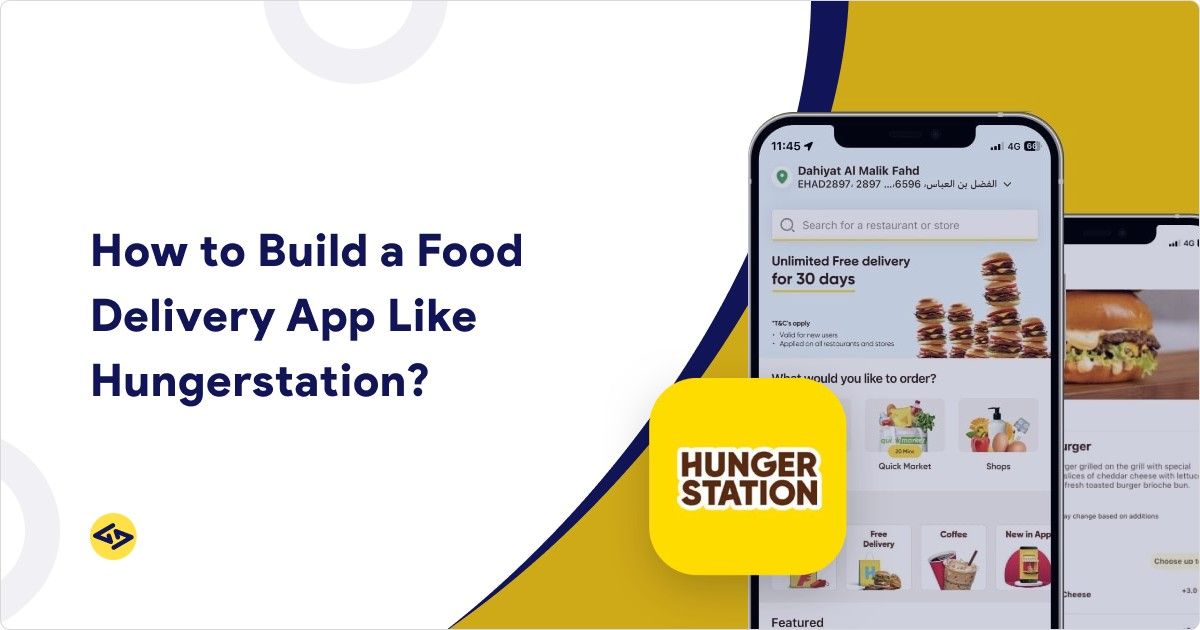
HungerStation—Best Food Ordering app in Saudi Arabia that helps users find different restaurants and outlets. It was established in 2013 and has since grown quickly because of its simplicity of operation and wide range of cuisines available within the country.
Some features include ordering food online and getting real-time updates on the ordering status, making eating from restaurants a more convenient experience from the comfort of the home or workplace. However, apart from the food delivery service, HungerStation has also added grocery delivery and alignment with other businesses, making it convenient to meet various consumer demands. Live order tracking, customer support, and other similar services make it stand as one of the leading services in the Middle Eastern food delivery market.
According to Google Cloud’s case study, HungerStation has successfully scaled its operations to handle millions of orders efficiently across Saudi Arabia.
Learn more: Top 5 Food Delivery Apps In the UAE.
Food Delivery Market in Saudi Arabia: Trends, Competitors & Development Cost Insights
Saudi Arabia is one of the fastest-growing food delivery markets in the Middle East, driven by high smartphone penetration, digital payments, and busy urban lifestyles. The demand for Saudi Arabia’s food delivery apps continues to rise across major GCC countries.
Key Competitors in Saudi Arabia
HungerStation – One of the leading players in KSA with a wide restaurant network and strong brand loyalty.
Talabat – A dominant regional platform operating across GCC countries, known for scale and aggressive promotions. Learn more about the Talabat business model.
Jahez – A strong local competitor with deep partnerships in the Saudi restaurant ecosystem.
Keeta – A fast-growing entrant backed by Meituan, gaining attention through competitive pricing and expansion strategies.
To compete in this market, businesses must focus on strong logistics, smart pricing strategies, loyalty programs, and localized user experiences — not just basic app features. Developing an app like HungerStation requires understanding these competitive dynamics.
What Are the Key Features of Food Delivery App Like Hungerstation?
Our team is developing the HungerStation Clone App to ensure it addresses all aspects and needs of online food and grocery delivery services. Below are the key features explained in detail:
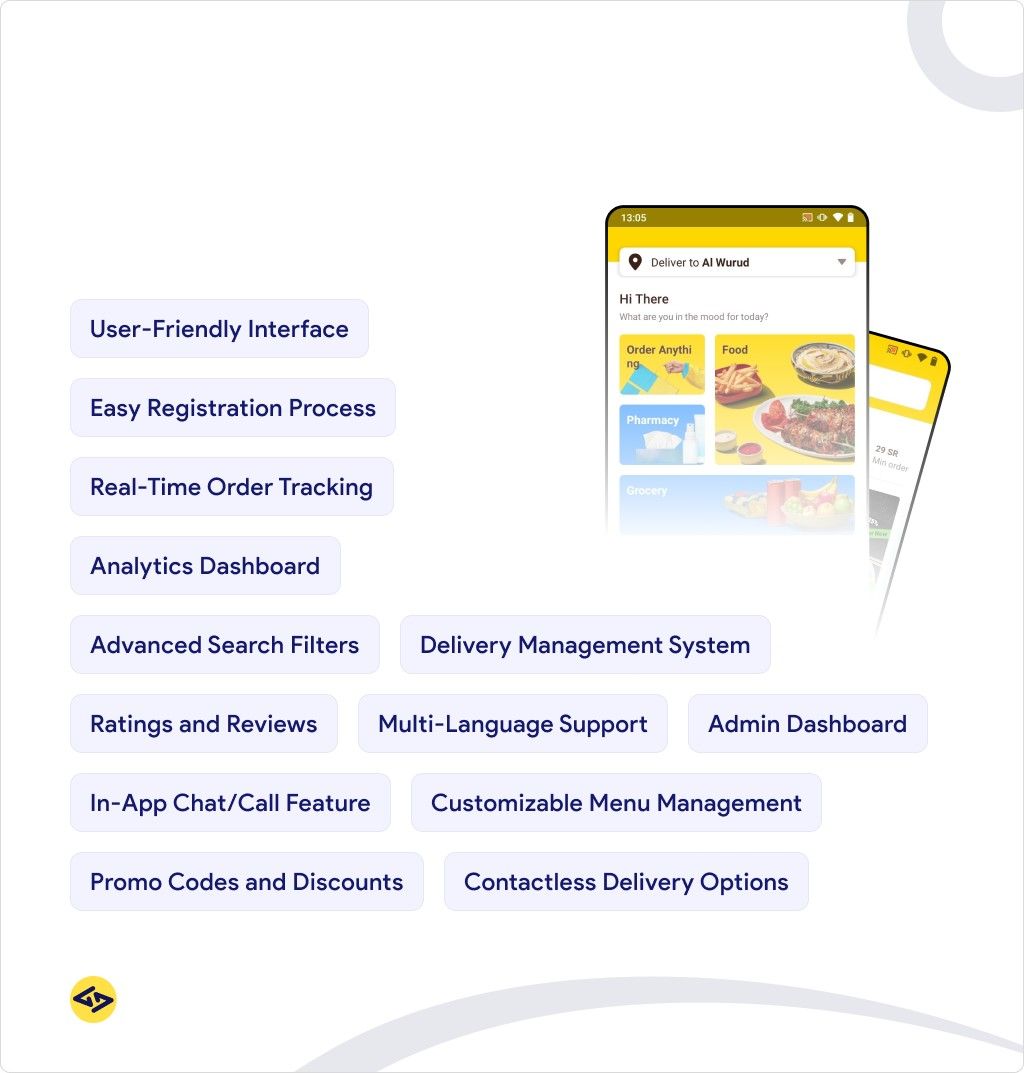
1) User-Friendly Interface
The app’s design and layout are clear, so individuals using it can easily find their way around it. Customers can peruse the different categories through this application, navigate the menus, and easily make orders.
2) Easy Registration Process
You can sign up with an email address, Facebook, or Google account. It minimizes the time and effort required in the onboarding process, which is helpful, especially for newcomers. Thus, Signing up is very simple.
3) Multiple Payment Options
It accepts credit/debit cards, e-wallets, and cash-on-delivery payment options as integral functionalities of the app. Such flexibility ensures that the app meets users’ preferences and improves user experience.
4) Real-Time Order Tracking
Customers can also follow an order’s progress from when they place it until it is delivered to their doorstep. This gives customers visibility of their orders’ status and helps them feel informed about their status.
5) Advanced Search Filters
Special search parameters, including categories, prices, ratings, and others, help users easily search for targeted products within a store or multiple stores. This feature improves the shopping experience by enabling users to navigate and quickly find what they want.
6) Ratings and Reviews
For their deliveries, customers can rate the service they received and write reviews on the stores and delivery services. This feedback mechanism is crucial in ensuring quality standards are met, and services are constantly improved.
7) In-App Chat/Call Feature
This feature allows the customers to interact with the delivery drivers or store managers if they have any issues or questions about their orders.
8) Promo Codes and Discounts
It allows store owners to create promotions where customers can enter a code at the end of the process and have some items on their list discounted. This plays an important role in raising the number of customers and increasing the sales of the products.
9) Admin Dashboard
The admin panel offers all the required options to control all the actions inside the application and manage users, sales, delivery, and customer response.
10) Delivery Management System
The application also has a functional delivery system whereby store owners can schedule tasks for delivery partners depending on their availability and location to enable efficient service delivery.
11) Multi-Language Support
Users can select from multiple language options during registration or in the application’s settings, catering to a diverse audience.
12) Analytics Dashboard
Store owners receive an analytics panel that provides information about sales, customer interaction, order statistics, and other aspects, helping them make the required business decisions.
13) Contactless Delivery Options
In light of health issues, especially after the COVID-19 virus outbreak, the app allows delivery drivers to drop packages at certain places without contacting customers.
14) Customizable Menu Management
Restaurateurs can adjust the menu to include new items or exclude those out of stock at any given time directly through a web-based interface within the application.
How to Create a Food Delivery App Like HungerStation: A Step-by-Step Guide
Making a food delivery app like HungerStation in Saudi Arabia includes planning up to launching and marketing. The following is a step-by-step guide on how to build food app:
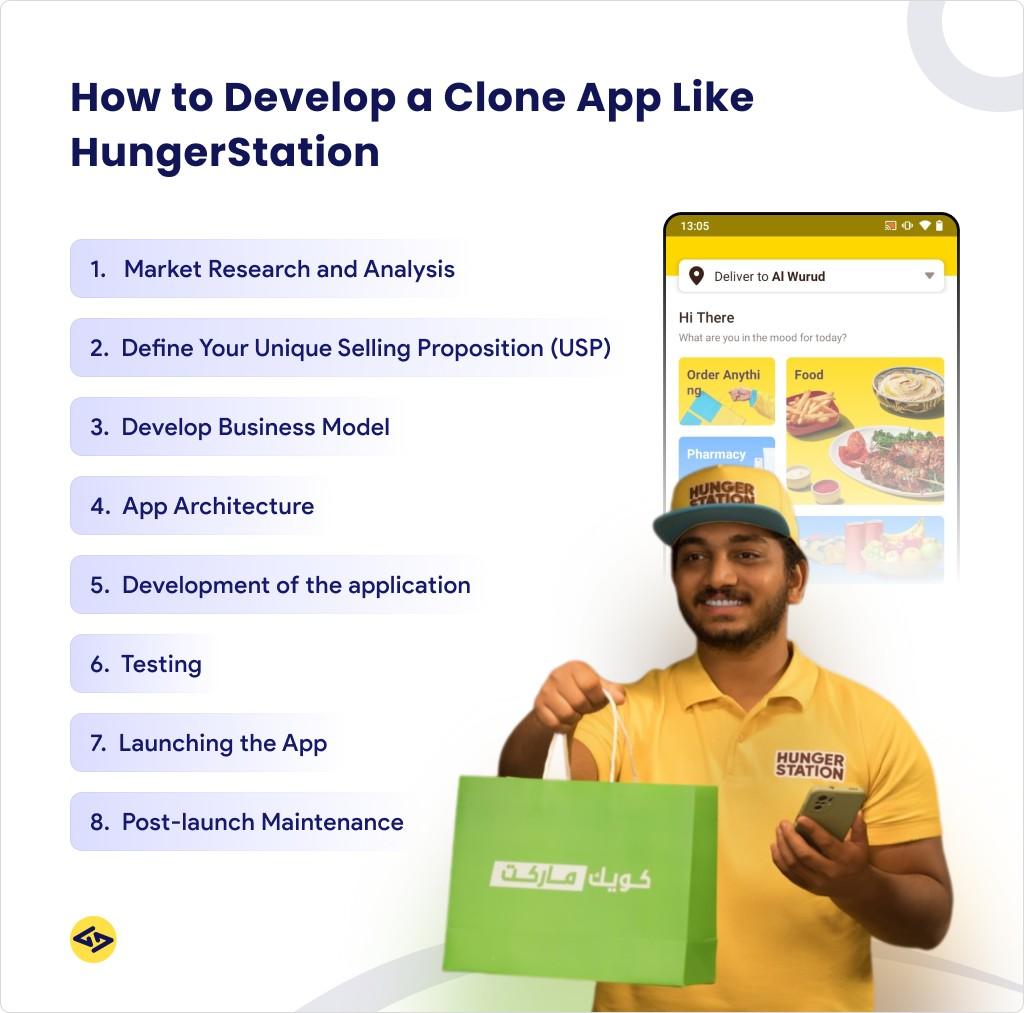
Step 1: Market Research and Analysis
This is where strategic planning comes in; it is advisable to undertake market analysis before starting the development process. This includes:
- a) Identifying Target Audience:
It is vital to gain insight into the individuals interested in your application, what they like or dislike, and what they need. - b) Analyzing Competitors:
Research existing food delivery applications such as HungerStation, Talabat, and Uber Eats. Consider their attributes, UI, cost structures, and customer reviews. - c) Understanding Trends:
One should consider trends impacting the application, such as contactless delivery or subscriptions.
Step 2: Define Your Unique Selling Proposition (USP)
After completing market research, define what makes your application unique from competitors. These aspects could be:
- a) Specialized Cuisine Options:
Specialization by offering certain food or recipes (e.g., vegetarian or low-carb). - b) Enhanced User Experience:
Providing a better UI/UX design experience. - c) Loyalty Programs:
Rewarding the most active users or participants of the website.
Step 3: Develop Business Model
Choose your revenue model for the app. Common models include:
- a) Commission-Based Model:
A business model charges restaurants a percentage of each order processed through the app. - b) Delivery Fees:
Offering and fellow charges from customers for the delivery services. - c) Subscription Services:
Having premium subscriptions for free delivery or offering sizable discounts.
Check Our Other Posts – Online Food Delivery Business Model
Step 4: App Architecture
Consider the technical design of your app. Key components include:
- a) User Interface (UI):
Construct a wireframe for the customer side and a wireframe for the restaurant side. - b) Backend Development:
Select between cloud services or physical servers for data storage and computing within the royalty company. - c) APIs Integration:
Define third-party services such as payment processing, GPS tracking, etc.
Step 5: Development of the Application
This phase can be broken down into several parts:
- a) Frontend Development
For cross-platform applications, consider frameworks such as React Native or Flutter.
Make it mobile-friendly for different devices. - b) Backend Development
Select the development programming language (e.g., Node.js, Python) and the database management system for your project (e.g., MongoDB, PostgreSQL).
Use RESTful APIs to manage the interaction between the front and back end. - c) Real-Time Features
Use real time updates through the WebSocket technology on the status of orders. - d) Payment Gateway Integration
Integrate safe and verified payment means, such as using Stripe or options like PayPal to manage payment. - e) Admin Panel Development
Design a section in the user interface where admins can view and track orders, users, restaurants, and usage analytics.
Learn more about building a food delivery app.
Step 6: Testing
Conduct rigorous testing to ensure functionality across all aspects of the app:
- a) Unit Testing:
Check separately segmented parts of it for glitches. - b) Integration Testing:
Make sure that separate modules are compatible to a certain degree. - c) User Acceptance Testing (UAT):
Conduct usability testing from real users to detect any problems you may have overlooked before the launch.
Step 7: Launching the App
Prepare for launch by following these steps:
- a) App Store Optimization (ASO):
Tweak your apps by including keywords and catchy descriptions to rank better in app stores. - b) Marketing Strategy Implementation:
You should try social media promotion, cooperation with influencers, and local advertising to attract the first audience. - c) Feedback Loop Creation:
Promote users to post their reviews and feedback after using the app to enhance the application periodically due to users’ feedback.
Step 8: Post-launch Maintenance
Once launched, focus on maintaining and updating your app regularly:
Use analytical solutions to track performance indicators.
Take feedback from the user and update the application according to the technology stacks available.
New features should be released occasionally to attract the users’ attention.
Tech Stack for Food Delivery App Development
To develop a food delivery app like HungerStation, you need to consider the following components of the technology stack:
Programming Languages:
Java and Kotlin for Android development.
Swift for iOS development.
It can be Python or JavaScript (Node.js) for backend services.
Frontend Frameworks:
Cross-platform frameworks, React Native or Flutter.
Angular, Vue.js, or simply HTML/CSS/JavaScript in the case of ‘traditional’ web user interfaces.
Backend Technologies:
Node.js, Ruby on Rails, or PHP for server-side logic.
Database Systems:
A relational database such as MySQL or PostgreSQL.
NoSQL databases like MongoDB.
Payment Gateway Integration:
Payment options that are safe to use such as PayPal, Stripe, or Braintree.
Cloud Services:
Hosting solutions include Amazon Web Service, Microsoft Azure, or Google Cloud.
APIs and Integrations:
Integration of third-party services such as Google Maps API for obtaining the location and Twilio API for the messaging service.
Real-Time Features Support:
Technologies such as WebSockets support real-time delivery notifications and updates.
Cost & Timeline to Build a Food Delivery App Like HungerStation
The cost of making a food delivery app depends on feature complexity, supported platforms (iOS, Android, Web), and scalability requirements.
Estimated Development Cost
Basic MVP (core features): $30,000 – $60,000
Mid-Level Platform: $60,000 – $120,000
Advanced Multi-City Platform: $150,000+
Typical Development Timeline
Planning & UI/UX: 1–2 months
MVP Development: 3–6 months
Full-Scale Platform: 6–12+ months
Pro Tip: Start with an MVP including a customer app, delivery app, restaurant panel, and admin dashboard. Once validated, scale with advanced features like AI recommendations, loyalty systems, and multi-language support.
For detailed cost breakdown, check out our guide on cost to build a food delivery app like UberEats.
Conclusion – Final Words on the Food Delivery App Development
Conducting proper market analysis, understanding the position on the market, and deciding on the technology stack can help you create a mobile app that will cater to users’ needs and be distinct from the competitor’s offerings. Developing an app like HungerStation provides many opportunities in the fast-growing industry.
Concentrate efforts on providing the best user experience and features, such as real-time tracking and different payment methods. Therefore, it is crucial to remain relevant in the food delivery market and enhance your app according to users’ desires for great success.
As a leading food delivery app development company, our professional team will help you from the idea to develop a unique and innovative app like HungerStation. With our help, you will have all the chances to succeed in a highly competitive sphere like food ordering app development.
Are you ready to create a food delivery application? Contact iCoderz today!
Ready to build your own food delivery app like Hungerstation?