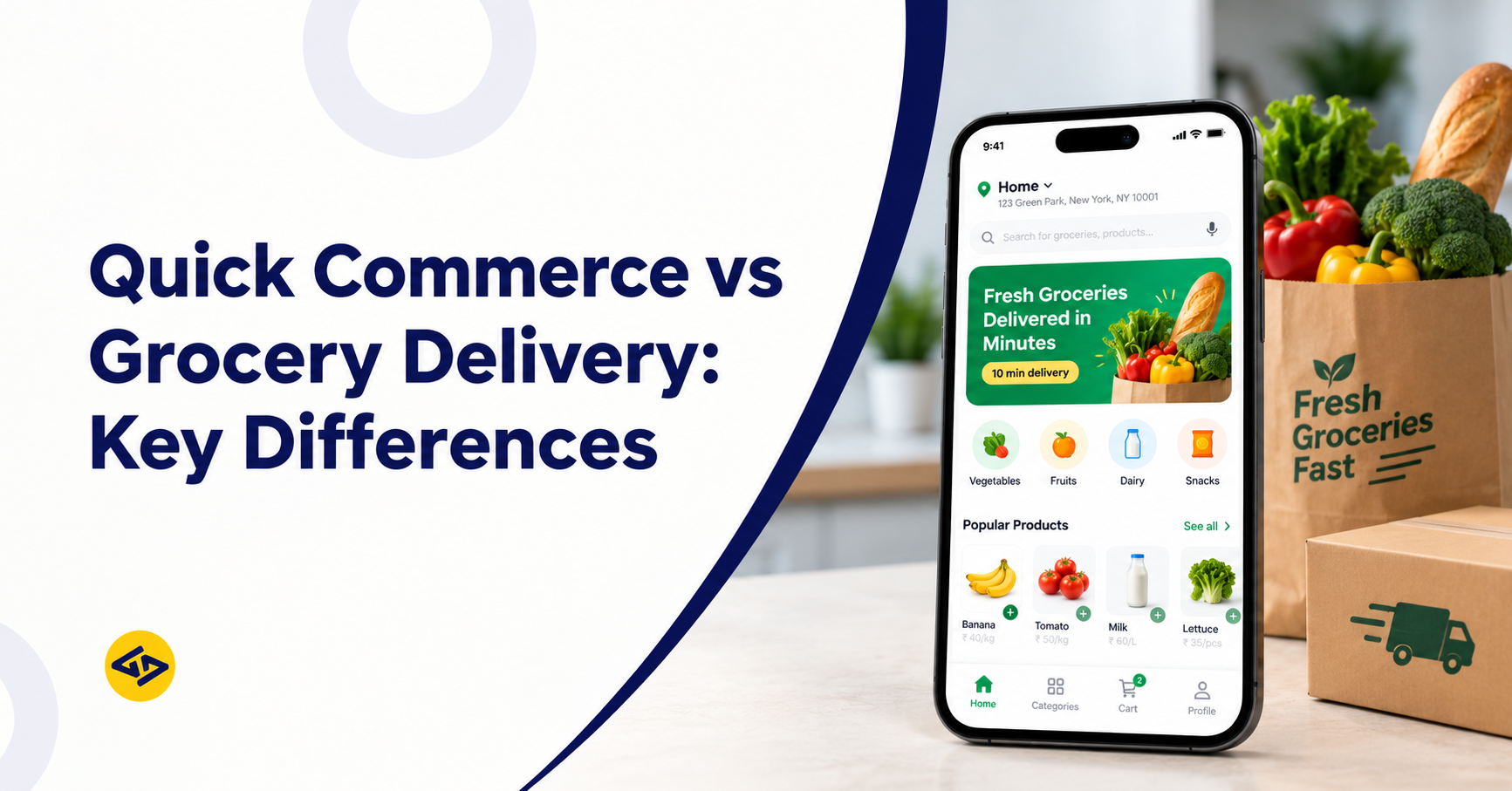
Quick commerce vs grocery delivery is a choice between speed and scale. Quick commerce delivers a small basket in about 10 to 30 minutes from a nearby dark store. Grocery delivery brings a larger basket in a scheduled slot or within a few hours.
Quick answer: Quick commerce wins on speed. It suits urgent, small orders in dense cities. Grocery delivery wins on cost and range. It suits planned, larger baskets. The difference between quick commerce and grocery delivery shows up in delivery time, store type, inventory, costs, and profit per order.
Demand for fast delivery is growing worldwide. Grand View Research values the global quick commerce market at USD 244.7 billion in 2025. It projects growth to USD 1,303.5 billion by 2033, a CAGR of 23.5 percent from 2026 to 2033.
Picking the wrong model is costly. You may build dark stores that sit idle, or offer slots that feel too slow. This guide compares both models for founders, retailers, and product teams.
What Is Quick Commerce (Q-Commerce)?
Quick commerce, or Q-commerce, is a retail model that delivers everyday items in minutes. Orders are packed at small local warehouses called dark stores. Riders then deliver within a few kilometers. So, what is quick commerce in grocery delivery? It is fresh produce, dairy, snacks, and household items arriving in roughly 10 to 30 minutes. Our guide explains what Q-commerce is in more depth.
How Does Quick Commerce Work?
Quick commerce works through four connected steps:
- The customer opens the app. It shows only items stocked at the nearest dark store.
- The order reaches the dark store. A picker collects and packs the items.
- The system assigns a nearby rider.
- The rider delivers the order. The customer tracks it live.
Each step is automated and the distance is short.
How Is Q-Commerce Different from E-Commerce?
Q-commerce vs e-commerce comes down to distance and urgency. E-commerce ships from large central warehouses. Delivery takes days. Q-commerce ships from local dark stores. Delivery takes minutes.
E-commerce offers a huge catalog for planned buying. Q-commerce offers a narrow range for urgent needs in dense neighborhoods.
What Is Traditional Grocery Delivery?
Traditional grocery delivery lets customers order groceries online and receive them later from a supermarket or warehouse. Baskets are larger. Delivery follows a chosen time slot or arrives within a few hours. It is the digital version of the weekly shop.
Online Grocery Ordering and Scheduled Delivery
Customers build a full basket and pick a delivery slot, such as tomorrow morning. Staff collect items from a store or warehouse. Drivers batch several orders on one route.
This is where quick commerce vs online grocery shopping differs most. Online grocery shopping rewards planning. Quick commerce rewards urgency. Quick commerce vs scheduled grocery delivery is a similar contrast. Scheduled delivery suits recurring weekly orders. Quick commerce suits last-minute gaps. You can see the backend side in this explainer on how an online grocery delivery app works.
Same-Day and Hyperlocal Grocery Delivery
Same-day delivery sits between the two models. Customers order by noon and receive groceries by evening. Quick commerce vs same-day grocery delivery is a gap of hours against minutes.
Hyperlocal delivery connects customers with nearby stores that deliver within a few hours. Quick commerce vs hyperlocal delivery differs in infrastructure. Hyperlocal uses stores that serve walk-in shoppers. Quick commerce uses stores built only for online orders.
Quick commerce vs supermarket delivery follows the same logic. Supermarket staff pick from shelves shared with in-store customers. That can slow picking and cause stock-outs.
Quick Commerce vs Grocery Delivery: Key Differences
How is quick commerce different from grocery delivery? Six factors matter most. Quick commerce vs traditional grocery delivery differs on each one.
Delivery Speed
Quick commerce delivery time vs regular grocery delivery is the clearest gap. Quick commerce targets 10 to 30 minutes. Regular grocery delivery takes a few hours, or the next day when slots are full. This step-by-step guide to how quick commerce works shows how dark stores and riders reach that speed.
Inventory and Fulfillment
Quick commerce stocks a narrow range of fast-selling items near the customer. Grocery delivery stocks a wide range in large stores or warehouses. Fulfillment is slower but covers more products.
Dark Stores vs. Retail Stores
Quick commerce dark stores vs grocery stores is mainly a layout difference. Dark stores are closed to the public and arranged for fast picking. Grocery stores are arranged for browsing shoppers. The dark-store section below covers operations in detail.
Delivery Costs and Pricing
Quick commerce spends more per order on delivery. Riders carry small baskets and wait on standby. Companies recover this through delivery fees, handling fees, and minimum order values. Grocery delivery spreads cost across bigger baskets and batched routes.
Product Availability
Quick commerce covers daily essentials. Grocery delivery adds bulk packs and niche brands.
Customer Experience
Quick commerce feels instant, with live tracking and short waits. Grocery delivery feels planned, with larger baskets and slot choice.
Quick Commerce vs Grocery Delivery: Comparison Table
Use this table for a fast side-by-side view.
| Factor | Quick Commerce | Traditional Grocery Delivery |
| Delivery time | 10 to 30 minutes | A few hours to next day |
| Infrastructure | Dark stores in dense zones | Supermarkets, warehouses, or partner stores |
| Typical order | Small, urgent top-up | Large, planned basket |
| Operating costs | Higher per order: rent, riders, wastage | Lower per order: batched routes, fewer sites |
| Inventory | Narrow range, fast turnover | Wide range, slower turnover |
| Ideal use case | Dense cities, urgent and impulse needs | Weekly shops, bulk and recurring orders |
Building a scheduled or same-day platform? See our on-demand grocery delivery app solution.
Quick Commerce vs Grocery Delivery: Which Business Model Is More Profitable?
Neither model wins by default. Quick commerce vs grocery delivery profitability depends on order volume per store, not speed alone. Grocery delivery has lower setup and running costs. Quick commerce earns more from frequent orders and brand ads. But it needs high order density to cover dark-store rent and riders.
Revenue Sources
Both models earn from product margin and delivery fees. Quick commerce adds brand advertising and private labels. Grocery delivery adds subscriptions and bulk-order margin. Any grocery delivery app business model needs one of these extra streams to protect margin.
Operating Expenses and Delivery Costs
Quick commerce last-mile delivery costs are high. Riders carry small baskets over short distances. Rider supply must match peak demand. Dark stores add rent, staff, cold storage, and wastage.
Grocery delivery has fewer fixed sites and batches routes. Its costs rise with long distances.
Profit Margins and Unit Economics
Quick commerce unit economics are measured per order. Start with product margin, delivery fees, and ad income. Then subtract picking, packaging, delivery, discounts, and wastage. The result is contribution per order.
A dark store turns profitable when enough orders share its fixed costs. Grocery delivery usually reaches break-even with fewer orders per site.
Factors Affecting Profitability
- Orders per store per day
- Average basket value
- Wastage and expiry losses
- Dependence on discounts
- Rider utilization
- Local rent and labor costs
Planning to launch a quick commerce platform? Explore how quick commerce app development can support your business model.
The Role of Dark Stores in Quick Commerce
A dark store is a small fulfillment center closed to the public. Every shelf is arranged for online orders. The dark store model for grocery delivery cuts the walk from shelf to packing table.
Dark-Store Operations
Stock arrives from a central warehouse, often overnight. Fast sellers sit near the packing area. Pickers follow app-guided routes. Each store serves a radius of a few kilometers.
Inventory Management and Order Fulfillment
Quick commerce inventory management is the hardest part. Stock must match local demand every day. Teams forecast demand by neighborhood. They set auto-reorder levels. They track expiry dates and sell the oldest stock first.
The app must also sync stock in real time. Otherwise customers order items that are not there. Fulfillment then follows a tight sequence: pick, pack, hand over.
A reliable quick commerce software solution can help businesses coordinate inventory, order processing, and delivery operations across dark stores.
Benefits, Challenges, and Practical Examples
Benefits include speed and control over stock and packing. Challenges include rent, wastage on fresh items, and thin demand in some areas.
Grand View Research groups Gopuff, Getir, Blinkit, and Zepto as emerging players built on dense dark-store networks. Our guide on how to build a dark store grocery delivery app covers the technology side.
Quick Commerce App vs Grocery Delivery App: Features and Technology
Both models need three connected products: a customer app, a delivery partner app, and an admin panel. Quick commerce app development adds speed-critical systems. Grocery delivery app development can start leaner.
Customer App, Delivery Partner App, and Admin Panel
- Customer app: Location-based catalog, search, cart, checkout, and order history. Grocery delivery adds slot selection.
- Delivery partner app: Order alerts, navigation, proof of delivery, and earnings. Quick commerce needs rider assignment within seconds.
- Admin panel: Catalog, pricing, store-wise inventory, order monitoring, offers, and reports.
Real-Time Order Tracking, Payments, and Inventory Management
Real-time tracking shows a live map and delivery estimate. Payments should cover cards, digital wallets, and local payment methods. Inventory must update per store after every order.
Technology Requirements for Quick Commerce Platforms
- Maps and geolocation APIs
- An order-assignment engine for riders
- Cloud hosting that scales for peak hours
- A payment gateway and push notifications
This quick commerce app development guide lists the full feature set.
Quick Commerce App Development Cost
Cost depends on scope, not on the model name. A quick commerce app usually costs more than a basic grocery app. It needs a dispatch engine and store-wise inventory. A number without a feature list is a guess, so no fixed figure is quoted here.
Features and Platform Complexity
Each platform adds work: Android, iOS, web, and the admin panel. Demand forecasting and multi-store inventory add more.
Third-Party Integrations
Most platforms connect to maps, payment gateways, messaging services, and analytics tools. Each integration adds build and testing time.
Scalability, Maintenance, and Development Considerations
Build for peak hours, not average days. Budget for maintenance and updates after launch. Many teams start with an MVP in one delivery zone. Your development partner also shapes the budget. Compare the top quick commerce app development companies and the grocery delivery app development companies before you decide.
How to Choose the Right Model for Your Business
Target Audience and Delivery Area
Choose quick commerce for dense urban customers who value speed. Choose grocery delivery for weekly planners across wider areas.
Budget and Investment Capacity
Quick commerce needs capital for dark stores, stock, riders, and tech. Grocery delivery can start from an existing store.
Operational Readiness and Business Goals
Ask whether you can manage fast picking, tight stock control, and rider supply. If not, begin with scheduled delivery and add a fast lane later.
The quick commerce business model for startups works best in small steps. Here is how to start a quick commerce business:
- Pick one dense delivery zone.
- Test demand with a small catalog.
- Set up one or two dark stores and local suppliers.
- Launch your app and track unit economics from day one, then expand.
For a deeper walkthrough, read how to start a 10-minute grocery delivery business like Zepto.
Illustrative scenario (not a real client): A supermarket chain with three city stores serves weekly shoppers. It starts with scheduled delivery. Later, it adds a fast lane from its busiest store for top-up orders. This hybrid costs less than building dark stores from day one.
Future of Quick Commerce and Grocery Delivery
Quick commerce market trends in 2026 point to steady growth. Grand View Research expects the global market to grow at a CAGR of 23.5 percent from 2026 to 2033. Asia Pacific led with 45.8 percent of revenue in 2025. The U.S. is forecast to grow at 14.2 percent a year over the same period.
Three trends stand out:
- Dark-store expansion: More local fulfillment hubs mean faster delivery in more cities.
- Scheduled delivery keeps growing: Shoppers still plan routine and bulk orders.
- Grocery leads the mix: Grocery and staples held 33.7 percent of quick commerce revenue in 2025.
Customer expectations are rising too. Shoppers expect fast delivery, live tracking, and accurate stock. Regulators also watch rider safety and labor practices, so operators must set delivery promises carefully.
The two models now work side by side. Planned shopping suits scheduled delivery. Local stores can add fast delivery through a hyperlocal grocery delivery app.
Conclusion
Quick commerce delivers small baskets in minutes from dark stores. It earns well when order density is high. Grocery delivery handles larger, planned baskets at lower operating cost.
Choose quick commerce for dense cities and urgent demand. Choose grocery delivery for planned shopping and a tighter budget. Many businesses combine both over time.
Ready to build either model? iCoderz Solutions designs and develops apps for quick commerce and scheduled delivery. Share your market and goals, and our team can help you plan the right platform.
Choose the Right Delivery Model for Your Business
Build a custom app for faster deliveries and smarter operations.

FAQs
Is quick commerce better than traditional grocery delivery?
Not always. Quick commerce is better for urgent, small orders in dense cities. Traditional grocery delivery is better for planned, larger baskets and lower operating costs. Your customers and budget decide.
What is the difference between quick commerce and 10-minute delivery?
Ten-minute delivery is a speed promise. Quick commerce is the full model behind it, including dark stores and real-time inventory. Most services deliver in 10 to 30 minutes.
How do quick commerce companies make money?
They earn from product margin, delivery and handling fees, and brand advertising on the app. Many also sell private-label products. Profit depends on order volume per dark store.
Are dark stores necessary for quick commerce?
Not strictly. Some businesses deliver quickly from existing stores. But dark stores give better control over stock and picking speed. For consistent delivery under 30 minutes, most operators use them.
What are the biggest challenges in quick commerce?
The main challenges are high last-mile costs, low order density, wastage on fresh items, and dark-store rent. Dependence on discounts also hurts margins. Demand forecasting and tight inventory control reduce these risks.
Can a grocery delivery business switch to a quick commerce model?
Yes. Start with fast delivery from your busiest store in a small radius. Then open a dark store in a dense zone. Upgrade your app with real-time inventory and rider assignment.
How much investment is required to start a quick commerce business?
It depends on the number of dark stores, opening stock, riders, app, and marketing. No single figure fits every market. Start with a pilot of one or two stores and build a cost model from local quotes.