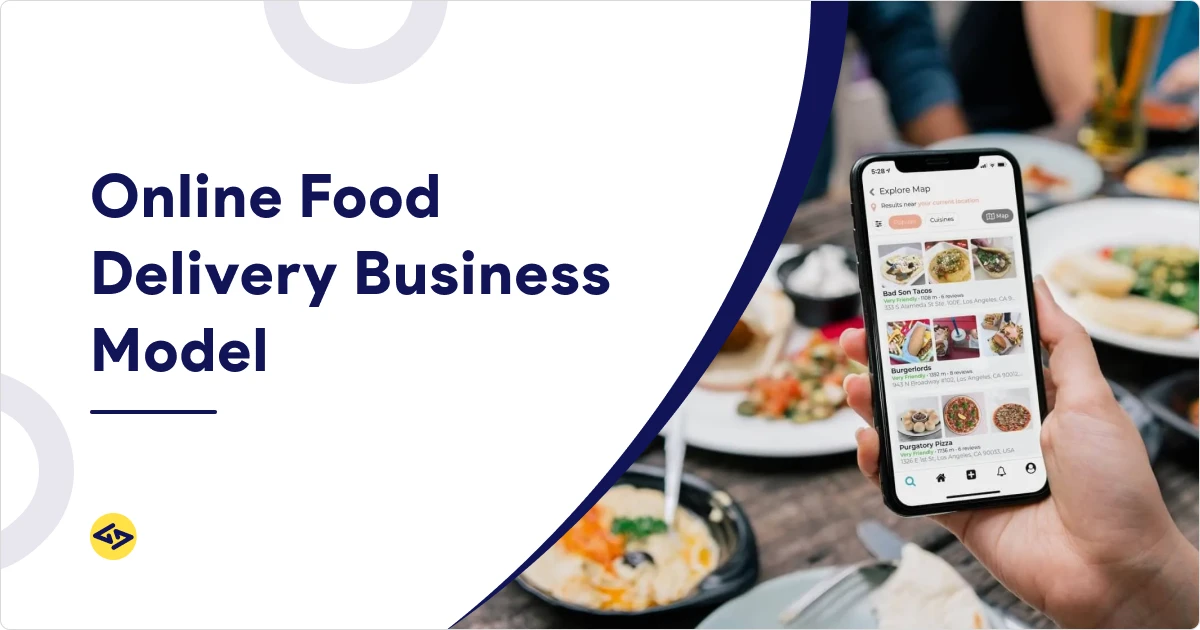
The online food delivery industry has become one of the fastest-growing segments of the digital economy, turning a simple craving into a few taps on a smartphone. Entrepreneurs keep entering this space because it solves a real, recurring problem: people want restaurant-quality food without the hassle of cooking or dining out, and restaurants want access to customers beyond their physical location.
At its core, the food delivery business model connects three groups — customers, restaurants, and delivery partners — through a technology platform that manages ordering, payment, and logistics. This guide breaks down how that model works, the different types of food delivery businesses, how these platforms make money, what it costs to start one, and how companies like Swiggy, Zomato, DoorDash, and Uber Eats structure their operations.
What Is an Online Food Delivery Business Model?
An online food delivery business model is a framework describing how a platform generates revenue by connecting customers who want food with restaurants that prepare it and delivery partners who transport it. The platform acts as the intermediary, earning money through commissions, fees, and other services rather than owning restaurants itself (in most cases).
Key participants:
- Customers – browse menus, place orders, and pay through the app
- Restaurants – prepare food and manage menu availability
- Delivery partners – pick up and deliver orders
- Platform/business owner – manages technology, payments, and coordination
Money flows from the customer to the platform, which then distributes payouts to the restaurant (order value minus commission) and the delivery partner (delivery fee or per-order payout), keeping the remainder as platform revenue. If you’re evaluating how such a platform is built, Food Delivery App Development is a useful starting point for understanding technical requirements.
How Does an Online Food Delivery Business Work?
A typical food delivery app operating model follows six steps:
- Customer places an order – browsing restaurants, selecting items, and checking out through the app
- Restaurant receives and accepts the order – notified in real time via the restaurant panel
- Food is prepared – the kitchen begins preparation once the order is confirmed
- Delivery partner picks up the order – assigned automatically or manually based on proximity
- Order is delivered – tracked in real time until it reaches the customer
- Payment and commission are settled – the platform deducts its commission and pays out the restaurant and delivery partner
Customer Order → Restaurant Accepts → Food Prepared → Delivery Partner Pickup → Delivery → Payment Settlement
This cycle usually takes 30–45 minutes end to end, and platform efficiency in managing each step directly affects customer satisfaction and retention.
Types of Food Delivery Business Models
Not every food delivery platform operates the same way. Here are the main food delivery business model types:
1. Aggregator Business Model – the platform connects restaurants and customers; the restaurant handles food prep, and delivery may be managed by either party.
2. Order-and-Delivery Business Model – the platform manages both ordering and delivery logistics, giving it more control but higher operational responsibility.
3. Integrated Food Delivery Model – a single platform manages ordering, payments, delivery, and the entire customer experience end to end.
4. Restaurant-Owned Delivery Model – restaurants run their own ordering and delivery operations without a third-party marketplace.
5. Cloud Kitchen-Based Model – delivery-only food businesses with no dine-in space, optimized purely for online orders.
Platforms exploring a food delivery marketplace business model or a food delivery aggregator business model often start with one type and expand into hybrid approaches, such as offering multi restaurant food delivery app development to support several restaurant partners on one platform.
Explanation of the Food Delivery Business Model Canvas
The above Food Delivery Business Model Canvas visually explains how a food delivery platform is structured to create value, serve customers, and generate revenue.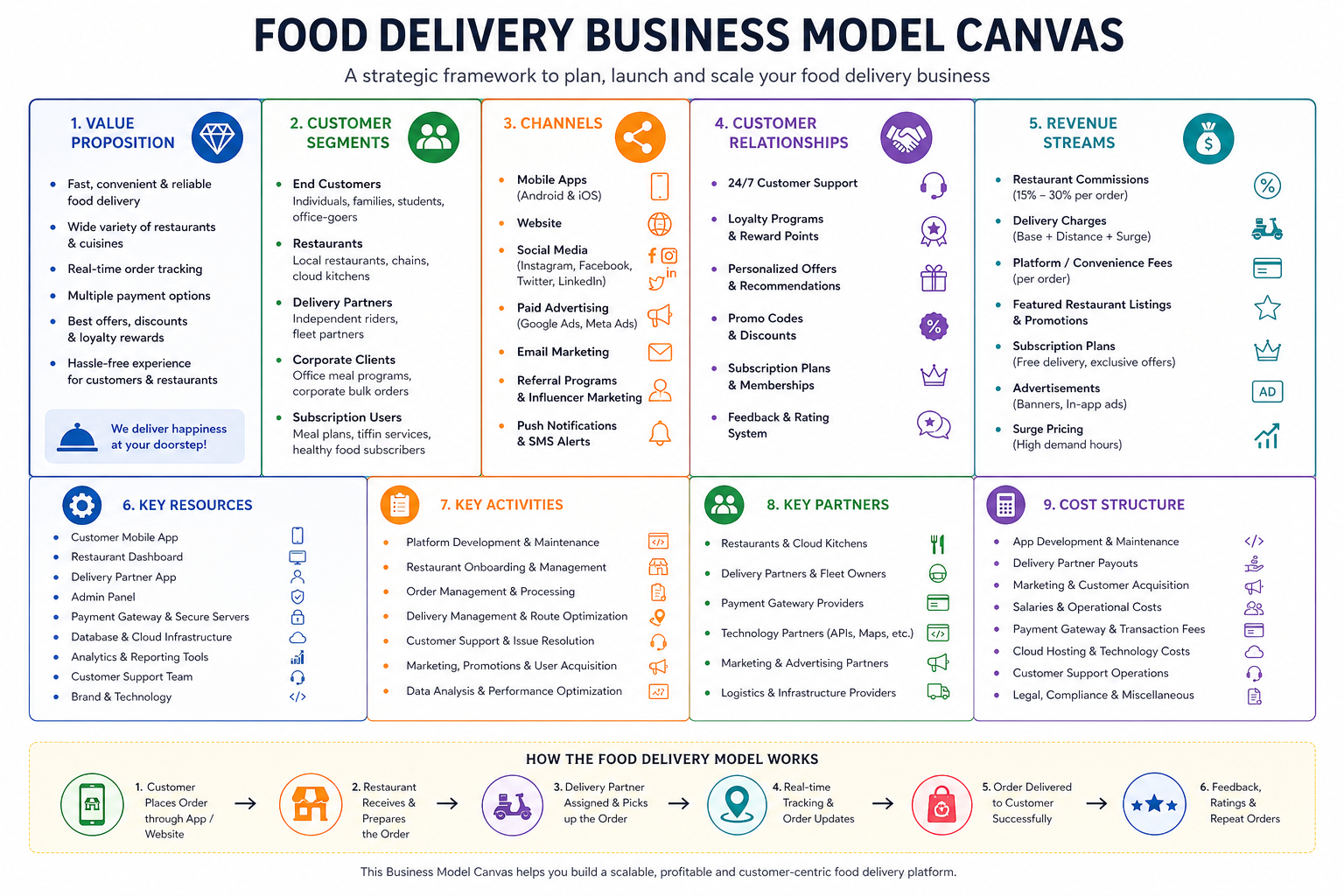
Let’s understand each section separately.
1. Value Proposition
This section defines the core value your platform offers to users.
In a food delivery business, the main value propositions are:
- fast and reliable delivery
- multiple restaurant and cuisine options
- real-time order tracking
- easy online payment options
- discounts and loyalty rewards
- hassle-free ordering experience
For restaurants, the value lies in:
- increased online visibility
- more orders
- access to a wider customer base
This is the main reason customers choose your platform over competitors.
2. Customer Segments
This section explains who your target audience is.
Typical customer segments include:
- end customers
- families
- students
- office workers
- restaurants
- cloud kitchens
- delivery partners
- corporate meal users
- subscription customers
Identifying the right customer segment helps create better offers, features, and marketing campaigns.
3. Channels
Channels are the platforms through which customers interact with your business.
These include:
- mobile apps (Android & iOS)
- website
- social media
- paid advertising
- email marketing
- push notifications
- referral programs
Strong channel distribution improves reach and customer acquisition.
4. Customer Relationships
This section focuses on retention and engagement.
A successful food delivery business must build long-term customer relationships through:
- 24/7 customer support
- loyalty points
- reward programs
- personalized offers
- promo codes
- subscription memberships
- feedback and rating systems
Repeat customers are one of the biggest drivers of profitability.
5. Revenue Streams
This section explains how the business earns money.
Common revenue streams include:
- restaurant commissions
- delivery charges
- convenience fees
- featured restaurant listings
- advertisements
- subscription plans
- surge pricing during peak hours
This directly answers how a food delivery app business model generates revenue.
6. Key Resources
These are the essential assets required to run the platform.
Examples include:
- customer mobile app
- restaurant dashboard
- delivery partner app
- admin panel
- payment gateway
- secure cloud infrastructure
- analytics tools
- support team
These resources form the technological backbone of the business.
7. Key Activities
This section highlights the daily operational functions.
These activities include:
- app development and maintenance
- restaurant onboarding
- order processing
- delivery management
- customer support
- marketing campaigns
- data analysis and optimization
Efficient execution of these activities ensures smooth business operations.
8. Key Partners
Food delivery businesses rely heavily on partnerships.
Key partners generally include:
- restaurants
- cloud kitchens
- delivery fleet partners
- payment gateway providers
- logistics providers
- technology vendors
- marketing partners
The stronger the partner ecosystem, the easier it is to scale.
9. Cost Structure
This section explains the major expenses involved.
Typical costs include:
- app development and maintenance
- driver payouts
- marketing spend
- operational salaries
- payment gateway fees
- cloud hosting
- customer support
- compliance and miscellaneous costs
Understanding this helps estimate profitability and long-term scalability.
How Do Food Delivery Apps Make Money?
Quick answer: Food delivery apps make money primarily through restaurant commissions (15–30% per order), customer delivery and service fees, subscription plans, restaurant advertising, and sponsored listings. Most platforms combine several of these food delivery app revenue streams rather than relying on just one.
Here’s how each revenue stream works:
- Restaurant Commission – a percentage of each order’s value charged to the restaurant
- Delivery Fees – charged to customers, sometimes varying by distance or order size
- Platform or Service Fees – a small fixed or percentage-based fee covering platform operations
- Customer Subscription Plans – monthly/annual memberships offering free delivery or discounts
- Restaurant Advertising – restaurants pay to boost visibility in search and category pages
- Sponsored Listings – paid placement at the top of listings or featured sections
- Surge or Peak-Time Delivery Fees – dynamic pricing during high-demand periods
- Premium Restaurant Services – analytics dashboards, marketing tools, or priority support
- Logistics and Delivery Services – some platforms offer their delivery network to restaurants as a standalone service
Food Delivery App Revenue Model: Example
Here’s an illustrative (not industry-standard) example of how a single order might generate revenue:
Order value: ₹500
→ Restaurant commission (20%): ₹100
→ Delivery fee (customer paid): ₹40
→ Platform/service fee: ₹15
→ Advertising/subscription contribution (allocated): ₹10
→ Total platform revenue from this order: ₹165
Actual commission rates and fee structures vary widely by platform, region, and restaurant category, so treat this only as a conceptual example.
What Are the Main Costs of a Food Delivery Business?
- App and Website Development – design, development, and testing
- Delivery and Logistics – rider payouts, fuel/vehicle support, routing tools
- Employee and Operations Costs – support staff, operations managers
- Marketing and Customer Acquisition – ads, promotions, referral incentives
- Payment Gateway Fees – transaction charges per order
- Customer Support – staffing for order issues and complaints
- Restaurant Acquisition – onboarding and partnership incentives
- Technology and Infrastructure – servers, cloud hosting, maintenance
Understanding the full cost to develop a food delivery app upfront helps founders budget realistically before launch.
How to Start an Online Food Delivery Business
- Identify your target market – local, regional, or niche cuisine focus
- Choose a food delivery business model – aggregator, integrated, or cloud kitchen
- Research competitors – understand pricing, commission rates, and gaps
- Define your revenue model – commission-based, subscription, or hybrid
- Build restaurant partnerships – secure early partners for launch
- Plan your delivery network – in-house riders or gig-based partners
- Develop the food delivery platform – build customer, restaurant, and delivery apps
- Launch an MVP – test with a limited restaurant and delivery area
- Market the platform – acquire customers and restaurants simultaneously
- Measure and scale – track KPIs and expand into new regions
For a full breakdown of each step, see this guide on how to start a food delivery business.
Must-Have Features for a Food Delivery App
Customer App: restaurant search, menu browsing, cart, online payment, order tracking, reviews/ratings, offers, order history, push notifications
Restaurant Panel: menu management, order management, availability management, offers, sales reports
Delivery Partner App: order requests, navigation, pickup/drop-off details, earnings tracking, delivery status
Admin Panel: user management, restaurant management, delivery management, commission management, payments, analytics, promotions
A well-planned list of features of food delivery app platforms ensures nothing critical is missed during development.
Technology Behind a Food Delivery Platform
From a business standpoint, a food delivery platform typically relies on: mobile apps (iOS/Android), a web platform, cloud infrastructure for scalability, payment gateway integration, maps and real-time location tracking, push notifications, analytics dashboards, order management systems, and live delivery tracking.
Founders don’t need deep technical expertise to launch — partnering with an experienced team to develop a food delivery app can shorten time-to-market considerably.
Food Delivery Business Model Examples
Swiggy Business Model
Operates as a marketplace connecting thousands of restaurant partners with customers, supported by its own delivery network and multiple revenue channels including commissions, delivery fees, and advertising. Read more on the Swiggy business model.
Zomato Business Model
Combines a restaurant marketplace with delivery, advertising revenue, and a subscription/loyalty ecosystem (Zomato Gold) to increase customer retention alongside order commissions.
DoorDash Business Model
Runs a marketplace model with its own delivery network, merchant services (like DoorDash Storefront), and additional revenue opportunities such as advertising and DashPass subscriptions. Compare it with the doordash business model breakdown for more detail.
Uber Eats Business Model
Leverages Uber’s existing driver network to power a restaurant marketplace, earning through delivery fees, restaurant commissions, and platform fees. See the ubereats business model for a deeper comparison. Similar structures are used by other major players — you can also explore the grubhub business model for another perspective.
Food Delivery Business Model: Challenges to Consider
- High customer acquisition costs
- Intense restaurant competition
- Complex delivery logistics
- Thin profit margins
- Customer retention difficulties
- Order cancellations
- Delivery delays
- Maintaining consistent food quality
- Competition between platforms
- Scaling operations across new cities
Data protection is also a growing concern as platforms handle sensitive payment and location data — reviewing food delivery app security practices early can prevent costly issues later.
How to Make a Food Delivery Business Profitable
Profitability isn’t guaranteed — it depends on how well a platform manages the following factors:
- Optimize restaurant commission structure – balance fairness with sustainable margins
- Increase order frequency – encourage repeat orders through personalization
- Improve customer retention – loyalty programs and consistent service
- Optimize delivery routes – reduce delivery time and rider costs
- Increase average order value – bundling, upselling, minimum order incentives
- Develop subscription programs – predictable recurring revenue
- Expand advertising revenue – monetize restaurant visibility
- Reduce operational costs – automate support and streamline logistics
Avoiding common pitfalls matters just as much as growth tactics — see these mistakes to avoid in food service app operations before scaling.
Key Metrics to Track in a Food Delivery Business
| KPI | What It Measures |
| GMV | Total order value |
| Average Order Value | Average customer spend |
| Customer Acquisition Cost | Cost to acquire customers |
| Customer Lifetime Value | Long-term customer value |
| Order Frequency | How often users order |
| Conversion Rate | Visitors who place orders |
| Cancellation Rate | Cancelled orders |
| Delivery Time | Operational efficiency |
| Restaurant Retention | Partner retention |
| Contribution Margin | Economics per order |
Food Delivery Business Model vs. Food Delivery App Business Model
| Aspect | Food Delivery Business | Food Delivery App Business |
| Core focus | Food ordering/delivery operation | Technology platform |
| Main assets | Restaurants + logistics | App + platform + network |
| Revenue | Orders, fees, commissions | Commissions, fees, ads, subscriptions |
| Technology dependency | Moderate–High | Very High |
| Scalability | Depends on operations | Depends on platform + operations |
Final Thoughts
The online food delivery industry offers multiple paths to entry — from asset-light aggregator models to fully integrated platforms with in-house delivery. Success depends on choosing the right business model for your target market, structuring revenue streams thoughtfully, and investing in the technology and operations needed to keep customers, restaurants, and delivery partners satisfied.
Planning to Launch Your Own Food Delivery Platform?
Talk to the iCoderz Solution team about building a food delivery app tailored to your business model, target market, and growth plans — including strategies for marketing food delivery app platforms after launch.
FAQs About the Online Food Delivery Business Model
What is an online food delivery business model?
It’s a framework where a platform connects customers, restaurants, and delivery partners, earning revenue through commissions, fees, and other services.
How does a food delivery business make money?
Primarily through restaurant commissions, delivery fees, service fees, subscriptions, and advertising.
What are the different food delivery business models?
Aggregator, order-and-delivery, integrated, restaurant-owned, and cloud kitchen-based models.
What is the most common food delivery revenue model?
The commission-based model, where restaurants pay a percentage per order, remains the most widely used.
How much commission do food delivery apps charge restaurants?
Rates vary by platform and market, typically ranging from 15% to 30% per order.
Is a food delivery business profitable?
Profitability depends on order volume, commission structure, delivery efficiency, and customer retention — it’s not automatic.
How much does it cost to start an online food delivery business?
Costs vary based on app complexity, features, and region; development, marketing, and operations are the primary expense categories.
How do food delivery apps attract customers?
Through discounts, referral programs, loyalty rewards, and targeted digital marketing.
What features are needed for a food delivery app?
Customer ordering, restaurant management, delivery tracking, and admin control panels at minimum.
How can I start my own food delivery business?
By choosing a business model, building restaurant partnerships, developing a platform, and launching in a defined target market.