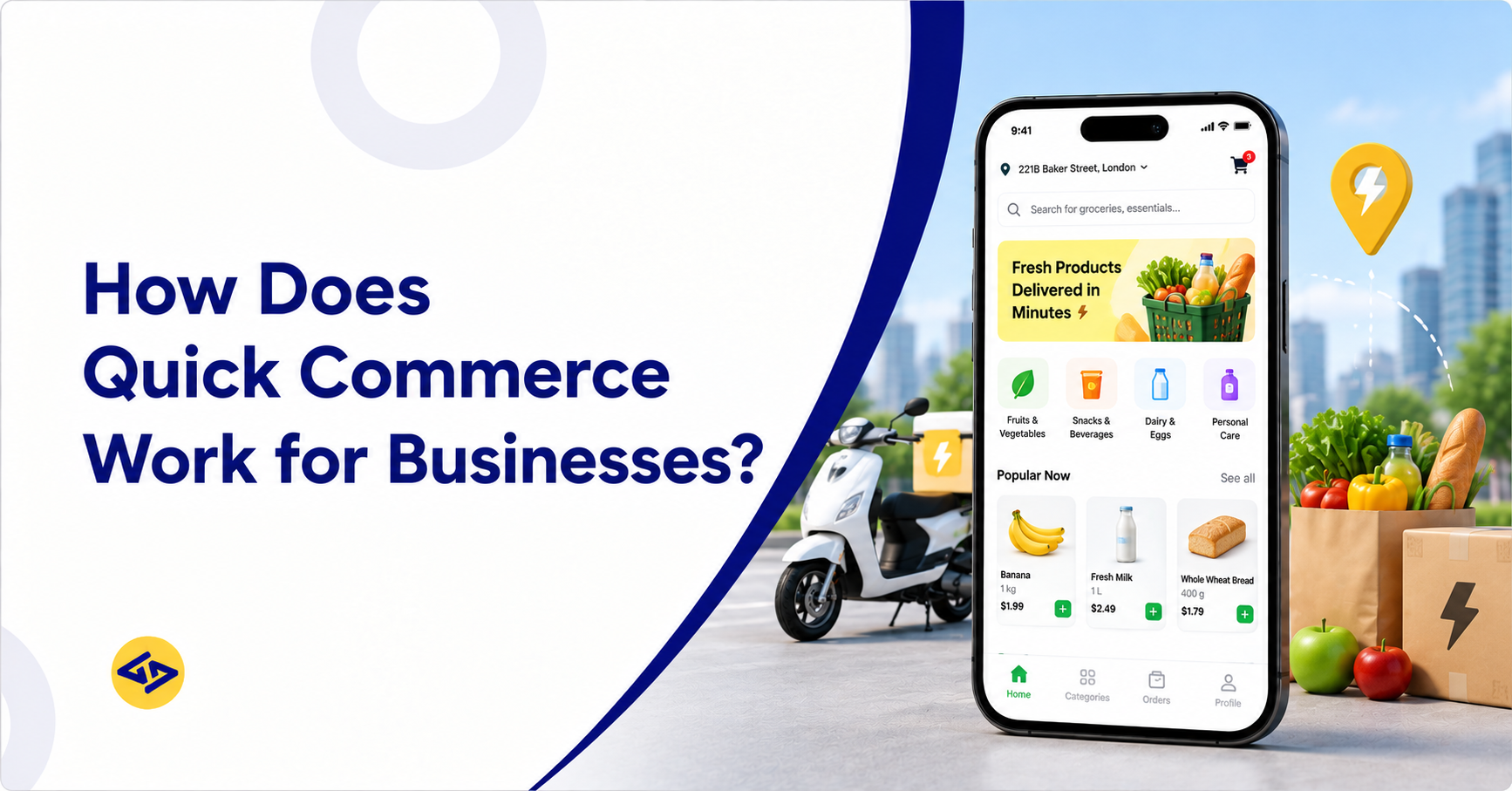
Ordering groceries and getting them at your door in ten minutes used to sound impossible. Today it’s routine in most major cities, and behind that convenience sits a tightly engineered system called quick commerce, or Q-commerce.
If you’re a business owner or operator trying to understand how does quick commerce work, this guide walks through the entire system — from dark stores and real-time inventory to order fulfillment, last-mile delivery, the technology stack, and the business economics that make ultra-fast delivery financially viable.
What Is Quick Commerce?
Quick commerce is a delivery model built around fulfilling orders — usually groceries, food, medicines, and everyday essentials — within 10 to 30 minutes of the customer placing them. Unlike traditional e-commerce, where a shipment can take days to arrive, Q-commerce depends on keeping inventory physically close to the customer, not on a single large warehouse serving an entire region.
The category itself grew out of two older models. It borrowed the catalog and checkout experience of e-commerce, and the perishable, everyday-essentials product mix of local grocery delivery, then compressed the fulfillment window down from days or hours to minutes. That compression only works because of one design choice: proximity. A quick commerce operator would rather run fifty small fulfillment points scattered across a city than one large distribution center on its outskirts, because distance is the single biggest constraint on delivery speed.
Quick Commerce vs Traditional E-Commerce
The two models look similar on the surface — an app, a cart, a checkout flow — but the operational engine underneath is completely different.
| Factor | Quick Commerce | Traditional E-Commerce |
| Delivery speed | 10–30 minutes | 2–7 days |
| Inventory location | Micro-warehouses near customers | Centralized regional warehouses |
| Delivery radius | 1–3 km | City, state, or national |
| Fulfillment style | Localized, hyper-fast picking | Centralized, batch processing |
| Customer expectation | Instant gratification | Planned purchase, willing to wait |
How Does Quick Commerce Work? (Step by Step)
At a high level, every order moves through the same sequence:
Customer Order → Inventory Check → Dark Store → Picking & Packing → Rider Assignment → Route Optimization → Delivery
- Customer places an order — browsing the catalog, adding items to the cart, and checking out through the app.
- The system identifies the nearest fulfillment location capable of serving that delivery address, usually within a couple of kilometers.
- Inventory is confirmed in real time, so the customer only ever sees products that are actually in stock at that specific store.
- Order picking happens on the store floor, where staff are trained and the layout is designed purely for speed, not browsing.
- Packing follows, matched to the size, weight, and fragility of the items in the order.
- A delivery partner is assigned, ideally one who is already near the store or finishing a nearby drop.
- Route optimization software calculates the fastest path, accounting for traffic, road closures, and any other orders the rider is carrying.
- Last-mile delivery completes the order within the promised window, with the app updating the customer at each stage.
Every one of these steps is measured in seconds rather than minutes, because the entire promise of quick commerce rests on speed compounding correctly across the whole chain. Businesses exploring this space typically start by studying quick commerce app development to understand what a platform actually needs to support this flow end-to-end, rather than trying to bolt fast delivery onto a standard e-commerce stack.
Why Is Quick Commerce So Fast?
Speed in quick commerce is never the result of one clever trick — it’s the compounding effect of several systems working in sync:
- Dark stores placed within a small, walkable-to-driveable delivery radius
- Localized, real-time inventory that mirrors actual neighborhood demand
- Automated order routing that assigns the nearest capable store instantly
- Fast in-store picking and packing workflows
- A pool of delivery riders already positioned close to the store
- Route optimization software that adapts to live traffic conditions
- Demand forecasting that keeps fast-moving items reliably in stock
How Does 10-Minute Delivery Work?
A ten-minute promise only holds up if every link in the chain is fast — not just the rider on the road. If inventory placement is off, if order confirmation lags, or if picking takes too long inside the store, no amount of driving speed can recover the lost time. That’s the operational reality behind headline numbers like “10-minute delivery”: it’s a system-level outcome, built from store layout, SKU selection, staff training, and dispatch logic working together. For a closer look at how automation is compressing these timelines even further, see our piece on ai in quick commerce.
What Are Dark Stores in Quick Commerce?
A dark store is a mini-warehouse used exclusively for fulfilling online orders — there’s no walk-in customer traffic, no browsing aisles, and no checkout counter. Every square foot is optimized for how quickly a staff member can locate, pick, and pack a product, rather than how appealing the shelf looks to a shopper.
Product assortment inside a dark store is chosen based on hyperlocal demand data rather than a standard planogram. A dark store in a residential neighborhood might stock more baby products and breakfast staples; one near office complexes might lean toward snacks, beverages, and ready-to-eat meals.
How Do Dark Stores Work?
Inventory → Order Received → Picking → Packing → Dispatch
Products are arranged by pick frequency rather than by the category logic a shopper would expect in a retail aisle. The highest-demand items sit closest to the packing station, and less frequently ordered items are placed further back, since staff — not customers — are the ones navigating the layout.
Why Are Dark Stores Important?
- Faster fulfillment than a traditional retail store designed for browsing
- A smaller delivery radius, so riders cover less distance per order
- Tighter inventory control, since every SKU is tracked digitally in real time
- Higher order-processing throughput per square foot
- Product assortment localized to actual neighborhood buying patterns
Curious what this model looks like in practice? Our breakdown of what is q-commerce goes deeper into how dark stores are planned and positioned.
How Does Quick Commerce Inventory Management Work?
Inventory accuracy is arguably the single most fragile part of the whole system. If the app shows a product as available and the store has actually run out, the customer experience breaks the moment the order reaches the picking stage — and that failure happens fast, since the entire model is built around speed.
A mature quick commerce inventory system typically manages:
- Real-time stock tracking synced across every dark store
- Demand forecasting broken down by store location and time of day
- Product assortment tuned to each micro-market rather than a citywide average
- Replenishment scheduling timed to avoid stockouts during peak hours
- Stock rotation and expiry management, especially for perishables
- Synchronization between the customer-facing app and store-level systems, so what the customer sees always matches what’s on the shelf
When an item does become unavailable after a customer has already placed the order, the system needs a graceful fallback — an automatic substitution suggestion, a partial refund processed instantly, or a proactive notification — rather than leaving the picker to quietly drop the item and the customer to find out only on delivery.
How Does Quick Commerce Order Fulfillment Work?
Fulfillment is the operational core that connects the order sitting in the system to the product physically leaving the store:
- Order received by the platform
- Nearest capable store identified
- Products located on the floor
- Items picked by staff
- Items verified against the order to catch errors before dispatch
- Order packed appropriately for its contents
- Delivery partner assigned
- Order dispatched for last-mile delivery
Every second saved in this sequence directly shortens the overall delivery promise — which is why most quick commerce operators track fulfillment speed as a core operational metric, not a back-office detail buried in a monthly report.
How Does Quick Commerce Last-Mile Delivery Work?
Last-mile delivery is the leg connecting the dark store to the customer’s door, and it depends on:
- Delivery partner allocation based on real-time proximity to the store
- Live GPS tracking, visible to both the platform and the customer
- Dynamic route optimization that adjusts as conditions change
- Real-time traffic and road-condition adjustments
- Careful management of the delivery radius to keep trip times predictable
- Batching multiple orders on one trip when it doesn’t compromise speed
- Proof of delivery, whether photo, OTP, or signature
- Real-time status updates sent to the customer at each stage
Last-mile delivery is often the most visible part of quick commerce to the end customer, but it’s genuinely only the final leg of a much longer operational chain. Businesses building their own delivery capability often review guidance on how to develop a quick commerce delivery app before deciding whether to build an in-house fleet or partner with existing delivery networks.
What Technology Powers Quick Commerce?
Quick commerce runs on four interconnected systems, each serving a different part of the operation.
Customer App
- Product discovery and search
- Cart and checkout
- Multiple payment options
- Live order tracking
Dark Store System
- Inventory management
- Order processing
- Picking and packing workflows
- Real-time stock updates
Delivery App
- Order requests and acceptance
- Turn-by-turn navigation
- Order status updates
- Earnings and availability management
Admin Platform
- Order, user, and store management
- Delivery partner oversight
- Inventory monitoring
- Analytics and reporting
Sitting on top of these four systems are the advanced technologies that make quick commerce genuinely fast rather than just app-based: AI-driven demand forecasting, machine-learning-based route optimization, real-time analytics dashboards, cloud infrastructure built for traffic spikes, and location APIs that keep every layer of the system synchronized to the same live picture.
Quick Commerce Business Model
On the revenue side, quick commerce businesses typically combine several income streams rather than relying on a single one:
- Product sales — the core revenue stream
- Delivery fees, often waived above a minimum order value
- Platform or convenience fees
- Membership and subscription plans
- Advertising and sponsored product placements
- Brand partnerships
- Vendor commissions, in marketplace-style models
Against that sits a demanding cost structure: inventory, dark-store rent, staff wages, packaging, delivery operations, technology upkeep, marketing, promotional discounts, and product wastage from perishable goods. The margin between these two sides — often thin in the early years of an operator’s growth — is what ultimately determines whether the model is sustainable rather than just popular.
How Does Quick Commerce Make Money?
Because this is one of the most common questions from businesses evaluating the space, it’s worth unpacking each revenue lever individually.
Product Margins
The baseline revenue from the markup on goods sold — usually the largest single contributor, though thin on low-margin grocery staples.
Delivery Fees
Charges tied directly to the delivery itself, sometimes flat, sometimes dynamic based on distance or demand.
Platform or Convenience Fees
Smaller service-related charges that help offset the fixed cost of running the fulfillment infrastructure.
Advertising
Brands pay for visibility inside the app — banner placements, sponsored search results, and featured product slots.
Subscriptions
Recurring plans that offer free or discounted delivery, encouraging order frequency and reducing per-order price sensitivity.
Private-Label Products
Goods sold under the platform’s own brand, typically carrying a higher margin than reselling third-party products.
Revenue alone, though, doesn’t determine profitability. Businesses evaluating this model also need to weigh fulfillment costs, delivery costs, inventory turnover, customer acquisition cost, and order density — the number of orders a single dark store can process per hour relative to its fixed costs.
Quick Commerce vs Grocery Delivery
Both models deliver groceries, but the operating logic underneath differs sharply — delivery speed, store format, inventory depth, delivery radius, product assortment, fulfillment approach, technology stack, and operating costs all diverge. Traditional grocery delivery often runs from larger warehouses with a broader product range and a more relaxed delivery window, while quick commerce trades assortment breadth for speed and tight proximity to the customer.
Neither approach is universally better. The right choice depends on the target customer’s expectations, the product category being sold, and how much capital a business is prepared to commit to dense, hyperlocal infrastructure.
Quick Commerce vs E-Commerce
Traditional e-commerce can operate comfortably with centralized warehousing and multi-day shipping windows, because the customer has already agreed — implicitly, by choosing that channel — to wait. Quick commerce is engineered around the opposite assumption: the customer expects the order to arrive almost immediately, so every layer of the business — warehousing, inventory strategy, fulfillment workflow, and last-mile logistics — is redesigned around minutes rather than days. This is, in essence, why quick commerce is built around speed and proximity as first principles rather than as optional improvements.
Key Features of a Quick Commerce App
Customer Features
- Product search and categories
- Real-time inventory visibility
- Cart and checkout
- Multiple payment options
- Delivery tracking
- Offers and coupons
- Order history
- Ratings and reviews
Store / Dark Store Features
- Inventory management
- Order management
- Picking management
- Stock alerts
- Product management and replenishment
Delivery Partner Features
- Order assignment
- Navigation
- Delivery status updates
- Earnings tracking
- Availability management
Admin Features
- Store management
- User management
- Delivery management
- Inventory monitoring
- Order management
- Analytics and promotions
How to Build a Quick Commerce App
Building a quick commerce platform is less about writing code and more about sequencing decisions correctly before development begins.
Step 1: Define the Business Model
Choose between a marketplace, dark-store-owned, single-store, or hybrid model — this decision shapes almost every technical requirement that follows.
Step 2: Identify the Target Market
Define the location, customer base, product categories, and realistic delivery-time expectations for that specific market.
Step 3: Plan the MVP
Start with the essential customer, store, delivery, and admin functionality — resist the temptation to build every advanced feature before launch.
Step 4: Design the UX
Create ordering flows that are simple and fast, since friction in the checkout experience directly undermines the speed promise of the whole platform.
Step 5: Develop the Platform
Build the customer app, store system, delivery app, backend, and admin panel as a connected ecosystem rather than isolated pieces.
Step 6: Integrate Required Services
- Payment gateways
- Maps and location services
- Notifications
- Analytics
- Authentication
- Inventory systems
Step 7: Test
Test ordering, inventory accuracy, payments, delivery flow, performance under load, and scalability before any public launch.
Step 8: Launch and Scale
Start in a single, well-defined service area, prove the operational model works, and expand only as fulfillment and delivery operations mature.
How Much Does It Cost to Build a Quick Commerce App?
Development cost is shaped by a long list of variables: the complexity of the customer app, the sophistication of the dark-store system, real-time tracking requirements, the depth of inventory management needed, payment integrations, AI/ML features, third-party APIs, backend architecture, the number of platforms being built, the location of the development team, and ongoing maintenance.
Most businesses end up choosing between three broad tiers:
MVP
Core ordering and delivery functionality — enough to validate the model in one market before investing further.
Standard Platform
A full customer + store + delivery + admin ecosystem with more advanced functionality across each app.
Advanced Platform
AI-driven forecasting, advanced analytics, real-time inventory automation, sophisticated logistics, and infrastructure built to scale across many cities at once.
If you’re comparing vendors at this stage, it’s worth reviewing the best quick commerce app development companies to understand what different pricing tiers actually include before committing to one.
Challenges of the Quick Commerce Business Model
- High and rising delivery-speed expectations from customers
- Maintaining inventory accuracy across many small locations
- Product wastage, particularly with perishable categories
- Dark-store operating costs, especially rent in dense urban areas
- Delivery partner availability during peak demand windows
- Traffic and route unpredictability
- Rising customer acquisition costs in competitive markets
- Managing profitability on low-value orders
- Sustaining enough order density per store to justify its fixed costs
- Scaling into new locations without repeating early mistakes
- Intense competition from well-funded rivals
- Achieving long-term profitability rather than growth funded by discounts
This is the section that most surface-level explanations of quick commerce skip — but for a business actually evaluating the model, these operational pressures matter as much as the appeal of fast delivery itself.
Future of Quick Commerce
Looking ahead, several trends are likely to shape how the category evolves, though none of them are guaranteed outcomes:
- AI-powered demand forecasting becoming more precise at the store level
- Increasingly automated fulfillment inside dark stores
- Early adoption of robotics for picking and sorting
- Smarter, more predictive inventory management
- Electric vehicle delivery fleets
- Predictive logistics that anticipate demand spikes before they happen
- Expansion into categories beyond groceries
- More personalized shopping experiences
- Retail media growing into a meaningful revenue stream
- Continued automation across the entire fulfillment chain
FAQs About Quick Commerce
What is quick commerce?
A delivery model that fulfills orders — usually groceries and everyday essentials — within 10 to 30 minutes using local dark stores positioned close to customers.
How does quick commerce work?
Orders flow from the app to the nearest dark store, where inventory is confirmed, items are picked and packed, and a delivery partner completes the last-mile drop within the promised window.
How does 10-minute delivery work?
It depends on the entire chain performing well — inventory placement, fast picking, and rider proximity — rather than delivery speed alone.
What is a dark store?
A mini-warehouse used only for fulfilling online orders, with no in-store shopping experience for customers.
How do dark stores work?
Inventory is stocked based on local demand, orders come in through the app, staff pick and pack quickly, and the order is dispatched to a rider.
How does quick commerce make money?
Through product margins, delivery fees, platform fees, advertising, subscriptions, and private-label product sales.
What is the quick commerce business model?
A hyperlocal fulfillment model combining product sales with delivery and platform fees, supported by a dense network of localized dark stores.
What is the difference between quick commerce and grocery delivery?
Quick commerce prioritizes speed and proximity with a narrower assortment; grocery delivery often offers broader product ranges with longer delivery windows.
What is the difference between quick commerce and e-commerce?
Traditional e-commerce accepts multi-day delivery timelines; quick commerce is built entirely around minutes-level fulfillment and hyperlocal inventory.
What technology is used in quick commerce?
Customer apps, dark store management systems, delivery apps, admin platforms, and AI-driven forecasting and route optimization tools.
What features does a quick commerce app need?
Real-time inventory, fast checkout, live delivery tracking, store-side picking tools, delivery partner management, and admin-level analytics.
How much does it cost to build a quick commerce app?
Cost varies widely, from a lean MVP to a full AI-powered platform, depending on the features, integrations, and scale required.
How long does it take to build a quick commerce app?
Typically a few months for an MVP, and considerably longer for a full-featured platform with AI, automation, and multi-city scalability built in.
Conclusion
Quick commerce works because every piece of the system — inventory, dark stores, fulfillment, technology, and last-mile delivery — is designed around a single goal: getting the order from the app to the customer’s door as fast as physically possible. Building a business around this model takes more than a promise of fast delivery; it requires the right combination of localized inventory, operational discipline, and technology built specifically to support minute-level logistics at scale.
Planning to build a quick commerce app? iCoderz Solution builds scalable quick commerce platforms with customer, dark-store, delivery, and admin systems tailored to your business model — talk to our quick commerce app development experts to get started.