Lyft is one of the most recognizable names in ride-sharing, connecting millions of riders with drivers through a simple mobile app. But behind the app is a carefully designed Lyft business model that balances two very different groups, riders who want convenient transportation and drivers who want flexible income, on a single platform.
Studying the Lyft business model is useful for more than curiosity. It’s a real-world case study in building a two-sided marketplace, diversifying revenue, and scaling operations without owning a single vehicle. For founders building anything in mobility, logistics, or on-demand services, this is a blueprint worth understanding.
This article breaks down how Lyft’s platform works, how does Lyft make money, what its business model canvas looks like, how it compares to Uber, and, most importantly, what startups and entrepreneurs can take away from it.
What Is Lyft’s Business Model?
At its core, the Lyft business model is a two-sided marketplace. Lyft doesn’t own cars or employ drivers directly — it builds and operates the technology layer that connects two customer groups: riders who need a ride, and drivers who have a car and time to offer.
The Lyft app is the connective tissue. Riders open it to request a trip; drivers open it to accept one. Lyft’s role is to make that match happen quickly, price it fairly, process the payment, and keep both sides safe and satisfied.
This Lyft platform business model creates value on both sides at once:
- Riders get an on-demand, cashless, trackable ride without owning a car.
- Drivers get flexible earning opportunities without needing to find their own customers.
Within the broader ride-sharing industry, Lyft has positioned itself primarily as a North America–focused mobility company, competing directly with Uber but leaning into brand identity around driver-friendliness and community.
How Does Lyft Work?
Understanding how does Lyft work is really about understanding the rider journey, since that journey is what the entire Lyft app business model is engineered around.
Step 1: Rider Opens the Lyft App
The rider enters their pickup location and destination. GPS auto-detects location to reduce friction.
Step 2: Ride Request and Fare Estimate
Lyft calculates an estimated fare using distance, time, demand, and ride type (standard, XL, Lux, etc.) before the rider confirms.
Step 3: Driver Accepts the Request
Lyft’s matching algorithm finds the nearest available driver and sends the request. The driver accepts and heads to pickup.
Step 4: Ride and Real-Time Tracking
Both rider and driver can track the trip live. Safety features like trip-sharing and in-app emergency support run in the background.
Step 5: Payment and Rating
Payment is processed automatically through the app. Both parties rate each other, reinforcing trust across the marketplace.
Simple flow: Rider → Platform (matching, pricing, payment) → Driver
This is the essence of the Lyft rideshare business model — a simple, repeatable loop that Lyft’s technology manages millions of times a day. Founders building similar platforms often study tech stack choices for taxi app development to understand what powers this kind of real-time matching at scale.
How Does Lyft Make Money?
Lyft’s monetization strategy isn’t limited to just taking a cut of rides. Understanding how does Lyft make money means looking at several layered revenue streams that together form Lyft’s revenue model.
Service Fees and Commissions
The primary way Lyft earns is through how Lyft makes money from rides — a percentage of each completed fare, plus additional service fees charged to riders. This commission-based structure is the backbone of the Lyft commission model.
Subscriptions
Lyft offers membership-style subscription plans that give riders benefits like reduced pricing or ride credits. This creates a predictable, recurring revenue layer on top of one-off ride fees.
Advertising
Lyft monetizes attention within its ecosystem — in-app placements and brand partnerships turn its rider base into an advertising audience, adding a non-transactional income stream.
Lyft Business
Lyft Business serves corporate clients with managed transportation programs, including employee commute benefits and business travel accounts — a B2B layer added onto a largely B2C product.
Rentals and Other Services
Beyond core rides, Lyft has experimented with vehicle rentals and micromobility options like bikes and scooters in certain markets, broadening its footprint across everyday mobility needs. Startups exploring similar diversification can compare approaches in this breakdown of taxi app revenue models.
Lyft Business Model Canvas
Understanding Lyft’s business model through the business model canvas provides a clear picture of how the company creates, delivers, and captures value.
This framework is especially useful for startups aiming to replicate or learn from Lyft’s success. Startups exploring the taxi app business model can gain insights from Lyft’s approach to customer segmentation, value propositions, and platform operations.
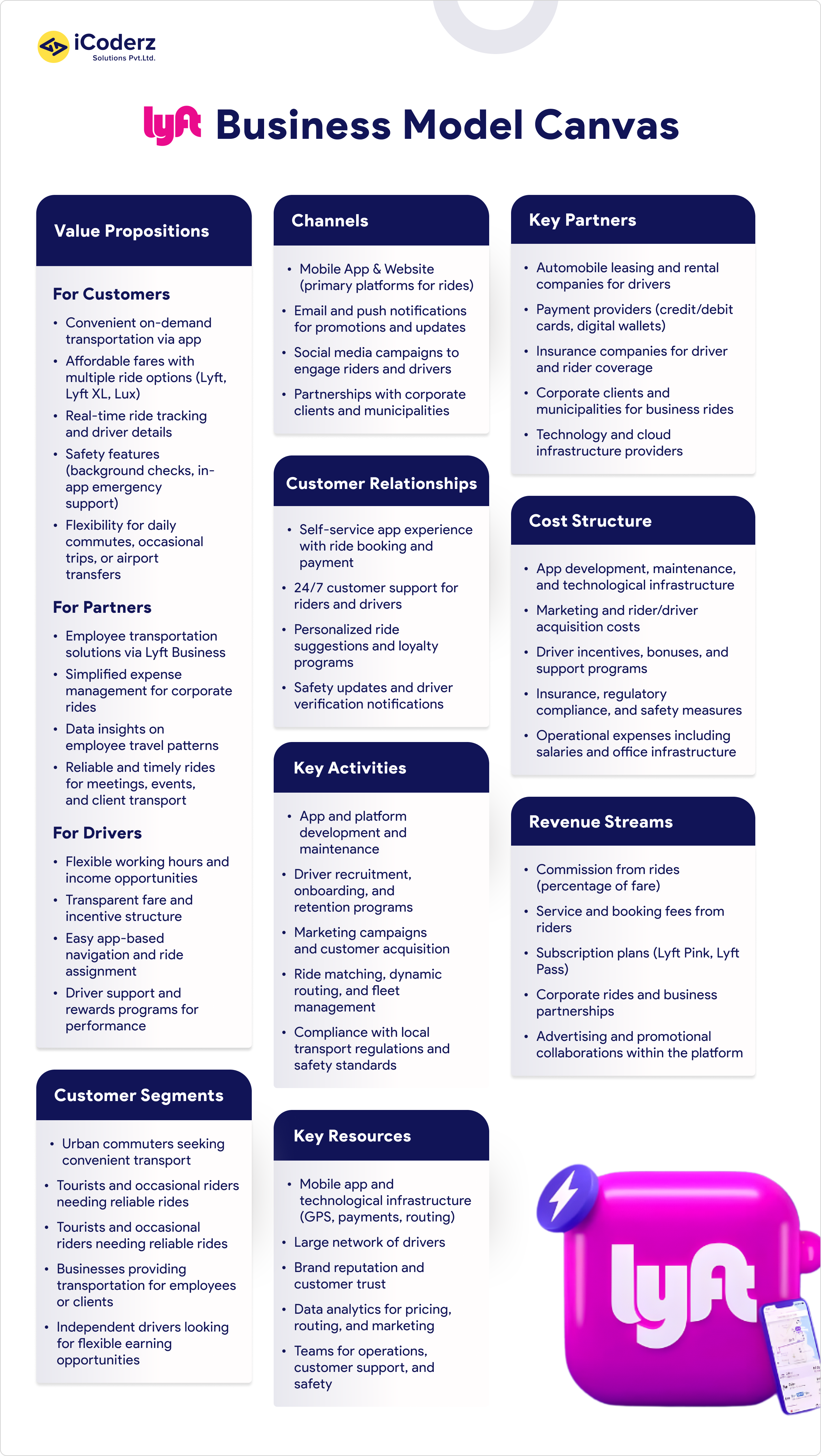
Customer Segments
Lyft targets three primary customer groups:
- Riders: Individuals who need safe, convenient, and affordable transportation. Riders include daily commuters, tourists, and occasional travellers. Lyft appeals to them through multiple ride options, flexible payment methods, and fast booking.
- Drivers: Independent contractors seeking flexible income. Lyft attracts drivers by offering incentives, bonuses, and a simple onboarding process, allowing them to choose when and where to work.
- Businesses: Companies that use Lyft for employee commuting, client transportation, or corporate travel programs. Lyft Business offers customised solutions, invoicing, and reporting features.
By segmenting its customers, Lyft can tailor services and promotions for each group, improving engagement and satisfaction.
Value Propositions
Lyft delivers specific value to each customer segment:
- For Riders:
- Convenient ride booking via a user-friendly app
- Multiple ride options like standard, Lux, and carpooling
- Cashless, secure payment experience
- Subscription perks via Lyft Pink for regular users
- Convenient ride booking via a user-friendly app
- For Drivers:
- Flexible earning opportunities without fixed schedules
- Incentives for high performance or peak hours
- Simple registration and support for onboarding
- Flexible earning opportunities without fixed schedules
- For Businesses:
- Reliable employee transportation with corporate tracking
- Customizable ride plans and billing solutions
- Easy integration with business travel programs
- Reliable employee transportation with corporate tracking
These value propositions ensure that Lyft addresses real pain points while encouraging repeat use and loyalty.
Channels
Lyft leverages multiple channels to reach and engage its customers:
- Mobile App: The primary interface for booking, payments, and ride tracking.
- Website: Provides account management, corporate solutions, and support.
- Partnerships: Collaborations with local businesses, events, and tourist organizations help attract new users.
By combining digital and partnership channels, Lyft maximizes its reach and ensures seamless customer experiences.
Customer Relationships
Lyft maintains strong relationships through:
- Self-service App: Riders can book, track, and pay for rides independently.
- Support Services: Dedicated help centers assist with issues such as lost items, fare disputes, or app problems.
- Loyalty Programs: Lyft Pink subscription encourages frequent riders with discounts, priority pickups, and exclusive perks.
Revenue Streams
Lyft generates revenue through multiple channels:
- Commission from Rides: A percentage of each fare is retained by Lyft, forming the main source of income.
- Subscriptions: Lyft Pink subscription provides steady recurring revenue while offering riders benefits.
- Corporate Partnerships: Lyft earns revenue from business clients using enterprise ride solutions.
- Advertising & Promotions: Partner brands can advertise within the app to reach riders.
This layered revenue approach ensures that Lyft is not dependent on a single income source.
Key Activities
Lyft’s operations revolve around:
- Developing and maintaining the mobile app and backend platform
- Recruiting and onboarding drivers while retaining high engagement
- Marketing to acquire new riders and promote loyalty programs
- Handling customer support and operational logistics
These activities are critical for maintaining platform efficiency and user satisfaction.
Key Resources
Lyft relies on several essential resources:
- Technology: Robust apps for riders and drivers, GPS routing, dynamic pricing algorithms
- Driver Network: A large, active pool of drivers ensures availability across cities
- Brand Reputation: Lyft is recognized as a reliable, safe, and innovative ride-sharing service
- Data Analytics: Insights from user behavior help improve matching, pricing, and personalized offers
Key Partnerships
Lyft collaborates with:
- Vehicle owners and fleet operators to increase ride availability
- Payment providers to facilitate secure transactions
- Local governments to comply with regulations
- Businesses and event organizers to expand user base
Partnerships reduce operational risks, expand reach, and enhance service quality.
Cost Structure
Lyft incurs costs in multiple areas:
- Driver Payouts: The largest expense, as drivers receive most of the ride fares
- Technology Development: Continuous investment in apps, algorithms, and platform security
- Marketing & Promotion: Campaigns to attract riders and drivers
- Insurance & Operations: Covering liabilities and ensuring smooth daily operations
By carefully managing costs while growing its platform, Lyft ensures sustainability and profitability.
For example, Lyft has also expanded into healthcare partnerships, allowing providers to book rides for patients through its Concierge program. This trend shows how companies like Uber and Lyft are stretching into the healthcare market, opening up new opportunities for startups to innovate in specialised mobility solutions.
What Makes Lyft’s Two-Sided Marketplace Work?
The Lyft two sided marketplace only functions if both sides — supply (drivers) and demand (riders) — stay balanced.
Rider acquisition relies on convenience, competitive pricing, and promotions. Driver acquisition depends on flexible earning potential and low barriers to entry. Matching supply and demand is handled algorithmically, routing requests to the nearest available driver in real time.
Lyft network effects kick in as the platform grows: more drivers mean shorter wait times, which attracts more riders, which in turn attracts more drivers. Combined with trust, ratings, and safety systems, this creates a self-reinforcing loop. Dynamic pricing helps rebalance the marketplace during high-demand periods by nudging more drivers online when needed.
Lyft’s Key Business Model Strategies
Lyft’s strategic playbook includes several deliberate moves:
- Building a large driver network to reduce wait times
- Improving rider convenience through app UX and pricing transparency
- Expanding beyond traditional ride-hailing into rentals and business travel
- Creating multiple revenue streams instead of relying solely on commissions
- Building recurring revenue through subscriptions
- Using technology to improve marketplace efficiency and reduce idle time
This is the essence of Lyft’s competitive strategy and ongoing business model innovation — constantly layering new value on top of a proven core loop.
Lyft vs Uber Business Model
A factual, side-by-side look at the Lyft vs Uber business model:
| Factor | Lyft | Uber |
| Core marketplace | Ride-hailing/mobility | Mobility + broader delivery ecosystem |
| Primary users | Riders & drivers | Riders, drivers & delivery users |
| Revenue model | Service fees, commissions & other streams | Service fees, commissions & other streams |
| Business services | Yes | Yes |
| Additional services | Mobility-related offerings | Mobility and delivery-related offerings |
Similarities: Both run on commission-driven, two-sided marketplace models with dynamic pricing and driver networks.
Differences: Uber has diversified more aggressively into adjacent categories like food delivery, while Lyft has stayed closer to its core mobility focus, particularly in North America.
What entrepreneurs can learn: There’s no single “correct” path — a focused model (Lyft) and a diversified model (Uber) can both work, depending on your resources, market, and long-term vision.
What Can Startups Learn From Lyft’s Business Model?
This is where the lessons from Lyft business model become directly actionable.
- Solve a clear marketplace problem — don’t build a platform looking for a problem.
- Focus on both sides of the marketplace equally; neglecting drivers or riders breaks the loop.
- Make the user journey simple — five steps, no friction, no confusion.
- Build multiple monetization channels rather than depending on one fee type.
- Use technology to scale operations without proportionally scaling headcount.
- Focus on trust and user experience through ratings, safety, and transparency.
- Start with one market before expanding to avoid spreading resources too thin.
- Build for supply-demand balance from day one, not as an afterthought.
These principles apply well beyond ride-sharing — any Lyft business model for startups or entrepreneurs building marketplace products can borrow this framework directly.
How to Build a Business Like Lyft
Turning inspiration into execution involves a few concrete decisions:
- Define your target market — a city, region, or niche segment (corporate travel, rural areas, etc.)
- Choose your business model — pure marketplace, hybrid, or asset-owning
- Decide your revenue model — commissions, subscriptions, or a blend
- Build the rider app — booking, tracking, payments
- Build the driver app — requests, navigation, earnings
- Develop the admin panel — for oversight and operations
- Integrate maps, payments, notifications, and tracking
- Launch an MVP in a single market
- Test and scale based on real usage data
For businesses considering a lighter-weight entry point, a white-label taxi app can shortcut much of this build process.
Essential Features of a Lyft-Like App
Rider App: registration, ride booking, fare estimation, real-time tracking, multiple payment options, ride history, ratings and reviews.
Driver App: driver registration, document verification, ride requests, navigation, earnings tracking, ride history.
Admin Panel: user management, driver management, ride management, pricing management, payment management, reports and analytics.
How Much Does It Cost to Build a Lyft-Like App?
Costs vary significantly based on:
- App platforms (iOS, Android, or both)
- Number of apps (rider, driver, admin)
- Feature complexity
- UI/UX design depth
- Backend infrastructure
- Third-party integrations (maps, payments, notifications)
- Admin panel sophistication
- Development team location and rates
- Ongoing maintenance and updates
For a detailed cost breakdown, see this guide on taxi booking app development cost.
Lyft-Like App Development: Technology and Integrations
A functioning ride-sharing platform depends on several integrated systems: GPS and mapping, real-time location tracking, payment gateways, push notifications, cloud infrastructure, analytics, authentication, and in-app driver/rider communication. Getting these integrations right early avoids costly rework later — something covered in this piece on cab booking software.
Common Challenges in Building a Ride-Sharing Business
- Acquiring drivers
- Acquiring riders
- Balancing supply and demand
- Pricing competition
- User trust and safety
- Payment and fraud management
- Scaling geographically
- Customer support
- Regulatory requirements
Many of these challenges are amplified for businesses targeting local or regional markets — explored further in this guide on taxi app development for local cab businesses.
Final Takeaways: Lessons From Lyft for Entrepreneurs
The Lyft business model explained in simple terms comes down to a few durable principles:
- Build a marketplace that creates value for both sides
- Keep the core user journey simple
- Develop multiple monetization channels
- Use technology to manage complex, real-time operations
- Focus on trust and long-term retention
- Validate the model with an MVP before scaling geographically
Looking ahead, models like Lyft’s continue to evolve — for more context on where the industry is headed, see the future of ride-hailing apps like Uber, Ola, and Lyft.
Thinking about building a ride-sharing or on-demand mobility platform of your own? iCoderz Solutions helps startups and businesses design, develop, and scale marketplace apps — from MVP to full-scale platform. Explore our on-demand taxi booking app solutions to see how we can help bring your idea to life.
Start Applying Lyft’s Lessons Today
Gain practical insights from our Lyft Business Model Analysis and take your entrepreneurial journey to the next level.

FAQs About Lyft’s Business Model
What is Lyft’s business model?
Lyft operates a two-sided marketplace connecting riders and drivers through a mobile app, earning revenue mainly through service fees and commissions on rides.
How does Lyft make money?
Lyft earns through ride commissions, service fees, subscriptions, advertising, business accounts, and rental services.
What are Lyft’s main revenue streams?
Service fees and commissions, subscriptions, advertising, Lyft Business, and rentals/other mobility services.
Is Lyft a two-sided marketplace?
Yes — it connects riders (demand) and drivers (supply) through a shared technology platform.
What is Lyft’s business model canvas?
It maps Lyft’s customer segments, value proposition, channels, revenue streams, key resources, activities, partners, and cost structure into one visual framework.
How does Lyft make money from drivers?
Indirectly — Lyft takes a commission or service fee from the fare drivers earn on completed rides.
How does Lyft’s ride-sharing model work?
Riders request trips through the app, Lyft’s algorithm matches them with nearby drivers, and payment is processed automatically after the ride.
What can startups learn from Lyft?
To build multi-sided marketplaces with simple user journeys, diversified revenue, and strong trust mechanisms from day one.
How much does it cost to build an app like Lyft?
Costs depend on features, platforms, and complexity, typically ranging from tens of thousands to several hundred thousand dollars for a full-featured platform.
How do I start a Lyft-like business?
Define your market, choose a business and revenue model, build rider/driver/admin apps, integrate core technologies, and launch an MVP before scaling.