The on-demand fuel delivery industry is growing fast as drivers, fleets, and businesses look for a faster way to refuel without visiting a gas station. For entrepreneurs, this shift has opened the door to a genuinely scalable, tech-driven business.
A clear fuel delivery app business model is the foundation of that opportunity; it tells you who you’re serving, how fuel reaches them, and how your startup actually makes money. Understanding this model matters more than the app itself, because even great technology fails without a sound business structure behind it.
This guide walks through how fuel delivery apps work, the different business models available, revenue streams, must-have features, tech stack, development costs, legal requirements, and the steps to launch, everything a startup founder needs before building.
What Is a Fuel Delivery App Business Model?
A fuel delivery app business model is the framework that defines how a startup sources fuel, delivers it to customers on demand, and generates revenue, instead of requiring customers to visit a physical station.
Unlike traditional fuel stations, delivery startups don’t need real estate or storage infrastructure; they coordinate between suppliers, mobile tankers, and customers through an app.
Key stakeholders include:
- Customers (individuals, fleets, businesses)
- Fuel suppliers/depots
- Delivery drivers with certified tankers
- The platform operator (the startup)
Common business types range from consumer-focused apps to B2B fleet refueling and franchise-based delivery networks. If you’re weighing whether this model fits your market, this breakdown of how startups have built a fuel delivery app is a useful starting point.
Why Startups Should Invest in Fuel Delivery Apps
- Growing demand for doorstep fuel delivery among busy professionals and fleet operators
- Convenience-driven adoption — no waiting in line at stations
- Recurring revenue through subscriptions and fleet contracts
- Lower overhead than opening new physical stations
- Untapped markets in suburban and semi-urban areas still underserved
This mix of low infrastructure cost and high customer convenience is why more startups are exploring fuel delivery app development as their entry into the on-demand economy.
How Does a Fuel Delivery App Work?
Customer Places an Order — The user selects fuel type, quantity, and delivery location through the app.
Fuel Supplier Receives the Request — The order is routed to the nearest verified fuel depot or partner.
Driver Accepts the Delivery — A certified driver with a mobile tanker accepts and heads to the location.
Live GPS Tracking — Customers track the driver’s route and estimated arrival in real time, powered by the same gps tracking in fuel delivery app systems used across the industry.
Secure Payment Processing — Payment is captured through integrated digital gateways.
Fuel Delivered to Customer — The driver dispenses fuel safely and confirms delivery in-app.
Key Components of a Successful Fuel Delivery Business Model
| Component | Purpose |
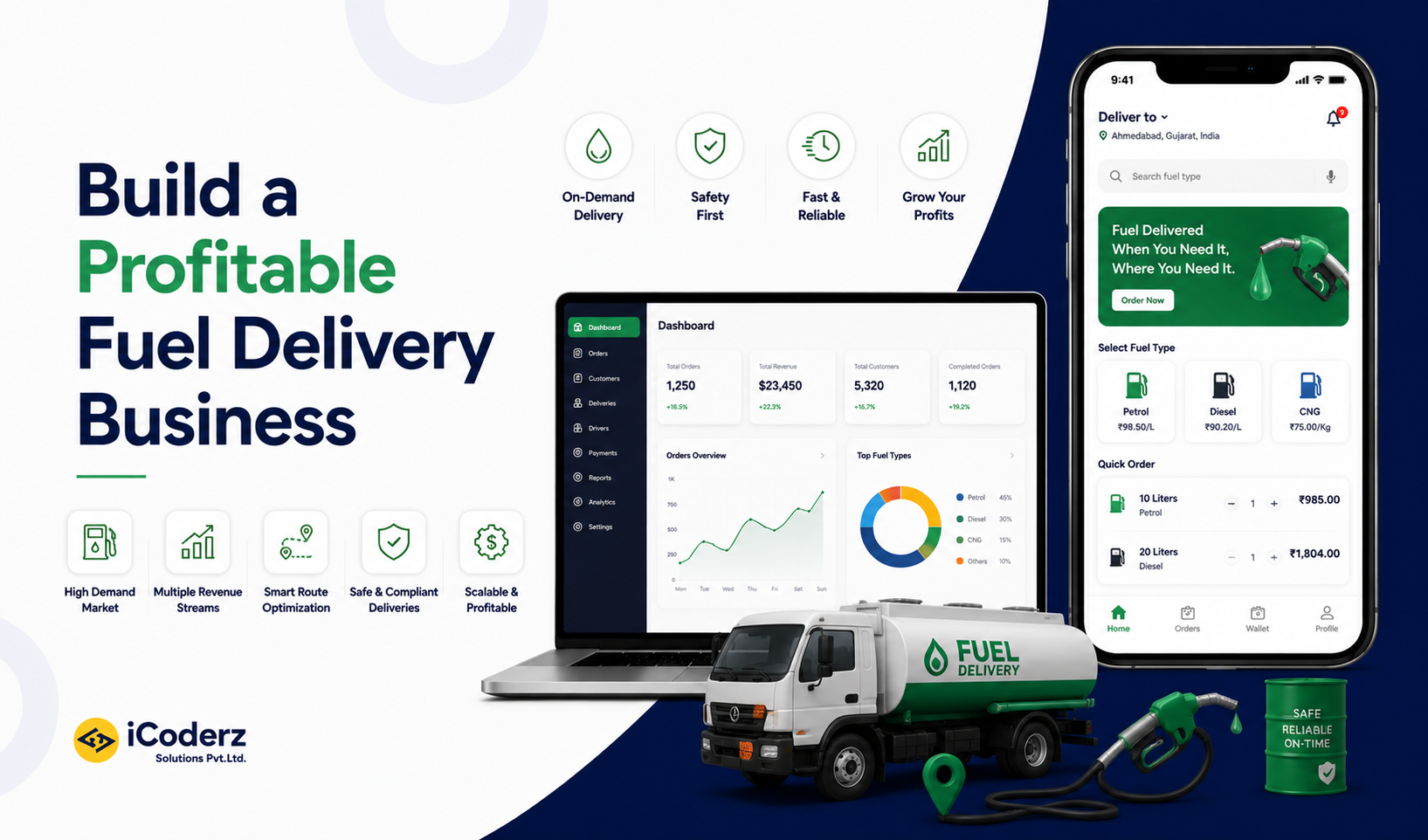
| Customer Mobile App | Order placement, tracking, payments |
| Driver App | Route navigation, order management |
| Admin Dashboard | Operations, pricing, fleet oversight |
| Fuel Inventory Management | Real-time stock and supplier sync |
| Route Optimization | Faster, cost-efficient deliveries |
| Payment Gateway | Secure, multi-option transactions |
| Analytics & Reporting | Demand forecasting, performance tracking |
These components come together in real products; platforms similar to this app like ezfill case study show how each piece connects in a live business.
Different Fuel Delivery Business Models
- B2C (Business to Consumer): Individual customers ordering fuel for personal vehicles
- B2B (Business to Business): Serving corporate clients and commercial vehicle owners
- Fleet Fuel Delivery: Scheduled refueling for logistics and transport fleets
- Subscription-Based Fuel Delivery: Recurring refueling plans for predictable revenue
- Marketplace Model: Connecting multiple fuel suppliers with customers on one platform
- Franchise Model: Licensing the business to regional operators for faster expansion
For a real-world example of how these models play out, see this booster fuel delivery business model case study.
Business Model Comparison
| Model | Target Audience | Investment | Scalability | Revenue Potential | Best For |
| B2C | Individual drivers | Moderate | High | Steady | Urban startups |
| B2B | Companies | High | Moderate | High | Established players |
| Fleet | Logistics firms | High | Moderate | Very High | Enterprise-focused startups |
| Subscription | Regular users | Moderate | High | Recurring | Customer retention |
| Marketplace | Suppliers + users | High | Very High | Commission-based | Aggregator startups |
| Franchise | Regional operators | Low (per unit) | Very High | Licensing fees | Rapid expansion |
Fuel Delivery App Revenue Model: How Startups Make Money
- Delivery charges per order
- Fuel margin on wholesale-to-retail pricing
- Subscription plans for recurring customers
- Fleet contracts with businesses
- Convenience fees for urgent/off-hour delivery
- Premium membership with added perks
- Advertising & promotions from partner brands
- Commission from fuel partners on each transaction
A diversified fuel delivery revenue model, mixing one-time fees with recurring income, is what makes these businesses genuinely investable. Looking at how the best fuel delivery apps monetize can help you benchmark your own pricing strategy.
Essential Fuel Delivery App Features
Customer Features: registration, fuel selection, real-time tracking, multiple payment options, delivery scheduling, order history, ratings & reviews
Driver Features: route navigation, order management, delivery verification, earnings dashboard
Admin Features: user management, fleet management, fuel inventory, pricing control, reports & analytics, CRM integration
A full breakdown of must-have functionality is covered in this guide to features of delivery app development.
Technology Stack for Fuel Delivery App Development
| Layer | Common Technologies |
| Frontend | React Native, Flutter |
| Backend | Node.js, Django, Ruby on Rails |
| Database | PostgreSQL, MongoDB |
| Cloud | AWS, Google Cloud, Azure |
| Maps & Navigation | Google Maps API, Mapbox |
| Payment Gateways | Stripe, Razorpay, PayPal |
| Notifications | Firebase Cloud Messaging, Twilio |
| Security | SSL encryption, OAuth 2.0, data tokenization |
For a deeper technical breakdown, see this guide on fuel delivery app tech stack selection.
Fuel Delivery App Development Cost
Costs depend on the factors affecting cost: app complexity, number of platforms, third-party integrations, and team location.
MVP vs Full-Scale Platform: An MVP focuses on core ordering and tracking, while a full platform adds analytics, loyalty programs, and multi-role dashboards.
Team structure typically includes project managers, UI/UX designers, developers, and QA engineers.
Estimated Cost Breakdown
| Solution Type | Features | Estimated Cost Range |
| Basic (MVP) | Core ordering, tracking, payments | $8,000–$15,000 |
| Standard | Admin panel, driver app, analytics | $15,000–$35,000 |
| Enterprise | Multi-city, AI features, integrations | $35,000+ |
Get a detailed estimate in this breakdown of cost to develop a fuel delivery app.
Legal Requirements and Compliance for Fuel Delivery Businesses
- Fuel transportation regulations specific to your region
- Business and fuel-handling licensing requirements
- Safety standards for tanker vehicles and drivers
- Environmental compliance for spill prevention and emissions
- Insurance coverage for vehicles, drivers, and liability
- Regional regulations that vary by state or country
Compliance isn’t optional; review fuel delivery business regulations early in your planning process.
Challenges in Running a Fuel Delivery Startup (and How to Overcome Them)
- Regulatory compliance — work with legal experts from day one
- Logistics management — use route optimization software
- Customer trust — build transparency through tracking and verified drivers
- Fleet optimization — invest in predictive scheduling
- Fuel quality assurance — partner only with certified suppliers
- Operational costs — automate wherever possible to control margins
Safety-specific concerns are covered in this guide to fuel delivery app safety and compliance.
Step-by-Step Guide to Starting a Fuel Delivery Business
- Conduct market research to validate demand
- Choose your business model (B2C, B2B, fleet, etc.)
- Create a detailed business plan
- Obtain the required licenses
- Partner with reliable fuel suppliers
- Develop a fuel delivery app with core features
- Build your delivery fleet
- Launch and market your business
Best Practices for Scaling a Fuel Delivery Startup
- Automate operations end-to-end
- Expand into new service locations gradually
- Build strategic partnerships with suppliers and fleets
- Introduce subscription plans for retention
- Use ai in fuel delivery app development for smarter route optimization
- Focus on customer retention over pure acquisition
Future Trends in Fuel Delivery App Development
- AI-powered demand forecasting
- IoT-enabled fuel monitoring in tankers
- EV charging integration alongside fuel delivery, see fuel delivery vs ev charging
- Predictive analytics for supply planning
- Contactless fuel delivery options
- Drone and autonomous delivery (emerging outlook)
- Sustainability initiatives across fleets
Why Choose iCoderz for Fuel Delivery App Development
iCoderz Solutions brings hands-on experience building on-demand platforms, including custom and white-label fuel delivery solutions. Our approach covers:
- Proven experience in on-demand app development
- Custom and white-label solutions tailored to your model
- Scalable architecture built for multi-city expansion
- Advanced security across payments and user data
- End-to-end development, from MVP to full platform
- Post-launch maintenance and continuous upgrades
From MVP to enterprise-grade platforms, our team has helped startups turn a fuel delivery idea into a fully operational, revenue-generating business.
Conclusion
A successful fuel delivery app business model for startups rests on three pillars: the right revenue model, a reliable technology stack, and a business strategy grounded in real market demand. Whether you choose B2C, B2B, subscription, or marketplace, the fundamentals, compliance, trust, and operational efficiency, stay the same.
Start with a lean MVP, validate demand in your target region, and scale based on real customer feedback rather than assumptions. Building a fuel delivery startup is achievable with the right technology partner by your side.
Ready to launch your fuel delivery startup? Consult iCoderz Solutions for custom fuel delivery app development built around your business model.
Build a Profitable Fuel Delivery Business
Partner with our experts to create a secure, scalable, and feature-rich fuel delivery app tailored to your business goals.

Frequently Asked Questions (FAQs)
What is a fuel delivery app business model?
It’s the framework defining how a startup sources fuel, delivers it via mobile tankers, and generates revenue through delivery fees, margins, subscriptions, or commissions, without relying on a physical fuel station.
Is a fuel delivery business profitable?
Yes, when it combines multiple revenue streams like delivery fees, fuel margins, and subscriptions, while keeping logistics and fleet costs optimized through route planning and automation.
How much does it cost to build a fuel delivery app?
Costs typically range from $8,000 for a basic MVP to $35,000+ for an enterprise-grade platform, depending on features, integrations, and team structure.
How long does it take to develop a fuel delivery app?
An MVP usually takes 8–12 weeks, while a full-scale platform with advanced features can take 4–6 months depending on complexity.
What licences are required to start a fuel delivery business?
Requirements vary by region but generally include a fuel handling license, transportation permits, business registration, and insurance coverage for vehicles and liability.
What features should a fuel delivery app include?
Core features include order placement, real-time GPS tracking, secure payments, delivery scheduling, driver management, and an admin dashboard for operations and analytics.
Which revenue model is best for fuel delivery startups?
Most successful startups combine delivery charges, fuel margins, and subscription plans rather than relying on a single revenue stream, which improves both cash flow and customer retention.
How can startups attract customers to a fuel delivery app?
Offering first-order discounts, subscription perks, referral programs, and reliable delivery times helps build early trust and repeat usage.
Can I launch a fuel delivery app with an MVP?
Yes, an MVP with core ordering, tracking, and payment features lets startups test demand and gather feedback before investing in a full-scale platform.
Why should I hire a fuel delivery app development company?
A specialized development company brings experience with fuel-industry compliance, route optimization, and secure payment integration, reducing risk and speeding up time to market.