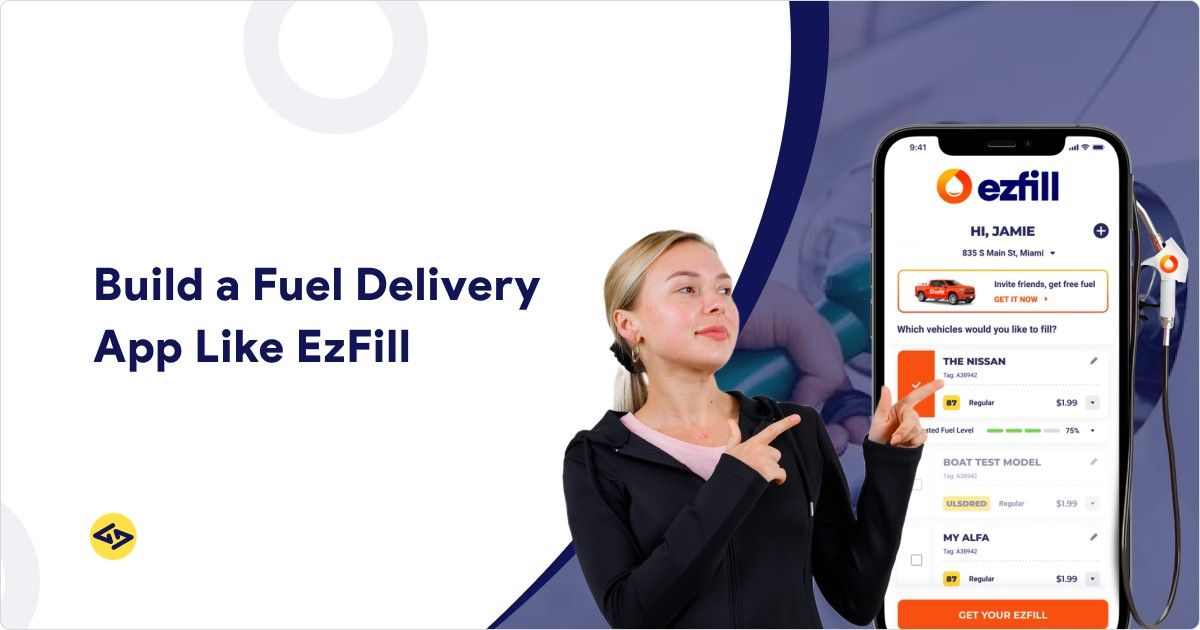
The way people refuel their vehicles is changing — fast. Mobile fuel delivery apps like EzFill are turning a traditional, time-consuming task into a seamless on-demand experience. If you’ve ever sat in a long queue at a gas station and thought, “there has to be a better way,” you’re already thinking like a fuel delivery entrepreneur.
This guide covers everything you need to know about building a mobile fuel delivery app like EzFill — from features and technology to development cost and launch strategy.
What Is a Mobile Fuel Delivery App?
A mobile fuel delivery app is an on-demand platform that allows users to order fuel directly to their location — home, office, or parking lot — using a smartphone. Think of it as Uber, but for gasoline.
Three key stakeholders power the platform:
- Customers who place fuel orders through the app
- Fuel delivery drivers who fulfill those orders
- Business administrators who manage operations, pricing, and analytics
Apps like EzFill have proven this model works at scale, and the opportunity is wide open for new players. Learn more about what a fuel delivery app is and how it works.
Understanding the EzFill Business Model
How EzFill Works
EzFill follows a simple but effective on-demand delivery process:
- The customer opens the app and selects fuel type and quantity
- They schedule delivery at a convenient time
- A driver picks up the fuel from a certified supplier
- Real-time GPS tracking keeps the customer informed
- Payment is processed securely in-app — no cash, no hassle
Why the Model Is Successful
The EzFill model succeeds because it solves a real pain point. Key advantages include:
- Convenience: Fuel comes to you — no detours, no waiting
- Time savings: Especially valuable for busy professionals and families
- Fleet fueling: Businesses can fuel entire vehicle fleets overnight
- Contactless delivery: A major plus in a post-pandemic world
Want to understand how a similar app operates? Read our breakdown of the Booster fuel delivery business model.
Market Opportunity for Fuel Delivery Apps
The on-demand fuel delivery market is growing steadily. Here’s why now is the right time to invest:
- The global on-demand fuel delivery market is projected to reach billions in value by 2030
- Mobile commerce is mainstream — consumers now expect everything delivered
- Commercial fleet operators are actively seeking automated fueling solutions
- Rising urban density makes doorstep fuel delivery logistically feasible
Entrepreneurs looking to start a fuel delivery business are entering a market with strong demand and relatively few established players outside major metro areas.
Must-Have Features of a Mobile Fuel Delivery App Like EzFill
Getting the feature set right is critical. Here’s what each component of your platform needs.
Customer App Features
- User registration and login (email, phone, or social login)
- Fuel type and quantity selection (regular, premium, diesel)
- Live order tracking via GPS map
- In-app payments (credit/debit card, digital wallets)
- Flexible delivery scheduling (now or later)
- Order history and receipts
- Push notifications for order status updates
Driver App Features
- Optimized delivery routes with turn-by-turn navigation
- Order management dashboard (accept, update, complete)
- Google Maps or Waze integration
- Earnings tracker
- Real-time order status updates
Admin Panel Features
- User and driver management
- Fuel inventory monitoring
- Order management and dispatch
- Analytics and reporting dashboard
- Dynamic pricing controls
For a detailed breakdown of all essential features, see our guide on fuel delivery app features.
Advanced Features to Differentiate Your Fuel Delivery App
Basic features get you to market. Advanced features help you dominate it:
- AI-powered route optimization — reduces delivery time and fuel cost
- Fleet management tools — ideal for B2B clients with multiple vehicles
- Subscription-based delivery plans — predictable revenue for your business
- Predictive fuel demand analytics — anticipate spikes before they happen
- IoT-enabled fuel tank monitoring — real-time tank level alerts for commercial customers
- Loyalty and rewards programs — retain users and increase repeat orders
These features are what separate a good fuel delivery app from a great one. Explore how these differ from EV charging app development if you’re considering future-proofing your platform.
Technology Stack Required for Fuel Delivery App Development
Choosing the right fuel delivery app technology stack is a foundational decision. Here’s what most professional teams use:
Frontend (Mobile App)
- Flutter — single codebase for iOS and Android
- React Native — popular for cross-platform performance
Backend
- Node.js — ideal for real-time applications
- Laravel (PHP) — robust and scalable
- Python (Django/FastAPI) — great for ML-powered features
Database
- PostgreSQL or MySQL — for structured transactional data
- MongoDB — for flexible, high-volume data
Third-Party Integrations
- Payments: Stripe, Braintree, PayPal
- Maps and GPS: Google Maps API, Mapbox
- Notifications: Firebase, Twilio
- Analytics: Google Analytics, Mixpanel
For a deeper look, read our complete fuel delivery app tech stack guide.
Step-by-Step Fuel Delivery App Development Process
1. Market Research and Validation
Identify your target geography, competitors, pricing benchmarks, and regulatory requirements before writing a single line of code.
2. Business Model Planning
Decide: delivery fees, subscription tiers, B2C vs B2B, or hybrid. Define your unit economics early.
3. UI/UX Design
Design intuitive flows for all three apps (customer, driver, admin). Prioritize simplicity and speed.
4. MVP Development
Build a working version with core features only. Launch fast, learn faster.
5. Testing and QA
Run unit tests, load tests, GPS accuracy checks, and payment gateway testing before launch.
6. Deployment and Launch
Deploy on AWS or Google Cloud. Submit to App Store and Google Play.
7. Ongoing Maintenance and Updates
Plan for monthly updates, bug fixes, and feature releases based on user feedback.
For a complete walkthrough, see our guide on how to develop a fuel delivery app.
Cost to Build a Mobile Fuel Delivery App Like EzFill
The cost to build a fuel delivery app like EzFill depends on your feature scope, platform, and team location. Here’s a realistic breakdown:
| App Tier | Estimated Cost | What’s Included |
| Basic MVP | $15,000 – $30,000 | Core features, single platform, basic admin |
| Mid-Level | $30,000 – $60,000 | Both platforms, advanced features, integrations |
| Enterprise | $60,000 – $120,000+ | Custom AI, fleet tools, high scalability |
Key factors that affect development cost:
- Number and complexity of features
- iOS only, Android only, or both platforms
- Third-party API integrations (GPS, payments, IoT)
- Development team location (US vs South Asia vs Eastern Europe)
- Security, compliance, and data regulations in your region
Get a more precise estimate in our fuel delivery app development cost guide.
Challenges in Fuel Delivery App Development
Building a fuel delivery business app isn’t without its hurdles. Be prepared to address:
- Regulatory compliance: Fuel transportation has strict local, state, and federal rules
- Safety requirements: Drivers need certified tankers and hazmat protocols
- Real-time logistics: Managing ETAs accurately is technically complex
- Inventory tracking: Syncing digital orders with physical fuel stock requires precision
- Payment security: PCI DSS compliance is non-negotiable for any payment-enabled app
Working with an experienced fuel delivery app development company significantly reduces these risks.
Best Practices for Launching a Successful Fuel Delivery App
These principles separate successful launches from expensive failures:
- Start with an MVP — validate product-market fit before scaling
- Obsess over UX — a clunky app loses users in seconds
- Ensure regulatory compliance from day one — retrofitting is painful and costly
- Build reliable logistics operations — technology only works when the supply chain does
- Use data from day one — track every metric that matters: delivery time, cancellations, revenue per order
Check out the top fuel delivery apps currently leading the market for real-world inspiration.
Why Choose a Professional Fuel Delivery App Development Company
You could hire freelancers, or you could build with a team that’s done this before. Here’s why an experienced fuel delivery app development company makes the difference:
- Deep domain expertise in logistics, payments, and safety compliance
- Faster time-to-market with proven development frameworks
- Custom solutions tailored to your specific market and business model
- Ongoing support, maintenance, and scaling as your user base grows
- Accountability — a real team behind your product, not a solo contractor who disappears
iCoderz Solutions has helped multiple fuel and logistics startups build scalable on-demand platforms. Contact our team to discuss your project.
Conclusion
The on-demand economy has transformed food, groceries, and medicine delivery — fuel is next. Building a mobile fuel delivery app like EzFill is a significant but achievable investment, and the market window is still open for new entrants with the right product and execution.
Key takeaways before you begin:
- Validate your market and regulatory environment first
- Build an MVP before going full-scale
- Invest in UX — your app is your product
- Partner with an experienced development team to avoid costly mistakes
The future of fuel delivery is mobile, and the businesses that act now will own the market tomorrow.
Ready to build your fuel delivery app? Talk to the iCoderz team today and get a free project consultation.
Frequently Asked Questions
What is a mobile fuel delivery app?
A mobile fuel delivery app lets users order fuel to their location on-demand through a smartphone, eliminating the need to visit a gas station.
How does an app like EzFill make money?
Revenue comes from per-delivery service fees, subscription plans for regular users, B2B fleet fueling contracts, and surge pricing during peak demand.
How long does it take to build a fuel delivery app?
A basic MVP typically takes 3–5 months. A full-featured enterprise platform can take 8–12 months depending on complexity.
What technology is used to build fuel delivery apps?
Most apps use Flutter or React Native for mobile, Node.js or Laravel for backend, and integrate Google Maps, Stripe, and Firebase for core functionality.
Is fuel delivery legal in all states?
No. Fuel delivery regulations vary by state and municipality. Always consult local authorities and obtain necessary permits before launching.
What is the cost to build a fuel delivery app like EzFill?
Costs range from $15,000 for a basic MVP to over $120,000 for an enterprise-grade platform with fleet management, AI features, and IoT integration.
Can I white-label a fuel delivery app?
Yes. A white-label fuel delivery app is faster and cheaper to launch than custom development and can be rebranded for your market.
What features do I need for a fleet fueling app?
Fleet clients need bulk ordering, scheduled overnight delivery, centralized billing, and real-time fleet tracking — all manageable through an admin panel.
How do I handle payment security in a fuel delivery app?
Use PCI DSS-compliant payment gateways like Stripe or Braintree and never store raw card data on your servers.
Do I need separate apps for customers and drivers?
Yes. The customer app, driver app, and admin panel are typically three separate applications with different interfaces and permissions.