The grocery delivery market has exploded in recent years, with apps like Instacart, Gorillas, and BigBasket transforming how consumers shop for essentials. The global online grocery market size is expected to reach USD 992.35 billion by 2033, registering a CAGR of 36.8% from 2025 to 2033, according to a new report by Grand View Research, Inc.
But here’s the critical question every business owner faces: which technology should you use to build it?
Choosing the right tech stack can determine whether your app delivers seamless experiences or frustrates users with crashes and slow performance. This is exactly why use Flutter for grocery delivery app development has become a trending topic among startups and enterprises alike.
In this comprehensive guide, we’ll explore why Flutter has emerged as the best framework for grocery delivery app development, breaking down its benefits, real-world capabilities, and how it compares to alternatives. Whether you’re a startup founder or an enterprise CTO, you’ll walk away knowing exactly why Flutter deserves your attention.
What Is Flutter and Why Is It Popular for App Development?
Flutter is Google’s open-source UI toolkit that allows developers to build natively compiled applications for mobile, web, and desktop—all from a single codebase. Launched in 2017, it has rapidly become one of the most popular frameworks for mobile application development.
Why is Flutter so popular?
- Single Codebase: Write once, deploy on iOS and Android simultaneously
- Hot Reload: See code changes instantly without restarting the app
- Expressive UI: Create beautiful, customizable interfaces with pre-built widgets
- Google-Backed: Strong community support and continuous updates
- Growing Adoption: Used by companies like Alibaba, BMW, and eBay Motors
When considering Flutter for mobile app development, it’s worth noting that Flutter’s GitHub repository consistently ranks among the most active, with over 160,000 stars—demonstrating massive developer trust and adoption.
Key Business Challenges in Flutter for Grocery Delivery App Development
Before diving into Flutter’s advantages, let’s understand the unique challenges grocery delivery apps face:
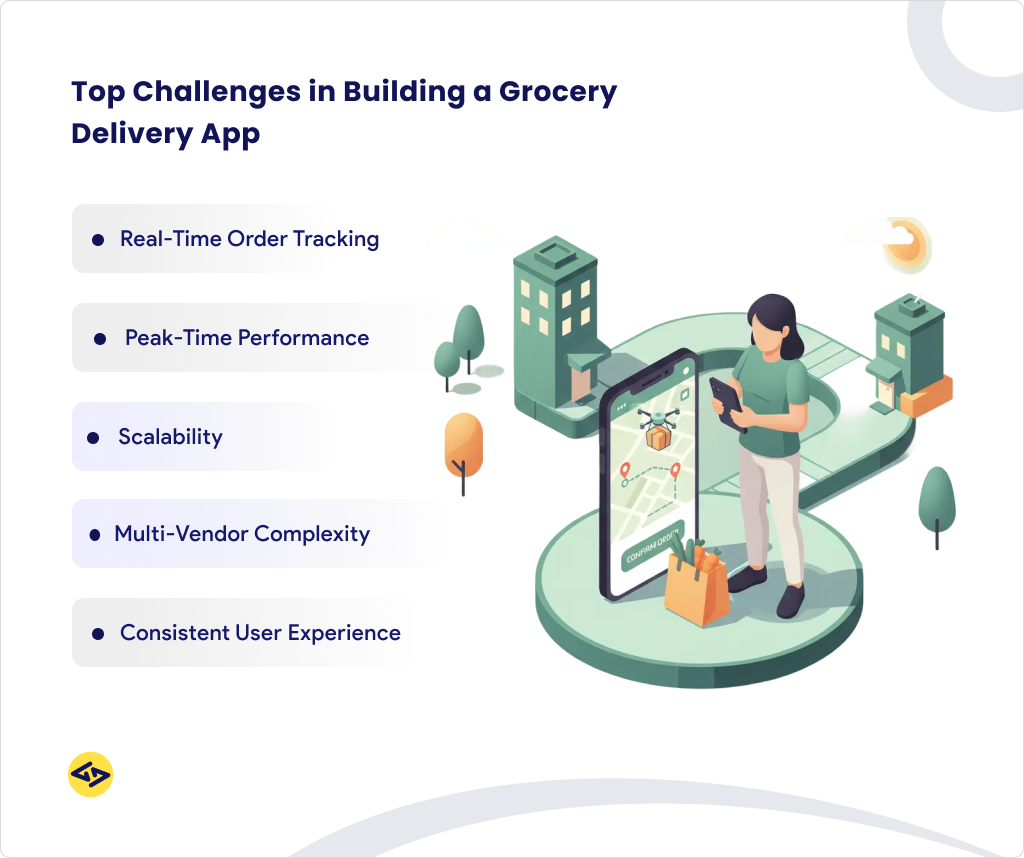
1. Real-Time Order Tracking
Customers expect live GPS tracking from store pickup to doorstep delivery—any lag destroys trust.
2. Performance During Peak Hours
Think Sunday mornings or holiday rushes. Your app must handle thousands of simultaneous orders without crashing.
3. Scalability Requirements
Starting with one city? Great. But your tech must scale when you expand to 50 cities.
4. Multi-Vendor Management
Managing multiple grocery stores, delivery partners, and inventory systems requires robust architecture.
5. UI/UX Consistency Across Devices
Your app must look and perform identically on a $200 Android phone and a $1,200 iPhone.
These challenges set the stage for understanding exactly why Flutter excels for grocery delivery apps.
Benefits of Flutter for Grocery App Development
The benefits of Flutter for grocery app development directly address every challenge mentioned above. Here’s how:
Faster Time-to-Market
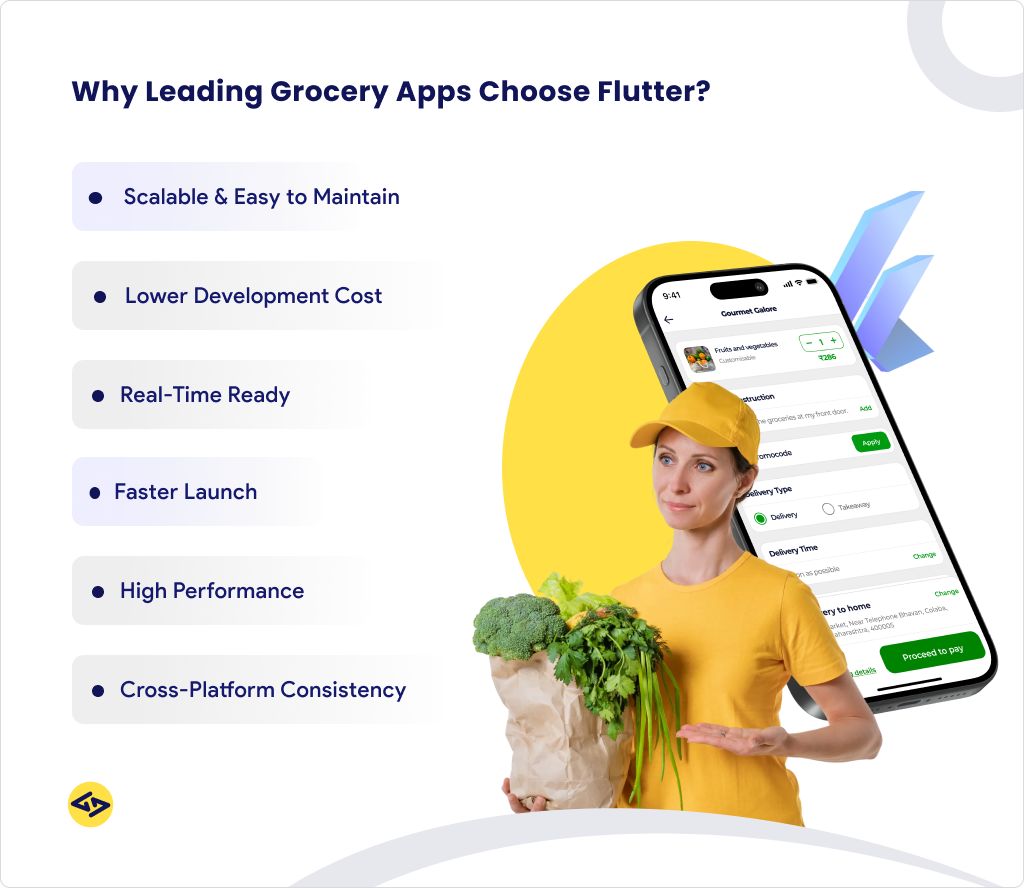
Flutter’s single codebase approach means your development team builds one app instead of two. Companies report 30-40% faster development cycles compared to building separate iOS and Android apps.
For grocery delivery startups racing against competitors, this speed advantage is invaluable. Apps like Nubank and Reflectly credit Flutter for helping them launch quickly without sacrificing quality.
High Performance & Smooth UI
Flutter performance for grocery delivery apps is exceptional because Flutter compiles directly to native ARM code—no JavaScript bridge slowing things down.
The result? Smooth 60fps animations, instant screen transitions, and responsive interfaces that feel native. For grocery apps where users scroll through hundreds of products, this performance is non-negotiable.
Cross-Platform Development
With Flutter, your cross-platform app development investment delivers pixel-perfect consistency across platforms. Your Android users in Mumbai and iPhone users in New York experience the exact same interface—strengthening brand identity.
Real-Time Capabilities
Flutter integrates seamlessly with Firebase, WebSockets, and streaming APIs—making Flutter for real-time delivery apps a natural fit. Whether it’s live location tracking, order status updates, or inventory synchronization, Flutter handles real-time data effortlessly.
Cost Efficiency
Building one codebase instead of two can reduce development costs by up to 50%. For grocery startups watching their runway, this cost efficiency makes Flutter incredibly attractive for MVP development.
Easy Maintenance & Scalability
Flutter scalability for grocery apps stems from its clean architecture and modular design. When you need to add new features—like subscription boxes or same-hour delivery—Flutter’s widget-based structure makes updates manageable.
One codebase also means one team maintaining everything, reducing long-term operational costs.
Can Flutter Handle Real-Time Tracking and Large-Scale Traffic?
Short answer: Absolutely yes.
Let’s address two common concerns directly:
Can Flutter Handle Real-Time Tracking for Grocery Apps?
Flutter excels at real-time functionality through:
- Google Maps Integration: Flutter’s official Google Maps plugin provides smooth, accurate GPS tracking
- Firebase Realtime Database: Synchronizes data across devices in milliseconds
- WebSocket Support: Enables persistent connections for live order updates
- Push Notifications: Firebase Cloud Messaging integrates natively for instant alerts
Apps like Grab (Southeast Asia’s super app) use Flutter for real-time ride and delivery tracking at massive scale—proving Flutter’s real-time capabilities.
Is Flutter Suitable for Large-Scale Grocery Apps?
Flutter handles enterprise-scale traffic because performance bottlenecks typically occur at the backend, not the frontend framework. Flutter apps have served millions of users:
- Alibaba’s Xianyu: 50+ million users on Flutter
- Google Pay India: Millions of daily transactions
- Nubank: 40+ million customers in Latin America
With proper backend architecture (which we’ll cover shortly), Flutter multi-vendor grocery app development scales reliably to millions of users.
Flutter vs Other Technologies for Grocery Delivery Apps
Choosing between frameworks? Here’s an honest comparison:
Flutter vs React Native for Grocery Delivery App
| Factor | Flutter | React Native |
| Performance | Native compilation, 60fps | JavaScript bridge, slightly slower |
| UI Consistency | Pixel-perfect across platforms | Platform-specific components |
| Learning Curve | Dart (newer but simpler) | JavaScript (more familiar) |
| Hot Reload | Excellent | Good |
| Community | Growing rapidly | Established and large |
| Ideal For | Performance-critical apps | Teams with JavaScript expertise |
Verdict: For grocery apps requiring smooth scrolling, real-time updates, and consistent UI, Flutter typically edges ahead. However, if your team already excels at JavaScript, React Native app development remains viable.
Flutter vs Native (Swift/Kotlin)
| Factor | Flutter | Native (Swift/Kotlin) |
| Development Time | Single codebase = faster | Two codebases = slower |
| Cost | Lower (one team) | Higher (two specialized teams) |
| Performance | Near-native | Maximum native performance |
| Platform Features | Excellent plugin ecosystem | Full platform access |
| Maintenance | Easier | More complex |
Verdict: For grocery apps, the performance difference is negligible for most use cases. Flutter vs native for grocery app development typically favors Flutter unless you require highly specialized platform features.
For teams specifically considering Swift app development or Kotlin development, weigh the 40-50% cost savings Flutter offers against any iOS/Android-specific requirements.
Best Tech Stack for Grocery Delivery App with Flutter
The best tech stack for a grocery delivery app combines Flutter’s frontend capabilities with a robust backend:
| Layer | Recommended Technologies |
| Frontend | Flutter (Dart) |
| Backend | Node.js, Laravel, or Django |
| Database | PostgreSQL, Firebase Firestore, MongoDB |
| Real-Time | Firebase Realtime DB, Socket.io |
| Maps & Location | Google Maps API, Mapbox |
| Payments | Stripe, Razorpay, PayPal SDK |
| Notifications | Firebase Cloud Messaging |
| Cloud Hosting | AWS, Google Cloud, Azure |
This stack powers successful on-demand grocery delivery apps with reliability and scalability.
How to Build a Grocery Delivery App Using Flutter (Step-by-Step)
Here’s how to build a grocery delivery app using Flutter:
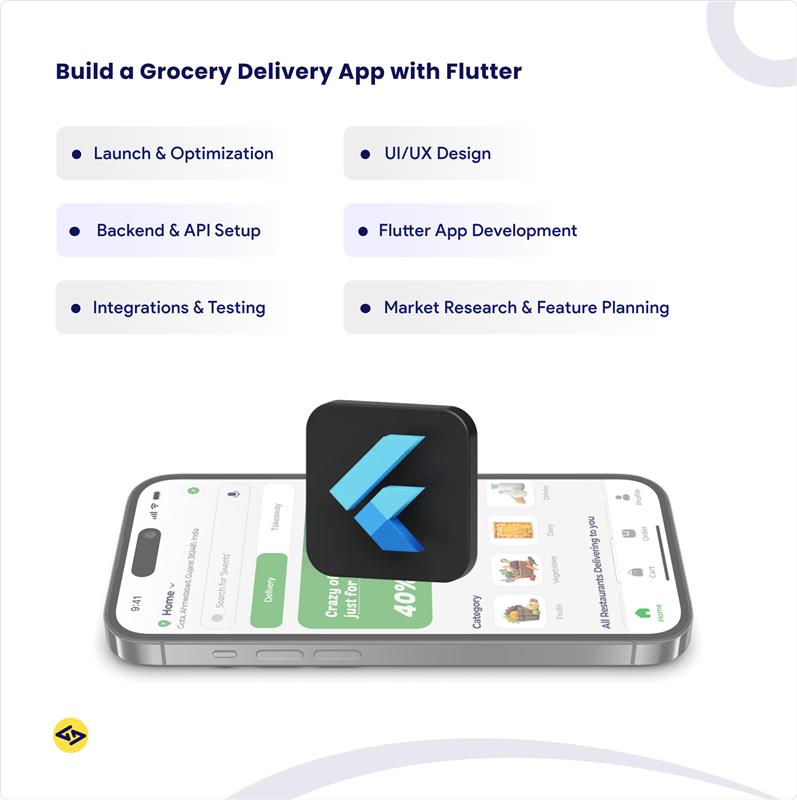
Step 1: Market Research & Feature Planning
Identify your target market, competitor gaps, and must-have features (product catalog, cart, payments, tracking, ratings).
Step 2: UI/UX Design
Create wireframes and prototypes focusing on intuitive navigation—grocery apps live or die by their usability.
Step 3: Backend & API Setup
Build your server infrastructure, database, and API endpoints for products, orders, users, and delivery management.
Step 4: Flutter Development
Develop your Flutter app with modular architecture—separate customer, delivery partner, and admin panels if needed.
Step 5: Integration & Testing
Integrate payment gateways, maps, and notifications. Conduct thorough QA across devices.
Step 6: Launch & Optimization
Deploy to app stores, gather user feedback, and iterate continuously.
Partnering with an experienced Flutter app development team can accelerate this process significantly.
Cost of Developing a Grocery Delivery App with Flutter
Flutter grocery app development cost varies based on complexity:
| App Type | Features | Estimated Cost |
| Basic MVP | Core features, single platform | $15,000 – $30,000 |
| Mid-Range App | Advanced features, multi-vendor | $30,000 – $70,000 |
| Enterprise Solution | Full-featured, multi-region | $70,000 – $150,000+ |
Cost factors include:
- Feature complexity
- Design requirements
- Third-party integrations
- Developer location (Flutter grocery app development India offers cost-effective solutions)
- Ongoing maintenance (typically 15-20% of initial cost annually)
When Should You Choose Flutter for Your Grocery App?
Choose Flutter if you:
- Need to launch on iOS and Android quickly
- Have budget constraints but quality expectations
- Require real-time features like tracking
- Plan to scale across regions
- Want consistent branding across platforms
Consider alternatives if you:
- Need ultra-specific platform features unavailable via plugins
- Have separate, specialized iOS and Android teams already
- Are building for a single platform only
For most grocery delivery businesses—from startups to enterprises—Flutter offers the optimal balance of speed, cost, and capability.
Hire Flutter Developers for Grocery App Development
Building a successful grocery delivery app requires experienced developers who understand both Flutter and on-demand logistics.
Why hire experts?
- Avoid costly architectural mistakes
- Accelerate development timelines
- Benefit from proven grocery app experience
- Access ongoing support and maintenance
What to look for in a Flutter grocery app development company:
- Portfolio of on-demand/delivery apps
- Full-stack capabilities (design, development, deployment)
- Transparent communication and pricing
- Post-launch support options
When you’re ready to build grocery delivery app with Flutter, consider hiring Flutter app developers with proven expertise in the grocery and delivery space.
At iCoderz Solutions, we specialize in custom grocery delivery app development with Flutter, helping startups and enterprises launch scalable, high-performance apps. Contact us to discuss your project.
Conclusion
Flutter has earned its reputation as the best framework for grocery delivery app development through its unique combination of speed, performance, cost-efficiency, and scalability. From handling real-time GPS tracking to delivering smooth UI across devices, Flutter addresses every critical challenge grocery apps face.
Whether you’re a startup launching your first MVP or an enterprise expanding into new markets, Flutter offers the flexibility and power to bring your vision to life—faster and more affordably than traditional development approaches.
Ready to build your grocery delivery app? The right development partner can transform your idea into a market-ready product. Start your journey today.
Start Building Your Grocery Delivery App with Flutter
Partner with our Flutter experts to launch a fast, scalable, and high-performance grocery delivery app tailored to your business goals.

FAQs
Is Flutter good for grocery delivery apps?
Yes, Flutter is excellent for grocery delivery apps. It offers cross-platform development, real-time capabilities, smooth performance, and cost efficiency—all critical requirements for successful grocery apps.
Why is Flutter better than native for startups?
Flutter reduces development time by 30-40% and costs by up to 50% through single-codebase development. Startups can launch faster, iterate quickly, and conserve resources while still delivering native-quality experiences.
Can Flutter support multi-vendor grocery apps?
Absolutely. Flutter’s modular architecture supports complex multi-vendor systems with separate interfaces for customers, vendors, and delivery partners. Apps like Alibaba’s Xianyu prove Flutter handles multi-vendor complexity at scale.
Is Flutter scalable for millions of users?
Yes. Flutter apps like Google Pay India and Nubank serve millions of users daily. Scalability primarily depends on backend architecture—Flutter’s frontend performs reliably regardless of user volume.
What is the cost of Flutter grocery app development?
Basic MVP apps cost $15,000–$30,000, mid-range apps $30,000–$70,000, and enterprise solutions $70,000–$150,000+. Costs vary based on features, design complexity, and developer location.