Table of Contents
- What is DoorDash?
- Doordash Facts and Figures (2026 Update)
- How Does DoorDash Work?
- DoorDash Business Model (Maplebear Business Model)
- Doordash Business Model Canvas
- DoorDash Revenue Generation Model
- DoorDash Value Propositions
- Challenges & Opportunities Faced By DoorDash
- Alternatives to DoorDash
- DoorDash Future [2026 Outlook]
- Conclusion
- Want to Build An App Like DoorDash?
Are you curious about how DoorDash, the Most Popular Food Delivery Service, works behind the scenes? Have you ever wondered what their revenue model looks like and how they manage to stay profitable in a highly competitive market? Look no further! In this blog post, we’ll dive into the nitty-gritty details of the DoorDash Business Model (legally known as Maplebear Inc.) and revenue model.
From their partnerships with restaurants to their tiered pricing strategy and beyond, we’ve got you covered. So buckle up and get ready to discover what makes DoorDash tick!
What is DoorDash?
DoorDash was founded in 2013 by four Stanford University students who wanted to make it easier for people to get food delivered to their homes. DoorDash’s platform allows customers to browse menus and place orders from local restaurants using their website or mobile app. The company partners with restaurants to provide a delivery service, using a network of delivery drivers to pick up and deliver orders to customers.
DoorDash operates in over 4,000 cities in the United States, Canada, and Australia.
Recently, through its strategic acquisition of Wolt, DoorDash has expanded its footprint into over 25 countries, solidifying its global dominance in local commerce.
ALSO READ: Top 5 Food Delivery Apps In USA
Doordash Facts and Figures (2026 Update)
Here are key facts about DoorDash, comparing its early growth to its massive Q3 2025 financial results:
- DoorDash was founded in 2013 by four Stanford University students: Tony Xu, Stanley Tang, Andy Fang, and Evan Moore.
- User Growth: As of late 2025, DoorDash’s user base has exploded. DashPass subscribers alone have reached over 18 million, driving higher customer retention.
- Financials 2025: The company is seeing massive growth. In Q3 2025 alone, DoorDash reported $3.4 billion in Revenue (up 27% year-over-year) and a Total Order count of 776 million.
- Market Volume: The total value of orders placed (Marketplace GOV) in Q3 2025 reached a staggering $25.8 billion.
- In December 2020, DoorDash went public. By late 2025, they proved the skeptics wrong by hitting GAAP Profitability (Net Income of $244 million in Q3 2025).
- DoorDash offers a variety of delivery options, including food delivery, grocery delivery, and alcohol delivery. They have also launched “DashMart,” a digital convenience store model.
- In addition to its delivery services, DoorDash offers white-label logistics (DoorDash Drive) and analytics tools for merchants. (If you are looking to build a similar platform, check out our white-label mobile app development service.)
- Is DoorDash bigger than Uber? Yes, in the US market, DoorDash holds over 65% of the food delivery market share, significantly outpacing Uber Eats.
- Driver Network: There are now over 7 million annual Dashers earning on the platform globally.
How Does DoorDash Work?
DoorDash has two different types of customers: individual customers and businesses. Individual customers can order food through the DoorDash Food Delivery App or website for themselves or their family and friends. Businesses can use DoorDash to have food delivered to their employees or customers. This is supported by a robust tech stack—similar to what we offer in our Food Delivery App Development solutions.
The basic working process of DoorDash is as follows:
- Customers Place an Order: Customers can use DoorDash’s website or mobile app to browse menus and place orders from local restaurants or DashMarts. They can also track their order in real time and receive updates on their status.
- Restaurants Receive the Order: Once the order is placed, it is sent to the restaurant for preparation. Restaurants can use DoorDash’s platform to manage orders, track sales, and access customer data.
- Delivery Driver Picks up the Order: DoorDash has a network of delivery drivers who pick up orders from restaurants and deliver them to customers. Drivers use the DoorDash app to accept delivery requests, navigate to the restaurant, and track the delivery in real-time. Sophisticated AI algorithms assign the most efficient driver.
- The Delivery Driver Delivers the Order: Once the delivery driver picks up the order, they deliver it to the customer’s address. Customers can track the delivery in real-time and receive notifications when the driver is approaching.
- Payment and Rating: Once the order is delivered, the customer pays for the order through the DoorDash app. They can also rate the restaurant and delivery driver based on their experience.
DoorDash’s platform uses algorithms to optimize delivery routes and minimize delivery times. The company also offers a variety of features to improve the customer experience, including real-time tracking, personalized recommendations, and customer support.
READ IN DETAIL: How Does the Giant Food Delivery App DoorDash Works?
DoorDash Business Model (Maplebear Business Model)
DoorDash has a network of over 500,000+ restaurants and merchants that it partners with. When a user places an order, the nearest available Dasher is dispatched.
Platform:
DoorDash operates a platform that connects customers with local restaurants. The platform includes a website and mobile app. For businesses wanting to clone this success, hiring the right tech team is crucial. You can Hire Full Stack Developersto build a similar scalable platform.
Partnerships & DashMart Business Model:
DoorDash partners with local restaurants to offer customers a wide selection. However, they have evolved. The DashMart business model involves DoorDash owning “dark stores” (micro-warehouses) that sell convenience items and groceries directly to consumers, bypassing third-party retailers.
Delivery:
DoorDash offers Logistics-as-a-Service (LaaS). This means even if a customer orders directly from a restaurant’s own website (like via Chowman – Food Delivery App for Restaurants), DoorDash drivers can still fulfill that delivery via “DoorDash Drive.”
Revenue Model:
DoorDash’s revenue model is based on charging restaurants a commission fee for each order placed through its platform, as well as charging customers a delivery fee. We will break down the specific “DoorDash commission fee for restaurants” in the section below.
Technology:
DoorDash invests heavily in technology. The company uses machine learning algorithms to optimize delivery routes and predict order volumes. This technology stack allows them to maintain a high “Take Rate” (the percentage of Gross Order Value they keep as revenue)
Marketing:
DoorDash invests in marketing to attract and retain customers. The company uses a variety of channels to promote its platform, including social media, email marketing, and advertising. DoorDash also offers promotions and discounts to encourage customers to place orders through its platform.
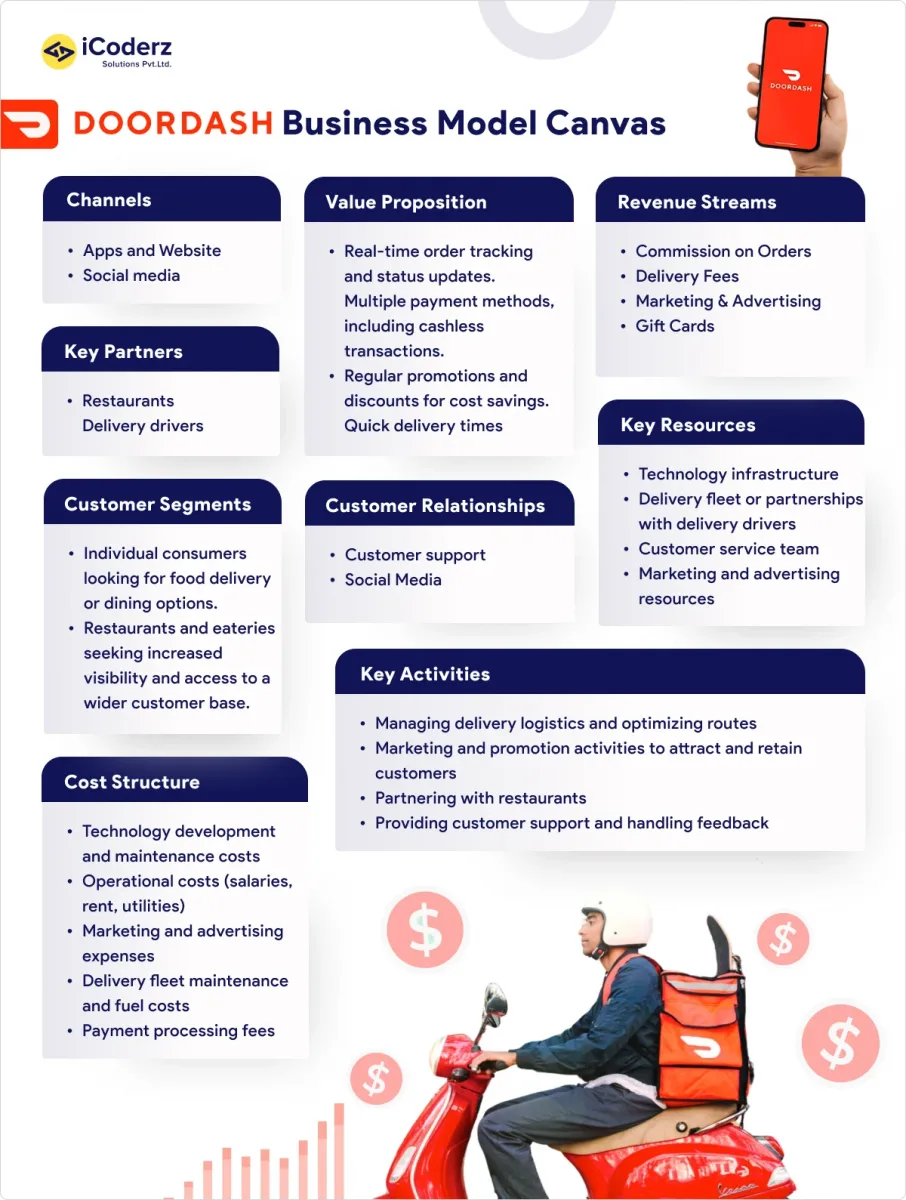
Doordash Business Model Canvas
DoorDash Revenue Generation Model
Is DoorDash profitable? To answer this, we must look at how they generate cash. While they historically focused on growth over profit, the Q3 2025 financial results marked a turning point. DoorDash reported a GAAP Net Income of $244 million, proving that their business model is sustainable.
Commission Fees (Tiered Pricing Update):
Is DoorDash profitable for restaurants? To make it more sustainable, DoorDash moved away from a flat commission to a Tiered Partnership Plan:
- Basic (15% Commission): Higher delivery fees for customers, smaller delivery radius.
- Plus (25% Commission): Lower delivery fees, access to DashPass customers.
- Premier (30% Commission): Lowest fees for customers, biggest delivery radius, and a guarantee of 20 orders per month.
Delivery Fees:
In addition to commission fees, DoorDash charges customers a delivery fee. They also utilize “Dynamic Pricing” during peak hours (busy times), similar to Uber’s surge pricing.
Advertising:
DoorDash offers advertising services to restaurants. This is a massive growth area. Restaurants pay for “Sponsored Listings” to appear at the top of search results, contributing significantly to DoorDash’s net revenue.
Subscription Services:
DashPass is a subscription service ($9.99/month) that offers free delivery and reduced service fees. With nearly 20 million subscribers, this provides predictable, recurring revenue.s.
Learn More: https://www.icoderzsolutions.com/blog/food-delivery-business-model
DoorDash Value Propositions
DoorDash offers several value propositions to its customers, restaurants, and delivery drivers. Some of the key value propositions are:
- Convenience: DoorDash offers a convenient and easy-to-use platform for customers to order food from their favorite local restaurants. Customers can order food from their smartphone or computer and track their delivery in real-time.
- Wide Selection: DoorDash partners with thousands of local restaurants, offering customers a wide selection of food options to choose from. Customers can order everything from fast food to high-end cuisine.
- Fast Delivery: DoorDash’s platform uses algorithms to optimize delivery routes and minimize delivery times. The company offers fast and reliable delivery, with orders delivered in under an hour.
- Cost-effective: DoorDash’s delivery fees are typically lower than the cost of traveling to the restaurant or paying for parking. Customers can also save money by using DoorDash’s promotions and discounts.
- Increased Sales: DoorDash offers restaurants access to a large customer base and provides them with a convenient way to manage orders and track sales. DoorDash Market Share is dominant, meaning restaurants must be on the platform to reach customers.
- Flexible Work: DoorDash provides delivery drivers a flexible and convenient way to earn money. Drivers can choose their hours and work as much or as little as they want. DoorDash also provides drivers with insurance coverage and support.
Overall, DoorDash’s value propositions focus on convenience, selection, fast delivery, cost-effectiveness, increased sales, and flexible work. By delivering on these promises, DoorDash has become a leading player in the food delivery industry.
Challenges & Opportunities Faced By DoorDash
Challenges:
- Competition: The industry is competitive. When analyzing UberEats and Grubhub, we see they are fighting for the same users, though DoorDash currently leads.
- Regulatory Environment: “Gig worker” classification laws in states like New York and California continue to impact operating costs.
Opportunities:
- Expansion: DoorDash is no longer just for food. They are aggressively entering the “Quick Commerce” sector, delivering retail items, flowers, and packages.
Diversification:The Wolt acquisition allows them to dominate the European market.
Alternatives to DoorDash
There are many other food delivery services available besides DoorDash. Some of these include Uber Eats, Grubhub, and Postmates. Each service has its unique features and benefits.
UberEats is one of the most popular food delivery services available. It offers a wide range of restaurants to choose from and delivers food quickly. Grubhub is another popular option that offers a variety of restaurants and delivery times. Postmates is a newer service that delivers food from a wider range of businesses, not just restaurants.
DoorDash Future [2026 Outlook]
The future of DoorDash appears bright, as the company continues to grow and expand its services. Here are a few potential developments that could shape the future of DoorDash:
Expansion into New Markets: DoorDash could continue to expand into new markets and increase its presence in existing markets. This could include entering new countries or expanding into additional cities and towns.
Autonomous Delivery: DoorDash is testing robotics and drone delivery to reduce the biggest cost center: human labor.
Diversification of Services: DoorDash could further diversify its services beyond food delivery, such as grocery delivery.
Increased Use of Technology: DoorDash could continue to leverage technology to improve its operations and delivery efficiency. For example, the company could use artificial intelligence to optimize delivery routes and reduce delivery times.
Continued Partnerships: DoorDash could continue to partner with other businesses to offer new services or expand its reach. This could include partnerships with grocery stores, pharmacies, or other retailers.
Focus on Sustainability: With an increasing focus on sustainability, DoorDash could explore ways to reduce its environmental impact. This could include using electric vehicles or partnering with restaurants that prioritize sustainability.
Overall, the future of DoorDash will likely involve continued growth and expansion, as the company seeks to meet the evolving needs of customers and merchants.
Conclusion
DoorDash is a great platform for businesses to take advantage of the delivery boom. Understanding the DoorDash business model structure reveals that they are transforming from a food delivery company into a local commerce logistics company. With its increasing popularity and recent profitability, DoorDash is sure to continue growing in the years ahead. Ready to build your own? Contact Us today.
Want to Build An App Like DoorDash?