Quick answer: To start a cloud kitchen in India, pick a niche using local Zomato/Swiggy demand data, write a business plan, choose a home or commercial kitchen, register your business, get an FSSAI license (plus GST where applicable and a local trade license), set up the kitchen, build a tight menu, and list on Zomato, Swiggy, and your own channel. A home-based setup can start under ₹5 lakh; a commercial kitchen costs roughly ₹10–15 lakh or more.
Key Takeaways
- FSSAI rules changed on 1 April 2026. Basic FSSAI registration now covers annual turnover up to ₹1.5 crore (earlier limit: ₹12 lakh), so most single-brand cloud kitchens no longer need a State license at launch. Registrations and licenses issued under the revised system also have perpetual validity, although annual fees still apply.
- Startup cost: under ₹5 lakh (home-based) to ₹10–15 lakh+ (commercial, multi-brand).
- Net profit margin: a well-managed kitchen may target 10–20% once operations stabilize, but actual profitability varies widely.
- Biggest cost trap: aggregator commission. A 15–30% range is a common planning benchmark, but actual terms vary, and effective deductions can be higher once GST on commission, ads, and discounts are added.
- Best long-term move: build a direct ordering channel (WhatsApp, website, or app) to reduce commission dependence.
If you’re searching for how to start a cloud kitchen in India, you’ve picked a good moment. Online food ordering keeps growing, and a delivery-only kitchen lets you enter the market without a dining hall, waitstaff, or prime retail rent. Low overhead, strong delivery demand, and platforms like Zomato and Swiggy make this one of the most accessible food businesses for first-time entrepreneurs, home cooks, and existing restaurant owners.
This guide covers the cloud kitchen business model, what changed in 2026, cloud kitchen registration and licenses, real investment and operating costs, menu pricing, profit math, and how to get your first orders. It also looks at how an online food ordering system fits into the picture once you start scaling.
What Is a Cloud Kitchen and How Does It Work?
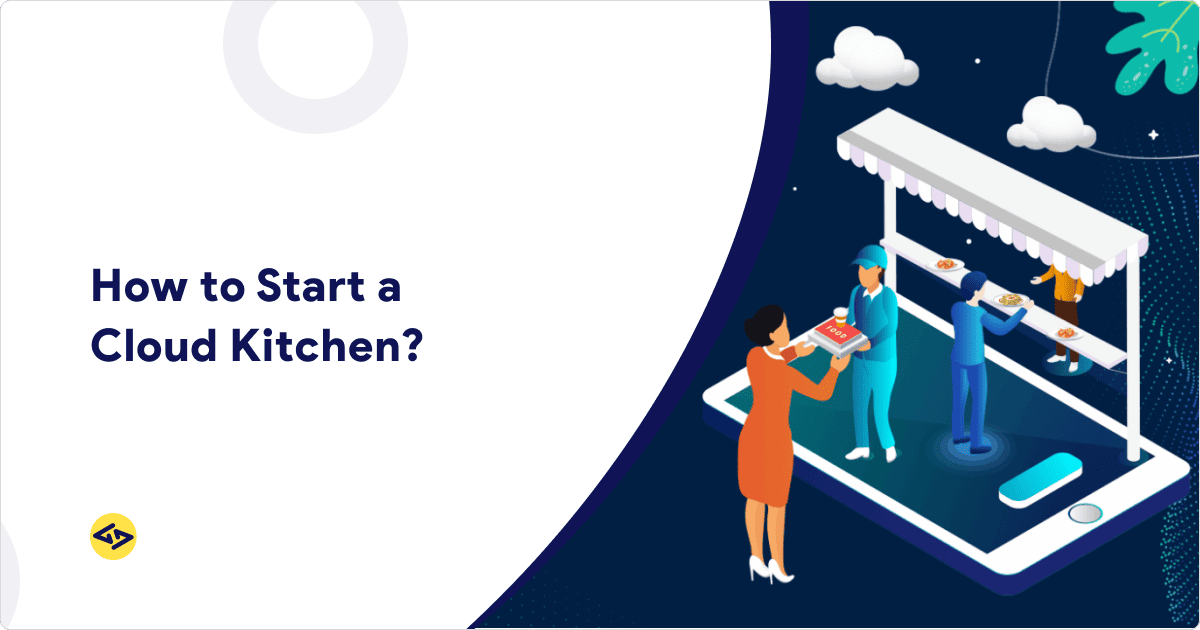
A cloud kitchen (also called a ghost kitchen, dark kitchen, or virtual kitchen) is a delivery-only food business with no dine-in seating. Orders arrive through Zomato, Swiggy, your own website or app, or WhatsApp. The kitchen prepares the food, and a delivery partner takes it to the customer.
How it differs from a traditional restaurant:
- No dining area, host, or front-of-house staff
- Lower rent, since the kitchen can sit in a smaller, cheaper, non-prime location
- Menu and brand can change quickly without renovating a storefront
- One kitchen can run multiple virtual restaurant brands at the same time
Is a Cloud Kitchen a Good Business in India in 2026?
Yes, for founders who plan costs carefully. Customer habits around ordering food online have stuck, and a cloud kitchen has structural advantages over a dine-in restaurant:
- Lower overhead with no seating, ambience, or front-of-house team
- Multiple virtual brands from one kitchen, provided your operations, food-safety setup, and platform arrangements support it
- Faster expansion, because a new “location” can be a new kitchen partnership
- Room for niche concepts such as single-item brands, regional cuisines, and health-focused menus that may not survive in a physical storefront
The trade-off is dependence on delivery platforms and their commissions, which is covered in detail below.
Types of Cloud Kitchen Business Models
| Model | How it works | Best for |
| Independent cloud kitchen | One brand, one kitchen, fully owned | Founders testing a single concept |
| Home-based cloud kitchen | Run from your own kitchen with basic licensing | Lowest-budget start and demand testing |
| Shared / commercial kitchen | You rent kitchen space alongside other operators | Low upfront cost without owning equipment |
| Multi-brand cloud kitchen | Several virtual brands from one location | Operators who want more order volume per kitchen |
| Aggregator-focused kitchen | Built mainly around Zomato/Swiggy orders | Fast launch with built-in demand |
| Hybrid model | Aggregator orders plus your own website or app | Brands working to cut commission costs |
How to Start a Cloud Kitchen in India: 8 Steps
Step 1: Choose Your Food Concept
Pick a cuisine or niche based on local demand, not personal taste alone. Before finalizing, check which concepts are already saturated within your planned delivery radius on Zomato and Swiggy. Look for gaps: a cuisine with few good options, strong ratings but long delivery times, or a niche (high-protein meals, regional thalis, desserts) with demand but few specialists.
Step 2: Create a Cloud Kitchen Business Plan
Your cloud kitchen business plan should define your target customer, menu, pricing, marketing channels, startup budget, and a 12-month revenue projection. You will need it if you approach investors or apply for a business loan.
Step 3: Choose the Right Location
Even without dine-in, location matters. Prioritize:
- A strong delivery radius with dense residential or office clusters
- Reasonable rent relative to expected order volume
- Easy access for delivery partners (parking, entry points)
Step 4: Decide Between a Home Kitchen, Shared Kitchen, or Commercial Space
A home-based cloud kitchen may be possible and is the cheapest way to test demand, but it caps order volume. Confirm local municipal requirements, property-use rules, and housing-society restrictions before operating from home. A shared kitchen gives you ready equipment at a lower upfront cost. A commercial kitchen costs more but scales further and supports multiple brands.
Step 5: Register Your Business and Get Licenses
Set up your business structure (sole proprietorship, partnership, LLP, or private limited) and complete the licenses covered in the next section. Do this before you launch. Most major food-delivery platforms require valid food-business documentation, including FSSAI details, during restaurant onboarding.
Step 6: Set Up the Kitchen
At minimum, you need a cooking area, safe storage, a dedicated packaging station, and a hygienic prep zone. Even a small home setup should follow basic food-safety layout principles: separate raw and cooked handling, clean water, pest control, and proper waste disposal.
Step 7: Build a Tight, Well-Costed Menu
Start with 15–25 dishes that travel well, calculate food cost per dish, and price in commission from day one. See the menu and pricing section.
Step 8: Go Live on Zomato, Swiggy, and Your Own Channel
Complete aggregator onboarding, create a Google Business Profile if your operating location is eligible, and open WhatsApp or direct ordering so repeat customers can order without aggregator commission.
Cloud Kitchen License and Registration Requirements in India
Getting your cloud kitchen license in India sorted before launch avoids fines and platform delays later.
FSSAI License for Cloud Kitchen (Updated for 2026)
2026 FSSAI Update: From 1 April 2026, the Basic Registration threshold rose from ₹12 lakh to ₹1.5 crore in annual turnover. State License now applies from ₹1.5 crore to ₹50 crore, and Central License above ₹50 crore. Registrations and licenses issued under the revised system have perpetual validity, although applicable annual fees must still be paid.
An FSSAI license is mandatory for every food business in India, including home-based cloud kitchens. The category depends on annual turnover. FSSAI revised its turnover slabs from 1 April 2026:
| FSSAI category | Annual turnover (from 1 April 2026) | Typical fee* |
| Basic Registration | Up to ₹1.5 crore | About ₹100/year |
| State License | ₹1.5 crore to ₹50 crore | About ₹2,000–₹5,000/year (varies by business category) |
| Central License | Above ₹50 crore | About ₹7,500/year |
*Annual fees per FSSAI’s 2026 fee matrix, as reported by licensing guides. The State License fee depends on your kind of business (guides report ₹2,000 for some food-service categories and ₹5,000 for many others), so check your exact category in the fee calculator on the official FoSCoS portal before applying.
FSSAI registrations and licenses issued under the revised system from 1 April 2026 have perpetual validity, so there is no periodic renewal. The prescribed annual fee must still be paid, and food-safety compliance continues.
Under the old limit of ₹12 lakh, many small kitchens had to upgrade to a State license quickly. The new ₹1.5 crore ceiling means most single-brand cloud kitchens can start and grow on Basic Registration.
Other Licenses and Registrations
| License / registration | Why you need it |
| GST registration | Required when applicable under GST law, depending on turnover, state, and how you supply food. Platform onboarding may also request GST details or documents depending on your setup and the services you use. Confirm with a CA. |
| Local municipal trade license | Required in most cities to legally run a food business from a given address |
| Shop & Establishment registration | Applicable in many states, mainly for commercial kitchens |
| Fire and safety NOC | Usually needed for larger commercial kitchens; shared or building-managed kitchens often inherit it |
| Business entity registration | Proprietorship, partnership, LLP, or company, depending on your plan, funding, and liability needs |
| Udyam (MSME) registration | Optional but useful for loans and government schemes |
Documents commonly required: identity and address proof, address proof of the kitchen premises, passport-size photo, bank account details or cancelled cheque, and a kitchen layout plan (more often needed for State licenses). Requirements vary by state, so confirm with your local municipal office and FSSAI officer.
Multi-brand note: if you plan to run several virtual brands from one kitchen, ask your FSSAI office how each brand should be listed, because aggregators typically ask for an FSSAI number against each brand or outlet.
Cloud Kitchen Setup Cost in India
The cloud kitchen setup cost in India (your total cloud kitchen investment, plus monthly operating cost) depends mainly on whether you start from home, a shared kitchen, or a full commercial space.
| Expense | Estimated range (₹) |
| Kitchen setup and equipment | 1,00,000 – 5,00,000 |
| Rent and deposit (commercial) | 20,000 – 1,50,000 per month |
| Licenses and registrations | 5,000 – 30,000 |
| Initial raw materials | 15,000 – 50,000 |
| Packaging | 10,000 – 40,000 |
| Technology (POS, ordering, delivery integration) | 10,000 – 1,00,000 |
| Branding and marketing | 15,000 – 1,00,000 |
| Staff (cooks, packers, delivery coordination) | 30,000 – 1,50,000 per month |
| Working capital buffer | 50,000 – 2,00,000 |
Total investment by model (approximate):
| Model | Typical startup investment |
| Home-based cloud kitchen | Under ₹5 lakh |
| Shared or hub kitchen | Roughly ₹3–8 lakh |
| Commercial single-brand kitchen | ₹8–15 lakh |
| Commercial multi-brand kitchen | ₹10–15 lakh or more |
Figures are estimates and vary by city, cuisine, and equipment choices.
Hidden costs to plan for: aggregator commission deductions, GST on commission, packaging redesigns, equipment repairs, discount funding, ad spend on platforms, and slow-season working capital.
Cloud Kitchen Equipment List
- Commercial cooking range, oven, or tandoor (depending on cuisine)
- Refrigerator, freezer, and cold storage
- Prep tables, cutting stations, and storage racks
- Packaging equipment such as sealing machines and insulated bags
- Cleaning and food-safety supplies
- POS and order-management software to track orders across platforms
How to Create and Price a Profitable Cloud Kitchen Menu
Menu tips
Great cloud kitchen menu ideas in India start with focus, not variety. A tight, well-costed menu beats a huge one almost every time.
- Choose 15–25 dishes that travel well and reheat cleanly
- Calculate exact food cost per dish before setting prices
- Bundle combos to raise average order value
- Add low-cost, high-margin extras such as sauces, sides, and drinks
- Test packaging so food does not degrade in transit
Pricing formula
Food cost + packaging + platform/delivery costs + overheads + desired profit = selling price
Keep food cost around 28–35% of the selling price as a starting benchmark, then adjust once you see real commission and delivery charges on aggregators. Price with commission in mind from day one. Do not set menu prices first and try to absorb commission later.
How Do Cloud Kitchens Make Money?
A cloud kitchen’s revenue model usually combines several streams:
- Direct food sales through aggregators and your own channels
- Multiple virtual brands from one kitchen, where operations and platform arrangements allow
- Combo meals, upselling, and add-ons
- Direct orders with no aggregator commission, although payment, delivery, technology, and marketing costs may still apply
- Subscription and meal-plan models
- Catering and corporate or bulk orders
- Repeat customers through loyalty programs
Cloud Kitchen Profit Margin and Break-Even in India
Is a cloud kitchen profitable in India? It can be, but margins depend on how well you control food cost, commission, and rent. A well-managed cloud kitchen may target a 10–20% net margin after reaching stable operations, but actual profitability varies widely by location, cuisine, order volume, food costs, platform fees, marketing spend, and overhead. Early months usually run tighter because of marketing spend and platform onboarding costs.
How to calculate break-even
Break-even orders per month = fixed monthly costs ÷ contribution margin per order
Fixed costs include rent, salaries, software subscriptions, and utilities. Contribution margin per order is the selling price minus food cost, packaging, and platform deductions.
Worked example (illustrative)
| Item | Amount |
| Average order value | ₹350 |
| Food cost (about 32%) | ₹112 |
| Packaging | ₹20 |
| Aggregator commission (22%) | ₹77 |
| GST on commission (18% of commission) | ₹14 |
| Contribution per order | about ₹127 |
| Fixed monthly costs (rent, staff, software) | ₹1,20,000 |
| Break-even | about 945 orders/month (roughly 32 a day) |
This is why commission matters so much. Moving repeat orders to your own channel can recover much of the roughly ₹91 in platform deductions per order, although payment processing, delivery, and technology costs still apply. That lowers the number of orders you need to break even.
How to Register Your Cloud Kitchen on Zomato and Swiggy
Most major platforms require valid food-business documents during onboarding. You will typically need:
- Your FSSAI license or registration number
- GST details, where applicable to your setup
- Bank account details (cancelled cheque)
- PAN
- Menu with pricing
- Photos of your dishes and kitchen
After you submit, onboarding commonly takes a few days to a couple of weeks, depending on document verification. Exact requirements can vary by platform, city, and service model.
Zomato and Swiggy commission for cloud kitchens
Platform commissions vary significantly by city, restaurant agreement, promotional plan, advertising, discounts, delivery arrangement, and other commercial terms. A 15–30% range is often used as a planning benchmark, but you should confirm the actual terms offered to your business. After GST on the commission (18%), payment-gateway charges, ad spend, and discount funding, effective deductions can reach 25–35% of the order value, according to restaurant-tech operators in 2026.
Example: on a ₹500 order with a 22% base commission, the commission is ₹110. GST at 18% on that is about ₹20, so around ₹130 (26%) is deducted before packaging, ads, or discounts.
Tips to protect margins:
- Price menu items with commission built in
- Negotiate commission once you have steady volume, especially with multiple brands
- Track profit per platform, not just total sales
- Explore lower-commission channels such as ONDC alongside Zomato and Swiggy
How to Get Orders for Your Cloud Kitchen
- List on Zomato and Swiggy, still the biggest discovery channels
- Create a Google Business Profile for your operating location, if eligible, for local search visibility
- Post real food photography on Instagram and Facebook
- Offer WhatsApp ordering for repeat, commission-free customers
- Invest in local SEO so nearby customers find you organically
- Run referral and loyalty programs to lift repeat orders
- Keep ratings above 4.0 with consistent quality, packaging, and on-time delivery
For a channel-by-channel cloud kitchen marketing strategy, see this guide to cloud kitchen marketing ideas.
Technology You Need to Run a Cloud Kitchen
- POS and order management system to manage orders across channels
- Inventory management to reduce wastage
- Customer database for repeat marketing
- Payment gateway for direct orders
- Analytics to track best-sellers and peak hours
- Delivery management and integrations that sync with Zomato, Swiggy, and your own app
Reliable cloud kitchen management software separates kitchens that scale smoothly from ones that drown in manual order tracking.
Should You Build a Cloud Kitchen App?
Not at launch. Once your order volume is steady, though, owning your ordering channel starts to pay off, because every direct order skips the aggregator commission. A dedicated app typically includes:
- A customer-facing ordering app
- A restaurant/admin panel to manage menu and orders
- Delivery tracking and push notifications
- Loyalty rewards and saved payment options
Here is what’s involved in building a restaurant app from the ground up, and how food delivery app development can support new kitchen locations without opening new storefronts. Once your kitchen model is validated, iCoderz can help you plan the digital ordering, delivery, and customer-management technology needed to scale.
Common Challenges and Mistakes to Avoid
Challenges
- High aggregator commissions eating into margins
- Rising customer acquisition costs
- Keeping food quality consistent at scale
- Delivery delays that hurt ratings
- Heavy local competition
- Inventory wastage from poor demand forecasting
Mistakes
- Skipping market research before choosing a concept
- Launching with an overly large, hard-to-execute menu
- Ignoring food costing until margins are already thin
- Depending 100% on aggregators with no direct channel
- Underinvesting in packaging quality
- Not tracking basic KPIs (order volume, repeat rate, food cost %, rating)
Cloud Kitchen vs Traditional Restaurant
| Factor | Cloud kitchen | Traditional restaurant |
| Startup investment | Lower | Higher |
| Rent | Lower (no dine-in space) | Higher (prime location needed) |
| Staff | Leaner team | Larger front and back of house |
| Scalability | Faster, brand-based | Slower, location-based |
| Customer acquisition | Aggregator-dependent at first | Walk-in plus delivery |
| Dependence on platforms | High | Moderate |
Cloud Kitchen Success Strategy for 2026
- Build a recognizable, consistent brand across platforms
- Stay focused on a specific niche instead of serving everyone
- Use order data to refine the menu every quarter
- Gradually reduce dependence on aggregator commissions
- Build a direct-ordering channel (website, WhatsApp, or app)
- Automate repetitive operations
- Open a second kitchen only after the first is consistently profitable
Founders who reach this stage often develop a food delivery app of their own to control the customer experience instead of relying entirely on aggregators.
Conclusion
Starting a cloud kitchen in India in 2026 is more accessible than opening a traditional restaurant, and the updated FSSAI slabs make the legal side easier for small kitchens. It still rewards founders who plan carefully, control food cost from day one, price in commission, and build a marketing plan that does not rest entirely on aggregators. Start small, validate demand in one location, and scale only after you reach unit-level profitability.
Launch Your Cloud Kitchen App
Build, manage, and grow your cloud kitchen with a custom app.

Frequently Asked Questions
How much does it cost to start a cloud kitchen in India?
A small home-based cloud kitchen can start for under ₹5 lakh. A fully equipped commercial or multi-brand kitchen typically costs ₹10–15 lakh or more, depending on city, rent, equipment, and technology.
Is a cloud kitchen profitable in India?
It can be. A well-managed cloud kitchen may target a 10–20% net margin once operations stabilize, but profitability varies widely by location, cuisine, order volume, food cost, platform fees, and overhead. Early months are usually tighter.
Can I start a cloud kitchen from home?
It may be possible. You need at least FSSAI registration, and you should confirm local municipal requirements, property-use rules, and housing-society restrictions before operating from home.
What license is required for a cloud kitchen?
At minimum, an FSSAI registration or license and a local trade license. GST registration applies where required under GST law, and platforms may ask for GST details at onboarding depending on your setup. Commercial kitchens may also need Shop & Establishment registration and a fire NOC.
Is FSSAI mandatory for a cloud kitchen?
Yes. Every food business in India, including home-based cloud kitchens, needs at least FSSAI Basic Registration. From 1 April 2026, Basic Registration covers turnover up to ₹1.5 crore.
Which FSSAI license does a cloud kitchen need in 2026?
Most single-brand cloud kitchens need only Basic Registration (turnover up to ₹1.5 crore). A State license applies from ₹1.5 crore to ₹50 crore, and a Central license above ₹50 crore. Licenses issued under the revised system have perpetual validity. Confirm current slabs and fees on FoSCoS.
How much space is required for a cloud kitchen?
As typical planning ranges, a compact home setup may use 100–200 sq ft and a commercial multi-brand kitchen 300–800+ sq ft. Actual space depends on cuisine, equipment, storage, staff, workflow, and local regulations.
What equipment is required for a cloud kitchen?
The essentials are cooking equipment, refrigeration, storage, a packaging station, and POS or order-management software.
How much can a cloud kitchen earn per month?
It depends on city, menu, and order volume. As an illustration, 1,500 orders a month at a ₹350 average order value is about ₹5.25 lakh in revenue, which at a 15% net margin is roughly ₹79,000 in profit. Use the break-even formula above for your own numbers.
How do cloud kitchens get customers?
Mainly through Zomato and Swiggy, supported by a Google Business Profile, social media, WhatsApp ordering, local SEO, and loyalty programs.
What is the Zomato and Swiggy commission for cloud kitchens?
Commissions vary by city, restaurant agreement, promotional plan, and other terms. A 15–30% range is often used as a planning benchmark, and effective deductions can be higher once GST on commission, ads, and discounts are included. Confirm your actual terms.
Do I need an app for my cloud kitchen?
Not at launch. Most kitchens start on aggregators and add a direct app once order volume justifies cutting commission costs.