Online grocery shopping has moved from a convenience to a habit. People now expect to browse, order, and receive groceries within a couple of taps and a couple of hours, not a couple of days. That shift has raised the bar for every grocery app on the market.
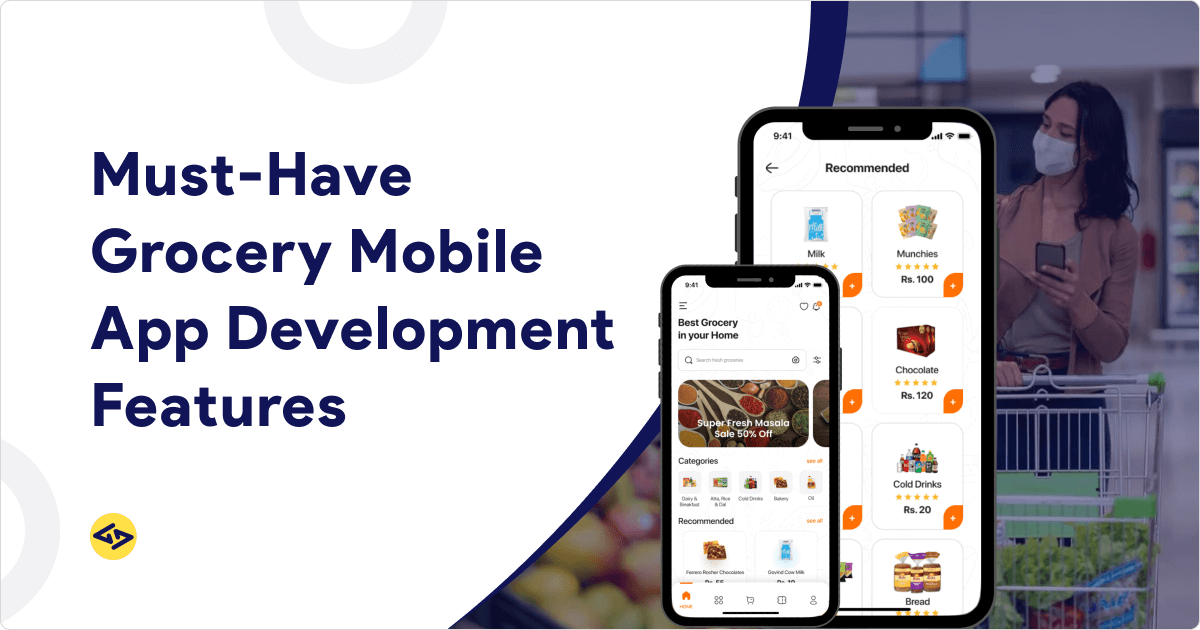
If you’re building or upgrading a grocery app, knowing the must-have grocery mobile app development features is the difference between an app people delete after one order and one they use every week. This guide explores the essential grocery mobile app development features, from customer-facing tools and admin dashboards to AI capabilities, security, and cost considerations, helping you build a scalable and successful grocery app.
Grocery Mobile Apps by the Numbers
- Online grocery sales continue to grow globally, year over year, as more shoppers move everyday purchases to mobile.
- Mobile commerce now accounts for the majority of digital grocery purchases in most markets, ahead of desktop and mobile web.
- Most shoppers prefer apps over browser-based ordering for repeat grocery purchases, largely due to speed and saved preferences.
- AI adoption among grocery retailers continues to rise, particularly in personalization, demand forecasting, and inventory management.
Key Takeaways
- Grocery apps need four connected modules: customer, delivery partner, store manager, and admin.
- The core customer-facing features, search, secure checkout, live tracking, and loyalty, drive the most retention.
- AI features like personalized recommendations and demand forecasting are becoming standard, not optional.
- Security (encryption, PCI DSS-compliant payments, 2FA) is non-negotiable for customer trust.
- Feature-rich doesn’t mean feature-heavy; the right features matter more than the most features.
Why Grocery Mobile App Features Matter
Growing Demand for Grocery Mobile Apps
Online grocery shopping has grown steadily as more shoppers shift everyday purchases to mobile. Consumers now research, compare, and buy on their phones by default, and hyperlocal, quick-commerce delivery models and 10- to 30-minute delivery windows have raised expectations for speed across the entire category. An app with outdated or missing grocery delivery app features simply can’t compete in this environment.
Business Benefits of Feature-Rich Grocery Apps
The right grocery app development features don’t just please users; they directly affect the bottom line:
- Increased customer retention through personalization, loyalty programs, and reliable delivery
- Better operational efficiency via automated inventory and order management
- Higher average order value through recommendations, bundles, and reorder tools
- Competitive advantage against both local stores and national grocery chains
The right feature set also opens up more ways to generate revenue, worth reviewing alongside this guide to grocery delivery app monetization strategies.
Key Components of a Grocery Mobile App Ecosystem
A complete grocery platform isn’t a single app, it’s four connected modules working in sync:
| Module | Primary Users | Purpose |
| Customer App | Shoppers | Browse, order, and track deliveries |
| Delivery Partner App | Drivers | Accept orders and manage fulfillment |
| Store Manager Panel | Store staff | Manage inventory and process orders |
| Admin Dashboard | Business owners | Oversee operations and analytics |
Each module feeds real-time data to the others. When a customer places an order, the store panel updates inventory instantly, the delivery app assigns a rider, and the admin dashboard logs the transaction for analytics, all without manual intervention.
Must-Have Grocery Mobile App Development Features for Customers
These are the essential features of a grocery delivery app that shoppers interact with directly:
| Feature | Why It Matters |
| Easy Registration & Login | Removes friction from first-time sign-up via phone, email, or social login |
| Smart Product Search & Filters | Faster product discovery by category, brand, price, or diet |
| Product Categories | Organized browsing across produce, packaged goods, dairy, and more |
| Personalized Recommendations | AI-driven suggestions increase basket size |
| Shopping Cart & Wishlist | Lets shoppers save items and edit orders before checkout |
| Family Shopping Lists / Wishlist Sharing | Lets household members build and share a single list |
| Secure Checkout | A fast, minimal-step checkout flow reduces cart abandonment |
| Multiple Payment Options | Cards, UPI, wallets, cash on delivery, and Buy Now, Pay Later (BNPL) |
| Delivery Slot Scheduling | Lets customers pick a convenient delivery window |
| Live Order Tracking | Builds trust by showing exactly where an order is |
| Push Notifications | Keeps customers informed on orders, updates, and offers |
| Ratings & Reviews | Builds trust through product and delivery feedback |
| Loyalty & Rewards Program | Encourages repeat purchases through points or tier-based perks |
| Order History & Quick Reorder | Saves time with one-tap reordering of past purchases |
| Barcode Scanner | Useful for in-store pickup and quick price checks |
| Voice Search | Improves accessibility and hands-free product discovery |
Essential Delivery Partner App Features
A smooth delivery experience depends on a well-built partner app. Key grocery delivery app delivery partner features include:
- Order acceptance and rejection controls
- Route optimization for the fastest delivery path
- GPS navigation integrated with maps
- Real-time delivery status updates
- Earnings dashboard with trip history
- Availability and shift management
- In-app communication with customers and support
- Digital proof of delivery (photo or signature)
Must-Have Store Manager Features
Store staff need tools that keep inventory and orders accurate in real time:
- Inventory management with low-stock alerts
- Product catalog management
- Order processing and fulfillment tracking
- Stock updates across categories
- Pricing management, including discounts
- Coupon and promotion management
- Customer management and order history
- Sales and performance reports
Admin Dashboard Features Every Grocery App Needs
The admin panel is the command center. Core grocery delivery app admin panel features include:
- User management (customers, vendors, delivery partners)
- Store management across locations
- Delivery management and partner assignment
- Revenue dashboard with real-time earnings
- Business analytics and performance metrics
- Promotion and campaign management
- Role-based access control
- Multi-store management
- CMS management for banners and content
- Security controls and audit logs
B2B & Enterprise Integration Features
Enterprise buyers and larger grocery chains typically need their app to connect with systems they already run. Look for:
- POS Integration – syncs in-store and online sales in real time
- ERP Integration – connects the app to existing finance and operations systems
- CRM Integration – keeps customer data consistent across sales and support tools
- Warehouse Management – coordinates stock across fulfillment centers and dark stores
- Vendor Portal – gives suppliers visibility into orders, stock levels, and payments
These integrations broaden the commercial relevance of a grocery app well beyond a single storefront, making it viable for larger retail and wholesale operations.
How These Features Improve Business Growth
Features aren’t just checkboxes, each one ties back to a measurable business outcome:
- Customer retention – loyalty programs, personalization, and quick reorder keep shoppers coming back
- Repeat purchases – subscription plans and buy-again shortcuts turn one-time buyers into regulars
- Operational efficiency – automated inventory and order management cut manual work and errors
- Delivery speed – route optimization and real-time tracking shorten delivery windows
- Customer satisfaction – transparency (live tracking, notifications) reduces support tickets and complaints
- Revenue – recommendations, bundles, and dynamic pricing increase average order value
Viewed this way, choosing grocery mobile app development features becomes a business decision as much as a technical one.
AI-Powered Grocery Mobile App Features
AI is no longer an optional add-on for grocery apps. From personalized shopping experiences to inventory optimization, AI helps retailers improve customer satisfaction while reducing operational costs.
AI-powered grocery delivery app features use machine learning to improve personalization, inventory management, and delivery efficiency, and are quickly becoming a baseline expectation rather than a differentiator:
- Personalized Product Recommendations based on browsing and purchase history
- Smart Search that understands typos, synonyms, and intent
- Demand Forecasting to predict what will sell and when
- Dynamic Pricing that adjusts based on demand and inventory levels
- Inventory Prediction to prevent stockouts and overstocking
- AI Chatbots for instant customer support
- Customer Segmentation for targeted marketing
- Fraud Detection to flag suspicious transactions
- Route Optimization for faster, cheaper deliveries
- AI-Based Marketing Automation for personalized offers and re-engagement
Advanced Features That Improve Customer Experience
Beyond the basics, these features help apps stand out:
- Buy Again shortcuts for frequent purchases
- Subscription grocery plans for recurring essentials
- Digital wallet for faster checkout
- Contactless delivery options
- In-app chat with support or delivery partners
- Referral program to drive organic growth
- Multi-language support for wider reach
- Multi-currency support for cross-border operations
- Gift cards for promotions and retention
- Social login for frictionless sign-up
- Dark mode for user comfort
- Voice assistants for hands-free ordering
Security Features Every Grocery Mobile App Should Have
Trust is non-negotiable when handling payments and personal data. Look for:
- Secure authentication protocols
- Two-factor authentication (2FA)
- End-to-end encryption
- PCI DSS-compliant payment processing
- GDPR compliance for data privacy
- Regular data backups
- Secure APIs for third-party integrations
- Ongoing fraud monitoring
Features for Multi-Store Grocery Chains
If you’re running or planning multiple locations, multi-store grocery app features and multi-vendor grocery app features are essential:
- Multi-store inventory synchronization
- Regional pricing controls
- Store-specific offers and promotions
- Geo-fencing for delivery zones
- Franchise management tools
- Centralized reporting across locations
- Warehouse and dark store integration
- Branch-level analytics
Retail chains expanding into delivery should also review this guide on grocery delivery app development for retail chains and the dark store model in this breakdown on how to build a dark store app.
Emerging Grocery Mobile App Features
The next wave of grocery delivery app trends includes:
- AI shopping assistants for conversational ordering
- Predictive ordering based on consumption patterns
- AR product visualization
- IoT-based inventory tracking
- Drone delivery support
- Autonomous delivery vehicles
- Voice commerce
- Sustainability and carbon-footprint tracking
Many of these trends are already visible in established players. For a real-world reference point, see how a large-scale platform app like BigBasket is structured.
How to Prioritize Grocery Mobile App Features
Trying to launch with every feature at once is a common mistake. A phased approach works better:
Phase 1: MVP Features: Registration, product search, cart, checkout, payments, and order tracking, enough to validate the business model.
Phase 2: Growth Features: Loyalty programs, referrals, AI recommendations, coupons, and push notifications, features that boost retention once you have real users.
Phase 3: Enterprise Features: AI forecasting, multi-store management, ERP integration, and advanced analytics, built for scale.
Still deciding what to build first? Browse this list of grocery app development ideas for inspiration, or walk through the full grocery delivery app development process step by step.
Basic vs. Advanced vs. AI-Powered: A Feature Comparison
Not every business needs every feature on day one. This matrix helps you see which tier fits your current stage:
| Capability | Basic | Advanced | AI-Powered |
| Product search | Keyword search | Filters & categories | Smart search with intent detection |
| Recommendations | None | Manual/rule-based | Personalized, ML-driven |
| Inventory | Manual updates | Real-time sync | Predictive stock forecasting |
| Pricing | Fixed pricing | Scheduled discounts | Dynamic, demand-based pricing |
| Delivery routing | Manual assignment | Zone-based assignment | AI route optimization |
| Support | Email/phone only | In-app chat | AI chatbot with human handoff |
What We Recommend
Based on our experience building grocery delivery platforms, businesses launching an MVP should prioritize customer onboarding, product discovery, secure payments, and live order tracking before investing in advanced AI capabilities. AI and multi-store features deliver the most value once you have real order volume to learn from; adding them too early often means paying for intelligence with no data to power it.
Common Mistakes to Avoid When Choosing Grocery App Features
- Adding unnecessary features that bloat the app
- Ignoring user experience in favor of feature count
- Poor inventory synchronization between store and app
- Weak security around payments and user data
- No scalability planning for future growth
- Not optimizing app performance and load times
- Skipping customer feedback during development
How Much Does It Cost to Build a Feature-Rich Grocery Mobile App?
Grocery delivery app cost depends heavily on feature complexity, platforms, and integrations:
| App Type | Estimated Cost |
| Basic MVP | $10,000–$20,000 |
| Standard Grocery App | $20,000–$45,000 |
| Advanced Grocery App | $45,000–$80,000 |
| Enterprise Multi-Store App | $80,000–$150,000+ |
Cost Factors
- Number and complexity of features
- AI integrations
- Third-party API costs (payments, maps, SMS)
- UI/UX design complexity
- Platform choice (Android, iOS, Web)
- Ongoing maintenance and support
For a deeper breakdown, see this detailed guide on the cost to develop a grocery delivery app.
Why Choose a Professional Grocery Mobile App Development Company?
Working with an experienced grocery app development company gives you:
- Industry expertise from prior grocery and delivery projects
- Custom feature development tailored to your business model
- Scalable architecture built for growth
- AI integration done right the first time
- Security and compliance built into the foundation
- Ongoing maintenance and support post-launch
- Faster time-to-market than building in-house from scratch
Curious what sets the leaders apart? Take a look at what makes the best grocery delivery app stand out in a crowded market.
Conclusion: Building a Future-Ready Grocery Mobile App with the Right Features
There’s no single “perfect” feature list for a grocery app. What matters is that every feature you add earns its place, solving a real problem for your customers, your delivery partners, or your team on the ground. Get that right, and the results follow naturally: smoother operations, higher order values, stronger retention, and a business that’s ready to scale rather than scramble every time demand grows.
The apps that win in this space usually share the same pattern. They nail the fundamentals first: search, cart, checkout, tracking, then layer in AI, loyalty, and multi-store capabilities as the business matures. Trying to launch with everything at once, or copying a competitor’s feature list without asking whether it fits your customers, is how budgets get wasted and timelines slip.
Investing in the right grocery mobile app development features today creates a scalable foundation for tomorrow’s growth.
If you’re mapping out your own feature roadmap, it helps to work with a team that’s built these systems before and knows where the real complexity hides, in inventory sync, real-time tracking, and payment reliability, not just the UI. That’s where iCoderz Solutions comes in. We’ve helped grocery businesses go from a rough idea to a fully working grocery delivery app, choosing the right features for their stage instead of the most features possible.
Build a Feature-Rich Grocery Mobile App
Build a grocery mobile app with powerful features for business growth.

Frequently Asked Questions (FAQs)
What are the must-have grocery mobile app development features?
The essentials include product search, cart, secure checkout, multiple payment options, live order tracking, push notifications, and a loyalty program, supported by a solid admin and delivery partner app.
Which features should every grocery delivery app include?
Every grocery delivery app needs registration, product browsing, cart and checkout, payment integration, delivery scheduling, and real-time order tracking at a minimum.
What AI features improve grocery mobile apps?
Personalized recommendations, smart search, demand forecasting, dynamic pricing, and AI chatbots all improve engagement and operational efficiency.
How do grocery apps manage inventory?
Grocery apps sync inventory in real time between the store panel and customer app, using stock alerts and, in advanced setups, AI-based demand prediction.
Why is live order tracking important?
It builds customer trust and reduces support queries by showing exactly where an order is, from packing to delivery.
What security features should grocery apps have?
Secure authentication, two-factor authentication, encryption, PCI DSS-compliant payments, and regular data backups are all essential.
Which payment methods should grocery apps support?
Cards, UPI, digital wallets, cash on delivery, and Buy Now, Pay Later (BNPL) options cover most customer preferences.
How much does it cost to build a grocery mobile app?
Costs typically range from $10,000 for a basic MVP to $150,000+ for an enterprise multi-store app, depending on features and complexity.
Can grocery apps support multiple store locations?
Yes — with multi-store inventory sync, regional pricing, geo-fencing, and centralized reporting, apps can support single or multi-vendor chains.
How do loyalty programs improve grocery app engagement?
Points, rewards, and tier-based perks give customers a reason to keep ordering from the same app instead of switching to a competitor.