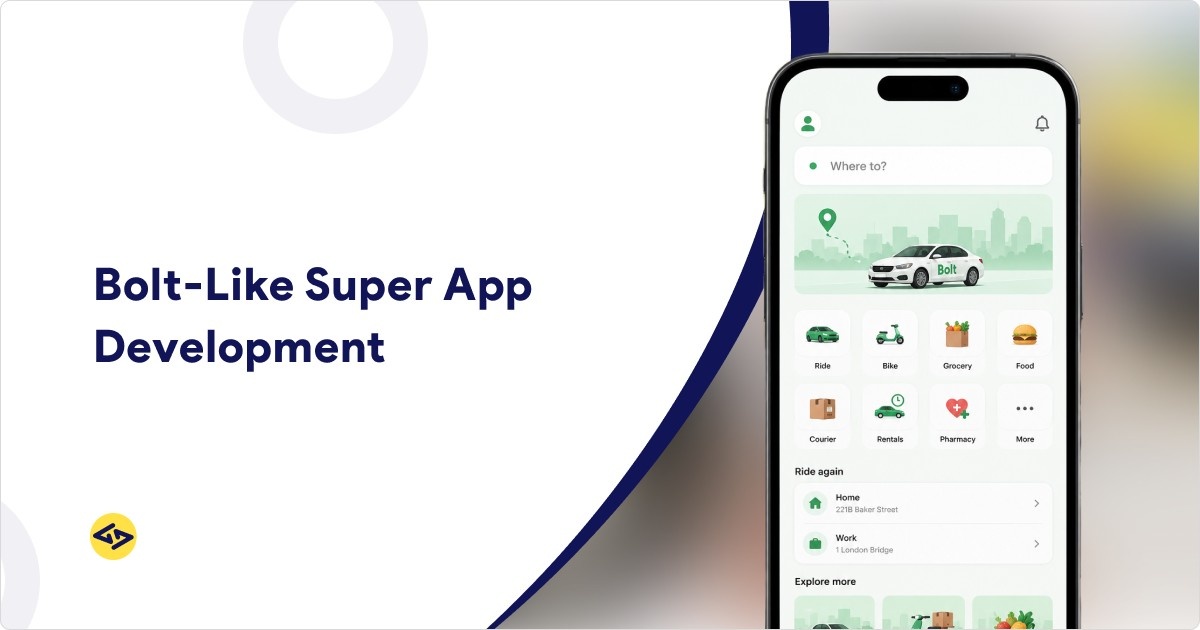
Bolt isn’t just a ride-hailing app anymore — it’s a multi-service platform where users book rides, order food, rent scooters, and pay for everything from one login. That shift, from single-service to multi-service, is exactly why so many founders now ask how to build a Bolt-like super app. This guide walks through what a Bolt-like platform actually is, how it works, what it costs, and the steps involved in Bolt-like super app development — from MVP to full-scale launch.
What Is a Bolt-Like Super App?
A super app is a single platform that bundles multiple on-demand services — ride-hailing, delivery, rentals — under one account, one wallet, and one app icon. Instead of downloading five separate apps, users open one.
For Bolt, ride-hailing is the anchor service, with taxi booking app development forming the technical backbone that everything else — food delivery, scooters, car sharing — gets layered onto later. This is what separates super app development from a traditional single-service app: it’s built to expand from day one, not bolted together afterward.
How Does a Bolt-Like Super App Work?
At a basic level, the flow looks like this:
Customer → Service Selection → Booking → Matching → Real-Time Tracking → Payment → Rating
Behind that simple flow sit three connected systems, a pattern common across on-demand app development projects:
- Customer app — browsing services, booking, tracking, paying
- Driver/provider app — accepting jobs, navigation, earnings
- Admin panel — managing users, drivers, services, and payouts in real time
Real-time communication (via APIs and sockets) is what keeps all three in sync during an active booking.
Key Features of a Bolt-Like Super App
Customer App Features
- Registration/login, location detection
- Multiple service categories in one app
- Fare estimation and real-time tracking
- Multiple payment options
- Ride scheduling, ratings, notifications, in-app support
Driver/Service Provider Features
- Registration & document verification
- Online/offline toggle, booking requests, navigation
- Earnings dashboard, trip history, wallet/payout management
Admin Panel Features
- User, driver, and service management
- Booking and payment management
- Commission and promotions management
- Analytics, reports, and content management
A well-planned feature set for chowman food delivery app for restaurants-style integrations shows how a delivery module can slot into the same admin structure as ride-hailing, without rebuilding the panel from scratch.
Additional Services You Can Add to a Bolt-Like Super App
Most successful platforms launch with one core service, then expand:
- Ride-hailing
- Food delivery app development
- Grocery delivery
- Courier/parcel delivery
- Scooter & bike rentals
- Car rental
Starting narrow and expanding later reduces launch risk while still keeping the multi service app development vision intact.
How to Build a Bolt-Like Super App?
- Define your business model — target market, service categories, commission structure
- Research competitors — find gaps Bolt, Grab, or Uber don’t cover locally
- Define the MVP — pick one service, prioritize must-have features
- Design UX/UI — map the customer and driver journeys
- Choose the tech stack — mobile, backend, database, maps, payments, cloud
- Develop the platform — frontend, backend, APIs, admin panel, integrations
- Test thoroughly — functional, performance, security, GPS, and payment testing
- Launch & scale — go live, monitor behavior, add services gradually
This process is central to any super app development process, and it’s often easier with guidance from an experienced super app development partner who’s shipped similar platforms before.
Technology Stack for a Bolt-Like Super App
| Technology Area | Purpose |
| Mobile Development | Customer & driver apps |
| Backend | Business logic & APIs |
| Database | Users, bookings, payments |
| Maps & GPS | Location & navigation |
| Real-Time Technology | Live tracking & driver matching |
| Payment Gateway | Online payments |
| Cloud | Scalability & infrastructure |
| Push Notifications | Booking & delivery updates |
Choosing the right stack for a mobile application early on avoids costly rewrites once you start adding services beyond ride-hailing.
Super App Architecture
Mobile Apps → API Layer → Backend Services → Database → Third-Party Services
A solid super app architecture relies on:
- Modular, service-based design (each service is its own module)
- API-first communication between services
- Real-time messaging for tracking and matching
- Scalable, cloud-native infrastructure
- Strong security and data management practices
Modularity matters most here — it’s what lets you add food delivery or rentals later without touching the core ride-hailing code.
How Much Does It Cost to Build a Bolt-Like Super App?
Cost depends on:
- Number of services included
- Platforms (iOS, Android, web)
- UI/UX complexity
- Backend complexity and third-party integrations
- Admin panel scope
- Development team location
- Testing and ongoing maintenance
MVP Development — lowest cost, tests the core idea with one service.
Custom Multi-Service Super App — higher investment, built for scale and multiple services.
White-Label Solution — mid-range cost, faster but less customizable.
Bolt-like app development cost and Bolt clone app cost vary widely based on these factors, so it’s worth getting a scoped estimate rather than relying on a flat industry number.
How Long Does It Take to Build a Bolt-Like Super App?
Typical phases:
- Discovery & planning
- UI/UX design
- MVP development
- Testing
- Launch
Super app development time increases significantly with each additional service, since every new module needs its own booking logic, admin controls, and testing cycle.
Bolt Clone vs. Custom Super App: What Should You Build?
| Approach | Best For | Flexibility | Time to Market |
| Bolt Clone | Similar core experience | Moderate | Faster |
| White Label | Quick launch | Limited–Moderate | Faster |
| Custom Super App | Unique business model | High | Longer |
If speed matters more than uniqueness, white label mobile app development gets you to market faster. If long-term differentiation matters more, custom development is usually worth the extra time.
How to Monetize a Bolt-Like Super App?
- Commission per booking
- Delivery/service fees
- Surge pricing
- Subscription plans
- Business partnerships
- Advertising/promoted listings
- Premium services
Platforms like Gojek combined several of these models at once — a useful reference point covered in this go-jek clone app development breakdown.
Challenges in Building a Bolt-Like Super App
- Real-time driver matching accuracy
- GPS reliability
- Handling high traffic during peak hours
- Payment security
- Driver onboarding at scale
- Managing multiple services without UX inconsistency
Most of these challenges are easier to navigate with an experienced mobile apps solutions provider that has handled similar scaling issues before.
How to Launch Your Bolt-Like Super App Successfully
- Start with a focused MVP
- Validate the core service before expanding
- Monitor customer feedback closely
- Optimize operations continuously
- Add services gradually, not all at once
- Track KPIs like retention, booking completion rate, and driver utilization
Grab’s own expansion path is a good case study here — see how they scaled service by service in this guide on how to build a super app like grab.
Why Choose iCoderz for Super App Development?
With 14+ years of experience in on-demand app development, iCoderz has built custom and multi-service platforms across ride-hailing, food delivery, and logistics — from MVP through full-scale launch, on iOS, Android, and web. Every engagement is covered under NDA, and support continues well after launch. You can browse our project portfolio to see similar platforms we’ve delivered.
Build Your Bolt-Like Super App With iCoderz → Get in touch
FAQs
How much does it cost to build an app like Bolt?
Cost depends on services, platforms, and complexity — an MVP costs far less than a full multi-service custom build.
How long does it take to build a Bolt-like super app?
An MVP can take a few months; a full multi-service platform typically takes longer due to added testing and integration work.
What features does a Bolt-like app need?
At minimum: booking, real-time tracking, payments, ratings, and a driver management system.
How do I build a super app like Bolt?
Start with a clear business model, build an MVP around one service, then expand gradually with proper architecture in place.
What technology stack is used to build a super app?
Typically native/cross-platform mobile frameworks, a scalable backend, real-time databases, maps/GPS APIs, and cloud infrastructure.
Can I add food delivery to a ride-hailing app?
Yes — with modular architecture, food delivery can be added as a separate service module without rebuilding the core app.
What is the difference between a Bolt clone and a custom super app?
A clone replicates Bolt’s core experience quickly; a custom super app is built around your specific business model and services.
Can I launch a Bolt-like super app as an MVP?
Yes, and it’s recommended — validate one service before investing in a multi-service platform.
How does a multi-service super app make money?
Through commissions, delivery fees, surge pricing, subscriptions, and advertising.
What services can be added to a Bolt-like super app?
Ride-hailing, food delivery, grocery delivery, courier services, and vehicle rentals are the most common additions.