A developer-first guide covering Talabat’s real features, UAE-specific tech decisions, architecture, and accurate cost breakdown.
| QUICK SUMMARY
Talabat completed the largest tech IPO of 2024 on the Dubai Financial Market — valued at nearly $12 billion. This guide covers exactly how to build a competitive food delivery app for the UAE, GCC, and MENA market: Talabat’s business model, must-have features, architecture decisions, and realistic 2026 cost estimates. |
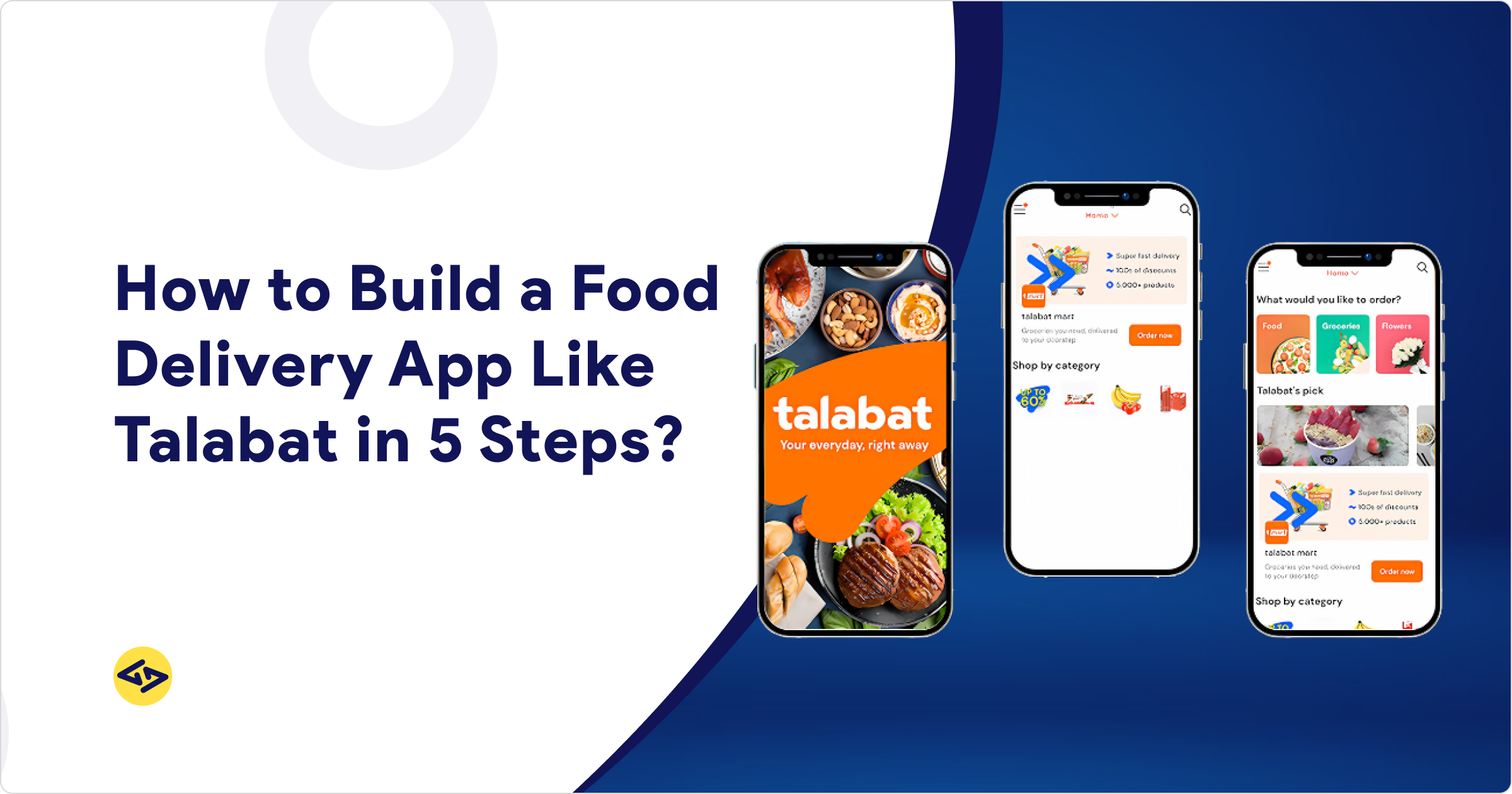
Talabat is not just a food delivery app. It is the dominant on-demand platform across eight MENA countries, with a dark-store grocery network, a drone delivery pilot, an AI-powered shopping assistant, and over 6.5 million active customers placing orders in under 28 minutes on average. Building something competitive means understanding what makes Talabat the benchmark — and then building smarter.
This guide is written for startup founders, product managers, and technical decision-makers who want to build a custom food delivery app like Talabat — not just clone a generic template.
What Is Talabat And Why It’s the Benchmark for MENA?
Talabat is the leading on-demand delivery platform in the Middle East and North Africa. Founded in Kuwait in 2004 (talabat.com), it has grown from a simple food-ordering website into a multi-vertical delivery ecosystem covering food, groceries, pharmacy, flowers, electronics, and pet supplies — all from a single mobile app.
Talabat — Company Snapshot (2026)
| 8
MENA Markets |
6.5M+
Active Customers |
68,000+
Restaurant & Retail Partners |
123,000+
Active Riders |
< 28 min
Avg. Delivery Time |
$2.4B
Q3 2025 GMV |
Source: Talabat IR, Q3 2025 Results | Dubai Financial Market listing, December 2024
| LATEST NEWS
Drone Delivery (Nov 2025): Talabat signed an MoU with UAE technology company K2 to pilot commercial drone delivery for food and groceries in urban UAE environments — the first of its kind in MENA. Talabat AI: A ChatGPT-powered grocery shopping assistant for Talabat Pro subscribers, launched in UAE with plans to expand across Kuwait and Oman. |
What makes Talabat different from a global player like Uber Eats? Localization. Talabat supports Arabic-first interfaces, cash-on-delivery (critical in GCC markets), local payment integrations, and region-specific promotions (Ramadan campaigns, UAE National Day offers).
“Over a quarter of our monthly active users are Talabat Pro subscribers, driving nearly half of total gross merchandise value.” — Talabat Q3 2025 Results
How Talabat Makes Money — The Business Model You Need to Replicate
Before you write a single line of code, understand Talabat’s revenue architecture. Your app will need a monetization strategy built in from day one — not bolted on later.
- Restaurant Commissions (core revenue): Talabat charges partner restaurants 15%–30% per order depending on volume, exclusivity, and category. Premium visibility (featured slots, homepage banners) commands higher commission tiers.
- Delivery Fees: Customers pay a delivery fee per order varying by distance, location, and time of day. This funds rider operations and contributes to per-order margin.
- Talabat Pro (Subscription): A monthly membership offering unlimited free delivery and exclusive discounts. By 2025, over 400,000 users subscribe — these high-frequency users drive nearly 50% of GMV. Build a subscription tier into your MVP.
- In-App Advertising: Restaurants pay for sponsored placements and AI-targeted promotions by cuisine, time, and order history. This contributes 10–12% of Talabat’s total revenue.
- Talabat Mart / Q-Commerce: An inventory-owned dark store network for 15–30 minute grocery delivery. Talabat operates 30+ Mart stores across all seven UAE emirates. Basket value is 1.8× higher than food orders.
- Q-CAAS (Quick Commerce as a Service): Talabat licenses its dark-store management technology to retail partners — turning operational expertise into a B2B revenue stream.
| DEVELOPER’S PERSPECTIVE
Your app should be architected to support multiple revenue streams from v1. Building a commission tracking module, delivery fee engine, and subscription management system as separate microservices will make it far easier to expand monetization later — rather than rebuilding a monolith. |
Must-Have Features in a Food Delivery App Like Talabat
Talabat is three apps in one: a customer app, a restaurant partner dashboard, and a rider app. Here is what matters — and how to prioritize across MVP vs Phase 2 vs Phase 3.
| FEATURE | PANEL | PRIORITY | TALABAT’S IMPLEMENTATION |
|---|---|---|---|
| User registration (email, social, phone OTP) | Customer | MVP | Phone OTP dominant in UAE; social login secondary |
| Restaurant search & filters | Customer | MVP | AI-ranked sorting by order history |
| Detailed menu with images & customizations | Customer | MVP | High-res images mandatory; combo builder essential |
| Real-time GPS order tracking | Customer | MVP | ±2 min accuracy; rider location every 5 seconds |
| Multi-payment: card, Apple Pay, cash on delivery | Customer | MVP | Cash on delivery is critical in GCC — never skip this |
| Arabic / English bilingual interface (RTL) | All Panels | MVP | RTL layout required for UAE App Store approval |
| Push notifications (order & promo) | Customer | MVP | Segmented by order state; personalized timing |
| Restaurant order management dashboard | Restaurant | MVP | Tablet-optimized; sound alerts for new orders |
| Rider dispatch, routing & earnings tracker | Rider | MVP | AI route batching for multi-drop deliveries |
| Ratings & reviews (restaurant + dish level) | Customer | MVP | Photo reviews; AI moderation filters spam |
| Subscription tier (Talabat Pro equivalent) | Customer | Phase 2 | Free delivery + discounts; drives ~50% of GMV |
| Scheduled / pre-order feature | Customer | Phase 2 | Restaurant gets automated timed prep reminder |
| In-app chat (customer ↔ rider / support) | Customer/Rider | Phase 2 | AI bot resolves 70%; human escalation for rest |
| Loyalty / points system | Customer | Phase 2 | Talabat Points redeemable across partner brands |
| Dark store / grocery vertical (Mart) | All | Phase 3 | Requires WMS, inventory mgmt, separate dispatch |
| AI-powered personalized recommendations | Customer | Phase 3 | ML models increase conversion 35%+ |
| In-app advertising platform | Restaurant | Phase 3 | Self-serve ad dashboard; 10–12% of total revenue |
| DEVELOPER’S PERSPECTIVE — UAE-SPECIFIC REQUIREMENTS
RTL support must be at the component level — not just a CSS flip. UAE-popular payment gateways: Checkout.com and Telr. Use Google Maps Platform (Apple Maps coverage is inconsistent in some emirate areas). AWS UAE Region launched in 2022 — use it for data residency compliance. |
How to Build a Food Delivery App Like Talabat: 5 Developer-Reviewed Steps
These aren’t generic startup steps. This is the actual development journey — reviewed from the perspective of what Talabat’s engineering team describes as their core technical priorities: reliability, scalability, and localization.
| 1 | Choose the Right Development Partner — Not Just Any App Agency
Talabat runs a tech team of 480+ engineers, product designers, and data scientists in Dubai. Your development partner must understand the UAE market. Look for a custom food delivery app development company with a live UAE or GCC portfolio, experience with Arabic RTL builds, and knowledge of regional payment gateways. Ask to see their rider dispatch logic and restaurant dashboard — not just the customer-facing UI. |
| 2 | Define Your Three-Sided Marketplace Architecture
Talabat is a three-sided marketplace: customer app, restaurant partner panel, and rider app. These are three distinct products. Define each separately: customer flows, restaurant onboarding, and rider assignment logic. Decide your delivery model early: own riders, third-party fleet, or hybrid. Factor in hyperlocal delivery zones by emirate — delivery economics in Dubai Marina differ from Al Ain. |
| 3 | Select Your Tech Stack Strategically
Talabat uses a microservices architecture hosted on cloud infrastructure — built to handle millions of concurrent orders across eight countries. For your MVP, your stack should be horizontally scalable by design. React Native or Flutter for cross-platform mobile is most cost-effective. Node.js or Go on the backend handles real-time order event streams effectively. Choose Google Maps Platform for geolocation from day one — migrating later is painful and expensive. |
| 4 | Build, Test, and QA Each Integration — Especially Payments
Payment failures are the single most common post-launch complaint. Talabat’s 99% order success rate is a key differentiator it uses in investor materials. Your QA phase must include load testing on the order management system, real-device testing across Android (dominant in UAE’s expat population) and iOS, full end-to-end payment gateway testing including failed transaction recovery, and GPS accuracy testing across Dubai, Sharjah, and Abu Dhabi corridors. |
| 5 | Launch: Acquire Restaurants First, Then Users
Talabat’s growth playbook in every new market started with restaurant supply before customer demand. Before your public launch, sign up 30–50 restaurants in your initial zone. Do a soft launch within one district before going city-wide. For digital marketing in UAE, TikTok and Instagram outperform Facebook for food discovery in the 18–35 demographic. Food influencer partnerships generate authentic, high-converting installs. Learn from the top food delivery apps in UAE before setting your competitive positioning. |
Recommended Tech Stack
Based on Talabat’s published engineering approach and proven patterns across MENA delivery platforms:
| LAYER | RECOMMENDED STACK | WHY |
|---|---|---|
| Mobile (Customer) | React Native or Flutter | Single codebase for iOS + Android; RTL support mature in both |
| Mobile (Rider) | Flutter (preferred) | Better background GPS performance on Android-dominant devices |
| Restaurant Panel | React.js Web App | Tablet browser access works best for restaurant kitchens |
| Backend API | Node.js + Go | Node for API gateway; Go for high-throughput order events |
| Real-Time Layer | Socket.io / Firebase | Order status push and live rider location tracking |
| Database | PostgreSQL + Redis | Postgres for orders/users; Redis for session cache and queues |
| Maps / Geolocation | Google Maps Platform | Best UAE coverage; Distance Matrix API for ETA calculations |
| Payments (UAE) | Checkout.com / Telr | UAE Central Bank compliant; supports AED natively |
| Cloud | AWS (UAE Region) | AWS launched UAE region in 2022; data residency compliance |
| Notifications | Firebase Cloud Messaging | Free, reliable, works seamlessly with React Native + Flutter |
| DEVELOPER’S PERSPECTIVE — ARCHITECTURE DECISION
Build with microservices or a modular monolith from day one — not a traditional monolith. When you hit 10,000 daily orders, your order service, payment service, and rider dispatch service need to scale independently. A monolith makes that nearly impossible without a costly rewrite. |
Food Delivery App Development Cost — Realistic 2026 Estimates
Cost varies based on geography of your development team, feature scope, and platform choice. Realistic breakdown for a Talabat-like build:
| TIER | FEATURES INCLUDED | EST. COST | TIMELINE |
|---|---|---|---|
| MVP / Starter | Customer app + restaurant panel, basic ordering, COD + card, GPS tracking, push notifications | $20,000 – $45,000 | 3–5 months |
| Mid-Range ★ | All MVP + rider app, live tracking, subscription tier, Arabic/English, ratings, promo engine | $50,000 – $100,000 | 5–8 months |
| Full-Scale | All above + grocery vertical, in-app ads, AI recommendations, analytics dashboard, dark store ops | $100,000 – $250,000+ | 9–14 months |
Key Cost Drivers to Watch
- Platform choice: Native iOS + Android costs 30–40% more than cross-platform Flutter / React Native for equivalent features.
- RTL / Arabic localization: Budget $5,000–$15,000 extra for proper RTL layout, Arabic typography, and locale-specific UX testing.
- UAE payment gateways: Checkout.com, Telr, and Payfort require backend work and compliance review — not a simple plug-in.
- Google Maps API costs: At scale, Maps Platform billing adds up. Budget API costs into your unit economics from day one.
- Post-launch maintenance: Expect 15–20% of development cost annually for bug fixes, OS updates, and feature iterations.
For a deeper cost breakdown: How Much Does It Cost to Build an App Like Talabat?
What Talabat Gets Right — And What Your App Must Replicate
These competitive advantages are what pure clone scripts completely miss. These must be deliberate product decisions:
- AI-Powered Restaurant Sorting: Order listings are personalized by order history, time of day, and predicted preference. Build this as a recommendation engine in Phase 2 — it increases conversion by over 35%.
- Ramadan & Regional Campaign Infrastructure: Your CMS and promo engine must support time-limited, geo-targeted campaigns without developer intervention. This is essential for UAE market.
- Dark Store / Talabat Mart Model: The fastest-growing vertical in on-demand delivery. A network of inventory-owned micro-fulfillment hubs delivers groceries in under 30 minutes. Plan this as a strategic expansion path even if not in v1.
- 99% Order Success Rate: Comes from redundant payment processing, smart retry logic, and proactive rider availability management. Reliability is a product feature, not just an ops concern.
- Drone Delivery Infrastructure (Emerging): Talabat’s tDrone is the first commercial food delivery drone service in MENA. Architect your dispatch system to eventually accommodate non-rider delivery types.
Final Thoughts
Talabat’s journey from a Kuwaiti startup in 2004 to a $12 billion publicly listed company on the Dubai Financial Market is a masterclass in regional focus, relentless localization, and building technology that solves real problems in specific markets. Its success was not built on being a global brand — it was built on understanding that a customer in Abu Dhabi ordering shawarma at 11pm has different expectations than someone in London ordering a burger.
If you want to make an app like Talabat, start with that same discipline: pick your city, lock in your restaurant supply, and build an experience that feels native to your market. Start building your food app with iCoderz.