Food delivery apps have transitioned from a luxury to a lifestyle necessity. Whether it’s a late-night craving or a busy workday lunch, the ability to get food delivered anytime, anywhere has become the “new normal.” At the forefront of this revolution is Uber Eats.
For entrepreneurs and startups, analyzing the Uber Eats business model offers a masterclass in scalability, logistics, and monetization. But how exactly does this giant operate, and more importantly, how does Uber Eats make profit?
In this comprehensive case study, we will break down the business plan, revenue streams, and the technology that powers Uber Eats, while exploring how you can build a similar solution with iCoderz Solutions.
What is Uber Eats? (The Overview)
Launched in 2014, Uber Eats is a three-sided marketplace connecting drivers, restaurant partners, and customers. Leveraging the existing fleet of Uber drivers, it quickly became one of the most efficient food delivery services globally.
Key Stats & Interesting Facts:
- Global Scale: Operational in over 11,000 cities across 45 countries with 1.5 million+ merchant partners.
- The India Pivot: In a strategic move to cut losses, the Uber Eats business in India was bought by Zomato in 2020. Uber received a 9.99% stake in Zomato, allowing them to remain profitable in the region without operational headaches.
- Autonomous Future: Uber is now actively testing autonomous delivery robots in cities like Austin, Dallas, and Osaka, signaling a shift away from purely human-dependent logistics.
How UberEats Works: The Operational Model
The Uber Eats business strategy relies on a “Hyperlocal On-Demand” model. It utilizes an aggregation policy where it doesn’t own any restaurants or commercial kitchens. Instead, it acts as the technological bridge.
- Browse: Customers scroll through local restaurant menus using the app.
- Order: The user selects items and pays via the app (including delivery & service fees).
- Prepare: The restaurant accepts the order via their Uber tablet and prepares the food.
- Deliver: An Uber delivery partner (or autonomous robot) picks it up and navigates to the customer.
- Track: The customer tracks the arrival in real-time until the doorbell rings.
Learn more about building a similar platform: How to Start a Food Delivery Business
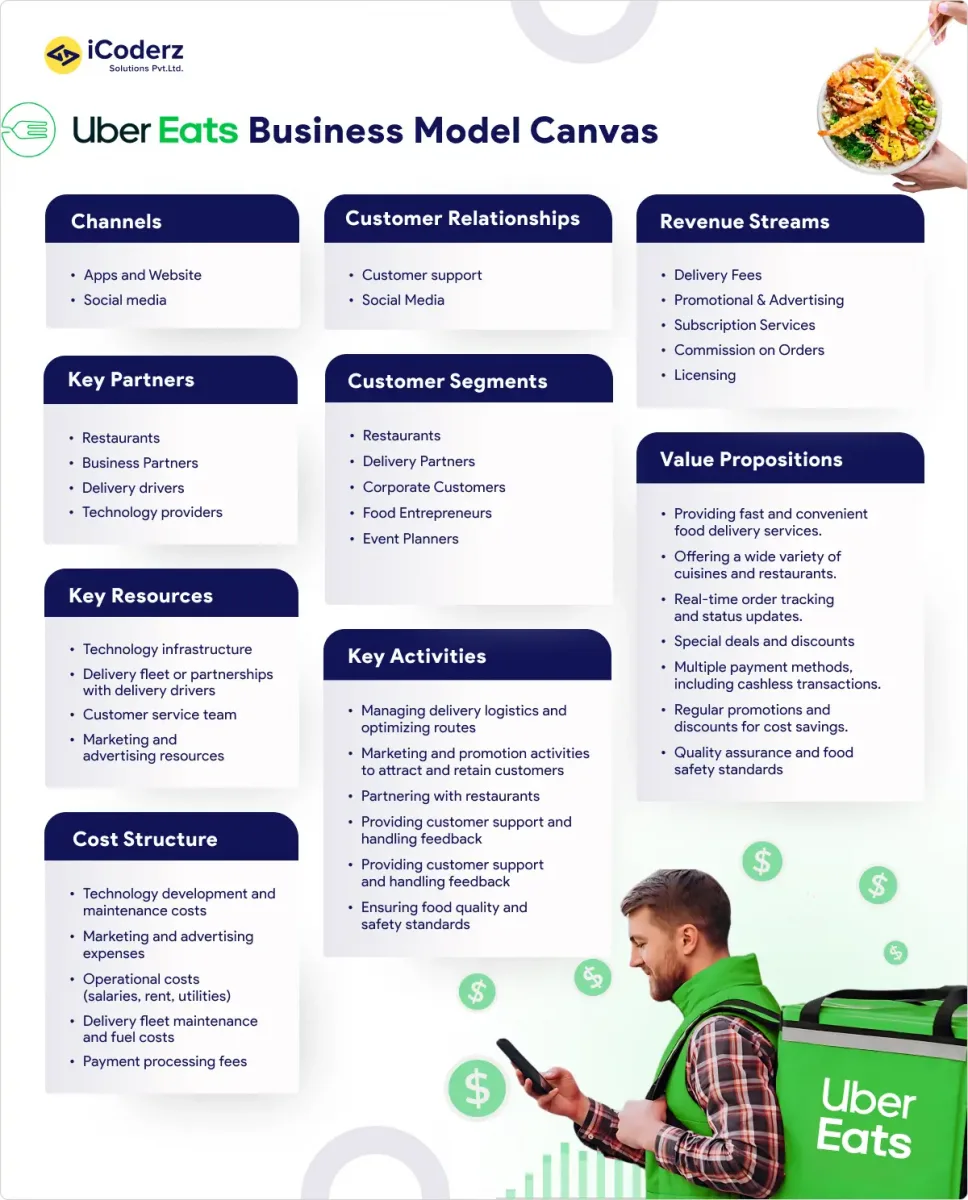
Uber Eats Business Model Canvas (Deep Dive)
To truly understand the value proposition, we must look at all 9 building blocks of the business model canvas Uber Eats relies on.
1. Customer Segments:
Uber Eats serves three distinct groups:
Users (people wanting convenient food or grocery delivery), Restaurants (businesses needing delivery infrastructure and more sales), and Delivery Partners (gig workers seeking flexible income).
2. Value Propositions:
For users, the value lies in speed, a massive variety of cuisines, and real-time tracking. For restaurants, Uber Eats offers access to a massive user base (marketing) and handles the logistics they cannot manage themselves. For drivers, it offers instant pay and the ability to work on their own schedule.
3. Channels:
The primary channels are the mobile apps (iOS and Android) and the website (UberEats.com). However, they also use aggressive digital marketing (Social Media, Email) and word-of-mouth referrals to acquire users.
4. Customer Relationships:
The relationship is primarily automated and self-service via the app. However, they maintain trust through automated customer support (AI Chatbots), social media engagement, and a robust rating and review system to ensure quality.
5. Revenue Streams:
Uber Eats generates cash flow through Commission Fees (15-30% from restaurants), Delivery & Service Fees (paid by customers), Uber Ads (sponsored listings for restaurants), and Subscriptions (Uber One recurring monthly revenue).
6. Key Resources:
The primary competitive advantage of Uber Eats lies in its Network Effect—the sheer volume of active drivers and users makes the platform faster and more reliable than smaller competitors. Other resources include their Technology Platform (matching algorithms), global brand reputation, and massive database of user analytics.
7. Key Activities:
The company focuses on App Development & Maintenance, Marketing & User Acquisition, Logistics Optimization (Routing algorithms), and Partner Management (B2B Sales to restaurants).
8. Key Partners:
The ecosystem relies on Restaurants & Retailers (Supply), Delivery Drivers (Logistics), Payment Processors, and Investors who fund expansion.
9. Cost Structure:
The major costs involve Technological Infrastructure (Server costs & R&D), Marketing & Advertising spend, Driver Payouts & Incentives, and managing Legal & Regulatory costs in various markets.
How Does Uber Eats Make Money? (Revenue Streams)
Many ask, how does Uber Eats make profit when delivery margins are so thin? The answer lies in a diversified revenue strategy that goes beyond simple delivery fees.
1. Commission Fees from Restaurants
This is the primary income source. The Uber Eats commission fee for restaurants typically ranges from 15% to 30% of the order value, depending on whether the restaurant uses Uber’s drivers or their own staff.
2. Delivery and Service Fees
Customers pay a delivery fee (variable based on distance) and a service fee (percentage of subtotal). In high-demand situations, a “Small Order Fee” or “Surge Pricing” may apply.
3. Uber Ads
Uber Eats allows restaurants to pay for visibility. Through “Sponsored Listings,” restaurants appear at the top of search results. This advertising model is highly profitable as it has zero operational cost for Uber.
4. Uber One Subscription
To increase customer retention, Uber launched Uber One. For a monthly fee, users get $0 delivery fees and discounts on orders. This recurring revenue model stabilizes cash flow and locks users into the ecosystem.
5. Virtual Restaurants (Ghost Kitchens)
Uber Eats utilizes data to identify food gaps in specific neighborhoods. They then encourage restaurants to launch “Virtual Brands”—delivery-only menus that operate out of existing kitchens to maximize kitchen utility.
Revenue Analysis: Financial Performance (2024-2025)
According to Uber’s Fourth Quarter and Full Year 2024 Results and the 2025 Merchant Impact Report, the Delivery segment has evolved from a cash-burning venture into a profit engine.
- Gross Bookings: The Delivery segment generated $20.1 Billion in Gross Bookings in Q4 2024 alone (up 18% Year-over-Year).
- Revenue Growth: Uber Eats revenue for the delivery segment hit $3.8 Billion for the quarter (up 21% YoY).
- Profitability (EBITDA): The delivery segment posted an Adjusted EBITDA of $727 Million, a massive 53% increase from the previous year.
- Economic Impact: Uber reported that in 2024, the platform generated an estimated $9.4 billion in NEW revenue for the US economy that wouldn’t have occurred otherwise.
Key Features That Drive Uber Eats’ Success (Must-Haves for Your App)
Beyond the business model, the app’s success lies in its user-centric features. If you are planning to build a clone, these are non-negotiable:
- Customizable Orders: Uber Eats allows customers to modify menu items for allergies or dietary preferences (e.g., “No onions,” “Extra spicy”). This flexibility reduces order anxiety and increases conversion rates.
- Real-Time Tracking: The “manage expectations” feature. Customers can see the driver move on the map, which psychologically reduces the frustration of waiting.
- Scheduled Deliveries: The ability to order food hours or days in advance for a specific delivery window.
- Contactless & Hygienic Delivery: Post-pandemic, safety remains a priority. Features that allow users to request “Leave at door” are now standard requirements for any food delivery app.
What Startups Can Learn From Uber Eats
If you are planning to build a hyperlocal food delivery app, performing a quick Uber Eats SWOT analysis reveals massive strengths in technology but threats from local competitors. Here are the key takeaways:
- Start Hyperlocal: Uber didn’t launch everywhere at once. They mastered specific cities before expanding.
- Navigate Regulations Early: As Uber Eats discovered, every city has different labor laws and food safety regulations. Your Uber Eats business plan must be flexible enough to adapt to local government restrictions regarding gig-workers and delivery zones.
- Don’t Ignore Ads: Build an advertising module into your app early. Allowing restaurants to pay for visibility is a high-margin revenue stream.
- Diversify Beyond Food: Uber Eats is now delivering groceries, alcohol, and retail items. Your app should support multiple vendor types, not just restaurants.
Why Choose iCoderz to Build an App Like Uber Eats?
Building a clone of a giant like Uber Eats requires robust technology, scalable architecture, and a deep understanding of the market. This is where iCoderz Solutions steps in.
We are a leading Food Delivery App Development Company with years of experience launching successful on-demand startups.
Why Startups Choose Us:
- 100% Customizable: We don’t just give you a template; we brand it to your vision.
- Dedicated Support: We support you from ideation to App Store launch.
- Try Ready-Made Solution: Want to launch ASAP? Check out Deonde, our readymade Uber Eats Clone solution. It offers all essential features—from real-time tracking to secure payment gateways—allowing you to get your business up and running in days, not months.
How Much Does It Cost?
The cost to build a food delivery app like Uber Eats varies based on features and platform (iOS/Android).
- A basic MVP (Minimum Viable Product) might start around $10,000 – $15,000.
- A fully featured custom solution with advanced admin panels and dedicated driver apps can range from $25,000 to $50,000+.
For a detailed breakdown, check our guide on the Top 5 Food Delivery Apps in USA to see feature comparisons.
Conclusion
The Uber Eats business model is a testament to the power of the platform economy. By connecting supply and demand with seamless technology, they have created a revenue engine that continues to grow.
If you are ready to enter this booming market, you don’t need to build from scratch. Whether you need a simple MVP or a complex On-Demand Food Delivery App Like Uber Eats, iCoderz has the expertise to make it happen.
Ready to launch your food delivery startup? Contact iCoderz Solutions Today