
Planning to build a SaaS product in 2026? You’re entering the right market at the right time. The global SaaS market is on track to cross $1.48 trillion by 2034 (Fortune Business Insights), and the companies that move early are the ones that capture it.
But before you write a single line of code, you need a clear answer to one very practical question: how much does SaaS app development actually cost?
Honestly: anywhere from $15,000 for a lean MVP to $200,000+ for an enterprise-grade platform. That range is wide because SaaS product development cost depends entirely on the decisions you make — about features, team type, architecture, and scope.
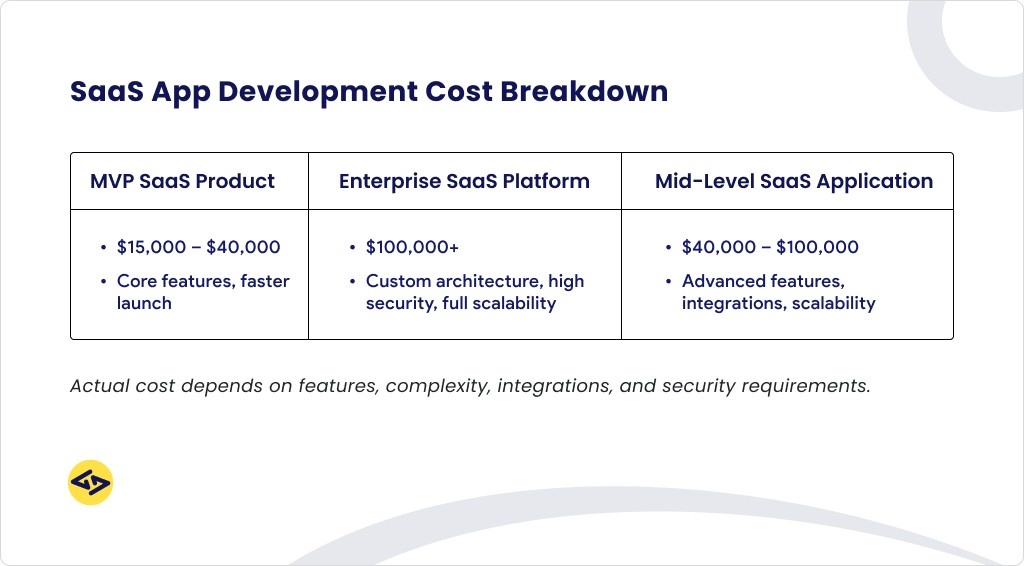
This guide breaks every variable down so you can budget with confidence and avoid costly surprises.
What Is SaaS Development?
SaaS (Software as a Service) development is the process of building cloud-based applications that users access via subscription — think Slack, Salesforce, or Zoom.
Unlike traditional installed software, a SaaS platform is centrally hosted and maintained by the vendor, making it inherently scalable and easier to update across all users at once.
Single-Tenant vs. Multi-Tenant SaaS
| Architecture | Description | Best For |
| Single-Tenant | One dedicated instance per customer | High-security enterprise clients |
| Multi-Tenant | Shared infrastructure, isolated data per client | Scalable B2C and B2B SaaS products |
Most modern SaaS platforms are multi-tenant — it’s more cost-efficient to build, maintain, and scale. Single-tenant architectures cost significantly more due to the overhead of maintaining dedicated infrastructure per client. If you’re building for enterprises with strict data residency requirements, single-tenant may be non-negotiable; otherwise, multi-tenant is almost always the smarter default.
Horizontal vs. Vertical SaaS
- Horizontal SaaS serves any industry (e.g., project management tools, CRMs). Bigger total market, more competition.
- Vertical SaaS targets a specific niche (e.g., dental practice management, salon booking software). Faster path to becoming the go-to solution in your space, usually with lower customer acquisition costs.
Understanding which model you’re building — and for whom — is the first cost decision you’ll make.
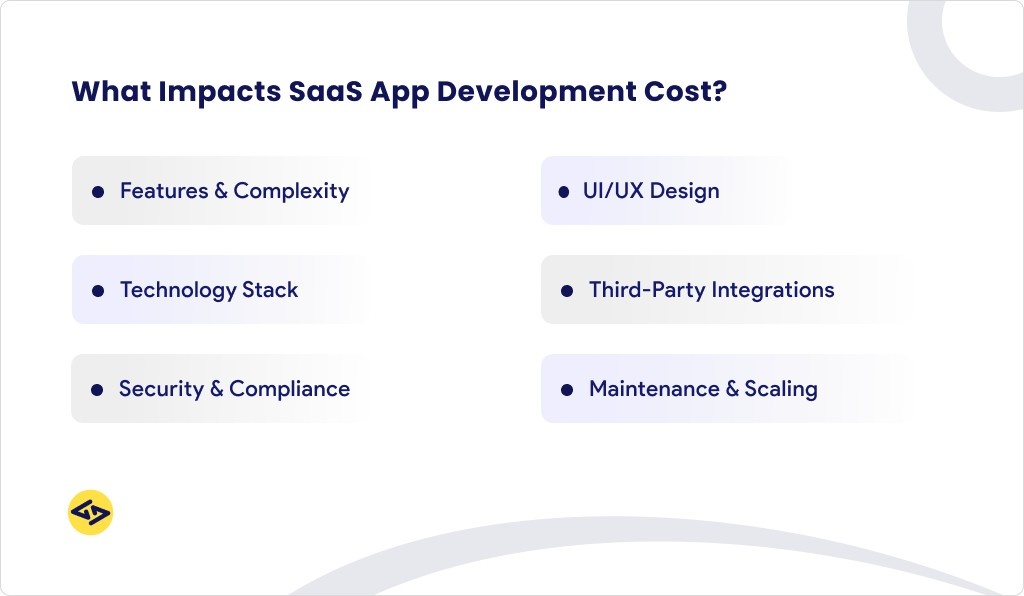
Factors That Affect SaaS Product Development Cost
Understanding what drives cost lets you prioritize smart and avoid budget blowouts.
Feature Complexity
The more functionality you pack into your initial release, the higher the SaaS development cost. A simple SaaS application with authentication, dashboards, and basic reporting can be built for $25,000–$60,000. Add AI-driven recommendations, real-time collaboration, or advanced analytics and you’re looking at $200,000+. A practical rule of thumb: every major feature module adds 3–6 weeks of development time.
Third-Party Integrations
Every API connection — Stripe for billing, Twilio for messaging, Salesforce for CRM sync — adds both time and cost. Complex integrations can add $2,000–$10,000 each depending on API depth. Plan your integration list before scoping begins; surprises here are one of the most common budget overruns on SaaS projects.
User Roles & Permissions
Basic SaaS products operate with 2–3 user roles. Enterprise platforms often require granular RBAC (Role-Based Access Control) with custom permission hierarchies — a meaningful cost multiplier in back-end development complexity and QA time.
Hosting & Cloud Infrastructure
Cloud hosting on AWS, GCP, or Azure adds recurring costs. A simple MVP runs on $50–$200/month. As your user base scales, infrastructure costs can climb to $5,000+/month — and the architecture decisions made during development directly determine how expensive scaling becomes later.
Security & Compliance
Depending on your industry, you may need SOC 2, HIPAA, GDPR, or ISO 27001 compliance. These aren’t optional extras — they’re gating requirements for enterprise sales cycles and regulated markets. Build compliance in from the start; retrofitting it post-launch costs far more in both time and money.
UI/UX Design
Poor UX drives churn faster than almost any other factor. Nearly 70% of new SaaS users stop using a product within three months (Hostinger) — and friction in the product experience is the most cited cause. Investing in quality front-end development and professional design from the start isn’t optional; it’s your single most important retention lever.
Backend Architecture
Your back-end development decisions — microservices vs. monolith, REST vs. GraphQL, relational vs. document databases — have long-term implications on both scalability and cost. Microservices offer flexibility at scale but cost 30–40% more to build initially. For most MVPs, a well-structured monolith is the faster, cheaper, and smarter starting point.
SaaS Platform Development Cost by Stage
Every SaaS application goes through distinct phases. Here’s what to budget at each:
| Stage | What’s Included | Estimated Cost | Timeline |
| Discovery & Planning | Requirements, technical architecture, product roadmap | $3,000–$10,000 | 2–4 weeks |
| UI/UX Design | Wireframes, prototypes, design system | $5,000–$20,000 | 3–6 weeks |
| MVP Development | Core features, auth, billing, basic integrations | $15,000–$60,000 | 2–4 months |
| Full Product Build | Advanced features, all integrations, QA, scalability | $60,000–$250,000+ | 4–12 months |
| DevOps & Deployment | CI/CD setup, cloud config, environments, go-live | $3,000–$10,000 | 1–2 weeks |
| Software Support & Maintenance | Bug fixes, security patches, updates, feature additions | $1,500–$8,000/month | Ongoing |
Budget Rule of Thumb: Annual SaaS maintenance typically costs 15–20% of your initial development investment. Plan for it upfront — it’s not an afterthought; it’s what keeps your product secure, performant, and competitive after launch.
Many startups skip the discovery phase to save money. This is one of the costliest mistakes in SaaS development. A proper discovery phase typically prevents 3x its cost in rework by catching architectural mistakes before they become expensive technical debt that’s painful to unwind later.
SaaS Development Pricing by Team Type
Your choice of development team is one of the biggest cost levers available to you. Here’s an honest breakdown of the SaaS development pricing landscape in 2026.
Hourly Rate Comparison
| Team Type | Hourly Rate | Pros | Cons |
| US In-House Team | $100–$150+/hr | Full control, best communication | Highest cost, slow to scale |
| US/UK Freelancers | $75–$100/hr | Flexible, specialized skills | Coordination risk, inconsistent quality |
| Eastern Europe Agency | $45–$85/hr | Strong engineering culture, closer timezone to Europe | Higher than India |
| Latin America Agency | $40–$80/hr | US timezone alignment, good English | Variable quality |
| Offshore SaaS Development (India) | $25–$60/hr | Cost-effective, full teams, proven delivery | Timezone gap — manageable with async workflows |
Total Cost Comparison: Mid-Range SaaS MVP
| Team Type | Estimated MVP Cost |
| US In-House | $150,000–$250,000 |
| Eastern Europe Agency | $60,000–$120,000 |
| Offshore Agency (India) | $20,000–$60,000 |
Working with an experienced software development outsourcing partner gives you enterprise-level output at a fraction of Western market rates.
The key is choosing a team with a proven SaaS track record — not just the lowest hourly number on a proposal. Before you decide, it’s also worth understanding how developer hiring costs break down by role and region , iCoderz has a full guide on exactly that.
Real-world note: Slack outsourced its early UI/UX and front-end development to MetaLab. That decision accelerated their launch and freed their internal team to focus on product strategy — not execution details.
B2B vs. B2C SaaS: How It Affects Cost and Complexity
Your target audience dramatically shapes your architecture, feature requirements, and total SaaS application development cost. iCoderz serves clients across healthcare, retail, logistics, fintech, and more — and the cost profile shifts significantly depending on which vertical you’re building for.
B2B SaaS Development
B2B products are typically more complex and expensive to build. Large enterprises hold over 60% of the global SaaS market share (Fortune Business Insights) — which means enterprise-grade features are increasingly table stakes, not premium add-ons. A typical B2B SaaS platform needs:
- Multi-tenant architecture with organization-level data isolation
- Admin dashboards for team, billing, and permission management
- Enterprise SSO (SAML 2.0, Okta, Azure AD integration)
- Audit logs and compliance-ready data architecture
- REST or GraphQL API access for integration with customer systems
- White-labeling options for reseller or partner channels
For larger B2B requirements, iCoderz also offers enterprise solution development — covering complex architecture, legacy integrations, and high-security environments.
Typical B2B SaaS Development Cost: $40,000–$120,000+ for a solid MVP
B2C SaaS Development
B2C SaaS lives or dies on onboarding speed and self-serve growth mechanics. Your users won’t wait for a demo call — they expect to sign up, see value, and convert in minutes. A competitive B2C SaaS needs:
- Frictionless signup (social login, email magic links, SSO)
- In-app onboarding flows with progressive disclosure
- Self-serve subscription billing with free trials and tiered plans
- Mobile-responsive design or native mobile apps
- Infrastructure that handles traffic spikes without degrading performance
Typical B2C SaaS Development Cost: $20,000–$80,000+ for MVP
One strategic consideration that applies to both models: a 5% improvement in customer retention drives 25%+ profit growth over time. The UX, onboarding, and engagement decisions made during development directly determine your long-term revenue trajectory.
How to Build a SaaS MVP on a Tight Budget?
You don’t need $200,000 to validate your idea. 90% of startups fail (CB Insights), most often because they built too much before proving real demand. A well-scoped MVP development approach lets you test your core assumptions with real users before committing your full budget.
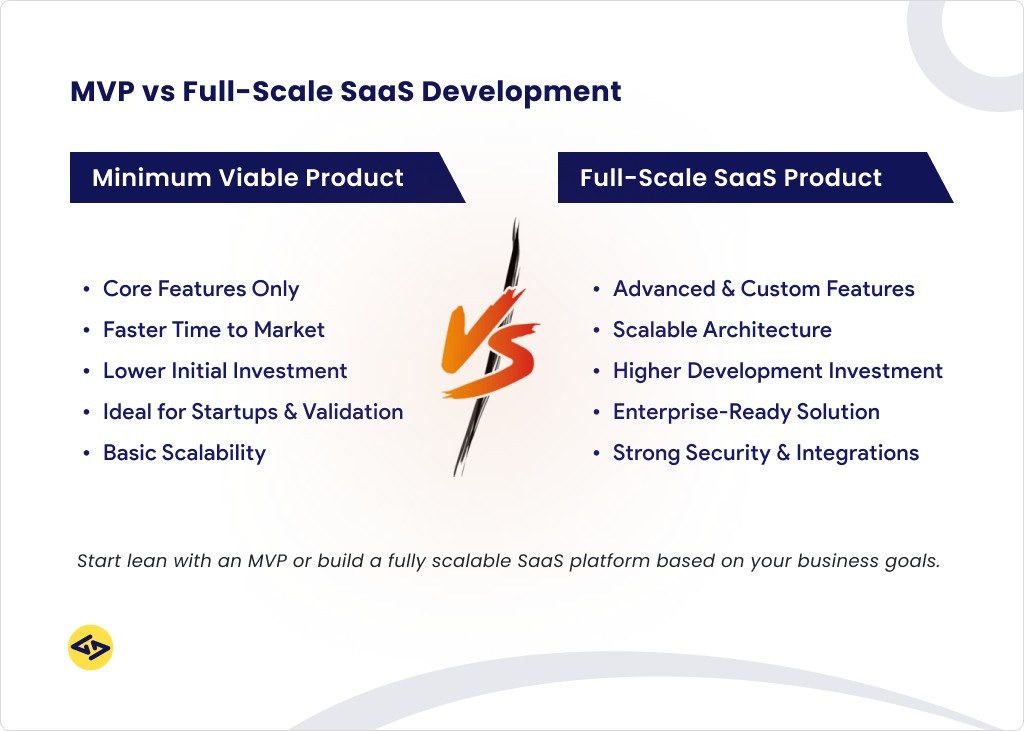
The leanest SaaS MVPs that have gone on to scale share one thing: they did less, better. And once you’ve launched, knowing how to improve your MVP after launch is just as important as building it right the first time.
The Lean SaaS MVP Approach
Step 1: Define Your Riskiest Assumptions
Write down the 3–5 things that must be true for your SaaS business to work. Build only what’s needed to test them. Everything else is a distraction until validated.
Step 2: Cut Features, Not Quality
Use the MoSCoW framework (Must Have / Should Have / Could Have / Won’t Have) to scope ruthlessly before a single line of code is written. Your MVP needs exactly one core workflow done exceptionally well.
Step 3: Use a Proven Tech Stack
Avoid bleeding-edge technology at the MVP stage. A battle-tested stack — React + Node.js + PostgreSQL + AWS — moves faster, costs less, and makes future hiring far easier.
Step 4: Leverage SaaS Infrastructure Tools
Don’t build what you can buy. Stripe for subscription billing, Auth0 for authentication, Intercom for in-app support, SendGrid for transactional email — these services save 2–4 months of development time on your first release.
Step 5: Consider a Full-Stack Developer for MVP Speed.
For early-stage MVPs on tight budgets, a full-stack developer who can own both front-end and back-end reduces coordination overhead and significantly speeds up iteration. It’s a cost-smart move at the MVP stage.
Step 6: Beta Before Public Launch
Run a closed beta with 20–50 real users before going public. Their raw feedback is worth more than months of internal assumption-making. Most SaaS churn happens in the first 90 days — what you learn in beta directly protects your post-launch retention numbers.
SaaS MVP Cost by Scope
| MVP Scope | Features Included | Estimated Cost |
| Micro MVP | Auth, 1 core workflow, basic dashboard | $10,000–$20,000 |
| Standard MVP | Auth, 3–5 features, payments, basic reporting | $25,000–$60,000 |
| Funded Startup MVP | Full UX, integrations, admin panel, onboarding flows | $60,000–$120,000 |
Hidden SaaS Costs to Budget For: Once live, plan for $200–$500/month in third-party tools (monitoring, analytics, email, error tracking). These are real, recurring costs that most first-time founders forget to account for upfront.
Why Build Your SaaS with iCoderz?
At iCoderz, we’ve helped 200+ startups and product companies across healthcare, retail, logistics, fintech, and more bring their SaaS ideas to life — from lean MVPs validated in 60 days to enterprise-scale platforms serving thousands of paying users.
Here’s what you get when you build with us:
- ✅ End-to-end SaaS expertise — strategy, design, development, and DevOps under one roof
- ✅ Transparent, fixed or milestone-based pricing — no hidden costs, no surprise overruns
- ✅ Scalable-first architecture — built for where you’re going, not just where you are today
- ✅ Post-launch software support & maintenance — retainers, feature roadmaps, and SLA-backed support
- ✅ Full tech stack coverage — React, Next.js, Node.js, Python, AWS, Docker, Kubernetes
- ✅ 50–70% cost advantage over US/UK teams, with zero compromise on code quality
Whether you need a custom SaaS platform, an MVP built in 60 days, a full software product, or an enterprise solution, our team has delivered it before, and we’ll do it right for you.
Get a Free SaaS Development Estimate →
Frequently Asked Questions
How much does it cost to build a SaaS application in 2026?
The cost to build a SaaS application in 2026 ranges from $15,000 for a minimal MVP to $500,000+ for an enterprise platform. Most early-stage SaaS products fall in the $25,000–$100,000 range, depending on features, integrations, and the development team you choose.
How long does SaaS application development take?
A lean SaaS MVP typically takes 3–6 months from kickoff to launch. A full-featured product can take 6–12 months or more depending on the scope. Sprint-based delivery means you see working software every 2 weeks — not months of silence followed by a big reveal.
What tech stack does iCoderz use for SaaS development?
We work with modern, proven stacks tailored to your use case — React.js / Next.js on the front end, Node.js or Python on the back end, PostgreSQL or MongoDB for data, and AWS or GCP for cloud infrastructure. We choose what’s right for your use case, not a one-size-fits-all template.
What is the cheapest way to build a SaaS product?
The most cost-effective approach that still delivers a viable product is a micro MVP — scoped to one core workflow, built with a proven tech stack, and supplemented with third-party services (Stripe, Auth0, Intercom) rather than custom-built solutions. With an offshore development partner like iCoderz, this can start at $15,000–$20,000.
Do you offer post-launch SaaS maintenance?
Yes. Our software support & maintenance retainers start at $1,500/month and include bug fixes, security patches, performance monitoring, and ongoing feature development. We’re with you after go-live, not just before it.
Can you build a SaaS product for a fixed price?
For well-defined scopes (like a standard MVP), yes — we offer fixed-price engagements so you know exactly what you’re paying before work begins. For evolving or complex products, a time-and-materials model gives more flexibility. We discuss both options during your free consultation.
How do you handle security and compliance for SaaS products?
Security is built in from day one. We implement industry-standard encryption, OAuth2/JWT authentication, RBAC, and environment hardening as standard practice. For products requiring HIPAA, GDPR, or SOC 2 compliance, we include the necessary architecture and documentation planning from the discovery phase.
What hidden costs should I budget for in SaaS development?
Beyond development, budget for cloud hosting ($50–$5,000+/month depending on scale), third-party SaaS tools ($200–$500/month), annual security audits, compliance renewals, and ongoing maintenance at 15–20% of your original build cost per year. We map all of these out during discovery so nothing catches you off guard.
Have a SaaS idea you’re ready to build? Contact iCoderz today — free consultation, no obligation.