| ⚡ Quick Answer
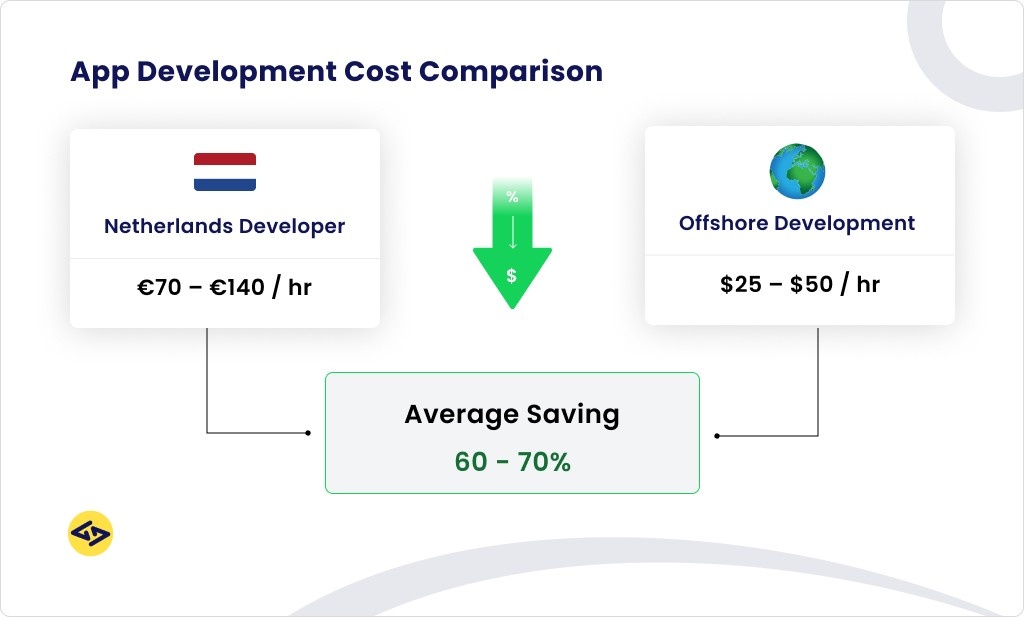
Mobile app development in Netherlands costs €20,000–€300,000+ when built locally, depending on complexity. Offshore development with a quality partner typically delivers the same quality for 60–70% less — $15,000–$140,000. Dutch developer hourly rates range from €70 to €140. Most Dutch businesses now use offshore development to control app development cost in the Netherlands without sacrificing GDPR compliance or local market requirements. |
The Netherlands has 11,301 active tech companies, raised €2.64 billion in venture capital in 2025, and counts 25.3 million active mobile connections — more than its total population (Datareportal, Digital 2025 Netherlands). Mobile is not optional here. It is infrastructure.
Yet the first thing most Dutch businesses discover when planning a mobile app is that quality local development is expensive. A medium-complexity app built by a Dutch team can cost €80,000 to €160,000 or more. Enterprise projects regularly exceed €250,000. The budget gap is real — and it is the primary reason Dutch businesses are increasingly turning to trusted offshore development partners.
This guide breaks down every cost factor specific to the Dutch market, gives you verified rate benchmarks, and explains how Dutch businesses are building enterprise-quality apps at 60 to 70 percent below local rates — without compromising on GDPR compliance, iDEAL and Wero payment integration, or Dutch UX standards.
What Does Mobile App Development Cost in Netherlands?
The mobile app development cost in Netherlands depends primarily on who builds it and how complex it is. Local teams charge significantly more than offshore partners — but the quality gap has closed substantially for businesses that choose the right partner.
Local Dutch Developer Hourly Rates in 2026
Dutch developer rates sit among the highest in Western Europe, driven by high living costs in Amsterdam and Utrecht, strong demand, and limited supply of senior mobile engineers. The average salary for a senior software engineer in Amsterdam is approximately €75,000 per year (Glassdoor Netherlands, 2025), with total employment costs pushing the effective rate to clients considerably higher.
| Developer Type | Hourly Rate (EUR) | Approx. (USD) | Typical Use |
|---|---|---|---|
| Mid-Level Developer | €70–€95/hr | $77–$105/hr | Standard apps, feature development |
| Senior Developer | €95–€140/hr | $105–$154/hr | Complex, fintech, AI, enterprise |
| Full-Service Agency | €100–€150/hr | $110–$165/hr | End-to-end: PM, design, dev, QA |
| Freelancer (Netherlands) | €50–€90/hr | $55–$99/hr | Variable quality — no built-in QA or PM |
A mid-complexity app requiring approximately 2,500 development hours costs €175,000 to €350,000 when built by a full-service Dutch team — before design, project management, QA, and first-year maintenance.
| 📊 Market Context
Software developers now represent 6.5% of the total Dutch workforce — one of the highest concentrations in Europe. The Netherlands ranks #1 globally for English proficiency as a second language (EF English Proficiency Index 2024) and 8th in the Global Innovation Index 2024. High talent demand and limited supply are the primary drivers of elevated local development costs. |
Offshore Development: Same Quality, 60–70% Less
India-based development partners serving Dutch and European clients typically charge $25 to $50 per hour for senior-level teams with strong English-language communication. At $35 per hour, the same 2,500-hour project costs approximately $87,500 — a saving of 60 to 70 percent compared to local development.
The critical distinction is not geography — it is whether the partner understands Dutch-specific regulatory requirements: GDPR and UAVG compliance, iDEAL and Wero payment integration, and the bilingual Dutch-English UX expectations of Dutch users.
| Location | Hourly Rate | 2,500-Hour Project | Quality Tier |
|---|---|---|---|
| Netherlands (local agency) | €70–€140/hr | €175,000–€350,000 | High |
| UK / Germany | $80–$130/hr | $200,000–$325,000 | High |
| Eastern Europe | $40–$70/hr | $100,000–$175,000 | High |
| India (reputable firm) | $25–$50/hr | $62,500–$125,000 | High (with right partner) |
Cost by App Type and Complexity
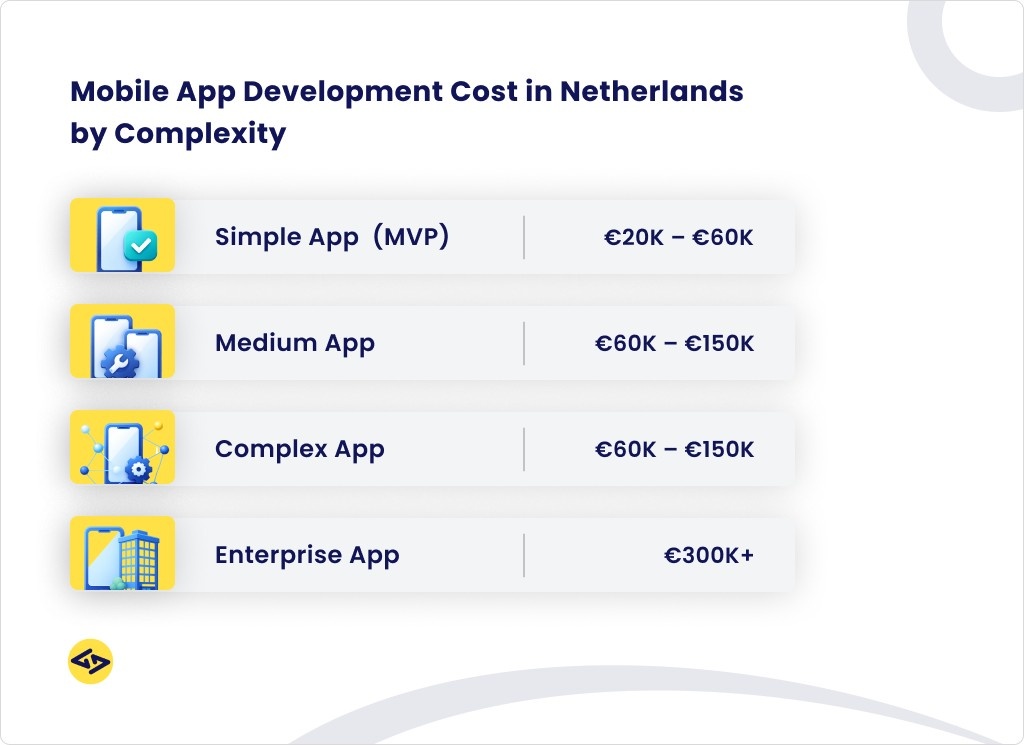
Complexity is the single largest cost driver in any app project. Here are realistic ranges verified against current Dutch market data for 2026.
| App Type | Examples | Timeline | Local (NL) | Offshore (India) |
|---|---|---|---|---|
| Simple / MVP | Booking tool, internal utility, single-feature app | 2–4 months | €20,000–€60,000 | $15,000–$30,000 |
| Medium | Marketplace, e-commerce, multi-user platform | 4–7 months | €60,000–€150,000 | $30,000–$70,000 |
| High Complexity | Fintech, healthtech, AI-powered, real-time logistics | 7–12 months | €150,000–€300,000 | $70,000–$140,000 |
| Enterprise | Multi-region, deep integrations, IoT, wearable sync | 12+ months | €300,000+ | $140,000+ |
| 💡 Pro Tip: Start with an MVP
The majority of successful Dutch apps launched as MVPs first. A focused MVP built in 10 to 16 weeks gives you real user feedback from the Dutch market before you commit to full product investment — the most reliable way to reduce budget risk on your app development cost in the Netherlands. |
7 Cost Factors Specific to the Dutch Market
Several factors specific to the Netherlands add meaningful cost to any app project — and are largely absent from generic app cost guides. Understanding these upfront prevents budget surprises.
1. Flutter vs. Native: The Right Tech Stack for Dutch Apps
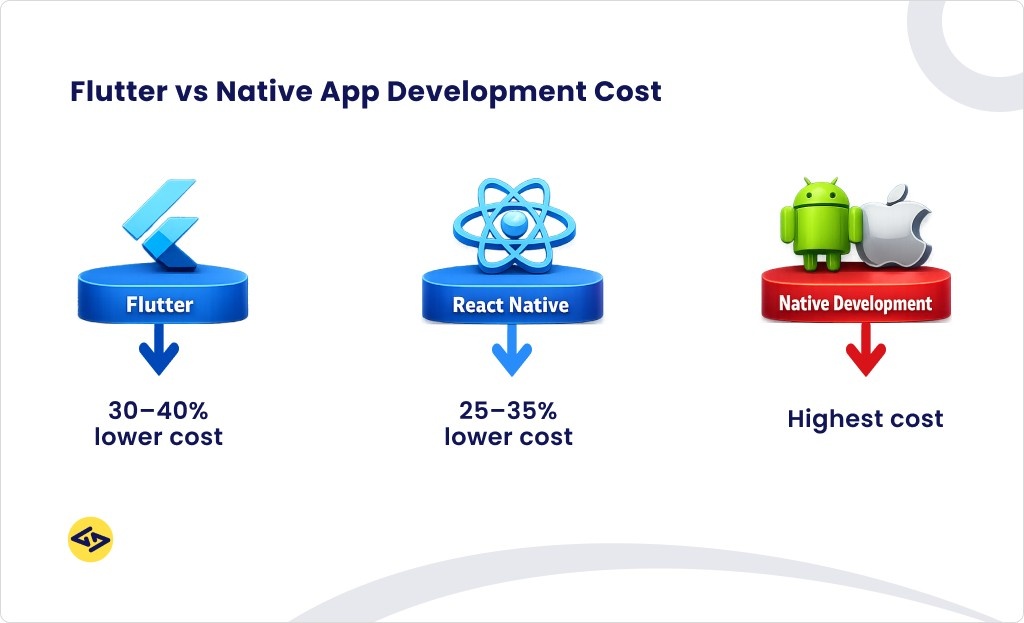
Cross-platform development using Flutter or React Native builds iOS and Android apps from a single codebase, reducing development cost by 30 to 40 percent compared to building two separate native apps. Flutter has become the dominant choice across the Dutch enterprise market for business applications — delivering near-native performance on both platforms with significantly lower build and maintenance cost.
Native development in Kotlin (Android) or Swift (iOS) remains the right choice for apps requiring deep hardware access, advanced platform-specific animations, complex streaming, or Bluetooth-heavy connected device features. For most Dutch business apps, cross-platform development is the cost-effective default in 2026.
| Approach | Cost vs. Dual Native | Best For | NL Market Adoption |
|---|---|---|---|
| Flutter (cross-platform) | −30–40% | Most business apps, MVPs, e-commerce, fintech | Very high — enterprise default |
| React Native | −25–35% | Apps sharing logic with web platforms | High |
| Native iOS + Android | Baseline (100%) | Streaming, deep hardware, complex animations | Medium — complex projects |
| Web App (PWA) | Lowest cost | Proof of concept, low-frequency internal tools | Low for consumer apps |
2. GDPR, UAVG, and Dutch Data Privacy — Non-Negotiable
Every app that processes personal data from Dutch users must comply with the EU’s GDPR and its Dutch implementation, the Uitvoeringswet AVG (UAVG) — the Dutch GDPR Implementation Act — in force since May 2018 and enforced by the Autoriteit Persoonsgegevens (AP), the Dutch Data Protection Authority.
The AP is one of the most active data protection regulators in Europe. In December 2024, it fined Coolblue €40,000 for inadequate cookie consent banners. Maximum fines reach €20 million or 4 percent of global annual revenue for serious violations. The UAVG adds Dutch-specific rules on top of the GDPR: the age of digital consent is set at 16 (not 13 as in some other EU states), with strengthened provisions for health and biometric data and enhanced employment data protections.
Privacy-by-design must be built into the architecture from day one — covering explicit consent flows, data minimisation, EU-hosted infrastructure, user data access and deletion capabilities, and Data Protection Impact Assessments (DPIAs) for high-risk processing. Budget GDPR and UAVG compliance work to add 10 to 15 percent to your total development cost.
| ⚠️ Critical
Retrofitting GDPR and UAVG compliance after launch typically costs 2 to 3 times more than building it in from day one. Any development partner — local or offshore — must demonstrate working familiarity with Dutch data protection law specifically, not just generic GDPR knowledge, before you sign. |
3. iDEAL, Wero, and the Dutch Payment Transition
Any Dutch consumer app with payment functionality must support iDEAL, which processed 1.5 billion transactions in 2025 (Dutch Payments Association). However, a major transition is now underway — and apps built in 2026 must account for it.
From 22 January 2026, text references to the co-branded ‘iDEAL | Wero’ name became mandatory; from 31 January 2026, all payment pages must display the co-branded iDEAL | Wero logo (ING Merchant Guide, January 2026). Full Wero rollout begins in Q4 2026, and every iDEAL merchant will have transitioned to Wero by end of 2027 (ABN AMRO, wero-wallet.eu). Wero is developed by the European Payments Initiative (EPI), backed by 16 major European banks including ABN AMRO, ING, and Rabobank, and is already live in Germany, Belgium, France, and Luxembourg — making it a significant opportunity for Dutch apps targeting cross-European markets.
Apps built now must support both the current co-branded iDEAL | Wero phase and full Wero capability by Q4 2026. Mollie (Amsterdam-headquartered) is the most popular payment gateway for Dutch-market apps and is actively developing its iDEAL-to-Wero migration path. Adyen and Stripe are also widely used. Budget €3,000 to €8,000 for payment integration depending on the number of methods, subscription handling, and Strong Customer Authentication requirements.
4. Bilingual UX — Dutch and English
The Netherlands ranks first in the world for English proficiency as a second language (EF English Proficiency Index 2024). Consumer and business apps are expected to support both Dutch and English interfaces seamlessly — including localised copy, Dutch date and number formatting, euro currency display, and Dutch character set handling. Budget an additional 5 to 10 percent on UI/UX design costs for proper bilingual implementation.
5. EU-Compliant Cloud Infrastructure
Dutch enterprise clients and regulated industries require all personal data to remain within the EEA. The three primary compliant options are AWS EU (Frankfurt or Ireland), Microsoft Azure Netherlands West (Amsterdam data centre), and Google Cloud EU. Azure Netherlands West is the most common choice in Dutch enterprise deployments given its Amsterdam location and data residency guarantees for Dutch regulated industries including fintech and healthtech.
6. Wearable and Connected Device Extensions
The Dutch connected devices, logistics, and healthtech sectors are growing rapidly. Apps extending to smartwatches (Apple watchOS, Wear OS) or IoT devices add 15 to 25 percent to development cost. If wearable support is on your product roadmap, build it into your initial architecture rather than retrofitting later.
7. Annual Maintenance and the Ongoing Cost
Apple and Google both release major OS updates annually, and apps must stay compatible and App Store-compliant. UAVG compliance requires ongoing attention — privacy-related updates are not optional given the AP’s active enforcement record. Annual maintenance typically runs 15 to 20 percent of the original build cost and must be budgeted from day one.
Hidden Costs Dutch Businesses Frequently Miss
The development fee covers only part of the total investment. These are the costs that most often catch Dutch organisations off guard.
| Cost Item | Range | Notes |
|---|---|---|
| App Store Registration | ~€125/year | Apple €99/yr + Google €25 one-time |
| iDEAL | Wero Integration | €3,000–€8,000 | Mollie, Adyen, or Stripe; SCA included |
| GDPR / UAVG Compliance | +10–15% of build cost | Privacy-by-design, consent flows, DPIA |
| Bilingual UX (NL + EN) | +5–10% of design cost | Localisation, formatting, QA |
| Annual Maintenance | 15–20% of build cost/yr | OS updates, security, bug fixes |
| EU Cloud Hosting | €100–€1,500/month | AWS EU, Azure NL West, Google Cloud EU |
| Third-Party APIs | €500–€3,000/month | Maps, analytics, push, AI services |
| DPIA Audit | €2,000–€8,000 per cycle | Required for high-risk data processing |
| App Store Optimisation | €1,500–€5,000 at launch | Dutch-language keywords, visuals |
| Wearable Extension | +15–25% of dev cost | If Wear OS or watchOS required |
| 📌 First-Year Budget Rule
Add 25 to 30 percent on top of your initial development estimate to cover year-one running costs: maintenance, UAVG compliance, hosting, API subscriptions, and App Store fees. Apps that feel affordable at build time are often underfunded for their first year of operation. |
Development Timeline for Dutch Projects
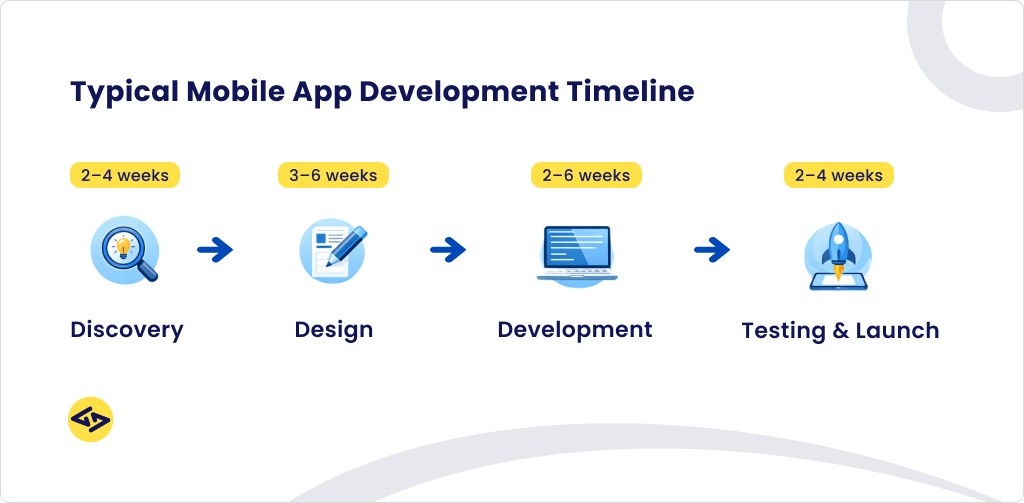
Two-week agile sprints are the standard delivery cadence for Dutch app projects — whether built locally or offshore. Timelines below assume a team of four to six people using this cadence throughout.
| Project Type | Discovery & Design | Development | QA & Launch | Total |
|---|---|---|---|---|
| Simple MVP | 3–4 weeks | 6–10 weeks | 2–3 weeks | 2–4 months |
| Medium App | 4–6 weeks | 12–18 weeks | 3–5 weeks | 4–7 months |
| Complex App | 6–10 weeks | 20–32 weeks | 4–8 weeks | 7–12 months |
| Enterprise App | 8–14 weeks | 32–52+ weeks | 6–12 weeks | 12+ months |
If you’re planning a new project, understanding how long it takes to develop an app helps set realistic expectations.
Complete Cost Summary
| Component | Offshore (India) | Local NL | Notes |
|---|---|---|---|
| Simple App (MVP) | $15,000–$30,000 | €20,000–€60,000 | One platform, core features |
| Medium App | $30,000–$70,000 | €60,000–€150,000 | Both platforms, standard features |
| Complex App | $70,000–$140,000 | €150,000–€300,000 | Fintech, AI, multi-user |
| GDPR / UAVG Compliance | +10–15% | +10–15% | Built-in from architecture stage |
| Flutter (vs dual native) | −30–40% | −30–40% | Recommended default for NL apps |
| iDEAL | Wero Payment | €3,000–€8,000 | €3,000–€10,000 | Transition-ready integration |
| UI/UX Design | €5,000–€20,000 | €15,000–€40,000 | Bilingual, Figma-based |
| Year 1 Maintenance | 15–20%/yr | 15–20%/yr | OS updates, UAVG, security |
| EU Cloud Hosting | €100–€1,500/month | €100–€1,500/month | EEA data residency required |
The Case for Offshore Development in the Dutch Market
Outsourcing app development has historically faced cultural resistance in the Netherlands, where local businesses often favour in-market partners for perceived control and accountability. That perspective is shifting, and for good reason.
The mobile app development cost in the Netherlands has risen steadily as local tech talent becomes more competitive and more expensive. At the same time, the quality of offshore development — particularly from established India-based companies — has matured significantly. English proficiency, European time zone overlap (India is 3.5 hours ahead of Amsterdam, enabling daily standups and bi-weekly sprint demos within normal business hours), and deep familiarity with European regulatory requirements have all improved.
The decision is less about proximity and more about whether the offshore partner understands what it means to build for the Dutch market specifically.
| ” The question is not where the code is written. It is whether your partner understands the Dutch market well enough to build for it correctly. “ |
How to Reduce Your App Development Cost
- Start with an MVP. Build and validate your core feature set with real Dutch users before investing in the full product. Most successful Dutch apps launched as MVPs first.
- Choose Flutter by default. Unless your app requires deep hardware access or complex native streaming, Flutter is the cost-effective default — delivering cross-platform coverage at 30 to 40 percent below dual native development.
- Build GDPR and UAVG compliance in from day one. Designing privacy-by-design into the architecture from the start costs a fraction of retrofitting it post-launch.
- Plan for iDEAL and Wero together. Building support for both now using a Wero-ready gateway (Mollie, Adyen, or Stripe) avoids a costly payment migration in 2026–2027.
- Use EU-certified third-party services. GDPR-compliant APIs for authentication, push notifications, analytics, and maps avoid the need to build these from scratch.
- Partner with an offshore team that knows the Dutch market. A partner familiar with UAVG, iDEAL and Wero, bilingual UX, and Azure Netherlands West delivers faster with less rework than a cheaper generic offshore team with no European experience.
Why iCoderz for Dutch Market App Development
iCoderz delivers mobile apps for Dutch businesses and digital agencies with genuine Dutch-market expertise built into every engagement. We build in Flutter, React Native, Swift, and Kotlin — fully GDPR and UAVG compliant from architecture to deployment, on EU-certified cloud infrastructure, with iDEAL and Wero-ready payment integration using Mollie, Adyen, or Stripe.
We work to the same two-week sprint standard that Dutch clients expect: bi-weekly demo calls, transparent Jira backlog management, English-language documentation, and full NDA and white-label capability for Dutch agencies managing client work. Our teams are 3.5 hours ahead of Amsterdam — practical overlap for daily standups and sprint reviews without anyone working outside business hours.
Whether you are a Dutch startup building your first MVP, an enterprise modernising a legacy platform, or a Dutch agency looking for a reliable white-label development partner, iCoderz delivers enterprise-quality mobile apps at 60 to 70 percent below local rates — without the compliance compromises that matter most in this market.
| 🤝 For Dutch Agencies
iCoderz works as a fully white-label offshore partner for Dutch digital agencies. Full NDA, your branding on all deliverables, no client contact without your explicit consent. Experienced in Dutch agency workflows, two-week sprint cadences, UAVG compliance, and iDEAL | Wero payment integration. |
| Get a Free Cost Estimate for Your Dutch App Project → |
Frequently Asked Questions
How much does a mobile app cost in the Netherlands in 2026?
The mobile app development cost in the Netherlands ranges from €20,000 to €300,000+ for local development, depending on complexity. Offshore development with a quality partner typically costs $15,000 to $140,000 — roughly 60 to 70 percent less. The most accurate estimate requires a scoped project brief.
How much do Dutch app developers charge per hour?
Mid-level Dutch developers charge €70 to €95 per hour. Senior developers and specialists charge €95 to €140. Full-service agencies typically quote €100 to €150 per hour as a blended team rate covering development, design, QA, and project management.
What is the UAVG and why does it matter for my app?
The Uitvoeringswet AVG (UAVG) is the Dutch GDPR Implementation Act, in force since May 2018. It adds Dutch-specific rules to the EU’s GDPR — including a digital age of consent set at 16, strengthened protections for health and employment data, and enforcement by the Autoriteit Persoonsgegevens (AP). Any app processing personal data from Dutch users must comply with both GDPR and the UAVG, built in from the architecture stage.
What payment method should a Dutch app support in 2026?
Dutch apps must support the co-branded iDEAL | Wero payment method. From January 2026, the transition from standalone iDEAL to co-branded iDEAL | Wero is mandatory for all merchants. Full Wero rollout begins Q4 2026, with the iDEAL brand fully phased out by end of 2027. Build for both now using Mollie, Adyen, or Stripe — all three support the transition.
Flutter or native — which is right for a Dutch app?
Flutter is the most cost-effective choice for most Dutch business apps — delivering a single cross-platform codebase for iOS and Android at 30 to 40 percent lower cost than dual native development, with near-native performance. Native Kotlin (Android) or Swift (iOS) is appropriate when the app requires deep hardware access, complex platform-specific animations, or advanced streaming.
Is offshore app development reliable for Dutch businesses?
Yes, provided you choose a partner with documented UAVG and GDPR experience, EU-compliant cloud infrastructure, iDEAL and Wero integration capability, English-language communication, and a structured two-week agile delivery process. The differentiator is Dutch-market knowledge — not location.
How long does it take to build a mobile app for the Dutch market?
A simple MVP takes 2 to 4 months. A medium-complexity app takes 4 to 7 months. Complex apps with AI features, real-time data, or deep integrations take 7 to 12 months or more. All engagements use two-week agile sprints throughout, covering discovery, design, development, QA, and deployment.
What cloud infrastructure should a Dutch app use?
AWS EU (Frankfurt or Ireland), Microsoft Azure Netherlands West (Amsterdam data centre), and Google Cloud EU are the three primary GDPR-compliant options. Azure Netherlands West is the most common choice for Dutch enterprise deployments given its Amsterdam location and EEA data residency guarantees. All personal data must remain within the EEA unless covered by Standard Contractual Clauses.