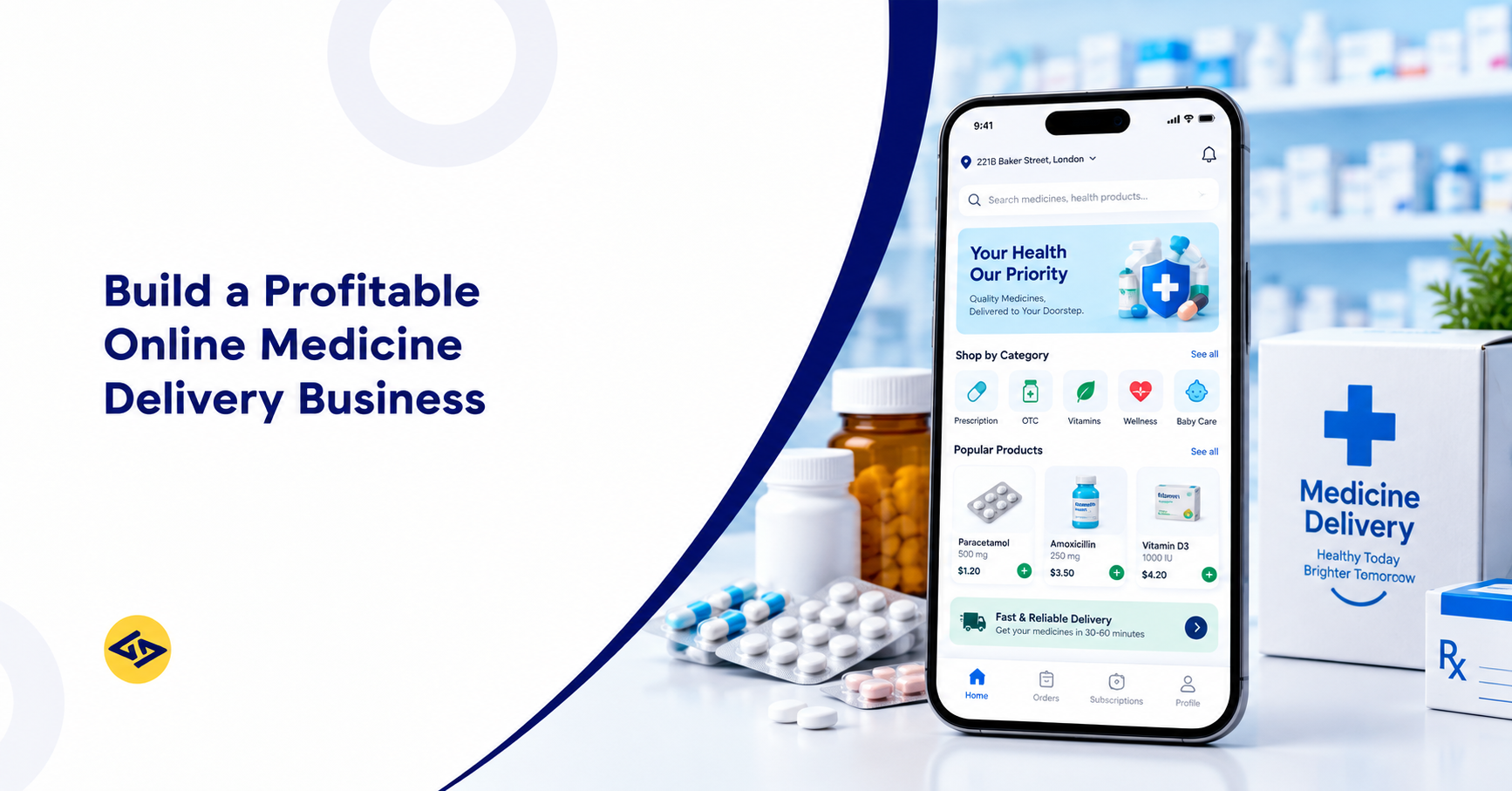
Ordering medicines through an app has become a convenient way to manage refills, urgent needs, and family healthcare. This growing demand creates opportunities for founders, pharmacy owners, and healthcare companies looking to start online medicine delivery business operations.
It is also harder than regular e-commerce. Medicines are regulated, prescriptions must be verified, and a wrong or late delivery can affect someone’s health. Success depends on getting compliance, pharmacy partnerships, technology and operations right together.
This guide explains how to start an online medicine delivery business in 2026, with a focus on India: models, licensing, MVP features, costs, profitability and a realistic launch plan.
Key Takeaways
- Pick your model first. It decides your costs, risks and licensing position.
- Confirm your legal position with the State Drug Control authority before you build or market anything.
- Marketplace and inventory-based businesses spend money in very different places. Budget for your model, not an average.
- Launch an MVP first, then add features once real orders show what customers use.
- Prove profit per order before you scale to new cities.
Quick Answer: To start an online medicine delivery business, research your market, choose a business model, build a plan with realistic unit economics, confirm licensing with your State Drug Control authority, partner with licensed pharmacies, launch an MVP app, set up delivery operations, and scale once each order is profitable. In India, drug-sale licensing, pharmacist supervision and prescription controls come before marketing.
What Is an Online Medicine Delivery Business?
An online medicine delivery business lets customers order medicines and health products through a website or app and receive them at home, supplied by licensed pharmacies.
How it works: a customer searches for a medicine or uploads a prescription. A pharmacist verifies it where required. The pharmacy packs the order, a delivery partner collects it, and the customer tracks it until delivery.
Online pharmacy vs. delivery marketplace: an online pharmacy holds its own stock and fulfils orders itself. A marketplace connects customers with independent licensed pharmacies and earns commission or fees. The legal position can differ between the two, which is why Step 4 matters.
Four participants make the system run:
- Customers who order and upload prescriptions
- Pharmacies that verify, pack and fulfil orders
- Delivery partners who collect and deliver
- Administrators who manage users, pharmacies, payments and compliance
Why Start an Online Medicine Delivery Business in 2026?
- Convenience: ordering from home suits older adults, caregivers and busy professionals.
- Recurring demand: chronic conditions create regular refills, which can improve retention.
- Digital healthcare: teleconsultations, e-prescriptions and digital payments make the full journey easier to build.
- Room for focused players: national platforms like PharmEasy and Tata 1mg are strong, but a city-focused service can compete on speed, reliability and service quality.
- Opportunity for existing pharmacies: a neighborhood pharmacy can add a delivery channel without starting from scratch.
How to Start Online Medicine Delivery Business in 10 Steps
Use this as your 10-step launch checklist.
Step 1: Research the Online Pharmacy Market
- Identify target customers: chronic-care patients, seniors, families or one specific city.
- Analyze demand and competitors: compare delivery time, stock availability, pricing and reviews. Studying how on-demand medicine delivery apps work helps you spot gaps.
- Find market gaps: slow delivery, poor prescription handling, weak support or limited availability in your area.
Step 2: Choose Your Medicine Delivery Business Model
Choose between inventory-based, marketplace and aggregator models, then decide whether to add hyperlocal fulfillment and subscription refills. These are compared in the next section.
Step 3: Create an Online Medicine Delivery Business Plan
A solid online medicine delivery business plan includes:
- Objectives and target city
- Startup budget for your chosen model
- Revenue streams and per-order economics
- Fixed and variable costs
- A break-even estimate (explained below)
Step 4: Understand Legal Requirements and Obtain Licenses
Confirm which licenses your model needs and who holds them. See the legal section below. Do this before development spending.
Step 5: Partner With Licensed Pharmacies and Medicine Suppliers
- Shortlist pharmacies with reliable stock and quick order acceptance.
- Verify every license and supplier credential.
- Agree service levels for acceptance time, packaging and substitutions.
Step 6: Choose the Right Technology Platform
Decide between website, app or both, and between a ready-made solution (faster, cheaper) and a custom build (more control). Plan four modules: customer, pharmacy, delivery partner and admin.
Step 7: Develop Your Online Medicine Delivery App
Start with an MVP: UI/UX design, core features, payment and pharmacy integrations, then testing. See the MVP section below for what to build first.
Step 8: Set Up Medicine Delivery Operations
- Delivery partners: onboarding, training and performance tracking.
- Dispatch: a clear flow from order acceptance to handover.
- Tracking: live status for customers and your operations team.
- Temperature-sensitive medicines: insulin and some injectables need cold-chain packaging and handling.
Step 9: Launch and Market Your Online Pharmacy Business
Pilot in one area. Use local SEO, educational content and pharmacy partnerships. Medicine advertising is restricted, so follow applicable healthcare advertising rules.
Step 10: Monitor Performance and Scale Your Business
Track orders, repeat rate, order value, delivery time and cancellations. Fix experience problems first, then add pharmacies and locations.
Online Medicine Delivery Business Models Compared
These approaches are not all the same kind of thing. Inventory-based, marketplace and aggregator describe how the business is structured. Hyperlocal describes how orders are fulfilled. Subscription describes how repeat orders are managed. The last two can run alongside the first three.
| Model | How it works | Best suited for |
| Inventory-based | A licensed pharmacy holds and sells its own stock | Established pharmacy businesses |
| Marketplace | Platform connects customers to licensed pharmacies | Technology-led startups |
| Aggregator | Platform coordinates several pharmacy partners and fulfilment | Multi-pharmacy networks |
| Hyperlocal fulfilment | Orders are sourced and delivered within a limited area | City-focused operations |
| Subscription / refill service | Eligible repeat orders are managed on a recurring schedule | Chronic-care programs |
How the Structural Models Differ
| Factor | Inventory-Based | Marketplace | Aggregator |
| Investment | High (stock, premises, staff) | Low to medium | Medium |
| Operational complexity | High | Medium | Medium to high |
| Main revenue | Product margins | Commission and fees | Commission, service fees |
| Scalability | Limited by capital and licensing | High | High with strong partner network |
| Compliance burden | Highest | Depends on structure and partners | Depends on structure and partners |
Practical insight: many founders start with a marketplace in one city, because it needs less capital. They then add hyperlocal fulfilment and subscription refills once pharmacy partners and demand are proven.
Legal Requirements and Licenses in India
Online pharmacy license requirements in India are shaped by the Drugs and Cosmetics Act, 1940 and the Drugs Rules, 1945. Online medicine delivery businesses must evaluate:
- Applicable state drug licensing requirements
- Prescription controls for scheduled drugs
- Pharmacist supervision of dispensing and verification
- Data protection obligations for customer health information
- Business registrations such as GST, where applicable
The legal position may differ between a licensed pharmacy selling its own stock and a technology marketplace connecting customers with pharmacies. Founders should confirm their proposed operating model with the relevant State Drug Control authority before launching.
Three points to keep accurate:
- E-pharmacy rules: CDSCO records list the 2018 e-pharmacy proposal as a draft, not a final regulation. Do not assume a single nationwide e-pharmacy licensing framework is settled.
- Data protection: India’s DPDP Rules were notified in November 2025, with provisions commencing in phases. Check which obligations are already in force and which come later.
- GST: registration is not automatically required from day one for every business. It depends on structure, turnover and the nature of transactions.
Official sources to verify against: CDSCO (cdsco.gov.in), MeitY (meity.gov.in), your State Drug Control authority and the GST portal. This article is general information, not legal advice.
Essential Features of a Medicine Delivery App
A strong medicine delivery app serves four user groups. For a full capability overview, see our medicine delivery app development service page.
| User | Core Features | Added Later |
| Customer | Medicine search and filters, prescription upload, secure payments, real-time tracking | Refill reminders, order history, family profiles |
| Pharmacy | Prescription verification, inventory management, order acceptance | Expiry date and batch tracking, analytics |
| Delivery partner | Order assignment, navigation, status updates | Proof of delivery (OTP or signature), earnings view |
| Admin | User and pharmacy management, order monitoring | Commission management, analytics and reporting |
MVP vs Full-Featured Medicine Delivery App: What Should You Build First?
Many founders overspend on features before they have a single repeat customer. An MVP lets you test demand and operations with real orders.
Build in the MVP:
- Customer app with search, prescription upload, payments and order tracking
- Pharmacy panel with prescription verification, order acceptance and basic inventory
- Simple delivery partner app (or a delivery integration)
- Lean admin panel for orders, pharmacies and payments
Add after launch:
- Refill reminders and subscription refills
- Expiry and batch tracking
- Loyalty and referral programs
- Advanced analytics and route optimization
- Integrations with labs or teleconsultation partners
How to avoid unnecessary spending: build the prescription and pharmacy order flow properly first, because errors there hurt trust most. Delay cosmetic and secondary features until usage data shows they matter. For a deeper look at what the build phase involves, read this guide to medicine delivery app development.
How Much Does It Cost to Start an Online Medicine Delivery Business?
The cost of starting an online medicine delivery business depends on the business model, technology requirements, licensing, inventory and operating scale. A marketplace may allocate more of its initial investment to app development and pharmacy onboarding, while an inventory-based pharmacy may require greater spending on stock, premises, qualified staff and logistics.
Methodology: the figures below are illustrative planning ranges in Indian Rupees (INR) for a single-city launch with an India-based team. They are built from typical scope assumptions (MVP vs full platform, six months of operations, mixed in-house and outsourced delivery), not from a market benchmark or a quote. Get current quotes before committing.
Scenario A: Marketplace Launch (INR)
| Cost Area | Illustrative Range |
| Business setup and legal | ₹0.5 – 2 lakh |
| App development (MVP) | ₹8 – 20 lakh |
| Licensing and compliance review | ₹0.5 – 1.5 lakh |
| Operations, first 6 months | ₹4 – 10 lakh |
| Marketing and acquisition | ₹3 – 10 lakh |
| Total | ≈ ₹16 – 44 lakh |
Scenario B: Inventory-Based Pharmacy Launch (INR)
| Cost Area | Illustrative Range |
| Business setup and legal | ₹1 – 3 lakh |
| App development (lighter MVP) | ₹5 – 15 lakh |
| Licensing, premises and fit-out | ₹3 – 8 lakh |
| Initial inventory | ₹10 – 30 lakh |
| Staff and operations, first 6 months | ₹8 – 18 lakh |
| Marketing and acquisition | ₹3 – 8 lakh |
| Total | ≈ ₹30 – 82 lakh |
What moves the numbers: feature scope, integrations, city competition, pharmacist and staff costs, inventory depth and delivery volume. A full multi-panel platform with custom features can cost more than the MVP ranges above. For app-specific figures, see this breakdown of medicine delivery app development cost.
Want a cost estimate for your model? Share your feature list and city plan with iCoderz and get a scoped estimate before you commit budget.
How Does an Online Medicine Delivery Business Make Money?
- Medicine sales margins: inventory-based pharmacies earn the difference between purchase and selling price. Margins are modest, so efficiency matters.
- Pharmacy commission: marketplaces charge partner pharmacies a percentage per order, sometimes with onboarding or listing fees.
- Delivery charges: flat or distance-based fees, often waived above a minimum order value.
- Subscriptions and memberships: paid plans with free delivery or refill benefits create recurring revenue.
- Other compliant revenue: wellness products, lab test bookings and teleconsultation partnerships, within applicable rules.
How to Calculate Online Medicine Delivery Business Profitability
Profitability depends on what each order earns after variable costs, then how many orders cover your fixed costs.
Illustrative Marketplace Order Economics
| Item | Amount |
| Order value | ₹1,000 |
| Platform commission (12%) | ₹120 |
| Delivery fee collected | ₹30 |
| Delivery expense | −₹55 |
| Payment processing and support | −₹20 |
| Promotions | −₹25 |
| Contribution per order | ₹50 |
Hypothetical example only. It excludes fixed costs, customer acquisition costs, taxes and other possible expenses. It is not a market benchmark.
Break-Even Logic
Break-even orders per month = monthly fixed costs ÷ contribution per order. If your fixed costs were ₹4 lakh a month (an assumed figure), you would need about 8,000 orders a month at ₹50 contribution. Improving delivery cost, average order value and repeat rate moves that number quickly.
Why this matters: prove positive contribution per order in one city before expanding. Scaling a loss-making order only multiplies the loss.
Technology Stack for Medicine Delivery App Development
- Frontend: React Native or Flutter for cross-platform apps, React or Angular for web panels.
- Backend: Node.js, Python or Java with REST APIs.
- Database and cloud: PostgreSQL or MongoDB on AWS, Google Cloud or Azure.
- Maps, payments and notifications: Google Maps APIs, payment gateways such as Razorpay or Stripe, and SMS, push and email services.
- Security: encryption in transit and at rest, role-based access, audit logs and secure prescription storage.
Choose a stack your team can maintain, and plan for growth from day one. Understanding broader on-demand app development solutions helps you design an architecture that can add services later.
Challenges and Common Mistakes
Key Challenges
- Regulatory compliance that varies by state and changes over time
- Prescription validation
- Medicine availability and inventory accuracy
- Delivery delays and logistics
- Customer trust and data security
- Operating expenses on thin margins
Common Mistakes to Avoid
- Launching without a regulatory review. Confirm your model with the State Drug Control authority first.
- Weak inventory synchronization. Stale stock data causes cancellations and lost trust, so test pharmacy-side inventory tools early.
- Underestimating delivery costs. Model delivery per order, including failed and returned deliveries.
- Poor prescription verification. Make pharmacist review a clear, auditable step.
- Scaling before proving unit economics. Expand only once each order is profitable.
How to Market and Grow Your Online Medicine Delivery Business
For how to market an online pharmacy business, start with trust, not discounts.
- Local SEO: keep business listings accurate and target local medicine delivery searches.
- Content marketing: publish educational, medically reviewed articles.
- Partnerships: work with clinics, diagnostic labs and doctors.
- Referral and loyalty programs: use them only where permitted, with care around discounts on medicines.
- Retention: refill reminders and reliable delivery drive repeat orders, the best way to increase online pharmacy sales.
How Long Does It Take to Launch an Online Medicine Delivery Business?
A realistic launch often takes 4 to 8 months, depending on licensing speed and app scope.
| Phase | Illustrative Duration | Dependencies |
| Research and planning | 3–6 weeks | Market data, model decision |
| Licensing and pharmacy onboarding | 6–12 weeks | State approvals; can run alongside development |
| App design and development (MVP) | 12–20 weeks | Finalized scope, integrations |
| Testing and compliance review | 3–4 weeks | Completed build, legal review |
| Pilot launch and rollout | 4–8 weeks | Pharmacy partners, delivery team |
Assumptions: one city, marketplace-style launch, no major licensing delays. Inventory-based models often take longer because of premises and licensing.
Why Choose iCoderz Solutions for Medicine Delivery App Development?
iCoderz Solutions has 15+ years of experience and has delivered 650+ apps and projects. For medicine delivery, the team can help with:
- Custom medicine delivery app development
- Customer, pharmacy, delivery and admin applications
- Scalable platform architecture
- Third-party integrations such as payments, maps and notifications
- Post-launch support and maintenance
Ready to plan your platform? Learn more about the team and services at iCoderz Solutions.
Launch Your Medicine Delivery Business With iCoderz
Conclusion
Launching an online medicine delivery business takes more than an app. You need a clear business model, a confirmed legal position, dependable pharmacy partners and technology that serves customers, pharmacies, delivery partners and admins.
Start with an MVP, pilot in one city, measure profit per order and scale only when the numbers work. A scalable platform built on that foundation gives you room to grow.
Turn Your Medicine Delivery Business Idea Into Reality
Launch a custom pharmacy delivery app built for your business.

Frequently Asked Questions
How do I start an online medicine delivery business?
Research your market, pick a business model, confirm licensing with your State Drug Control authority, partner with licensed pharmacies, launch an MVP app, run a one-city pilot and scale once each order is profitable.
How much investment is required to start an online pharmacy?
Illustratively, a single-city marketplace launch may need about ₹16–44 lakh, while an inventory-based pharmacy may need about ₹30–82 lakh. Ranges depend on features, premises, inventory and marketing, as shown in the scenario tables above.
Is an online medicine delivery business profitable?
It can be, but medicine margins are thin. Profit usually depends on positive contribution per order, repeat purchases and controlled delivery cost, so model your unit economics before scaling.
What licenses are required to start an online pharmacy business in India?
Requirements depend on your model and state, but typically involve drug licenses under the Drugs and Cosmetics Act and Drugs Rules, pharmacist supervision and relevant business registrations. Confirm with your State Drug Control authority.
Can I start an online medicine delivery business without owning a pharmacy?
Possibly, through a marketplace or aggregator model where licensed pharmacies fulfil orders. The legal position differs from an inventory-based pharmacy, so verify your structure with the authority first.
How does an online medicine delivery business make money?
Through product margins, pharmacy commissions, delivery fees, memberships and compliant extras such as wellness products or lab bookings.
How much does medicine delivery app development cost?
As an illustration, an MVP may cost roughly ₹8–20 lakh, while a full multi-panel platform with custom features can reach ₹25–40 lakh or more. Scope and integrations drive the difference.
How long does it take to build an online medicine delivery app?
An MVP often takes about 3 to 5 months. The full launch, including licensing, testing and pilot, commonly takes 4 to 8 months.
What are the essential features of an online pharmacy app?
Medicine search, prescription upload, secure payments and order tracking for customers, plus prescription verification and inventory tools for pharmacies, delivery management and an admin panel.
How can I compete with PharmEasy and Tata 1mg?
Focus on one city or niche, deliver faster and more reliably, keep stock data accurate, and build pharmacy relationships before expanding.