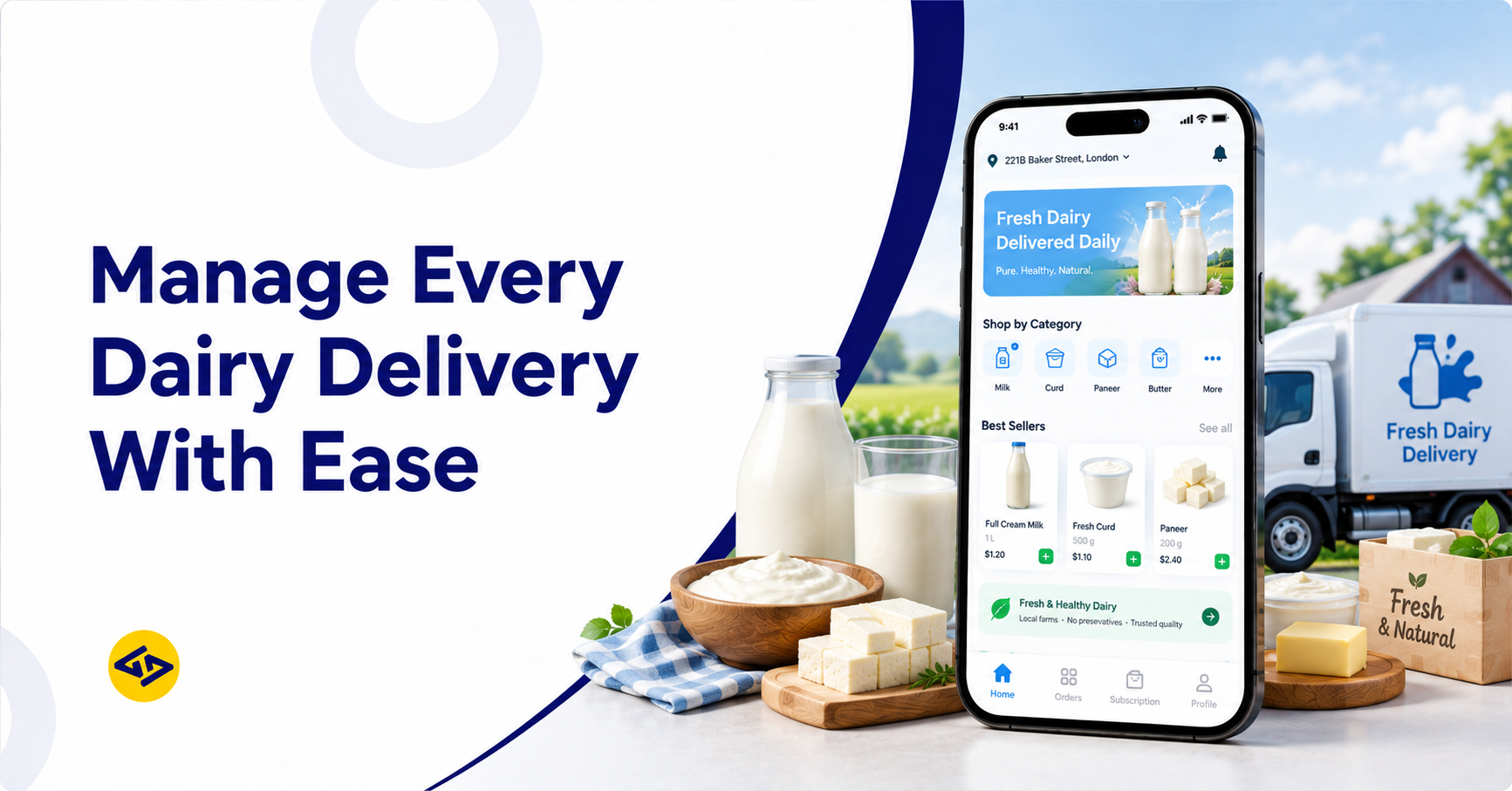
Dairy business home delivery management involves organizing customer subscriptions, scheduling orders, planning delivery routes, assigning delivery staff, tracking deliveries, and collecting payments. At a small scale, a notebook, spreadsheet, or phone may be enough. As customer numbers and delivery complexity grow, a dedicated system can make these operations easier to manage.
Home delivery is an important part of modern dairy businesses. Customers expect fresh milk at their doorstep on schedule, while also wanting the flexibility to pause, skip, or change deliveries. Managing hundreds of recurring orders manually can lead to incorrect quantities, missed deliveries, scheduling issues, and delayed payments.
Better subscription management, scheduling, route planning, tracking, and automation can reduce these problems. This is where dairy delivery management software becomes useful. If you’re still planning your business model, our guide on how to start a milk delivery business covers the basics.
In this guide, we’ll walk through the daily delivery workflow, the common operational challenges, and how technology can help you run recurring home deliveries more efficiently.
Why Managing Daily Dairy Deliveries Is Challenging
Daily milk delivery management is difficult because it combines perishable products, early-morning delivery windows, and hundreds of small, repeating orders. Unlike a one-time online purchase, every customer expects the same reliability every day, and a single mistake is noticed right away.
The most common challenges are:
- Large numbers of recurring customers: Each household has its own routine and preferences.
- Different schedules and quantities: One customer takes 1 litre daily, another takes 2 litres on alternate days, and a third adds curd on weekends.
- Last-minute changes: Cancellations and skips often arrive the night before or even the same morning.
- Multiple delivery routes: Each area needs its own plan and its own person.
- Staff coordination: Delivery staff need clear lists, and owners need to know what was delivered and what wasn’t.
- Missed or delayed deliveries: Without tracking, owners often hear about problems from customers first.
- Recurring payments and billing: Chasing monthly dues takes time, especially with skips and holds to adjust for.
- Accurate customer records: Addresses, preferences, and pending balances are easy to lose in paper registers or scattered chats.
Larger dairy brands rely heavily on technology to handle these challenges. Looking at the country delight business model shows how subscriptions, logistics, and apps can work together. Smaller dairies can borrow the same principles in a simpler form.
How Dairy Businesses Manage Daily Home Deliveries
A reliable delivery operation follows seven connected steps. A weakness in an early step usually causes problems in the later ones, so it helps to see the whole flow first.
1. Collect and Manage Customer Orders
Everything starts with clean customer data. For each customer, record:
- Name, phone number, and full delivery address, including landmarks
- Products and quantities, such as full-cream milk, curd, paneer, or ghee
- Delivery frequency: daily, weekly, or monthly
- Special instructions, such as “leave at the door” or “don’t ring the bell”
Also make it easy for customers to pause, resume, or modify their plan. The fewer phone calls and messages it takes to make a change, the fewer errors slip in.
2. Manage Recurring Milk Subscriptions
Recurring delivery management means storing each customer’s repeating plan so that daily orders follow it without being re-entered. Common plan types include:
- Daily subscriptions: The same items every morning
- Alternate-day delivery: Popular with smaller households
- Monthly plans: Prepaid or postpaid
- Product-wise subscriptions: Milk daily, paneer weekly
- Vacation holds and skips: Customers pause specific dates without cancelling
Handling these by hand is where mistakes multiply, especially when holds and skips overlap. Subscription management tools apply plans, holds, and skips automatically. If you’re planning to build one, this breakdown of subscription based milk delivery app development shows how these plans are typically structured.
3. Create and Organize Delivery Schedules
Once subscriptions are clear, turn them into a daily plan:
- Assign delivery dates to each order
- Define time slots, for example 5:30 to 7:00 AM
- Prepare the next morning’s delivery list
- Apply new customers and changes before a fixed cutoff
A firm cutoff, such as 9 PM the previous night, keeps late changes from disrupting loading and packing. Scheduling tools can generate the list automatically each evening and flag changes made after the cutoff.
4. Plan Efficient Delivery Routes
Route planning determines how quickly and cheaply you reach every doorstep. The basics are:
- Group customers by locality, society, or street
- Assign each cluster to one delivery person
- Sequence stops to avoid backtracking
- Keep distant areas on separate routes
Even small improvements add up over a month. Fewer kilometres per route generally means lower fuel costs and earlier finishes. Route optimization software goes a step further by suggesting the most practical stop order and adjusting when customers join or pause.
5. Assign Deliveries to Drivers or Delivery Staff
With routes ready, assign work clearly:
- Give each person a list of customers, products, and quantities
- Add route-wise notes, such as gate codes or preferred drop spots
- Match the load to vehicle capacity, including crates and cold-chain limits
- Keep backup staff available for absences
When staff know exactly what to deliver, and you know who is responsible for each route, accountability improves and disputes become easier to resolve.
6. Track Deliveries in Real Time
Tracking shows what is happening while it happens. Useful elements include:
- Delivery status: completed, pending, or missed
- GPS or location updates
- Customer notifications such as “Your milk is on the way”
- Proof of delivery, like a photo or tap confirmation, where needed
A simple tracking app in the delivery person’s hands is often the easiest way to capture this data. It lets you fix problems before customers have to complain, and timely updates are one of the simplest ways to improve milk delivery customer retention.
7. Manage Billing and Payments
Billing is where many dairies lose money quietly. The basics to cover are:
- Calculate subscription charges accurately, accounting for skips and holds
- Send monthly invoices
- Offer online payment options such as UPI, cards, and wallets
- Track outstanding dues by customer
- Send automatic payment reminders
Automated billing reduces manual calculation work and helps avoid disputes about what was delivered.
Common Problems With Manual Milk Delivery Management
Manual methods can work well for a while. They tend to struggle as volume grows. Here is where they usually break down:
| Manual Process | Common Problem |
| Customer records | Difficult to update and maintain |
| Route planning | More travel and delivery delays |
| Subscription tracking | Missed or incorrect deliveries |
| Driver assignment | Difficult to coordinate |
| Billing | Manual errors and delayed payments |
| Delivery tracking | Limited visibility |
| Customer communication | Repetitive manual work |
These problems compound. A wrong address leads to a missed delivery, which leads to a complaint, which takes staff time to resolve. Over time, repeated issues can affect customer loyalty.
Fixing the process is the first step, and it naturally leads to automation. The tools available here are also changing, so it’s worth following milk delivery app development trends when you plan improvements.
How Technology Can Automate Daily Dairy Deliveries
An automated milk delivery system is software that handles the repetitive parts of delivery, such as orders, schedules, routes, reminders, and billing, so your team can focus on exceptions instead of routine tasks. If you want to automate daily milk deliveries, these are the areas to tackle.
Automated Order Management
- Recurring orders are created automatically from each subscription
- Quantities and products update when customers change plans
- Cancellations and skips are applied without manual edits
Automated Delivery Scheduling
- Daily delivery schedules are generated on their own
- Customers are grouped by delivery date, area, and time slot
Route Optimization
- Routes are built to reduce unnecessary distance
- Multiple delivery zones are handled separately
- Plans adjust when customers are added or paused
Automated Customer Notifications
- Order confirmations
- Delivery reminders
- Payment reminders
- Delivery status alerts
Automated Billing and Payments
- Recurring billing runs on schedule
- Customers pay digitally
- Invoices are generated automatically
- Payments are tracked against dues
Some newer platforms also use AI for demand forecasting, smarter routing, and predicting which customers may stop ordering. Our overview of ai features for milk delivery apps explains where these are practical and where they may be more than a small dairy needs.
Key Features of a Dairy Delivery Management System
Dairy delivery management software is a digital platform that manages customers, subscriptions, deliveries, routes, and payments in one place. From a business perspective, these are the features that matter most:
- Customer management: Profiles, addresses, and order history in one place
- Product management: Catalog, pricing, and stock for milk and related products
- Subscription management: Flexible plans, pauses, and skips
- Recurring orders: Automatic daily order creation
- Delivery scheduling: Time slots and daily lists
- Route planning: Organized stops for each delivery person
- Driver management: Assignments, attendance, and performance
- Real-time delivery tracking: Live status of every order
- Online payments: Multiple digital payment options
- Automated billing: Invoices and reminders
- Push notifications and SMS: Timely customer updates
- Reports and analytics: Delivery, revenue, and dues insights
- Admin dashboard: A single view of daily operations
For a deeper breakdown, see this list of features of milk delivery app solutions.
Benefits of Using a Milk Delivery Management System
A good management system can improve daily operations and support long-term growth.
Reduce Manual Work
Staff spend less time on registers, phone calls, and calculations.
Improve Delivery Accuracy
When subscriptions and delivery lists are generated automatically, the right product is more likely to reach the right door.
Optimize Delivery Routes
Well-planned routes can reduce fuel use and delivery time, which also helps products reach customers earlier.
Improve Customer Experience
Customers can manage plans themselves and receive timely updates without calling anyone.
Simplify Subscription Management
Pauses, skips, and changes are applied consistently.
Improve Payment Collection
Digital payments and automatic reminders can shorten the time it takes to collect dues.
Get Better Operational Visibility
You can see completed, pending, and missed deliveries in one dashboard.
Scale Delivery Operations More Easily
Adding customers or routes becomes far less chaotic when the process is already structured. Understanding the milk delivery app business model can also help you plan revenue as you grow.
How to Choose the Right Dairy Delivery Software
The best software fits your size, budget, and workflow. Evaluate options on these points:
- Subscription management: Can it handle daily, alternate-day, and holds?
- Route optimization: Does it help plan routes, or only list stops?
- Delivery tracking: Is delivery status visible in real time?
- Driver management: Can you assign routes and monitor performance?
- Billing and payments: Does it support recurring invoices and digital payments?
- Customer communication: Are SMS and push notifications included?
- Reporting and analytics: Can you see trends and dues at a glance?
- Scalability: Will it cope if your customer base doubles?
- Mobile accessibility: Are customer and driver apps easy to use?
- Customization: Can it match your products and processes?
- Integrations: Does it connect with accounting tools, payment gateways, and maps?
Before committing, run a small pilot on one route. It shows how your team and customers respond before you roll it out fully.
You also have a choice between fully custom software and a ready-made base. Some businesses launch faster with a white label milk delivery app development approach and customize it over time.
When Should a Dairy Business Automate Its Delivery Operations?
Consider automating when manual effort starts costing you customers, time, or money. Watch for these signals:
- Your customer base is growing steadily
- You’re hiring more delivery staff
- You cover multiple delivery zones
- Recurring orders are too many to track by hand
- Delivery mistakes happen often
- Payments are hard to track
- Customer support calls and messages keep increasing
- Spreadsheets are becoming slow, messy, or error-prone
Customer count alone is not the only measure. A dairy with 100 customers and complicated plans may need software sooner than one with 300 simple daily orders.
You also don’t need to automate everything at once. A practical order is subscriptions and billing first, then scheduling and routes, and finally tracking and notifications. If you decide to build custom software, compare the best milk delivery app development companies on experience, past work, and post-launch support.
How Much Does It Cost to Build a Milk Delivery App?
The cost of building a milk delivery app depends mostly on scope and complexity. There is no single price, but these are the factors that move the budget most:
- Number of apps: A customer app, a delivery personnel app, and an admin panel are separate builds. Adding each one increases effort.
- Subscription functionality: Simple daily plans are quick to build. Flexible schedules, alternate days, holds, and mid-month changes take more logic and testing.
- Route optimization: Basic route grouping is far cheaper than automated, map-based optimization.
- Real-time tracking: Live GPS tracking needs map services and careful handling of battery use and connectivity.
- Payment integration: Each gateway, wallet, or UPI option adds integration and testing work.
- Notifications: Push notifications, SMS, and reminders add both development time and running costs.
- UI/UX requirements: Custom design costs more than standard templates but can improve usability.
- Technology and team: Team size, experience, and location all affect the final estimate.
- Third-party integrations: Accounting tools, maps, and SMS providers can add ongoing fees.
Also budget for costs after launch, including hosting, map and SMS usage, maintenance, and updates. Many dairies reduce risk by starting with a minimum viable product covering subscriptions, deliveries, and billing, then adding features later.
For a more detailed breakdown, read our guide to the cost to develop a milk delivery app.
Final Thoughts on Dairy Business Home Delivery Management
Daily dairy delivery runs as one connected workflow:
Customers → Subscriptions → Orders → Scheduling → Route Planning → Delivery → Tracking → Billing
If one step is weak, the others tend to suffer. The good news is that you don’t need to change everything overnight. Start with clean customer records and subscription tracking, add scheduling and route planning, and automate tracking, notifications, and billing as your customer base grows.
If you’re considering a customized solution, you can explore our milk delivery app development service to see what a tailored setup could look like for your dairy.
Frequently Asked Questions
How do dairy businesses manage daily home deliveries?
They combine customer records, subscription plans, daily schedules, planned routes, delivery staff assignments, tracking, and billing. Small dairies often begin with spreadsheets. As volume grows, they move to dedicated software to reduce errors and keep everything visible in one place.
How can a dairy business optimize milk delivery routes?
Group customers by area, assign each group to one delivery person, and arrange stops to avoid backtracking. Route optimization software can automate this and adjust when customers pause or join. Shorter routes typically reduce fuel use and delivery time.
How do milk delivery businesses manage recurring subscriptions?
They store each customer’s plan, such as daily, alternate-day, or monthly, and generate orders from it automatically. Pauses, skips, and vacation holds are applied before the delivery list is finalized, which helps prevent missed deliveries and billing mistakes.
What is a milk delivery management system?
A milk delivery management system is software that manages customers, subscriptions, schedules, routes, delivery staff, tracking, and billing on one platform. It replaces paper registers and scattered spreadsheets. Businesses that also want customers to order directly may explore online milk delivery app development.
Can dairy delivery software track drivers in real time?
Yes, many platforms use GPS in the delivery person’s app to show live location and delivery status. Owners can see completed, pending, and missed deliveries, and customers can receive “on the way” alerts. Features vary by product, so confirm this before choosing.
How can dairy businesses automate daily deliveries?
Automate in stages: recurring orders and scheduling first, then routes, then notifications, billing, and payments. The software generates daily lists, suggests routes, sends reminders, and creates invoices, cutting manual work as you scale.
What features should dairy delivery software include?
Look for customer and product management, flexible subscriptions, scheduling, route planning, driver management, real-time tracking, online payments, automated billing, SMS or push notifications, reports, and an admin dashboard. Mobile apps for customers and delivery staff matter for daily use.
How much does it cost to build a milk delivery app?
The cost depends on how many apps you need, features like route optimization and tracking, integrations, design needs, and the development team. A basic version costs less than a full-featured platform. The cost article linked above breaks this down in more detail.