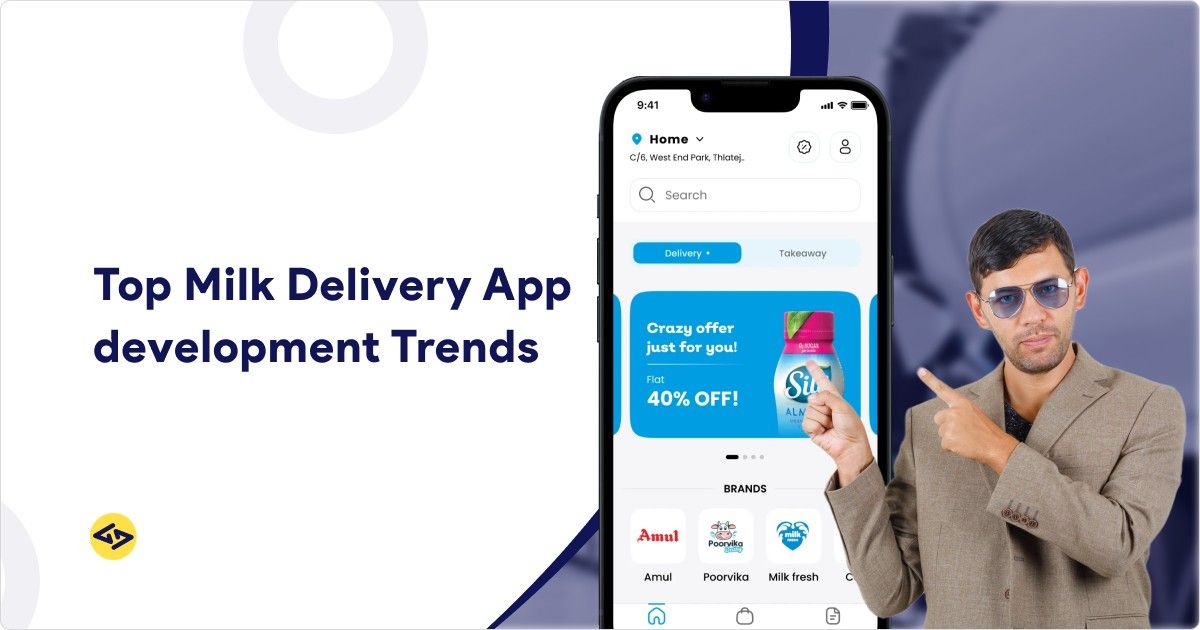
Milk delivery is no longer just about dropping a bottle at the doorstep every morning. In 2026, it’s about subscriptions that run themselves, delivery routes planned by AI, and apps that know what a customer needs before they do. Dairy businesses that once relied on paper registers and phone calls are now expected to offer the same convenience as any quick-commerce app.
This shift is being driven by a mix of technologies: AI, smart subscription management, real-time tracking, IoT-based cold-chain monitoring, deep personalization, and a growing push toward sustainable delivery. Together, these are redefining what a “milk delivery app” actually means.
For dairy businesses, staying on top of these milk delivery app development trends isn’t optional anymore. Customers expect flexibility and transparency, and operators need lower costs, less wastage, and tighter control over inventory and routes. Businesses that adapt early gain a real edge over those still running on outdated systems, much like the entrepreneurs who start a milk delivery business today are building on app-first foundations from day one.
Quick Answer: What Are the Latest Milk Delivery App Development Trends in 2026?
The biggest milk delivery app trends in 2026 include AI-powered demand forecasting, smart and flexible subscription management, real-time delivery tracking, AI-driven route optimization, IoT-based cold-chain monitoring, voice commerce, contactless delivery, and sustainable EV-based logistics. Together, these milk delivery app development trends help dairy businesses cut wastage, improve delivery accuracy, and deliver a more personalized, tech-enabled customer experience.
Why Are Milk Delivery Apps Evolving in 2026?
Several forces are pushing the future of milk delivery apps forward at once:
- Changing customer expectations — people want the same real-time visibility they get from food delivery apps.
- Growth of subscription-based milk delivery — recurring orders give dairy businesses more predictable demand while giving customers greater convenience.
- Demand for flexible delivery schedules — customers want to pause, skip, or reschedule deliveries without calling support.
- Need for better route and inventory management — rising fuel and staffing costs make manual planning unsustainable.
- Increasing adoption of AI and automation — businesses need to do more with leaner teams.
- Competition from quick commerce — instant grocery apps have raised the bar for speed and convenience.
Established subscription-first dairy players, similar in spirit to the country delight business model, show how a well-built app and a reliable delivery system can turn a local dairy operation into a scalable, trusted brand.
Top Milk Delivery App Development Trends in 2026
Here’s a closer look at the milk delivery app technology trends shaping how dairy businesses build and operate their apps in 2026.
1. AI-Powered Demand Forecasting
AI in milk delivery apps is most powerful when it’s predicting what customers will need before they order. AI demand forecasting for milk delivery apps can analyze historical order patterns, seasonality, customer behavior, and relevant external factors such as weather to:
- Predict daily and seasonal milk demand
- Reduce overstocking and wastage
- Improve procurement and inventory planning
- Personalize recommendations based on buying behavior
An AI-powered milk delivery app with strong forecasting directly protects margins by keeping stock levels accurate. To see this in more depth, check out our breakdown of ai features for milk delivery app development.
2. Hyper-Personalized Customer Experiences
Milk delivery app personalization goes beyond just remembering an order. It includes:
- Personalized product recommendations
- Customized delivery preferences
- User-specific offers and notifications
- AI-driven customer segmentation
This kind of milk delivery app customer experience keeps users engaged instead of switching to a generic grocery app.
3. Smart Subscription Management
Milk delivery subscription trends in 2026 revolve around giving customers full control. A strong smart subscription management for milk delivery system offers:
- Flexible subscription plans
- Pause, resume, skip, and modify deliveries
- Automated recurring orders
- Prepaid and wallet-based subscriptions
This is one of the most requested capabilities in any milk subscription app development project, and it’s covered in detail in our guide to subscription based milk delivery app development.
4. Real-Time Milk Delivery Tracking
Real-time milk delivery tracking gives customers the same visibility they’d expect from any delivery app:
- Live delivery status
- Driver location tracking
- ETA notifications
- Route visibility for customers and admins
This feature can reduce “where is my order?” support requests by giving customers clear visibility into delivery status.
5. AI-Powered Route Optimization
AI route optimization for milk delivery plans the most efficient path for every delivery partner, factoring in traffic, order clusters, and time windows. Benefits include:
- Automated route planning
- Optimizing multiple deliveries per run
- Reduced travel time and fuel usage
- Ability to handle changing delivery conditions in real time
Combined with demand forecasting, milk delivery route optimization is one of the fastest ways to cut daily operating costs.
6. IoT and Cold-Chain Monitoring
IoT in milk delivery apps ensures product quality doesn’t get compromised in transit. Cold chain monitoring milk delivery systems typically include:
- Temperature monitoring
- Smart sensors on delivery crates or vehicles
- Product freshness monitoring
- Alerts for temperature deviations
For a perishable product like milk, this isn’t a nice-to-have — it’s a trust signal.
7. Digital Wallets and Flexible Payment Options
Payment friction is a common reason for churn. Modern apps now support digital wallets, auto-payments, UPI and card payments, subscription billing, and automated payment reminders, all reducing failed or missed payments.
8. Voice Commerce and AI Assistants
Voice commerce for milk delivery apps is emerging as a convenience feature for repeat customers. It enables voice-based ordering, subscription modifications through voice, smart assistant integration, and simple conversational ordering.
9. Contactless and Smart Delivery
Contactless doorstep delivery, delivery confirmation, smart lockers, OTP-based verification, and automated delivery notifications all add a layer of safety and reliability that customers now expect as standard.
10. Sustainable Milk Delivery
Sustainable milk delivery apps are gaining attention as dairy brands respond to environmental concerns. This includes EV delivery fleets, route optimization to cut emissions, reusable packaging, and other eco-friendly delivery practices. EV delivery for dairy businesses can help reduce delivery emissions while supporting sustainability-focused brand positioning.
11. Quick Commerce Meets Scheduled Milk Delivery
Quick commerce and milk delivery are starting to merge. Businesses are building hybrid models that support both same-day, on-demand dairy orders and traditional scheduled recurring deliveries within the same app.
12. B2B Milk and Dairy Delivery Platforms
Beyond individual households, milk delivery app development is increasingly extending into B2B dairy supply. This covers:
- Dairy supply to restaurants, cafes, hotels, and retailers
- Recurring wholesale orders
- Business-specific pricing
- Bulk ordering
- Invoicing and payment terms
- Scheduled commercial deliveries
- Business account management
Adding B2B capability lets dairy businesses serve commercial clients through the same platform used for consumer subscriptions, opening up a second revenue stream.
13. Predictive Inventory and Automated Replenishment
Predictive inventory tools forecast product demand, trigger automated stock alerts, give warehouse inventory visibility, and help reduce stockouts and wastage, extending AI’s value from the customer app into back-end operations.
14. Conversational Commerce and WhatsApp Ordering
Order updates, subscription reminders, customer support, payment notifications, and even reordering are increasingly handled through conversational channels like WhatsApp, meeting customers where they already spend time.
How These Trends Are Transforming Milk Delivery Businesses
Adopting these trends isn’t just about staying current, it has direct business impact:
- Better customer retention
- Lower delivery costs
- Reduced product wastage
- More accurate inventory planning
- Faster deliveries
- Better subscription management
- Improved customer satisfaction
- Higher operational efficiency
Many of these gains come down to one thing: keeping customers subscribed longer. Our guide on Milk delivery customer retention covers this in more detail.
Essential Features of a Modern Milk Delivery App
A modern milk delivery platform needs to connect customers, delivery partners, and business administrators through a single system. Each application should have features designed around its specific role in ordering, subscriptions, delivery, inventory, and operations. For a full feature-by-feature breakdown, see our guide to milk delivery app features.
Customer App: Product browsing, one-time orders, milk subscriptions, flexible delivery schedules, online payments, order tracking, wallet, notifications, ratings, and support.
Delivery Partner App: Delivery assignments, route navigation, real-time location sharing, delivery status updates, OTP/proof of delivery, and earnings history.
Admin Panel: Customer management, subscription management, order management, inventory management, delivery management, route optimization, payment management, and analytics/reports.
Technology Stack for a Future-Ready Milk Delivery App
Rather than listing tools in isolation, here’s the stack organized by purpose:
- Mobile app development — customer and delivery partner apps
- Backend and APIs — order, subscription, and payment logic
- Cloud infrastructure — scalability and uptime
- AI/ML — forecasting, personalization, route optimization
- GPS and mapping — live tracking and navigation
- IoT — cold-chain and freshness monitoring
- Payment gateways — wallets, UPI, cards, auto-billing
- Push notifications — order and subscription alerts
- Analytics — business and customer insights
- Security — data protection and secure transactions
Which Milk Delivery App Trends Should You Prioritize?
Not every business needs every feature on day one. It helps to map trends against your growth stage — a decision closely tied to your Milk delivery app business model.
For an MVP: Subscription management, payments, delivery scheduling, order tracking, basic inventory, and notifications.
For an Advanced App: AI demand forecasting, AI route optimization, IoT monitoring, personalized recommendations, voice commerce, predictive inventory, and advanced analytics.
How Much Does It Cost to Build a Milk Delivery App With 2026 Trends?
Cost depends on several factors: the number of apps (customer, delivery, admin), feature set, AI/ML requirements, IoT integrations, payment integrations, UI/UX complexity, chosen development platform, backend complexity, third-party APIs, and ongoing maintenance and support.
Because pricing varies so widely based on these variables, it’s best to review a detailed breakdown rather than rely on a generic number. Our guide on cost to develop a milk delivery app walks through this in depth.
How Long Does It Take to Develop a Milk Delivery App?
Timelines generally follow this sequence: discovery and planning, UI/UX design, mobile app development, backend/admin development, integrations, testing, and deployment.
If speed to market matters more than a fully custom build, a white label milk delivery app development approach can significantly shorten the timeline. Keep in mind that advanced AI, IoT, and automation features naturally add development complexity and time.
How to Build a Future-Ready Milk Delivery App in 2026?
- Define the business and delivery model
- Research customers and competitors
- Select essential features
- Design the UX/UI
- Choose the technology stack
- Develop customer, delivery, and admin apps
- Integrate payments, maps, notifications, and AI/IoT where required
- Test the complete platform
- Launch the MVP
- Monitor data and continuously add advanced features
Why Choose iCoderz Solutions for Milk Delivery App Development?
Building a milk delivery app that’s actually ready for 2026’s trends takes more than generic app development — it needs domain understanding of dairy logistics, subscriptions, and cold-chain requirements.
iCoderz Solutions specializes in milk delivery app development built around custom subscription-based delivery models, with dedicated customer, delivery partner, and admin applications. Our solutions are built on scalable architecture with AI and automation capabilities baked in, and every feature set is customized to match your specific business requirements rather than forced into a one-size-fits-all template.
Final Thoughts
Milk delivery in 2026 is being reshaped by AI, smart subscriptions, real-time tracking, IoT, automation, personalization, and sustainable delivery practices. Businesses that adopt these capabilities early aren’t just keeping up with customer expectations — they’re building the operational efficiency needed to scale profitably.
If you’re ready to build a future-ready milk delivery app, iCoderz Solution can help you turn these trends into a working, scalable platform tailored to your business.
Build a Future-Ready Milk Delivery App
Stay ahead with the latest milk delivery app innovations.

FAQs About Milk Delivery App Development Trends
What are the latest milk delivery app development trends in 2026?
The top trends include AI demand forecasting, smart subscription management, real-time tracking, AI route optimization, IoT cold-chain monitoring, voice commerce, and sustainable EV-based delivery.
How is AI used in milk delivery apps?
AI is used for demand forecasting, personalized recommendations, customer segmentation, and optimizing delivery routes in real time.
Why is subscription management important for milk delivery apps?
Because milk is a recurring purchase, flexible subscription tools (pause, skip, modify) directly reduce churn and improve customer satisfaction.
How does AI route optimization improve milk delivery?
It automatically plans the most efficient delivery paths, reducing fuel costs, travel time, and missed delivery windows.
What role does IoT play in dairy delivery?
IoT sensors monitor temperature and freshness throughout transit, sending alerts if conditions deviate from safe storage ranges.
Is real-time tracking necessary for a milk delivery app?
Yes — it’s now considered a baseline expectation, giving customers visibility into delivery status and reducing support inquiries.
What features should a modern milk delivery app have?
At minimum: subscription management, order tracking, flexible scheduling, digital payments, notifications, and an admin panel for inventory and delivery management.
How much does it cost to develop a milk delivery app?
Costs vary based on features, AI/IoT integrations, platform choice, and complexity — there’s no single fixed number without scoping the project.
How long does it take to build a milk delivery app?
Typically several weeks to a few months, depending on feature complexity, with AI and IoT integrations adding to the timeline.
What technology is best for building a milk delivery app?
A combination of native or cross-platform mobile frameworks, cloud backend infrastructure, AI/ML models, GPS mapping, and secure payment gateways works best for most dairy businesses. For a sense of who else is building in this space, see our list of milk delivery app development companies.