On-demand fuel delivery is quickly becoming one of the most practical business models in the mobility and logistics space. Instead of driving to a gas station, customers simply open an app, request fuel, and have it delivered to their car, home, or fleet yard. For businesses eyeing this space, the real challenge isn’t the idea; it’s finding the right fuel delivery app development company to build it.
Choosing the wrong partner can mean delayed launches, buggy GPS tracking, unreliable driver dispatch, or an app that simply can’t scale once demand grows. Choosing the right one means a smooth MVP launch, a stable platform, and a product investors and customers actually trust.
This guide walks you through what to look for in a fuel delivery app development partner, what features and technology matter, what it costs, and how to compare companies before you sign a contract.
What Is a Fuel Delivery App Development Company?
A fuel delivery app development company designs, builds, and maintains software platforms that let customers order fuel on demand and have it delivered by a driver, while giving businesses the tools to manage that operation end to end.
This is different from hiring a general mobile app developer. Fuel delivery app development requires specific experience with real-time logistics, live GPS tracking, driver dispatching, route optimization, and secure payment processing — none of which are typical requirements for a standard business app.
A capable on-demand fuel delivery app development company can typically build:
- On-demand fuel delivery apps for individual consumers
- Fleet fuel delivery platforms for businesses with vehicle fleets
- B2B fuel delivery solutions for construction, logistics, or industrial clients
- White-label fuel delivery apps for faster market entry
- Fully custom fuel delivery platforms built around your specific business model
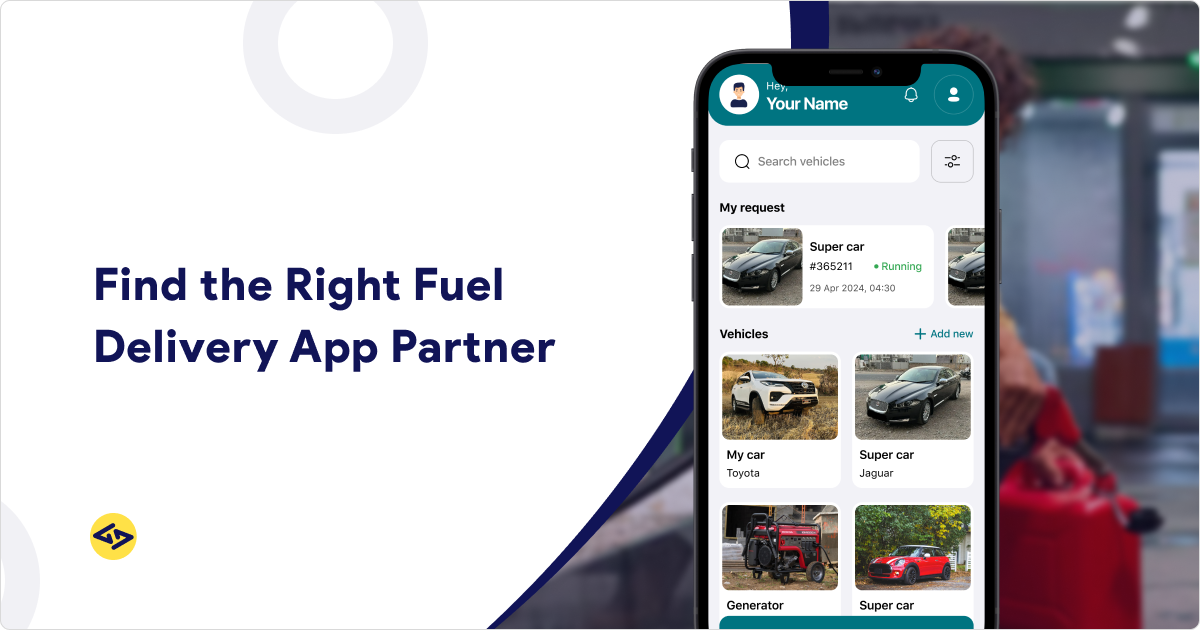
Most projects also include three connected applications: a customer-facing app, a driver app, and an admin panel to manage the entire operation. You can see how these pieces fit together in this breakdown of what a fuel delivery app actually is.
Why Choosing the Right Fuel Delivery App Development Partner Matters
Why is choosing the right fuel delivery app development company important? Because fuel delivery isn’t a simple e-commerce transaction — it’s a live operation involving moving vehicles, hazardous product handling, real-time coordination, and money changing hands, often within minutes of an order being placed.
A qualified partner needs to understand:
- Fuel delivery workflows from order to dispatch to delivery confirmation
- Real-time operations, not just app screens
- Driver and fleet management logistics
- GPS and route tracking accuracy
- Secure, PCI-compliant payment handling
- Scalability as order volume and cities grow
- Data security and regulatory compliance
- Long-term post-launch maintenance
An inexperienced team may deliver something that looks like an app but breaks down the moment real orders, real drivers, and real edge cases enter the picture.
What to Look for in a Fuel Delivery App Development Company
Relevant Industry Experience
Look for a fuel delivery app development company that has specifically built fuel delivery, on-demand delivery, or logistics/fleet-management platforms before — not just generic delivery apps. Fuel delivery has unique constraints around safety, quantity tracking, and compliance that general delivery experience doesn’t fully cover.
Strong Technical Expertise
Check their depth across mobile development, backend architecture, API design, cloud infrastructure, GPS/location services, and payment gateway integrations. A fuel delivery software development company should be comfortable discussing all of these, not just the app’s front-end design.
Proven Portfolio and Case Studies
Ask for similar past projects, live applications you can actually test, measurable business outcomes, and client testimonials. A strong portfolio is one of the clearest signals separating top fuel delivery app development companies from the rest.
UI/UX Design Capabilities
The customer ordering flow should be simple, the driver interface should be built for fast in-vehicle use, the admin dashboard should be easy to navigate, and real-time tracking should feel intuitive on all sides.
Scalability and Performance
Your fuel delivery app development partner should be able to explain how the platform handles rising order volumes, multiple service locations, multiple fuel types, and larger driver fleets without a rebuild.
Security and Compliance
Confirm secure authentication, payment security, data protection practices, role-based access control, and awareness of fuel-delivery regulations in your operating region. For a deeper look at this, see this guide on fuel delivery app safety and compliance.
Must-Have Features of a Fuel Delivery App
Solid fuel delivery app development features are non-negotiable across all three apps.
Customer App
- Registration/login
- Fuel selection
- Delivery address input
- Scheduled delivery
- Real-time order tracking
- Multiple payment options
- Order history
- Push notifications
- Ratings and reviews
Driver App
- Driver registration
- Order management
- Delivery status updates
- GPS navigation
- Route optimization
- Earnings tracking
- Delivery history
- Proof of delivery
Admin Panel
- Central dashboard
- Customer management
- Driver management
- Order management
- Fleet management
- Pricing management
- Payment management
- Reports and analytics
A full breakdown of these is available in this guide to fuel delivery app features.
Advanced Features That Can Make Your Fuel Delivery App Stand Out
Beyond the basics, these on-demand fuel delivery app features help differentiate a platform in a competitive market:
- Real-time GPS tracking with live driver location
- Route optimization for faster deliveries
- Automated dispatching
- Driver and fleet monitoring
- Recurring/subscription fuel orders
- Dedicated business accounts
- Geofencing for service zones
- Dynamic, demand-based pricing
- Promo codes and referral incentives
- AI-powered demand forecasting
- Analytics and reporting dashboards
- Multi-location management
AI is increasingly used for demand prediction and route planning — you can read more in this piece on AI in fuel delivery app development.
Custom vs. White-Label Fuel Delivery App: Which Should You Choose?
| Factor | Custom App | White-Label App |
| Customization | High | Limited |
| Development time | Longer | Faster |
| Initial cost | Higher | Lower |
| Scalability | High | Depends on platform |
| Branding | Complete | Available |
| Integrations | Flexible | May be limited |
When each makes sense: A white label fuel delivery app development approach suits businesses that want to launch quickly and test the market with lower upfront investment. Custom fuel delivery app development suits businesses with a specific operating model, long-term scaling plans, or a need for full ownership and flexibility. Many companies weigh custom fuel delivery app vs white label early, then move toward custom development once the business model is validated.
What Technology Stack Should a Fuel Delivery App Use?
What technology stack is used to build a fuel delivery app? Rather than one fixed stack, the right choice depends on your goals, but most reliable builds draw from these categories:
- Frontend: Flutter, React Native, or native iOS & Android
- Backend: Node.js, Laravel, or other suitable frameworks
- Database: PostgreSQL, MySQL, or MongoDB
- Cloud: AWS, Google Cloud, or Azure
- Maps & GPS: Google Maps APIs
- Payments: Secure payment gateway integrations
- Notifications: Firebase
- Analytics: GA4 or Firebase Analytics
- Security: Encryption, authentication, and API security layers
For a deeper technical comparison, see this guide on the fuel delivery app tech stack.
How Much Does It Cost to Develop a Fuel Delivery App?
Fuel delivery app development cost depends on several factors rather than a single fixed number:
- App complexity and feature set
- Number of platforms (iOS, Android, web)
- Whether customer, driver, and admin apps are all included
- UI/UX design requirements
- Backend and API complexity
- Third-party integrations
- GPS and tracking implementation
- Payment gateway integration
- Advanced AI-driven features
- Development location and team structure
- Ongoing maintenance requirements
As a general framework:
- Basic MVP: Core ordering, tracking, and payment features across a limited platform set
- Mid-level build: Full customer/driver/admin apps with standard advanced features
- Advanced platform: Multi-city scalability, AI forecasting, fleet management, and deep integrations
Fuel delivery app development cost in India is typically lower than in the US or UK due to development rate differences, which is why many businesses explore a fuel delivery app development company in India for cost-efficient builds without compromising quality. A full cost breakdown is available in this guide to fuel delivery app development cost.
How Long Does It Take to Build a Fuel Delivery App?
How long does it take to develop a fuel delivery app? Timelines vary by scope, but most projects move through these stages:
- Discovery & requirements gathering
- UI/UX design
- MVP development
- Backend & API development
- Third-party integrations
- Testing & QA
- Deployment
- Post-launch maintenance
A focused MVP can launch in a few months, while a full-featured platform with advanced integrations takes longer. Your fuel delivery app development company should give you a realistic, stage-by-stage timeline rather than a vague estimate.
Questions to Ask Before Hiring a Fuel Delivery App Development Company
Use this checklist during vendor calls:
- Have you built a similar delivery platform before?
- Can you show live projects I can test?
- What technology stack do you recommend, and why?
- How will GPS tracking work in the app?
- How will driver dispatching be handled?
- How will payments be integrated and secured?
- Can the platform scale to multiple cities?
- What security measures are in place?
- Do you provide full source-code ownership?
- What’s included in the maintenance package?
- How do you handle post-launch support and bug fixes?
- What is your estimated timeline and development cost?
How to Compare Fuel Delivery App Development Companies
Once you’ve spoken with a few vendors, the hardest part isn’t finding fuel delivery app development companies — it’s comparing them fairly. Proposals often use different language, different pricing structures, and different timelines, which makes side-by-side comparison difficult unless you’re scoring everyone against the same criteria.
The simplest approach is to shortlist 3–5 companies, score each one against the factors below, and use the totals to guide your decision rather than relying on gut feeling or the lowest quote alone.
| Evaluation Factor | Importance | What to Check |
| Relevant experience | ⭐⭐⭐⭐⭐ | Have they built fuel delivery or similar logistics apps before? |
| Portfolio | ⭐⭐⭐⭐⭐ | Can you test a live app, not just view screenshots? |
| Technical expertise | ⭐⭐⭐⭐⭐ | Do they explain their stack clearly and justify their choices? |
| Scalability | ⭐⭐⭐⭐⭐ | Can the architecture support more cities, drivers, and orders later? |
| Security | ⭐⭐⭐⭐⭐ | Are payment security, data protection, and access control addressed upfront? |
| Communication | ⭐⭐⭐⭐ | Are responses clear, timely, and jargon-free? |
| Pricing transparency | ⭐⭐⭐⭐ | Is the quote itemized, with no vague “miscellaneous” costs? |
| Post-launch support | ⭐⭐⭐⭐⭐ | Is there a defined maintenance plan after launch, not just a handoff? |
A practical way to use this table: rate each company 1–5 on every factor, multiply by the number of stars shown for that factor’s importance, and total the score. This turns a subjective impression into a comparable number across every proposal on your shortlist — and it’s especially useful when comparing a best fuel delivery app development company claim against what a vendor can actually demonstrate.
This framework applies whether you’re comparing fuel delivery app development companies: the fundamentals of what makes a strong partner don’t change by region, even though rates and communication styles might. For a sense of what well-built platforms look like in practice, it’s worth reviewing this roundup of top fuel delivery apps already live in the market.
Red Flags to Avoid When Choosing a Development Partner
Watch for these warning signs among fuel delivery app development companies:
- No relevant portfolio to show
- Unrealistically low pricing
- No clear, written project scope
- No dedicated QA process
- Poor or slow communication
- No post-launch support plan
- Hidden costs that appear later
- Unclear ownership or source-code terms
- Overpromising unrealistic timelines
Why Choose iCoderz for Fuel Delivery App Development?
iCoderz Solutions brings hands-on experience building fuel delivery mobile app development company-grade platforms, including customer, driver, and admin applications built around real operational needs — not just app templates.
What sets the team apart:
- Direct experience delivering on-demand and fleet-based fuel delivery platforms
- Full-cycle development capabilities: mobile, backend, cloud, and integrations
- Deep technology expertise across modern frameworks and secure API architecture
- Custom solutions built around your specific business model, not a rigid template
- UI/UX design focused on usability for customers, drivers, and admins alike
- Structured QA and testing processes before every release
- Architecture built for scalability across cities and fleet sizes
- Ongoing post-launch support and maintenance
- A track record of similar projects and case studies available on request
You can explore the full range of capabilities on the fuel delivery app development services page.
Ready to Build Your Fuel Delivery App? Talk to our experts to discuss your business model, features, technology requirements, timeline, and estimated development cost. Get in touch with iCoderz Solutions to start the conversation.
Ready to Build Your Fuel Delivery App?
Partner with iCoderz to build a scalable fuel delivery app tailored to your business goals.

Frequently Asked Questions
What is a fuel delivery app development company?
It’s a software development company that builds on-demand fuel ordering and delivery platforms, typically including customer, driver, and admin applications with GPS tracking and payment integration.
How do I choose a fuel delivery app development company?
Evaluate relevant experience, portfolio, technical expertise, scalability, security practices, communication quality, pricing transparency, and post-launch support before making a decision.
How much does it cost to develop a fuel delivery app?
Cost depends on app complexity, platforms, features, integrations, and development location, generally ranging from a basic MVP to a fully advanced multi-city platform.
How long does it take to build a fuel delivery app?
Most projects move through discovery, design, MVP development, backend work, integrations, testing, and deployment, with timelines varying by scope and feature complexity.
What features should a fuel delivery app have?
At minimum, it needs customer ordering and tracking, a driver app for delivery management, and an admin panel for operations, pricing, and reporting.
What technology is used to build a fuel delivery app?
Common choices include Flutter or React Native for mobile, Node.js or Laravel for backend, cloud platforms like AWS, and Google Maps APIs for location tracking.
Should I choose a custom or white-label fuel delivery app?
White-label suits faster, lower-cost market entry, while custom development suits businesses needing full ownership, flexibility, and long-term scalability.
Can a fuel delivery app support GPS tracking?
Yes, real-time GPS tracking is a core feature, allowing customers to track deliveries and businesses to monitor driver routes and delivery times.
Can a fuel delivery app manage drivers and fleets?
Yes, most platforms include driver management, fleet tracking, and dispatch tools within the admin panel, especially for fuel delivery fleet management app development projects.
How can a fuel delivery app be scaled to multiple cities?
Through cloud-based, modular architecture that supports multiple service zones, localized pricing, and independent fleet management per location.